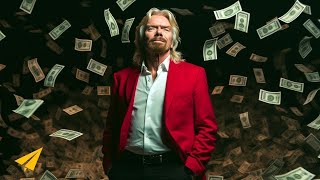
Evan Carmichael breaks down Richard Branson's ten principles for building 400+ companies. Branson started Virgin Atlantic despite skeptics, funded early ventures with bracelet sales, and built his empire on simplicity, people-first leadership, and disciplined cash flow.
Chapters
He's a businessman, investor, and is involved in over 400 companies. He takes on big companies, breaks the rules, and likes to go after world records. He's worth an estimated $4.9 billion. He's Richard Branson, and here are his top 10 rules for success.
I mean, I am dyslexic and therefore I think I've been very good at keeping things simple because, you know, as a dyslexic, I need to— I need things to be simple for myself. And therefore Virgin, I think, you know, when we launch a financial service company or a bank, you know, we do not use jargon. It's— everything is very clear-cut, very simple. And, you know, I think people, you know, people have an affinity to the Virgin brand because we don't, you know, we don't talk above them or talk down to them.
I mean, I think a lot of people do not have the courage to try to start a business. And all I would say— I mean, I've written a book called Screw It, Just Do It, and it basically is trying to say to people, just give it a try. Actually, sometimes a very, very small amount of money is all that's needed to start a company. I mean, my mother found a bracelet on the street and she handed it into the police station, and after 3 months the police let her sell it. And, you know, the couple of hundred dollars was really critical at a critical time in the development of our business. So all I say is just give it a go. And good luck on that one.
I think the most important— the most important thing about running a company is to remember all the time what a company is. A company is simply a group of people. As a leader of people, you have to be a great listener, you have to be a great motivator, you have to be very good at praising and looking for the best in people. You know, people are no different from flowers. If you water flowers, they flourish. If you praise people, they flourish. And that's a critical attribute of a leader.
You know, there is a very thin dividing line between success and failure when you start a business from scratch. And, you know, if you don't have enough money to pay the bills, you go the wrong side of that dividing line, and if you can somehow get enough money to pay the bills, you stay the right side of that dividing line. You know, I've always been running, running faster than perhaps I should, and I have great difficulty saying no to things, so keep on taking on new things. And we've just managed to stay the right side of the dividing line over the last 50 years in business. Equally, in those early days, when you're starting a business without any financial backing, it's easy to slip the wrong side. And in fact, most entrepreneurs do slip the wrong side, and the important thing is then just to pick yourself up and start again, and if it doesn't work at that time, keep going until you do succeed, and not to give up.
I think the next stage is to be— be a great delegator and not try to do everything yourself. Try to find people who are better than you all the time. Try to find people who are better than you to put you out of business, effectively. So whatever you're spending all your day doing, try to find someone who's better than you to do that, to replace you at it, so that you can go off and think about the next big picture. An entrepreneur is not a manager. I mean, an entrepreneur is somebody who is great at conceiving ideas, starting ideas, building ideas, but then handing over to really good managers to manage the businesses. You know, the moment you've got more than one business, you can't be hands-on doing everything.
I don't actually think that the stereotype of a businessperson treading all over people to get to the top generally speaking, works. I think if you treat people well, people will come back and come back for more. And it's a very small world. I actually think that the best way of becoming a successful business leader is dealing with people fairly and well. And I like to think that's how we run Virgin.
I love learning. I've never actually thought I was, you know, starting a company as such. I just saw situations as I traveled in life where I felt I could improve on the way things were being done by other people. So, you know, so I would, you know, one of my favorite phrases is screw it, let's do it. And I've used that phrase a lot of times. And we've, and, and we've, you know, we just love going in and trying to shake-up industries and doing it better than it's been done before.
Yeah, when we launched Virgin Atlantic 30 years ago, the New York Times did a review and they did some market research and they said, you know, first of all, with a name like Virgin, it's not going to go the whole way, but, but, but secondly, that they did market research which said only 7% of people would fly on an airline called Virgin and and we put our hands up and said 7% would be just fine, so we carried on with it. But there were a lot of skeptics out there, and there always will be lots of skeptics when you want to start something new. Everybody will tell you why it's a bad idea, why you shouldn't do it, why you'll lose everything you've got, and in the end you've just got to get out and try to prove them wrong. But good luck.
I think the word business— it becomes a business, but what you're doing is you're You're painting a picture. You're trying to create something to make a difference to other people's lives. You have a blank canvas, and you're filling in every little bit of that canvas to get every single little detail right. And if that canvas sings out at you at the end, and it's a beautiful picture, you'll your business is going to be successful. If bits of the canvas are not quite right, your business may fail. So if you set up to change people's lives, you've got to get every single little detail right. You've got to make sure that the people that you're working with 100% believe in what you're trying to do. And you've got to make sure that what you're trying to do is worthwhile spending your time on. And at the end of the day, you want to be sure that, you know, that the people's lives you've affected, you've really benefited them and benefited them. And, you know, if you get all that right, you know, hopefully you'll be able to pay the bills at the end of the year.
I would say the overarching and key thing that really binds the group together is the idea of not just playing the game but changing it for good. I think Richard embodies the principles better than anyone I've ever worked with and anybody that I know because he's very focused on business, on starting new businesses, on making sure that he's got the right people in the businesses, but also on doing things differently and really changing the game. And I, I think that it's the combination of those that sets him apart as the great entrepreneur of his generation.
Thank you guys for watching. I made this video because Arlene D asked me to. So if there's a famous entrepreneur that you want me to profile next, leave it in the comments below and I'll see what I can do. I'd also love to know which of Richard Branson's top 10 rules you like the most. Leave it in the comments and I'm going to join in the discussion. Thank you so much for watching.