How to Actually Reprogram Your Subconscious Mind | Gregg Braden, Dr Joe Dispenza, Bruce Lipton
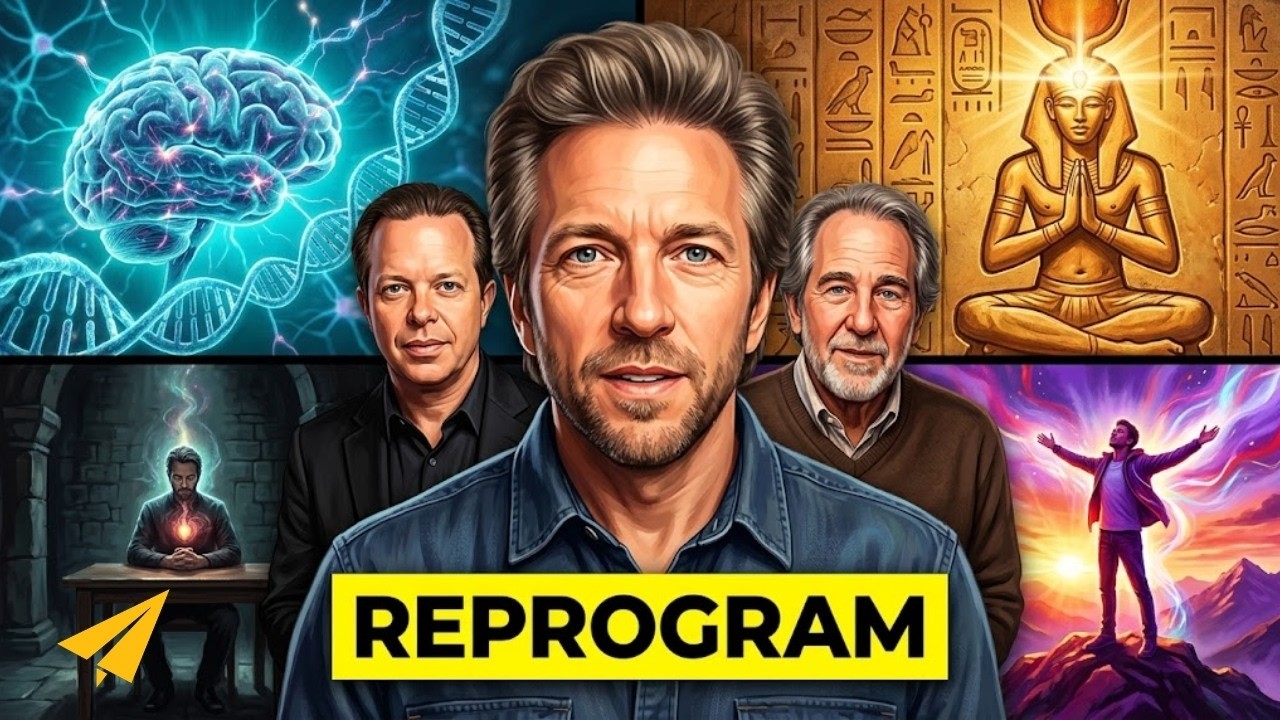
Gregg Braden, Dr. Joe Dispenza, and Bruce Lipton share neuroscience techniques to reprogram your subconscious mind. They cover heart-brain coherence breathing, focused intention, and whole-brain integration to break limiting habits. Sadhguru emphasizes shifting from compulsive to conscious action by aligning body, mind, emotion, and life-energy.
Chapters
Everything goes better with heart-brain coherence. So how do we do this? 3 steps. The first step is to simply shift your awareness from your mind into your heart.
When your will gets greater than the program— because most people lose their free will to programs— so then when they've lost their free will to a program and their body Which is a habit, has become the mind. Now their body's dragging them into a predictable future.
Some people say, oh yeah, you can change your life, and then they find it's very difficult, it's very hard. I go, why? Because they don't know how to push the damn record button.
Have you ever wondered why some people have such an educated mind? They have degrees coming right off the end of their business card, but it doesn't show up in their results.
Why?
Paradigm. The law of attraction. You've got to change this. You've got to change the vibration you're in, and your whole world changes.
Unless you believe that you're worthy, unless that you practice love, you're never going to think that you deserve the things that you want.
So we're talking about this union, this marriage between our heart and our brains. A very, very different way to think about things in the West. Very different from what we are traditionally invited to consider. When I was in school, I was taught that the brain is the master organ. And when I am working with indigenous people, often I'm taught the heart is the master organ in the body. And I want to just say to you that both of those are valid in some circumstances, but the truth is they're both incomplete. Because what we now know is that while the brain, our brain, releases the chemistry into our bodies for rejuvenation and healing and hormonal balance and all these other things, our brain receives many of the instructions that tell it what to do from the heart. And we are the ones that create the instructions.
That's right.
through our thoughts, feelings, emotions, beliefs that we are creating in our hearts. Because now, as you remember, the studies are showing our heart has the ability to think on its own, to remember and to feel on its own.
Hey, it's Evan Carmichael, and I make these videos because in my first business, I quit on my business partner. I struggled to keep going. I was making $300 a month and felt like a complete failure. And the thing that saved me, that pulled me up, was studying the stories of Famous entrepreneurs. I got the motivation from them. I also got the strategies of what to do next so that I can go off and achieve my dreams. And quite honestly, I still need the stories today myself to continue my motivation to take it to the next level. So today let's learn from Gregg Braden, Joe Dispenza, Bruce Lipton, and more. Enjoy.
We're having a new sense of what this heart-brain connection is all about. And as I mentioned before, we've been conditioned to use them independently, one or the other. So I'm acknowledging that I know this is a very different way to think about our heart and our brain, to think about them as 2 organs that support a single common neural network. And just in case there's any question in your mind, that network, it is about the nerves. It's about the spinal cord between the heart and the brain and the vagus nerve between the heart and the brain. And this conversation between the heart and the brain, it fascinates me. It's a big conversation that's happening in every moment of every day. But the thing is, most of the conversation is in fact coming from our heart to our brain. That's where the thickest nerve bundle is to support that conversation. There is a lesser conversation from the brain through the spinal cord back into the heart. So while it's possible, the brain doesn't say too much to the heart. The heart has a lot to say to the brain. So we've explored many of the potentials that come from awakening this marriage, this union between the heart and the brain. And there are others. We're just barely scratching the surface. But what I'd like to do now is share with you a technique, a technique so that you can tap these potentials In your life when you choose to do so. What scientists know is that every moment of every day, as I mentioned, there's this conversation. It's a conversation between the heart and the brain. The heart is speaking to the brain, and the quality of the conversation that comes from the heart and the brain tells the brain what chemistry to release into the body. So for example, when we're feeling emotions that we would typically consider negative, and I don't I don't like to characterize emotions as negative or positive, but I'm doing this so you get a sense of what we're doing here. When we have emotions such as anger, hate, jealousy, rage, what you're seeing on your screen is an actual printout of the quality of the signal from the heart to the brain. And you can see it's very chaotic. It's a very jagged signal. It's a rough signal. And it's that chaotic, jagged, rough signal that's Signal that signals chaotic chemistry in your brain. This is the kind of chemistry that tells us that we need high amounts of adrenaline, high amounts of cortisol, the stress hormones, to respond to something quickly in life. That's a good thing for a few moments. You don't want to live your life day in and day out like this. If you can create a feeling in your heart of 0.1 hertz, then that feeling is going to harmonize your heart and your brain. Now, in indigenous traditions that I've been with, they have techniques to do this. There are a vast and myriad number of applications for the one technique that we're going to do right now, and this technique is the doorway for all the potentials that we've just listed. By achieving heart-brain coherence, it opens the door and we get to choose. It's like once we're in this place, now we can do anything we want. This, this, this, or this. We can do subconscious. We can go into intuition. We can simply use this technique before we go to bed at night to begin to sleep and trigger a healing within our bodies. We can do it first thing in the morning. We can do it before our yoga. We can do it before our martial arts. We can do it before our qigong, our healing practice, any of these things, because everything goes better with heart-brain coherence. That's all we're doing. Is we're optimizing the conversation between the heart and the brain, between your heart and your brain. So how do we do this? 3 steps. The first step is to simply shift your awareness from your mind into your heart. And what I've found is in the Western traditions, for many people, that's easier said than done. I'll ask people, are you in your heart? And they'll say, yep, I'm in my heart. But what they are really doing is they're still in their brain thinking about what it would be like if they're in their heart. This is where the indigenous traditions come in. Our ancestors told us, and when I spend time with my indigenous friends, I say, "How do you guys do this?" And they say it helps if you can gently touch your heart center physically in a way that's comfortable for you. In the Mayan traditions, you see an open palm right on the heart. In many of the Middle Eastern traditions, you see the same thing. In the Buddhist traditions. You see a prayer mudra that physically touches the sternum. The key is any of those things creates a gentle touch, a physical sensation right over the heart center, and your awareness will always go to the place where you feel the sensation. That's the key. So if you can create a touch over your heart, your awareness will go there. First step. Second step, very simple. Slow your Slow your breathing a little bit slower than typical, maybe 5 seconds inhale, 5 seconds exhale. And here's why that's powerful, because the only time you would ever slow your breathing and breathe in that way is when you feel safe. When you feel that you're in a place that's safe and you're not threatened and you're not vigilant of your surroundings. So you're telling your body you're in a place that's safe. Slow your breathing. Third step, and this is the key, is to begin to feel the feeling that creates 0.1 Hz. Feel the feeling that sets up the coherence between your heart and your brain. How do we do that? I gave it away earlier. We've already mentioned it. Scientists have found at the Institute of HeartMath, their researchers have found that there are 4 Keywords that work almost 100% of the time for everyone: appreciation for anything or anyone, gratitude for anything or anyone, care and compassion. If you can feel one or some combination of those feelings in your heart while you're breathing, as if your breath is coming from your heart, touching your heart center, Now you're setting up this communication between the heart and the brain. Now you are triggering those neurons to begin to reach out and find other neurons to strengthen this connection. And that's why I mentioned before, it takes about 72 hours, 3 days to build these networks. So that means the more you do what we're about to do right now, the stronger this connection becomes in your life.
Rule number 2 is get beyond yourself with Joe Dispenza.
What do you tell people who struggle with that assertion of will that, that needs to be there to overcome the addiction to being yourself, right? Like, you know, if there's someone who just, who believes what you're saying, like, yeah, yeah, I get it, but they're still finding themselves not quite stepping up to the plate to put that phone down, to go through that meditation the first thing, to break the habit of being themselves, but because they're addicted, they just don't have that will. Like, what do you, what do you say to them?
I say come to a week-long. We'll take care of you in a week, right? I mean, we'll take care of you, you know. I mean, there's so many times the husbands get dragged to events with their wives, you know, and they're sitting there like, you know, by the 3rd day, I'm their best friend, man. Their heart's wide open. They're— I mean, they're healed. I mean, crazy stuff happens. And look, I mean, it's a movement now. I mean, I'm waking up in my dream. I honestly, Aubrey, never thought that I would witness what I'm witnessing in this lifetime. And there is a new consciousness emerging. There's something happening where people are latching on to their own empowerment, latching on to their own unlimitedness, and it's becoming very contagious. So the person— you know, I used to golf a lot with my friends, and I used to say to them— I mean, I'm a decent golfer, but I'd say to them, I'm just not good enough to get upset. Just, I'm really not. But I'm going to have a lot of fun and I'm going to play. And the more fun I have, the better I play. I watch, you know, you duff a shot and then you start getting angry and frustrated. It's the same thing.
Yeah.
That's your game is going to— you're going to make the same mistake on the next swing because your emotion is keeping you in your past. So you got to make a choice to self-regulate or not. And the ones that get right back on that have ice water in their veins that can settle down and refocus again. Yeah, those are the ones that execute really well. So the person who can't get beyond themselves, it's just a matter of practicing. How many balls do you have to hit? How many punches do you have to throw? How many kicks do you have to throw till all of a sudden you start looking forward to doing it?
Mm-hmm.
And, and yeah, I can tell you this because I've been doing it for a very long time. Some days are easier than others, but I'm not going to give up. I'm just not. I mean, if I'm going to carve out some time, then I'm all in. I'm not going to shut my cell phone off. I'm going to disconnect from it. It's all going to be there when I get back. What I'm going to do is I'm going to make my inner world more real than my outer world. And step by step, I mean, you can't get impatient doing this. You can't get frustrated doing this. You can't get resentful doing this. You can't force it or control it doing it. I've seen what happens in the brain. You're going to make your brain worse. So sooner or later you start figuring out that isn't it. And all of a sudden you start following the instructions and you start going, wow, that was really easy. What was I doing up to this point? Everything but the formula. You were doing everything else but the formula, doing it your way.
Mm-hmm.
Analytical mind telling you to quit. It's too hard. You'll never get it.
Yeah.
Those are the exact things that are standing in the way between you and your future. And every time you become conscious that you do that and you settle back down, that's a victory. Every time your body wants to get up and check an email or check the cell phone or check— get up and get a cup of coffee and you settle it down, you're telling the body it's no longer the mind, that you're the mind. Every time it wants to go back to the past and romance some trauma just to reaffirm some emotional state and you become conscious of that and you say, where I place my attention is where I place my energy, and I'm siphoning energy out of the present moment into the past, and you become conscious of it and return back to the present moment, that's a victory. And every time you start thinking about the staff meeting at 6 o'clock or 5 o'clock in the afternoon, and that's the known, and you stop and you return back to the present moment, you're disinvesting your attention and energy out of that future, and you're making room for the unknown in your life. And that's a victory. And when your will gets greater than the program, because most people lose their free will to programs because they are on that wheel where they are— you could take their yesterday and lift it up and set it on their tomorrow. Tomorrow because they're in the habit of doing everything in a routine way. So then when they've lost their free will to a program and their body, which is a habit, has become the mind, now their body's dragging them into a predictable future and they've lost their free will to a program. And you sit down and your body is telling you, I'm going to die in this meditation. I'm going to suffocate. This is going to end. And you just keep settling it back down. Every time you do that, It's a victory.
Rule number 3 is stop being a victim with Bruce Lipton.
You're talking about a lot of people are victims in the world. Why do you think so many people center their identity with being a victim? And why do you think they hold on to it so tightly when they know they could reprogram their beliefs and start living in accordance with a harmonious life and being the creator and manifester as opposed to the victim who is powerless?
Yeah.
Well, I think the biggest thing, some people say, oh yeah, you can change your life. And then they find it's very difficult. It's very hard. I go, why? Because they don't know how to push the damn record button. You know? And so many of them are talking to themselves. I'm gonna make Bruce, you do better. You just do better about this. You do better. And I go, okay, let's stop for a second. Who am I asking to do better? Oh, my subconscious. I go, oh, there's nobody in there. Who are you talking to?
Nobody.
I go, well, that's a big waste of time, man, because that's not where change comes from. They don't know how to push that button. If you don't know how to push the button, it's frustrating. And it says, oh, it takes so— it's so much hard work to change. It's not easy. Takes time. These are belief systems.
Why?
Because they try and it doesn't work. I go, that's because they didn't know how to push the record button. So most people say, yeah, I can change, but it's not working. They said think positive and I thought positive and it didn't work.
It's not working.
Yeah.
No, because the idea was you can think all you want, but the problem is while you're thinking, you're actually playing the negative program. So you could think about being positive is actually creating the negative problem because you're not paying attention when you're thinking about being positive. So this is a whole issue. People have a feeling that they can change, but they have no effort. They don't want to get in the game because they feel it's, you know, it's just too much time and it doesn't work. And I tried it and it didn't work. And then they give up and then life just goes on. It's seamless. You don't see it. It's just the way you've been living it ever since 7 years old. You've been just living this program.
If someone had only said, you know what, I'm a victim, I've got too much going on, I don't have time to do these new program things you're talking about, the record button seems like too much work, it's exhausting, I've tried and started and stopped so many times with health, money, relationships, whatever it might be, and I'm a failure at all these things. If you could only give people a 5-minute thing to do every day and you said, Just focus on this 5 minutes a day. Well, that's just to get you started, to get you started.
Well, to get you started is this. If you like, like the first time that I really started to be aware that my subconscious was controlling me was when I was in my car, stopped at a red light, and I realized I was going to be late. And then all of a sudden I started berating myself. Well, you can't do things right. You're not—
You idiot.
You're such an idiot. How do you forget these things?
It was that moment that I said, wait, I'm listening to what these words are. I'm actually stopping. I'm not just saying the words. I'm saying the words, but I'm actually listening. I said, well, how many positive things did I just say? Zero.
Uh-oh.
There's a problem right there. And I started to realize we have to stop and be conscious just long enough to listen to these things. They flow through just continuously. You got to stop and just tune in and say, what am I thinking?
Why?
Because if you start to realize that most of your thoughts are negative, and this is not good enough, that won't work, blah, blah, blah. And I said, but that's a creative voice you're talking about right there. That voice is creating and everything you just said is now part of your creation. So what if you stopped? What if you just said, wait, what I did is I just covered up the clock on my car so I didn't have to see how late I was going to be. And I got there on the right time. It's like, why? Because I didn't focus on, you know, all the steps between here and the destination. I just said, I gotta get there. Boom, I was there. That's how it worked. Okay. So what can a person do? I think the first time is just for them to wake up long enough to hear, are you giving yourself positive vision of a future? Or you already canceled the future with negative things that you can bring up any number of negative things. It's not going to happen because of X, fill in X. You can put anything in there, it's not going to happen. I go, until you understand, oh my God, I am not thinking a positive thought in this process. Well, then I'm not— if I'm not thinking a positive thought, then I don't want those other thoughts to manifest. And that was a wake-up call.
Should we—
is there a place where we should—
where negative thinking is Can't see it because it's a delusion. It's a delusion. It's not the reality. And negative thinking, besides manifesting it as a reality, it's only— and now you are manifesting. Well, that was— when do you want to stop manifesting? I say when you stop long enough to correct yourself. No, I don't want to think that. No, let me think something positive. Let me assure you something. A while back, I would've been what loosely called manic-depressive. I'd be happy most of the time, and then something would go wrong, and then the next thing would go wrong, and I would go in a spiral, and then it got worse, and I'd get down and be totally depressed, giving myself self-talk, bad criticism, not smart enough, not good enough, whatever. I was engaged in it. This was like a repetitive process. Once it starts, it's like, oh, here we go. It's going to go. And I was in my lab doing something, and it required so much work to get this done. And, and then there was the part where I prepared the experiment, then I'm going to run the experiment. Takes like 2 hours to prepare, and then I start to run it, and if you mess up a little bit, the whole thing goes to crap.
Mm-hmm.
And I— so I did it the first time, went to crap, and it's like, oh God, it's got to spend 2 more hours putting it all back together again, weigh out all this stuff, do everything, get it ready. I ruined it the second time. Third time, really me off because now I've spent over 6 hours of the day repeating an experiment that never worked. And I got real mad at myself and I went into that, you idiot, you can't do anything right. And it was cool. I was alone in the room and I hear a voice just right out in front of me somewhere, right out there. And that voice says, don't you have anything better to do than to listen to this Wow. And I, for a moment, I was stunned. Like, I'm the only one in the room, you know? It was my higher self looking at me going through this and saying, don't you have anything better? And I laughed. That's kind of funny. I said, sure, I'd rather go see a movie. And there was a newspaper. I picked it up, found a movie, went to the movie, came out clear. No more depression. Gone.
Okay.
The next time I started to go down, I remembered that, don't I have anything better to do? I started to laugh, immediately changed, just went and did something else, stopped. It was a choice. I could continue going back and forth with that, or the choice was do something else. And I did it. Guess what? After a number of times, not too many, I never got depressed again because the system—
Really?
Made a habit that if I would start in that direction, the habit was go do something else. And that has been now a valid part of my whole life. I carry nothing forward on this anymore. And this was like the freedom because it said, oh my God, I used to get so depressed hearing how bad I was, talking to myself about how bad I was. And now it's like it doesn't exist anymore.
Also, to make sure you're actually taking action after watching this video, I've designed a special free worksheet just for this video. The worksheet will highlight all of the lessons learned in this video, as well as pull out our 3 favorite learnings and quotes that will inspire you to actually do something. The worksheet will also give you space to write down what your key takeaways are and your specific plan of action to make sure you're getting results. If you want the worksheet designed specifically for this video, absolutely for free, there's a link in the description Go click on it and start building the momentum in your life and your business. I'll see you there. Rule number 4 is Understand Your Potential with Gregg Braden.
As far as younger generations, I really think there are a lot of people who want this change.
They want a better world to live in and believe in, but they're often met with peers who don't see the same that way, or maybe family members that don't agree. Can you give them any advice to maybe continue their empowered way of thinking so that they don't give up?
Yeah, you know, this is the year 2016, and March of this year was my 30th anniversary of offering this material in one form or another. And my path has been to marry the best science of the modern world with the understandings of ancient and indigenous people. It's not science, but it's practical wisdom, and marry those together. And I brought a consultant in for a period of time to follow me to the different programs because I wanted to know who I was speaking to. And they prepared these beautiful hardbound reports of charts and graphs and pie charts of demographics, who my audience was. And we were speaking to young people, their parents, and their grandparents. 3 generations were coming. The young people often would come to me and say this, and this is directly to your question. They'd say, Greg, in this room with these people, everything that you have just said and everything we're talking about makes perfect sense. When I go to school, nobody thinks this way. And I understand that because I lived that in my life as well. And what I've come to understand, and this is what I can say to young people, is every one of us in our own lives, we have to develop what I call the the spiritual anchor, the rock, the soul compass. And it has nothing to do with religion. When I say the spiritual anchor, it's— the spiritual anchor is when we know who we are in relationship to ourselves. We know who we are in relationship to the Earth, to one another, to our past, to our future. We know how we are empowered and what our potential is. And once you know that, we then can live our truth. in the world whether other people support it or not. When we depend on other people for that support, that's where we give our power away. And that's where many of us come from. I'll just say to the young people listening, I come from a very difficult family background, dysfunctional alcoholic family full of criticism, instilling self-doubt in the young people. I have a younger brother We came from the same family and we had the same criticisms. I didn't believe what my father told me about my inability in life. And my younger brother, he did believe it. He embraced much of it. It's so interesting, 2 different people, the same family, same background, interpreting the information differently. And I attribute My ability to let that criticism roll off of me and the blessing I had very early on, I knew who I was and I understood my place in this world at an early age. Not everyone has that, but I began looking at an early age. It takes a lot of work to explore the potential within every one of us. And there was a very famous author and prophet in the early— in the 20th century. His name is Khalil Gibran. And I began reading Khalil Gibran when I was 8 years old. And Khalil Gibran, there is one sentence that has been my soul compass. It has been with me. I think of it every day. I apply it in every situation, every relationship, every job, every commitment. What he said is, work is love made visible. It takes a lot of work to know who we are in this world and to demonstrate for ourselves our potential. That is our love made visible. That is us loving ourselves in a way that empowers us to be in this world in a healthy, a healthy way where we thrive in the presence of all of the changes. So my invitation for any young people is love yourself. And your love made visible is you taking the time to understand your potential and who you really are. The good news is we have that information now. New discoveries, new science, indigenous wisdom married together. I think we owe it to ourselves to bring it all to bear on our lives today.
Rule number 5 is develop a greater sense of consciousness with Joe Dispenza.
I remember I worked with a Siberian mystic, and we did what could have been like an acting exercise, and she wanted me to go through every emotion and just select it. Okay, now feel sad. Now feel happy. Now feel surprised. Now feel depressed. Now feel overwhelmed with joy. And I would do it, but there was some part of me that says, you can't do this. You can't select your emotions. Your emotions are determined by the outside world. And I think I was afraid to actually admit that I really could do it, because then if I could really do it, well, then I had all of this responsibility to actually do this. I had to take responsibility for everything I feel. I could no longer blame anything out there in the world for how I was feeling. This was all on me. So is that where you see the biggest resistance to doing this work? Is it the resistance to accepting that responsibility, forgiving yourself for not knowing this before, and not being able to blame anything? Or where is the resistance to just jumping in and giving it a try?
I think my view about that has changed a lot In the last couple years, when you see a person who is blind because of a stroke and is told they'll never heal from that stroke—I mean, after two weeks, if it doesn't heal, you normally have to live with it—and loses her job, can't drive, you know, she's clinically blind. I'm not the person that is going to tell her. You can absolutely heal this. She has to come to that understanding on her own. So people, many times when they gather knowledge and information, the information causes them to become conscious of what they were once unconscious to. And when you have a greater level of consciousness, You see possibilities. And in a sense, you're energized by information. You're enlightened, you're filled with light in some way, and you see possibilities that you haven't seen before. Now, getting beyond the analytical mind is one of the main purposes of meditation. And I can tell you that the analytical mind is always going to talk us out of possibility because it is fascinated— On trying to predict what's going to happen next. So if you can predict your future, then you're laying a known on an unknown. And this is a habit we have because the brain is an anticipation machine. So there's many different obstacles and resistance resistances that come with a persistent disbelief that has been programmed. Over and over again. I mean, I don't watch television, but I've watched it because of what's happening in the world. And I am so insulted by television commercials. I, I can't believe people would sit there and allow that information to program them, some drug to make them feel a certain way, some looks, some whatever. You don't think that has profound effects on programming a person into limitation? When I wrote the book You Are the Placebo, I was so angry at myself for two weeks. I was so frustrated with myself because I bought the program. People people believe they people believe they need a flu shot because they don't believe their bodies in the body's innate capacity to heal. Four days. of teaching people how to elevate their state increased immunoglobulin A in our research by 50%. Immunoglobulin A is your body's primary defense against bacteria and viruses. It's better than the flu shot. It's better than a flu shot. But that's not the information that people get. So there's a layer of programming that's happening, and the beauty behind all of this is nobody's buying information any longer. I love it. And I'm, I'm not prone to believe that guy in that tube telling me the way it is, and nobody should. And more and more people then, as they start to wake up to information, there's a change in energy because change in consciousness requires a change in energy. And now a greater energy causes systems that were once stable to become unstable, to become chaotic. And chaos is just unpredictable order. It's novelty, it's newness, it's an unraveling of systems. So hang on. This is a really profound time because it's gotta break. And when it breaks, something better come out of it. And it's not gonna be governments and politicians and, and religious figures and whatever leading the way. There, there is no one leader. Everybody's gotta lead. Mm-hmm. Just like those birds that move in one direction or those fish that are all in a school and they're moving together to give the appearance of something bigger to predators. You study that principle in biology. It's called emergence. You think that there's one leader that everybody's following. Everybody's leading. And there's a stigma we have in our minds that if you lead with too much passion in your life, you're going to lose your life, whether you're Martin Luther King or William Wallace or Joan of Arc or Abraham Lincoln. You're gonna get it. And that stigma is branded in people's minds for a reason. But this is a time in history to not die for the truth. This is time in history to live for the truth. And if you're working on your anger and frustration, and I'm working on my fear and anxiety and my judgment, and I'm taking care of me, and you emerge in that heart of yours, and I emerge in that heart, we are going to be like-minded. We're gonna be connected by that invisible field. Now everybody's leading and you just can't take out everybody now. So we can't, we can't wait for anybody else to take care of us.
And rule number 6, the last one before some very special bonus clips, is study your brain with Bruce Lipton.
I really want to focus on something called an urban myth, and this particular urban myth is the belief that we only operate off of 10% of our brain. So we've all heard that, yes, we're only using 10% of our brain, and boy, if we could use all the rest of it, we We'd be super smart, but hey, that's all we use. Firstly, where did that number come from, 10%? A long time ago, when putting the body together through an understanding of histology and the cells that make up organs, a study of the brain revealed one very important fact, and that is only 10% of the brain was made up of neurons. 90% of the cells in the brain were not neurons, but they were called supporting or connective tissue and given the name glial cells. Well, what's really interesting about that is in the neuron principle, the neuron doctrine, it was believed that the neurons were the functional cells of the brain and the glial cells were more or less just support. Well, then by definition, right away it says then you're only using 10% of your brain because that's all that the neurons comprise in the brain, 10%. For a For a long time, the glial cells again were thought to be just like connective tissue, support physically and nutritionally the neurons. But over the last number of decades, what we started to find is this: there was a misunderstanding about glial cells, that glial cells are a lot more important in neural function than just physical support. Glial cells can inhibit or activate neurons. Glial cells connect to neurons. Glial cells can control control the activity of neurons. So all of a sudden, these glial cells, which were looked at as just passive cells in the brain, turn out to be actually quite functional in integrating the nature of how the brain works. In a way of looking at it in a simple analogy, consider that the neurons are nouns in a sentence and that the glial cells are the verbs and the adjectives and the adverbs, the modifiers of all the nouns. So the glial cells create a fulfillment of a picture. So neurons are like a stick figure, and when you add the glial cells, you fill out the nature of the whole human. So glial cells become a very functional, integrated part of all neuronal activity. So the concept of the neuron doctrine that said only neurons are involved with functioning In the nervous system. It turns out the glial cells are as well. So now we're not dealing with 10% of the brain, we're dealing with 100% of the brain. Yes, you have access to 100% of your brain all of the time. But does that mean that we actually use the whole brain all of the time? And the answer is no. Because what we start to find out is when we start to live in patterns and in habits, that what What happens is we just activate certain neuronal pathways that are habitual pathways, and as a result, these are the pathways that have preference in our everyday life. But if you can engage whole brain activity, you can enhance your consciousness and your awareness and your ability to control your life. So basically it says that we can become whole brain when we start to think holistically instead of just playing recurrent programs that play over And over again and activate the same pathways. So the relevance is that once we start to engage in whole brain activity, we enhance our ability as humans on this planet. And now we're beginning to find out there are many different ways to engage and activate the whole brain. Some of them involve simple exercises such as something called Brain Gym. And Brain Gym is a very interesting exercise of the body and the nervous system integration in this way. My right hand is controlled by my left hemisphere. My left hand is controlled by my right hemisphere. But here's an interesting story. If my right hand, controlled by my left hemisphere, crosses the midline, then it simultaneously gets picked up by the other hemisphere because now it's in that territory as well. So when you cross your arms and when you cross your legs, what you're doing is causing the right and the left hemispheres to work together in harmony. When we are activating brain synchronization, where right and left hemispheres are engaged together simultaneously, it activates something like superlearning. With both hemispheres working together, we have much more superior characteristics of neural function. However, after age 7 and 8, we start to express what is called brain dominance, meaning during the day we don't have synchronization of both hemispheres. During the day, it's like a waveform. Sometimes we're more in the left hemisphere, sometimes we're more in the right, then it comes back to the left and back to the right, so that we're cycling through one hemisphere at a time. This is called brain dominance. Where one hemisphere is dominant over the other hemisphere. Well, the relevance about that is integrating our lives is very difficult in brain dominance for a simple reason. As been suggested, our left hemisphere is based on logic and details. Our right hemisphere is actually associated with emotions and wholeness. And this becomes very important because if you're only looking With your left hemisphere, then all the logic things make sense, but there's no emotional component to it. And reverse, if you're in the right hemisphere, you get emotionally tied up, but the logic drops out. Well, this happens to us ever since the time we were 8 through our adult life. If you can get both hemispheres to be in sync, hemisync, then you're engaging logic and emotions at the same time. That opens up a window for super learning opportunities where you can download information very, very quickly and very fast, but it also opens up a whole wide range of thinking that includes an emotional component as well as an intellectual component, which is necessary to fulfill a whole picture. So if you're operating from brain dominance, you're actually shutting off one component of your nervous system at that time. So if you do an exercise like Brain Gym, where you're involved with crossing your arms and your legs. When you do that, you start to integrate both. Very interestingly, when we have hemisync, we're much more calm, collected, and able to really express neurological functions that are very fully supporting of ourselves. And this is why it's very interesting when you go home and relax at night, sometimes you find yourself with your ankles crossed over each other just sitting in your chair. Without even knowing what you're doing, by crossing your ankles, you're actually engaging a whole brain process. So if you're stressed, for example, during the day, or you just want to relax when you go home at night, crossing your arms and legs actually engages both hemispheres, which calms the system down but engages a whole brain process. So you become much more effective in your So if you're having a tough moment during the day, just take a moment and cross your arms and legs, hold them together, and just wait for about 3 or 4 minutes, and you'll start to feel a calmness overcome. And in this calmness, your neurological functions will be totally enhanced. When we start to operate from patterns that are replayed every day, we start to express very specific pathways that are reused over and over and over again. And as a result, We actually shut down a large amount of functioning of the brain and just go through the habit, the patterns that replay themselves over and over again. So basically, what you really have to understand is this: we can use 100% of the brain, but if we play the same patterns over and over again, we don't need to use 100% of the brain. So simple point: I'd just like to suggest that once you start to recognize. that you can have hemisync, where you can get right and left hemispheres to engage together and stay conscious, you are using 100% of your brain activity. And when you do that, you'll also find that your life is easier, more harmonious, and healthier, because when you're using your full nervous system, it will support your life and enhance your growth. And this becomes important, so don't get stuck that I'm only I'm only using 10% of my brain, that story is false. You can use 100%, and it's available to us. And basically all you have to understand is this: stay conscious, stay mindful, and stop playing the same patterns over and over again, because that opens up an opportunity to create new behavior when you stop playing the programs.
I want to explain something to you. That not many people really understand. I want to talk about the law of attraction. Do you know that the law of attraction is always working? It's like the law of gravity. If I let this go, it's going to go down. It's never going to go back up. It's going to go down. That is the law of gravity. Anything heavier than Earth is attracted towards the center of the world. Well, the law of attraction is always working. Now, how does it work? Well, I use a diagram to explain the mind. Now let this circle represent your mind, and let this little circle here represent your body. Now I want you to think of this for a moment. Your body is a molecular structure. This is a mass of energy and a very high speed of vibration. If you looked at your body through a microscope, you'd see that energy dancing right before your eyes. And here's something that'll keep you thinking for the next 20 years. When you move out of it, the body does not stop moving. If you go to a funeral parlor and pick up the remains and look at it, you will see it moving. And if it wasn't moving, how would it ever change to dust? You move into your body and you will move out of it. And it's how you use your mind that's going to dictate the vibration you're in. Now stay with me. You have an imaginary line right across here. And that separates the conscious mind from the subconscious mind. Now, the subconscious mind has been programmed. When you were a little baby, this is the way it was. You were just like this, subconscious mind wide open, and everything that was going on around it went right in there. And all the energy that went in there when you were just a little baby formed something called A paradigm. Now, a paradigm is information. It's a multitude of habits. You are the product of your environment, but prior to that, you were the product of a genetic strain that goes back for generations. Now, I'm going to say that the paradigm is X-type energy. Now, you've got the ability here on a conscious level to think, and you can think anything you want to think. And as you think, you build ideas. There's a power that's flowing into your consciousness. It never stops. It flows to and through you. You can actually photograph this power leaving you. It flows to and through you. Now, as it flows in, you will start thinking, and you'll probably think X-type thoughts. Therefore, you're going to be in an X-type vibration. And that will produce X-type results. Now it's the results you want to change. And to change the results, you're going to have to change what you attract. You see, the thoughts that you think control the vibration that you're in. Vibration is nothing but an idea. It's a law of the universe. Everything vibrates, nothing rests. We live in an ocean of motion. And it's the thoughts that you're thinking that you impress upon your subconscious mind that control the vibration the body's in. And that dictates how you act, but it also dictates what you attract. You attract energy that's in harmony with you. You attract people that are in harmony with you. You see, everything operates on frequencies. There's an infinite number of frequencies, but you and I operate on a frequency just like a radio station does. And the only music you can attract is the music that is tuned into the vibration you're in. Now it's the paradigm that has been controlling the vibration. You can change your thinking, but that doesn't do anything. You've got to change the paradigm. And if you don't change the paradigm, nothing happens. Now, talking about paradigms is another subject. We'll do that at another time. But it's the thoughts that you think that control the vibration you're in, and that dictates what you attract. So if you keep attracting what you don't want, Understand this, it's the paradigm that's causing the problem. You can think a Y-type thought, which is totally different than the X-type conditioning. It isn't going to go anywhere. Because when you go to get emotionally involved, and this is the emotional mind, when you go to get emotionally involved with that Y-type thought, the paradigm will kick it out. You know why? It's so uncomfortable. That's stepping out of the box. That's doing things different. And we don't like to do things different because it causes a lot of discomfort. But understand this, the paradigm and the thinking control the vibration you're in, and the vibration you're in is going to dictate what you attract. People that are in a poverty consciousness will continue to attract lack and limitation. It has nothing to do with this, what's going on here. This is your educated mind, and you could gather all kinds of information. Have you ever wondered why some people have such an educated mind, they have degrees coming right off the end of their business card, but it doesn't show up in their results? Why? Paradigm. The law of attraction. You've got to change this. You've got to change the vibration you're in and your whole world changes. Listen, in 1961, a man gave me this book. And he said, do exactly what I tell you. He was giving me Y-type ideas. It caused an enormous amount of discomfort, but I did exactly what he said. And you know something? My income went from $4,000 to $175,000 in a year, and then I took it over a million. It took me 9 and a half years to figure out what happened. This is what I'm showing you. Watch this over and over and over again. There's a number of lessons in here.
Just give yourself permission to want the things that you want. And unless you believe that you're worthy, unless that you practice love, you're never gonna think that you deserve the things that you want.
Right. So tell the story.
Okay. So I'm probably gonna sob hysterically. I mean, it's long. It's a really big— I'll shorten it. I'll shorten it. So the bottom line is, is that so in 19— '90. I was a senior in college at Dartmouth, and my parents came to visit from Western Michigan, and we went to this place called Simon Pearce, which is a famous glassblowing mill. And as we walked into the restaurant, I had an experience that you may be able to relate to, and that is, I walked in and I immediately saw this painting hanging on the wall, and it was about the size of a door, only horizontal, and it was a Vermont landscape. And I was drawn into it immediately. Like, I was no longer in that restaurant. I was standing in that field. I could feel that breeze. I'd never, ever had an experience like that with a painting. Have you ever had an experience like that with art?
No, I mean, not like that.
Not like that. I mean, my— yeah, my sense was that this is very atypical for you.
Very. So I kind of lost it. The, the, the restaurant was quiet. And then I leaned back, I'm suddenly kind of back in the moment. I'm like, I'm gonna own this painting someday. It just, that was what was right there. And I looked at the price and it said like $3,000. I'm like, not today. And I went back and I sat down and that was it. But the painting never left my mind. You see, there's something called the Zeigarnik effect. I always say it wrong.
Mm-hmm.
But it's like, there's a checklist in your brain that when you have a moment where you're like, this is important, Your brain puts it on a checklist.
Yeah, there's like a notch.
Yes, a notch happens. And now your brain, as part of the filter in the brain, is always going to be kind of scanning the subconscious to let anything into your mind related to that incident. It can be positive, by the way, like with the painting, or this is how trauma happens too. Like, you have this high-intensity emotional experience that notches something in your brain, and now your brain kicks in to remember. So bottom line is, I always thought about that painting. Years go by. Whenever somebody would say Vermont, I'd think of the painting. I don't know why. I can't explain it. Never wanted a painting before. Was not an art student. Was going to law school. It's not like you're out collecting art. No, no, no, no, no. And so I, you know, fast forward the story 10 years, and my Chris and I are engaged and we're gonna go up to Vermont to see the leaves. And immediately I'm like, we gotta go to Simon Pearce. I gotta show you the painting. So we pull up to the mill and we walk in and right in front there is, boom, a painting by the same artist, Gayle Shepherd. And I'm like, oh my God, it's here. And we race all around the place and it's gone. And the funny thing was, and this is the way your brain works, Chris was more disappointed than I was. I literally turned to him and said, it's okay, dude. Like, it'd be weird if it were still here after 10 years. I'm gonna track this thing down. I actually said to him, you know what's gonna happen, Chris? I'm gonna be able to buy this like 40 years from now. It's gonna be hanging in the corporate lobby of some fucking building, and I'm gonna have to track down the owner and pay like quadruple the money they paid, but I'm gonna own this damn thing. You have a mission now, right? I have a mission, yes. So a couple years pass, and it's my birthday. I think I was turning 30, and Chris says, Chris gets a couple people to, Give money. And he said I could buy anything I wanted with it. So I had, what, $500? Now I'm pregnant at the time with our first kid. I should have bought a crib or stools, but for whatever reason, the Zeigenark effect takes over and I'm like, the painting. So I call the mill and I get this guy on the phone. I'm like, you know, I wanna buy a Kayl Shepherd piece. And I said, could you send me Polaroids? And he's like, sure. And I tell him the budget and he goes, I'll send you Polaroids of some of her smaller things.
Mm-hmm.
And she's like blowing up in the meantime, right?
Yeah, she's a very, very successful Vermont landscape artist. And so I, I, I say to him, you know, by the way, there's this one painting. And I describe the painting I had seen over 10 years ago. And he said, well, that was way before my time, but I bet Gail will know. And I'm like, Gail? You know Gail? He's like, of course I know Gail. She like lives in in down the road. Here's her number. So for 2 days, I paced around the apartment with $500 in my pocket, driving Chris crazy. Because I felt like, what am I going to say to her? And I must be a weirdo. I've been stalking this lady. I've been thinking about her for 10 years. I can't afford a painting. You know, what, who am I to buy a painting? Like, what the hell? So finally, Chris is like, would you fucking call her? I'm gonna call her. You're driving me crazy. So I call her. And I start talking a mile a minute. And she was amazing. And then I said, by the way, there was this one painting. And I go and I explain this painting. There's a stand of poplar trees down the center and a big mountainscape behind it and this beautiful blue Vermont sky and geese flying in formation overhead. And I could hear her thinking on the other end of the line. And she said, you know, Mel, I've done so many large-scale paintings over the years, I'd hate to mistake the one you're talking about. But I'll tell you what. What if my husband and I meet you and Chris at the Mill at Simon-Pierce, and we'll walk all around and have lunch, and I'll tell you the stories behind every painting. And if you don't see what you like there, I'll take you back to my studio, which is a couple miles down the river, and you can look at everything I'm working on. And if you don't see anything you like there, then you can go through all my slides and see if you can find that painting that you saw 10 years ago. And I said, deal. So a month passes. We go up to the mill. I walk in, we meet each other. She's amazing. She's like twice our age, just incredibly cool lady. She's walking around. As we're walking around looking at these paintings, Rich, I've got, I'm like 8 months pregnant. I'm realizing these are 10 times the amount of money that I have.
Mm-hmm.
I can't afford this. Like, I don't, I don't have this kind of money. And I'm getting like more and more into that imposter syndrome. What am I doing mode? Oh my God, I'm so embarrassed. I'm meeting somebody I idolize. I don't deserve to be here. Right, wasting her time 'cause she thinks she's gonna get a payday out of this. Correct. We sit down and she goes, now that you're sitting down, I have something to tell you. She said, there's only been 2 times in my career as an artist that I've done 2 studies of the same piece. And your painting is one of them. It's one of a pair.
She knew all along.
She knew all along.
She was playing games with you about not knowing which painting.
Yeah. And she said the sister piece to the one that you saw, All those years ago is sitting in my studio right now, where it's been for the past 11 years. I start sobbing. Everybody's like totally emotional. Her husband's like, you should have seen her when she was on the phone with you. It was like she saw a ghost. So we get in the car and we drive to the mill. And when we walk in, there in the center of this massive kind of barn studio space is an easel with a painting taped up with painter's tape on it. And it was the sister to my painting. There were slight differences, not as much movement in the grass, but it was one of the most extraordinary experiences of my life. It was as if time suspended and I was standing before that painting in 1990 saying it would be mine. And there I was 11 years later standing in front of it. And then I realized, oh my God, I can't afford this. And Chris walks over and he's like, what's wrong? And I'm like, just promise me someday, like promise me that I don't need jewelry. I don't need a car. Like just promise me you will buy me this thing. And he kind of leans over and goes, hey Gail, how much for the big one? And she said, Mel can have it for $500, 'cause clearly when I was making it 11 years ago, I was making it for her.
Yeah.
And so it hangs in my kitchen. It's on the back of the book.
This is the galley though, right?
Yeah.
So wait, is it in the—
I think so, yeah.
Yeah.
And it's a reminder every day that your mind is designed to help you. Get what you want. I never stopped believing that I could make it happen. And when you tell your mind what's important to you, there is extraordinary science that proves that your mind has a live and ever-changing filter, a live network that changes how it views the world, what it lets in, what it blocks out. And if you program your mind correctly, and if you're clear about what you want to create, your mind will help you get what you want.
You need to create an environment of excellence. Excellence. Most people's environments are not excellent. The people around you, the videos that you watch, the things that are on your wall, the voices that are in your head. You have these moments That are bold, that are courageous, that make you feel unstoppable and you can do anything. And then you fall back down because the environment is the thing that's keeping you small. It takes a giant effort to overcome your environment. You definitely can. It's definitely possible. Tons of people are doing it, but it takes that giant effort to say, I don't want to stay stuck here. Most people stay stuck. People make minimal, minimal, minimal improvements in their life year over year. And if you don't want to stay where you are right now, fast forward to one year from today. You don't want to stay stuck. You want to be in a different place. Could actually be physically moving, but a different place in terms of your finances, in terms of your purpose, in terms of how much you're giving and caring and sharing and the life that you want to build. You want to be somewhere totally different. Like today, this is not acceptable anymore. Anymore. I, I accept that this is where I am right now, but where I end up is not going to be the same spot as where I am right now, right? If that's your commitment, the biggest shift that will help you get from where you are now to where you want to be is creating that environment of excellence. What's the fastest way to learn a language? What's the fastest way to learn Japanese? Well, it's to go to Japan. Sure, you can read some books and, and you can hire a tutor, and the more intense it becomes The more you're actually living it, the faster you're going to pick it up. So if you want to develop the mindset of the high achiever, if you want to become that person, the people that you look up to, the whoever of the world, like I want to be the next whoever, perfect, that person. The more you hang around with them, the more it's going to rub off on you how they think. Because how they think, how they act, how they behave, how they see the world is very different than how you see it right now and how the people around you definitely see the world right now. So how do you do it? How do you start to become it? Well, I look at what I'm doing, and this was one of my biggest challenges when I was getting started and honestly still in. Like, I think the biggest problem in the world is a lack of belief. I'm trying to solve the world's biggest problem. People don't believe in themselves enough. I don't You don't. Oprah doesn't. People don't believe in themselves enough for the next level. So how do you start to believe in yourself more? The thing that helped me the most was to have these successful people around me constantly. And so I want to share a few tactics that I think can really help you that has really helped me as being the shy, introverted kid who never wanted to be in front of a camera and was making $300 bucks a month and quit on my business partner and thought life was over, right, to now here. And it's taken me 20 years to get here. So hopefully we can shorten that path for you if you actually follow some of the advice in this video. So step number 1, how do we create that environment of excellence? What you feed into your brain really, really, really matters. So figure out how you love to learn. For me, it's videos. I like to see things. I need to be visual. If that's you, then you need to have a way to have those videos coming into your life every day. It could be part of your morning routine. That's why I make this channel part of your morning routine. Subscribe to the channel every morning, every weekday. We got a new video out there for you to give you the shot of espresso to help you. But if it's not my channel, it's some other channel, one of my other channels. Subscribe to the channels that make you feel bold, powerful, unstoppable. Unstoppable, give you hope, give you belief in yourself, and then watch that video every day or listen to that podcast every day or read that book every day. The trick is it can't be the same book or the one video because that one video on repeat is going to lose its effectiveness, right? You know it. You watch a video, it gets you all fired up, and then you watch it again the next day and it's not as like, oh, what happened? I don't feel as good. And you watch it the next day and the feeling's gone. So You can't just read the same book over and over, watch the same video over and over and over again. The key is to find a consistent source. So if you love this channel, you love this video, I'm making other videos just like this that you can subscribe to. If you like an author, go find their other books or go find the people that inspire them so that you can read something every day. If you like a podcast, go find other podcasts like them. So you have something every day. So you, you are manipulating what comes in your head with intention now, with intention. So you're not just scrolling through things like, I am going to watch one of these videos every day to slowly shift myself forward because it'll happen. If you love Elon Musk and you watch Elon Musk every day, what will happen is slowly, day by day, you will start to think like Elon Musk. It will happen. He will pull you forward. You will start to see the big difference in how he thinks versus how the people around you think versus how you think right now. And he will give you more courage and more boldness and more a sense of hope and purpose that you can do it too. You'll start to think more like him. So be careful who you pick. And maybe you don't like Elon Musk. Maybe you like Kanye West or Oprah Winfrey or whoever. But the more you're around that person, the more you will start to think like them. So you want to Put that as part of your daily routine. That every day, because yesterday was a different day. You might have been fired up, bold, motivated, great. But today's today's a new day. The motivation you had yesterday is nowhere near what it is right now when you wake up, right? You can have the best day of all time. You wake up the next day and it's gone. So how do you keep the consistency? The routine. Tell yourself, "I'm going to watch a video even when I don't want to, even when I feel low energy, even when right all the excuses." excuses we come up with. I'm going to watch a video to get myself into the state I need to get into because I want to follow— I want to follow my dreams. I don't want to be stuck here anymore. Tied to that is then subscribe to the channels that make you feel that way. So do an audit of all of the channels you follow on YouTube, of all the people you follow on Instagram, anywhere you're spending time on social. Do an audit of Who makes you actually feel more bold, and who makes you just waste time, or who makes you feel bad about yourself? There's some people you probably follow who when you look at their stuff, it actually makes you feel worse about yourself. Unfollow those people immediately, right? They don't care about you, so why are you caring about them? And then the people who make you feel better, follow them, subscribe to them, so that when you happen to be on the platform. When you happen to be throwing— going through YouTube or Instagram, you see them and it makes you remember why you're doing what you do. So the first part of it is a habit where we are designing our routines around this, that I'm going to watch a video every day with my heroes so that they pull me forward, right? We're putting it into our calendar. The second part of it is I'm also going to subscribe to channels and people that inspire me so that when I happen to be on the platforms, I'm feeding myself with things that inspire me and lift me up instead of waste my time or put me down. Okay, so that habit, that environment really, really matters. The second part of environment to create our environment of excellence, right, is the physical environment. So this office inspires me. This office, this was all with intent. The people on the wall behind me, we got Steve Jobs, AP Giannini, My parents, Howard Schultz, Kanye West, the trophies, you know, the YouTube stuff, the getting my hands wrong here. This side, you know, the art, the art that people drew, my book, my neck brace from when I broke my neck, like all, even the colors on the wall, all of this, it inspires me. This inspires me. When I walk into this office, I want to believe more in myself. I see Steve Jobs staring me down. I see my parents staring me down. It's like a reminder of what I want to do because I wake up and I, and I don't have, you know, the most energy. I don't feel super bold and like, let's go take on the day, right? I don't have that as soon as I wake up. But we manufacture it through the habits and routines, but also the actual physical environment. And the beauty about this is you only have to set it up once. You know, I set this up once and then I walk in and every day I'm being hit with these messages and reminders of the person that I want to be. So whether that's a mood board you put up for yourself, whether it's people that inspire you, you have to look at the thing that inspires you to want to push a little harder. It inspires you to want to believe in yourself more. It inspires you to want to go off and take some kind of action today. The physical environment matters a lot and you can control that. So think about, think about your office, think about your bedroom, think about your car, think about where you're spending significant time and how much of that has actually been done with intent. How much of your physical environment has been created with intent to make you believe in yourself more? It matters a lot. And then the third thing, really quick, is the actual— your outfit, the clothes that you wear, how you show up for yourself. When I put this on, I remind myself that I'm a superhero going to work. That might sound really dumb or cheesy, but you know what? It works for me. I am a superhero going to work. I'm not fighting crime. I'm fighting lack of belief. I want people to believe in themselves more, and I'm going to work. When I see— there was a Green Arrow show I used to watch, and when they were in their base, in their lair, they always put their outfits on a mannequin. Right? So they're— when they're out fighting crime, they're in their uniforms, but then when they come back to their base, they're in normal clothes, but they put their outfits on a mannequin. So I went and got myself a mannequin. It's just— you can't see it, but it's just sitting here off camera. I got a mannequin, and it's got my hoodie on it as a reminder that I'm a superhero going to work every day. And again, that might sound really cheesy or dumb or corny, but I like it. It works for me. Putting this on every day instead of just showing up in my pajamas. I just, I work from home. You know, we've got 30-something people on the team. I don't see my team physically that often. Most people work from home. I could just show up every day in my pajamas. But putting this on reminds me that I'm a superhero with a mission. Whether you want to adopt that or not is That is up to you, but, but how you present yourself for yourself, not just for the camera. I'm not putting this on just for the camera. I'm putting this on because this is what I put on. This is for me. I could make a video in my pajamas. That's fine. But I'm making this for me. I wear this for me. What do you need to do for you? Not just because there's some expectations. When your expectations of yourself become higher than what you think other people's expectations are for you, that's when the game starts to change. When I'm wearing something just because of how I think you guys will perceive me, or, or some speech I'm doing, or some meeting, I'm, I'm only living up to that person's standards, or what I think their standards are. And said, no, I'm doing this for me. I wear this for me. I show up like this even if I'm not making any kind of content. I only make content once a week, usually for YouTube. What are the— what am I doing the other days of the week? I'm still wearing this because I'm a superhero going to I'm going to work and it's my reminder. This is how you start to create an environment of excellence, guys. Your environment is keeping you where you are. Your environment is keeping you stuck. And if you don't want to be stuck anymore, if you want to change your circumstances, if you don't want to be in the same spot you are right now one year from today, you have to create an environment of excellence. How do we do that? Number one, we start feeding our mind with excellence. From the videos and podcasts and books from people who inspire us. Number 2, we change our physical environment so that you walk into a room, you walk into your car, you walk into your bedroom or office or wherever you're spending time, and it pushes you forward to step into the person that you want to be. And then number 3, the outfits, what you wear, how you present yourself, having a higher standard for yourself than what other people expect, that you are a superhero. Going to work every day because you are on a mission. You've got a great heart, you've got tons of ideas. I see it over and over and over and over and over again. So much potential and just stuck, just stuck because there's a lack of momentum that stems from having a really poor environment. If you can just change with intention that I'm I am going to create an environment of excellence for myself that inspires me and pushes me forward to step into the person I want to believe that I can be. If you can do that every day, your entire life will change.
Learning to create our minds the way we want is the basis of creating the world the way we want. There is a wonderful story in the yogic lore. On a certain day, A man took a walk. He went for a long walk. Accidentally, unawares, he walked into paradise. Fortunate, isn't he? He just took a walk and he landed up in paradise. After this long walk, he felt little tired. So he thought, "Oh, I am tired. I wish I could rest somewhere." He looked around, there, there was a nice tree underneath which there was very cushiony grass, so it was inviting. He went and put his head down there and slept. After a few hours, he woke up well rested and he thought, oh, I'm well rested. But I'm feeling hungry. I wish I had something to eat. And he thought about all the nice things that he ever wanted to eat in his life, and instantly all those things appeared in front of him. You need to understand, there the service is like that. Hungry people don't ask questions. Food came and he ate. Stomach became full. Then he thought, "Oh, my stomach is full. I wish I had something to drink." All the nice things that he ever wanted to drink, he thought about it, and all of them just appeared in front of him. Drinking people also don't ask questions, so he drank. Now with With a little bit of alcohol in him, you know Charles Darwin told you all of you were monkeys. Your tail fell away. Not me. Charles Darwin told you that you were all monkeys and your tail fell away and then you became human. Yes, definitely the tail fell away. But the monkey in yoga we always refer to an unestablished mind as markata, which means a monkey. Why we are referring to the mind as a monkey is, what are the qualities of a monkey? One thing about a monkey is its unnecessary movement. And another thing about the monkey is, if I say you're monkeying somebody, what does it mean? Imitation. Monkey and imitation have become synonymous.
Yes.
So these 2 essential qualities of a monkey are very much the qualities of an unestablished mind. Unnecessary movement, you don't have to learn it from the monkey, you can teach it to the monkey. And imitation is full-time job of the mind. So when these 2 qualities are on, a mind is referred to as a monkey. So this monkey became active within him. He just looked around, thought, what the hell is happening here? I asked for food, food came. I asked for drink, drink came. There must be ghosts around here, and ghosts came. Oh, the ghosts have come, they're going to surround me and torture me, he thought. Immediately the ghosts surrounded him and started torturing him. Then he started screaming in pain and said, "Oh, they're going to kill me!" And he died. Just now he said he's a fortunate being. The problem is he was sitting under a culpa riksha or a wishing tree. He asked for food; food came. He asked for drink; drink came. He asked for ghosts; ghosts came. He asked for torture. Torture came. He asked for death, death happened. Now don't go looking for these Kalpavrikshas in the forest, you can barely find a tree these days. A well-established mind, a mind which is in a state of samyukti is referred to as a Kalpavriksha.
Hmm.
If you organize your mind, To a certain level of organization, it in turn organizes the whole system. Your body, your emotion, your energies, everything gets organized in the direction. Once all these four dimensions of you, your physical body, your mind, your emotion, and the fundamental life energies are organized in one direction, once you are like this, anything that you wish. Happens without even lifting a little finger actually. It would help to assist it with activity, but even without doing any activity, you can still manifest what you want if you organize these 4 dimensions in one direction and keep it unwavering in that direction for a certain period of time. Right now, the problem with your mind is every moment it is changing its direction. It is like you want to travel somewhere, and every two steps if you keep changing your direction, the question of you reaching the destination is very remote unless it happens by chance. So organizing our minds and in turn organizing the whole system and these four basic dimensions of who you are right now in one direction, if you.
Yes.
Once you do this, you are a Kalpavruksha yourself. Anything that you wish will happen. But right now, if you look at your lives, everything that you have wished for till now, if it happens, you're finished. Everything and everybody that you have desired for, if all of that lands up in your house today, could you live with that? Once we're empowered like this, it's very important That our physical action, emotional action, mental action and energy actions are controlled and properly directed. If it is not so, we become destructive, self-destructive. Right now, that is our problem. The technology which is supposed to make our life beautiful and easy has become the source of all the problem that we are destroying the very basis of our life which is the planet.
Yes.
So what should have been a boon, we are making a curse out of it. What has brought incredible levels of comfort and convenience to us in the last 100 years or so has also become a threat to our life simply because we are not conscious action, we are in a compulsive state of action. So organizing our minds fundamentally means Moving from a compulsive state of activity to a conscious state of activity. You might have heard of people for whom they asked for something, and beyond all expectations, it came true to true for them. Generally, this happens to people who are in faith. Now, let's say you want to build a house. If you start thinking. Oh, I want to build a house. To build a house, I need fifty lakhs, but I have only fifty rupees in my pocket. Not possible, not possible, not possible. The moment you say not possible, you are also saying I don't want it. So on one level, you are creating a desire that you want something. On another level, you are saying I don't want it. So in this conflict, it may not happen. Someone who has some faith. In a god or in a temple or whatever, who is simple-minded. Faith works only for those people who are simple-minded. Thinking people, people who are too much thinking, for them it never works. A childlike person who has a simple faith in his god or his temple or whatever, he goes to the temple and says, Shiva, I want a house. I don't know how, you must make it for me. Now in his mind there are no negative thoughts. Will it happen? Will it not happen? Is it possible? Is it not possible? These things are completely removed by this simple act of faith. Now he believes Shiva will do it for him and it will happen. So is Shiva going to come and build your house? No, I want you to understand, God will not lift his little finger for you. What you refer to as God is the source of creation. As a creator, he has done a phenomenal job. There's no question about it. Could you think of a better creation than this? Is it in anybody's imagination to think anything better than what is there right now? So as a creator, he has done his job wonderfully well. But if you want life to happen the way you want. Because right now, the very crux of your happiness and your well-being is this: if at all if you're unhappy, the only and only reason why you're unhappy is life is not happening the way you think it should happen. That's all it is. So if life is not happening the way you think it is, it should happen, you're unhappy. If life happens the way you think it should happen, you are happy. It's as simple as that. So if life has to happen the way you think it should happen, first of all, how you think, with how much focus you think, how much stability is there in your thought, and how much reverberance is there in the thought process will determine whether your thought will become a reality or is it just an empty thought. Or how you do not create any impediments for your thought by creating negative thought process. This possible— is something possible or not possible— is destroying humanity. What is possible and not possible is not your business, it's nature's business. Your business is just to strive for what you want.
For everything you need to become mentally strong, focused, and free, check the video right there next to me. I think you'll love it. Continue to believe, and I'll see you there. Distractions are stealing your life one decision at a time.
Trying to pursue too many goals at once can definitely be counterproductive. Now, I realize that life is complicated. We all have multiple goals that we're trying to pursue, but if
More from Evan


How the Biggest Mistake in History Created A Trillion-Dollar Empire | Sergey Brin



9 Machiavelli Principles That Force People To Respect You | Machiavellian Philosophy



The First 10 Words That Instantly Ruin A Sales Conversation | Vanessa Van Edwards

The Top 1% Mindset Behind The First $5 Trillion Company | Jensen Huang (Nvidia)

