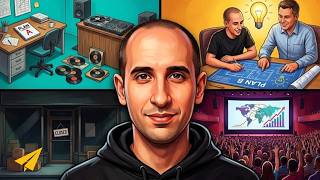
William Hewlett and Dave Packard started HP with $538 in a garage, flopped with a bowling-lane indicator, then pivoted to measuring instruments. A sale to Walt Disney for Fantasia launched them, and they kept adapting through direct mail and workplace innovations that became the HP Way.
Chapters
Welcome to another Famous Friday. I believe that whatever goal you have, whatever challenge you're facing right now, it has already been solved by somebody else, and the fastest way to solve it yourself is to model that success. Learn what worked for them and apply it to your business as well. So today I want to look at the success behind Hewlett-Packard, and their lesson is adapt. The plan you start with is very rarely going to be the plan that actually makes you successful, and you're going to need to adapt and change. And it's okay if your first plan doesn't work out, because it rarely does. So William Hewlett and Dave Packard started Hewlett-Packard with $538. They were young engineers, they didn't have a lot of startup capital. They started in, in Dave Packard's backyard one-car garage, and they flipped a coin over whose name would be first. William Hewlett won, so it became Hewlett-Packard instead of Packard-Hewlett. Their very first product was a foul line indicator for bowling alleys. So if you're bowling and your foot goes across the line, it's gonna send you a notification. And it was ingenious, it was different, it was new, never been done before. But there was a problem. Nobody wanted the product. They couldn't convince bowling alleys to buy it. And so this is a really important point because this is where a lot of entrepreneurs, that's where they give up. That's where they quit, right? Say, "Well, we put everything we had into it. This was our big idea. It didn't work out. I took my shot. You know, I tried. So maybe I'm not meant to be an entrepreneur. I'm gonna go back and get a job." But Hewlett-Packard didn't take that mentality. Instead, they adapted and they said, "You know what? Our first product didn't work out. We're gonna We're gonna adapt and we're gonna try something new. So their next product they came out with was the HP-200A. And what it was, was a tool to help measure instruments and tune harmonicas. And they released it to the market and again they had very little success with it. But one young entrepreneur named Walt Disney decided to buy 8 of them for a movie he was making called Fantasia. And their tool was used to help make the movie. And they were excited that somebody had used it, somebody had bought so many of them, and they thought, you know, maybe this product can work, but we need to adapt how we're selling it. And so they said, let's try doing direct mail marketing. And they wrote out a few letters to people saying, you know, promoting their product and how great it was, and some orders started to trickle in. So they started to do more and more, and more orders came in, and that was the growth of Hewlett-Packard. And so the first product didn't work out, but they adapted. The first marketing strategy they used didn't work, and so they adapted. And Hewlett-Packard continued to adapt over the years, and they're a company known for innovation and adaptation. And they launched tons of new products. They not only created new product lines but also adapted the way business was done. They were one of the first companies to introduce flex hours and profit sharing for employees. They created a culture called the HP Way at a time when there wasn't corporate culture. Their, their one-car backyard garage is now considered the birthplace of Silicon Valley and is a museum that you can go and see. And so all along the way, they continue to adapt to improve their business. And that's what you need to do, because it's very rare that your first idea is going to work. That your first marketing strategy is gonna work, that your first employee that you hire is gonna work. It almost doesn't work out, and that's okay, and that's normal, and that happens to everybody. The key to the winners, the ones that make it, the entrepreneurs who make it through and achieve their goals, are the ones who continue to adapt, to change, to make it better, to take the feedback that they're getting and find another way to stand. So adapt. And believe. For those of you watching, like the video, you can subscribe to the channel to see more videos just like this. Thank you so much for watching. I'll see you soon.