How To BE More CHARISMATIC! - #BelieveLife
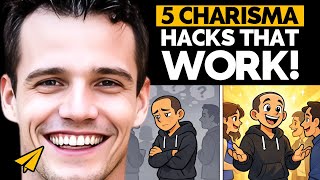
Evan Carmichael and experts including Tony Robbins and Simon Sinek explain five ways to build charisma: adopt the mindset that you'll be okay no matter what, use body language and posture to project confidence, visualize success before important meetings, uplift others, and listen more than you speak. Charisma is learnable and reduces resistance in sales and leadership.
Chapters
If you want to be more charismatic and you're looking for 5 ways on how to do it, then this video is for you. What's up, Believe Nation? It's Evan. My one word is believe, and I believe in you. I believe in your potential and this amazing gift that you have inside here that I want to see explode out onto the world. And so to help you on your journey today, we're going to talk about how you can be more charismatic. How important is charisma, uh, and is it necessary as a sales executive?
Very important, and yes. See, the reason I research charisma is when I tell people there's 100 tools, the knee-jerk reaction is, okay, Kurt, what's the most important tool, right? People want to know. What's the most important tool? And it's charisma. People want to be around you. They want to be influenced by you. There's very little resistance. And so I set out to find out and interviewed charismatic salespeople, charismatic entrepreneurs, charismatic CEOs. What did they have that the average person didn't have? And first of all, you already have some elements of charisma. And second of all, the rest can be learned. And that's the key elements of charisma. It dramatically reduces resistance and makes you very, very influential. And it's something that can be learned.
No matter what, I will be okay. In my opinion, this is the most fundamental mindset to charisma because so many people live their life wrapped in this sort of mental loop of what-if questions, right? What if I speak up and my boss doesn't like my idea? What if I ask this girl on a date and she says no? Or what if I lean in for a kiss and, even worse, she ducks away? right? What if I were to ask this person to go, just as a friend, out to coffee, and they said, "Ah, I was busy that day." All of these sorts of things stop people from acting, from speaking up, from expressing who they really are. Now, in the social context, what you need to realize is that the repercussions for even the worst-case scenario of every single one of these are not so bad. You recover from these. If your boss doesn't like the idea, fine, move on. If a girl doesn't want to go on a date with you, probably better that you know rather than spending 6 months trying to figure out which signals she's sending that indicates that she does. When you can get that mindset that no matter what, I will be okay, and I apply this to the social field, I don't necessarily mean that you need to extend this to jumping out of 40-story buildings, but socially, no matter what happens, you will be okay. That enables you to act with the sort of freedom that most people never ever experience, and that means that you can risk social things in terms of cracking jokes, expressing ideas, asking people, expressing how you feel. That means that you can risk that more than other people. And when other people see that you seem to have this immunity to social pressure, that you're expressing who you are more, they will naturally gravitate towards you because that is a strength that most of us really, really want to have in ourselves. The most fundamental piece—no matter what happens, you will be okay—if you ever find yourself stuck, not knowing if you should speak up, come back to this belief. It is so critical.
If you see someone who's depressed, without me telling you anything, you could tell me that person has a physiology to them, a way of using their body. What's their posture like? Slumped. Where's their head? Down. Are they breathing full or shallow? You know, shallow. Do they talk really loud and fast or more quiet and more hesitant? In order for us to feel any emotion— anger, frustration, uncertainty, excitement— we have to use our body a certain way. Emotion comes from motion. So most of us have habits of using our body, our breath, our movement, our facial muscles. We have 80 different muscles in our face. Eight-zero. Eighty. For most people, this is the largest area of unemployment in the country. If you want to change your life and you want to be more assertive, Get around more assertive people and model them. Take on their posture, move. It seems artificial and bullsh— Stand with your hands on your hips, standing straight up. If you stand that way for 2 minutes like Superman, Wonder Woman, within 2 minutes, the testosterone in you, male or female, increases an average of 20%. And the cortisol, which is the stress hormone that stresses you out, drops 15% in 2 minutes. And all you're doing is standing like this. And you're 1/3 more likely to take action, be more assertive, do something you normally wouldn't do.
When you have confidence, or we could even call it fire, when you have that fire within you, that confidence, that interior bravery, you almost have this power to do whatever it takes to get your brave vision done. You see, in this world, it's not about, you know, in many ways, your strategy in your business or your ability in your life. It's about this thing called confidence, and we have all had these times in our lives when we are full of confidence, and what other people see as a problem, we simply do see as an opportunity. Other people see it as a stumbling block or a wall, and we see it as a stepping stone or this solution. And so confidence is something that you really want to wire in. Confidence is something you really want to develop. Confidence is a practice. Confidence is a muscle. Like any muscle, the more you focus on it and practice it and train it, the stronger your confidence is going to grow.
So for an entrepreneur, since my audience is mostly entrepreneurs or want to be entrepreneurs trying to start a business or get their business to the next step, for an entrepreneur going into a big meeting with a potential investor, potential customer that they want to win that deal, they want to feel that influence, what do you recommend they do to get into that mindset before going into the meeting?
Whatever it takes. See, everyone's a little bit different. Some people do affirmations. My early mentor, Brian Tracy, he was a big sales guy. He taught us to think, I'm the best, I'm the best, and that just didn't click for me. And so I just turned it around like, they owe me money, they owe me money, and that worked for me. Some people visualizing the sale, uh, some people having a little ritual to get them into the game. For some people, it's Being prepared and knowing your material, it might be all of the above. And so everyone's a little bit different here. Some people listen to music, some people pace. I don't care, but you find the 2 or 3 things that work for you, you get in that zone, feel influential and become influential.
Are there recommendations you have for how to find that thing? Do you think we already know it? Do you just recommend cycling through a whole bunch of different things to find it? What do you suggest?
I would cycle, you know, remembering past victories, I know for everyone, visualizing them saying yes, visualizing getting the sale works for pretty much everybody. And that's what's interesting about mindset and self-persuasion, that if you're stuck on worry, it's because your vision's not strong enough. If you're worrying about this— what if they say no? What if they don't agree? What if they don't do it? You haven't visualized the sale. You haven't visualized the negotiation to, to you and your success. And so I encourage everyone, I know everyone that I've ever met, visualization works. When you can see yourself doing it, it works because the universe will not reward you physically until you can see it mentally.
Charismatic characteristic number 5 is be encouraging and uplifting. How hard is it to encourage somebody? Great job, you're amazing, you're incredible, I really like you, you're great, what a great pair of shoes you're wearing. Compliments don't hurt either. But I'm telling you, the simple act of eliminating the negative speak and mindset is one of the most critical components of being charismatic. You can do it! You're amazing! I believe in you! How hard was that? Wasn't hard at all. And how'd you feel? Exactly, amazing. And I probably looked like I was pretty damn charismatic, and so can you.
Thank you guys so much for watching. I hope you enjoyed. I'd love to know, what did you take from this video that you will immediately apply somehow to your life or your business? What rule resonated the most with you that just hit home the hardest that you're going to apply? Leave it down in the comments below. I'm really curious to find out. I also wanna give a quick shout out to Tony. Tony, thank you so much for picking up a copy of my book, Your One Word, and posting the link on Twitter. I really, really appreciate the support, man, and I'm so glad you enjoyed the book. Thank you guys again for watching. I believe in you. I hope you continue to believe in yourself and whatever your one word is. Much love. I'll see you soon.
If you wanna get stronger, you can go to the gym. And if you're interested in learning how to code, there's tons of classes that you can take on that. But where do you go if you wanna learn how to to develop your confidence and your charisma. So, the first one is for the type of person who might get into conversation and feels like they very quickly run out of things to say, whether that happens after a minute or after 20 minutes. And the thing that I recommend, the class that I took that helped me the most with that, is improv comedy. First off, because it is scary, right? To get up there in front of a group of people you don't know and try to be funny, let alone say anything, is a terrifying experience. And anything that pushes your comfort zone is going to help you in social situations. But that's not why I recommend improv comedy. In fact, there's something that is much, much stronger about that, and that's that you have nothing to go off of when you stand up there. You stand up there, your mind is blank, and all of a sudden, the audience shouts out a suggestion, and you have to riff off that, which might sound like it's a very isolated incident, but, really, that's what all sorts of conversation are. You're talking to someone, they give you a conversational thread, and then you have to riff on that, and that has helped me more than anything I've ever done. Continue conversations with people even when they start to stall. So check out improv comedy if that's something that you have identified as a problem in your life. Smile often.
Fact: charismatic people know the power of the pearly whites, and they're not afraid to use them. If you want to be viewed as one charismatic motherfucker, you need to smile now. One of the issues that I hear a lot is guys are like, yo, I hate my grill. I'm here to say, gentlemen, that if you do, if it is preventing you from smiling, save up up the money and get it fixed. Braces, implants, orthodontic procedures, veneers— gentlemen, there are options out there. Are they expensive? Some of them. Is it worth saving up? Yes. But regardless of the quantity or quality of the teeth you have in your mouth, the one thing you can do is keep them clean and white.
Nelson Mandela is a particularly special case study in the leadership world because he is universally regarded as a great leader. You can take other personalities, and depending on the nation you go to, we have different opinions about other personalities, but Nelson Mandela across the world is universally regarded as a great leader. He was actually the son of a tribal chief, and he was asked one day, "How did you learn to be a great leader?" And he responded that he would go with his father to tribal meetings, and he remembers two things when his father would meet with other elders. One, they would always sit in a circle, and two, his father was always the last to speak. You will be told your whole life that you need to learn to listen. I would say that you need to learn to be the last to speak. I see it in boardrooms every day of the week. Even people who consider themselves good leaders, who may actually be decent leaders, will walk into a room and say, "Here's the problem, here's what I think, but I'm interested in your opinion. Let's go around the room." It's too late. The skill to hold your opinions to yourself until everyone has spoken does two things. One, it gives everybody else the feeling that they have been heard. It gives everyone else the ability to feel that they have contributed. And two, you get the benefit of hearing what everybody else has to think before you render your opinion. The skill is really to keep your opinions to yourself. If you agree with somebody, don't nod yes. If you disagree with somebody, don't nod no. Simply sit there, take it all in, and the only thing you're allowed to do is ask questions so that you can understand what they mean and why they have the opinion that they have. You must understand from where they are speaking, why they have the opinion they have, not just what they are saying. And at the end, you will get your turn. It sounds easy. It's not. Practice being the last to speak. That's what Nelson Mandela did.
So let me give you the one, one secret to happiness. One word. This is all you need to be happy.
The most important word ever. If you had to think of one word that's most important to you or that sums you up or that would be kind of like a little beacon.
Hey, Believe Nation! If you want to know what the most important one word is for Tony Robbins, Gary Vaynerchuk, Oprah Winfrey, will.i.am, and Howard Schultz, I have a very special secret video for you. Check the description for details.
More from Evan


How the Biggest Mistake in History Created A Trillion-Dollar Empire | Sergey Brin



9 Machiavelli Principles That Force People To Respect You | Machiavellian Philosophy



The First 10 Words That Instantly Ruin A Sales Conversation | Vanessa Van Edwards

The Top 1% Mindset Behind The First $5 Trillion Company | Jensen Huang (Nvidia)

