How To BRAINWASH Yourself For Success | Bruce Lipton (10 Rules for Success)
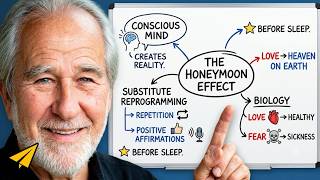
Dr. Bruce Lipton explains how 95% of our behavior runs on subconscious programs installed before age seven, when the brain is in a hypnotic state. He outlines ten rules to reprogram yourself through repetition, shifting perception, and choosing love over fear, backed by research showing meditation can alter inflammatory gene expression.
Chapters
The movie The Matrix, everyone thinks science fiction. I go, no, no, that's a documentary. Everybody got programmed. That's a fact. That's a biological reality. But what was interesting, they always said, well, there's a red pill, and if you take the red pill, you get out of the program. And I go, guess what? Almost everybody in our audience has taken that red pill at one time, changed their life. Yes. When was that? It turns out science has recognized that when you fall in love, you stop playing the programs and you start creating from your conscious mind. And wishes and desires are conscious mind. And so once you let go of the program and you start creating wishes and desires. It's called the honeymoon. You created this heaven on earth experience. And I go, and here's the inside story that Michael's been telling you for years, but I can now tell you, you could have that every day for every day of your whole life. Yes, we created that. And if you understand you created, then you can say, well, why didn't I create it tomorrow? And I go, you can create it every day. That's the beautiful part.
Need motivation?
Watch a top 10 of Belief Nation.
Hey, it's Evan Carmichael, and I watch these videos every day because I need them for motivation. Being around successful entrepreneurs every morning helps me believe that I can do great things too. It's like your morning coffee, but for your goals, kickstarting your day with a blast of positivity. So here is a challenge for you. Try watching one video every morning for the next 30 days, and let's find out together if they help you do great things too. If you're in, leave a hashtag #believe in the comments below so I can celebrate with you. So today, let's learn from one of the best, Bruce Lipton, and our take on his top 10 rules of success. Believe. Rule number 2 is repeat the desired habit.
You as an identity are in your conscious mind. You actually are in there. That's where your personal identity is. And we have a tendency to say, if I talk to myself, I'm going to give myself a good talking to and I'm going to change that subconscious. I say to myself, Bruce, don't do that again. Do this. Don't do that again. And then I say, "It's very frustrating." "Why?" "You can talk until you're blue in the face and nothing will change." I say, "Why?" And the answer is, and this is the most important part, there is nobody in the subconscious. There's nothing there, it's a machine. It's a record-playback device, so you can talk to the machine as much as you want. If you don't know how to push the record button, Nothing's gonna happen. So then I say, how do you change the program? I say, how did you get the program? The first 7 years, your brain was in theta hypnosis. So I say, you want to change a program? Every night when you go to bed, just as your mind disconnects, just as you fall into sleep, your brain is now operating in theta. So if you put earphones on your head and you play a tape, a program, a CD, of what you want. As your conscious mind disconnected, your subconscious is downloading. So you just play that tape as you go to bed, and after a number of playings, your subconscious will learn the new program without even your conscious being involved. That's number 1. After age 7, how do we put a program in? Repetition. How did you do anything? You repeated it over and over again. How long did it take you to learn the alphabet? How many times did you have to go from A to Z before you could remember the whole alphabet? When you drove a car, you didn't know how to drive a car until you did what? You practiced. You repeated. So if you want to change a program, you put into your mind a repetition. And it's not— recognize this: what you want to change doesn't exist. So when you put in the new program, it'll sound strange. So let's say you are sick. "you have a disease." And I say, "What program do I want? I am healthy." I go, "It doesn't sound right. I know I'm sick." I say, "I don't care. There's a saying in English, 'Fake it until you make it.'" What that means is, if you want to be happy, just keep in your mind, "I am happy. I smile." Even if you have to force a smile. "I am happy. I'm smiling." I say, "Repeat this and repeat this." And guess what? After a short time, it becomes a habit. And when you're in that habit, you don't even have to think, "I am happy." The new habit will keep you happy all the time because that's the new program.
Rule number 3 is reprogram your mind.
95% of our behavior is coming from sub-below consciousness. And we're the ones that can't see it when we play it, but everybody else, of course, is seeing exactly what we're doing. So the whole idea is, are you living the life you want, or are you living the you've been programmed, and the answer, unfortunately, is most of us are living the life we've been programmed, and the programming comes from other people, so it's not our lives. The reason, let's give a reason why programming occurs, okay? The brain is a computer, most powerful computer that humans have ever experienced, but it has parallels to computers, and number one is this. In the old days, when you would buy a computer before they put the programs in, you could bring it home, brand new computer, plug it in, push start, boots up, screen's on, and I say, do something. And people, "Well, no, I can't do it." I say, "You got a brand new computer." First you have to put programs into a computer before you can use that computer. The brain of a human is the same thing. The screen lights up in the last trimester of pregnancy. It's ready, but there are no programs. So the first 7 years of a child's life is the brain is not operating at the higher level of consciousness, higher level, higher vibration. That's what we talk about. We put wires on a person's head, electroencephalograph, read brain function. A child up through 7 is not operating at consciousness except for a little bit. It's primarily operating at a lower vibration called theta. And I say, well, what is theta? I say it's expressed as imagination. So that's how children can have a tea party and they pour nothing into the cup and then they drink the nothing and then they explain how that was the best tea they ever had. Or a child rides a broom saying it's a horse. In the child's mind, that is not a broom, it's a horse. But it's mixing imagination and reality. But theta is hypnosis. And the significance of that is children have to learn how to become a member of a family, the rules, member of a community, the rules. I go, how can an infant, a young kid, learn these rules? They can't go to school, they can't read the book and all that. And I say, you don't have to. Nature provided theta hypnosis so that they can observe the parents, the family, and the community, just observe their behavior and download those as programs. Age 7, then that's That's when they start to become more conscious and engaging themselves. First 7 years is programming, but after age 7, 95% of your life is coming from that program. So if you can program the child for the first 7 years, then the rest of the life of that child is actually an expression of that program.
Rule number 4 is choose love.
In all biological organisms, there's something referred to as the biological imperative. The biological imperative can't be found by biologists. There's no place they say, "Oh, here it is in the cell." But what it represents is the drive to survive. When we start to feel that our life is threatened, it's not a conscious— at first, it's a gut feeling. It's visceral. Something in my gut says something's not right. This is the biological imperative looking at your potential future in the world that you're living in. And what we really have to recognize is that people are feeling it in their gut. The world is not right. It's not right. I go, well, this is wonderful because this is a feedback system that's saying the world in which you live is not in harmony with you. And therefore, what it really means is that we have to change how we influence the world in our own way. And it says that if we start to change and send out love instead of just receiving fear, that the love we send out has two aspects. Yes, there's an external consequence of love. It influences everyone and everything around me. There's a profoundly different chemistry if I have a thought of love. Coming into my body, which you can feel. When you're in love, you can feel it. Yes, your cells are bathing in chemistry of love. But when you have fear, it's a different chemical response. It gets you girded up for response protection, walling you off from the outside. I don't want that thing to come in and take care of, you know, my inside. And I say, well, what's the relevance? And the answer is very simple. The chemistry released by the brain in fear shuts down the mechanism of the body, shuts down the maintenance of the body to conserve energy. And the biggest thing is there's only one consequence, and that is disease and illness. And it turns out 1% of disease on this planet is connected to genetics, and 90% of disease or more is lifestyle and the psychology of love and fear. 90%. And so Be in love and your body will be maintained and your immune system will be at peak performance. Be in fear and the game is over. Hi, I'm Bruce Lipton, author of the best-selling books The Biology of Belief, Spontaneous Evolution, and The Honeymoon Effect. I'm here to thank Evan Carmichael for featuring me on his YouTube channel, and I want to let you know that Evan is giving away links where you can watch the first episodes of my special Gaia series entitled Inner Revolution for free. Evan is making this offer to thank you for watching this video. You will find the links in the description section below. Thank you.
Rule number 5 is don't let your mind limit you.
The belief that is taught is that biology in the world we live in operates according to Newtonian principles. Unfortunate part about that is quantum mechanics 100 years ago said that's obviously not true, and physicists No, this is not true. And yet medicine doesn't buy into it because it still focuses on the material reality and lets go of the invisible shaping fields that quantum physics emphasizes as primary. Okay, so we have to change that belief system. We have to get people to recognize that the field and the thoughts and all these other things are as important as anything else in shaping the matter we live in. Number 2, the belief which I blew away years ago, but it's still being taught in school is the concept that genes control life. This is totally false. Genes control nothing. Control is an action. A gene is a blueprint. It's physically, literally a string with blueprint data on it. Why is that relevant? It's interesting. Go to an architect's office and the architect's working on a blueprint and then lean over the architect's shoulder and say, "Is that blueprint on or off?" And he looks at you and says, "What's that?" The blueprint's not on or off, it's a blueprint. Yeah, but we talk about genes being on and off, like genes are turning on and genes are turning off. And the question is, but genes are blueprints. They can't turn on and off. There is no on and off. It's just the blueprint. It's a pattern. What we have failed to focus on because we gave genes a character of self-actualization, that my genes decided to do something. It's like, okay, now we're a victim of the genes. But it turns out biologists know that this is not true. Biologists know that genes are not turned on and off. Genes are read or not read like blueprints. Then all of a sudden it says, well, it's not the blueprint that's important. If the blueprints were self-actualizing, an architect could go by a building site, drop the blueprints off, come back 2 weeks later, and the building will be there. That's what we think about animals and plants. The genes are blueprints and they're controlled. All this is like, no, the blueprints are important. I'm not saying they're not. You got the bad blueprints, you got some problems going on here. But the issue is it's not the presence or absence of a blueprint, it's whether the blueprint is being read. And then you say, well, then who reads the blueprint? And the answer is a contractor. And who's the contractor? The mind is the contractor. The mind reads genes. The mind can change the genes readout. Here's something so blow away that most people can't in their conventional world make sense of it because it's like, ah, it goes like this. The mind through what is called epigenetic mechanisms can start with a single gene blueprint and create over 30,000 different versions of products from the same blueprint. 30,000 different products from the same blueprint. All of a sudden you realize, "My God, you can infinitely vary the expression of the gene." And the answer is, "Yes." And why has this become relevant to all of us? And the answer is because many of us think genes control our lives, and yet we don't realize that we modify the readout of the gene. So we could be totally healthy and our mind can cause cancer. Our mind can cause any disease, diabetes, anything like that. And what's interesting is the flip side. Is some people come here with actually defective genes. And guess what? With their mind, they can rewrite those genes and make them normal. So the genes are not the limiting factor, it's the mind.
Rule number 6 is always seek knowledge.
A lack of knowledge is a lack of power. Mm-hmm. And I say you're suffering out here because you feel you have no power. And if you really understand the biology that we're talking about and the spirituality that you're talking about, and you start to recognize it, you recognize, oh my God, You are so powerful, and yet you have a belief of victim. And since belief controls it, no matter how powerful you are, if your belief is you're a victim, then you are a victim. And we have been victimized by beliefs that are incorrect. And if we adjust the science, it automatically then comes right together with the whole spiritual message that Agape and my brother Reverend here have been providing for years. But there's a scientific context to it to it because a lot of people go, "Well, is it scientific?" I go, "Yes, it is." I mean, what are those flawed beliefs that we've been living under all these years? Well, there are 4 of them, and 2 of them are actually part of Darwinian theory, which I'll mention. But the first one that's really important is people have been programmed to believe that the genes they inherited at conception are programming the rest of their life. The genes, we didn't select them as far as we know. If you don't like the characteristics, you can't change these genes. And then we add on top of that, We say, and the genes turn on and off by themselves. And all of a sudden you start to realize then I'm not running my life, the genes are running my life. Oh my God, there's cancer in the family and there are genes that are going, I'm going to get the cancer gene. And I say, what's the belief? You already got the belief, I'm going to get cancer. I go, this is trouble right there. Just a little sidebar, 'cause I love this sidebar. There's not one gene that causes cancer. Cancer is not caused by a gene. Cancer is caused by disharmony, in your life. Unresolved anger is the biggest one. Feeling lost, left out, not part of something is another one that separates you. And I want people to understand that because so many people say, oh, I've got this cancer and the gene doesn't, and I'm just a victim back here and the genes took this and genes made this. And I go, stop. You are co-creating with those genes. The gene does not turn on and off and the gene does not control things. The gene responds to the environment. And if you're your perception of the environment is not in harmony and support of your life, that disharmony is what can activate a gene. A gene is a blueprint, just like in an architect's office. And I mention, I say, go into an architect office and she's working on a blueprint. You ask her and you say, hey, is your blueprint on or off? And she'd look at you like, what are you crazy? It's a blueprint. There's no on and off. I go, yes. DNA is a blueprint to make the proteins of the body. It cannot turn itself on and off. You need an architect. Consciousness, mind, is architect, right, that turns the genes on and can modify the readout of the genes.
Also, to make sure you're actually taking action after watching this video, I've designed a special free worksheet just for this video. The worksheet will highlight our favorite lessons from the video that will inspire you to remember what you learned today and actually apply them. The worksheet will also give you space to write down what your key takeaways are and your specific plan of action to make sure you're getting results. If you want the worksheet designed specifically for this video, absolutely for free, there's a link in the description below. Go click on it and start building the momentum in your life and your business. I'll see you there. Rule number 7 is change your perception.
Perception can rewrite the genetic code. When you're under stress, you will rewrite your genes It's built into every one of your cells. You have genetic engineering genes. The function of these genes is if you find stress that the body cannot seem to get out of, the body will make an effort to change its structure to get out of the problem. And of course the issue is this: what if your perception wasn't real and you change your genes? Now you're in deep doo-doo. And we now find a very important In fact, 95% of cancer has no genetic linkage. 95% of cancer is a response of the individual cells to their experiencing life. And if you change your experiences, you can change the presence of that cancer. That's how it works.
Rule number 8 is change your thoughts.
They did a recent study where they looked at some genes controlling inflammation. And then they had— they read the genes of these people, and then the people went to 8 hours of meditation. And at the end of 8 hours, the genetic activity was completely changed. In other words, you can change the genes in just 8 hours of a meditation. And that means how powerful your thought is in controlling your biology.
Rule number 9 is identify the stressors. So someone's not feeling well, they've got, I don't know, they've got the flu or they've got something wrong with their stomach or something. What should they practically do? They should presumably go to the doctor and get a diagnosis. Would you go along with that? I'm just, I'm just trying to see where this goes in day-to-day life.
Well, I wouldn't say don't go to a doctor, but I say before you go to a doctor, just look around and think about this. What's going on in your life? Where are the stresses coming from? Because it's almost Because your physiological expression is a complement to your life experiences. Those people that are happy are healthy. As I said, when you're in the honeymoon, you didn't get sick in the honeymoon. That's when you're absolutely healthy. But when you got caught back up into real life, that's when illnesses start to occur. So we always look at, oh, I must be sick, there must be something wrong with my biology, when it turns out it didn't begin with your biology. About 2% of illness is actually connected to genetics, let's say. 98% of illness is not just genetics, it's environment. So when a person says, "I have the breast cancer gene," and people think, "Oh, I'm going to get breast cancer," and I say, "Well, wait, wait. 50% of women that have the breast cancer gene get cancer. What about the 50% that have the gene and didn't get the cancer?" And we never study that side. We only study the side that got the cancer, and you find out, well, what is it that the 50% do that don't have the cancer yet have the gene? What's different? The answer is their lifestyle is different. Their stresses, their fears, their concerns are not the same as the one that get the illness. The genes are like give you a propensity to get a disease, but that propensity is based on how you perceive life. And it's interesting, studies showed that when children get adopted into a cancer family, the adopted child will get the cancer with the same percentage or probability as any of the natural siblings. And you say, yeah, but the, the child came from totally different genetic stock. And the point is, yes, it wasn't the genes that promoted the cancer, it was the lifestyle that promoted the cancer, especially the lifestyle of stress. And then I say, well, If stress is causing lifestyle, I can look around at the world, I go, my God, no wonder everybody's sick. Every day is filled with more stress than the day before. And if you buy into the stress, you take that disharmonious vibration, essentially bring it in your life, and you end up with disharmony inside your body. Your life is a reflection of what you see.
And rule number 10, the last one before our very special bonus clip, is eliminate threats.
About that. Well, the stress is what? Is to, to prepare you for, for a threat. Stress says there's something threatening you. And I say, well, if I'm preparing for stress, that's what we just mentioned. I say, if I'm not threatened, I'm free to go outside and do anything I want. If I feel threatened, I'm going to wall myself off to protect myself, put all the goggles on, the face mask, and do all that. Now I'm going to be inside here. I You can't survive inside. I'll give a simple example. When I was young, we had air raid drills in the U.S. because we thought the Russians were going to bomb us, so we built bomb shelters. So I'll give you a very simple story. A city, a community is in growth. It's a beautiful day out. The businesses are working. The kids are in school. The community is growing and doing well. An air raid siren goes off. What does everybody do? They stop work. Where do they go? They go under the ground into the air raid shelter. I say, then what? I said, well, nothing is happening now. Everything's shut down. Okay. I go, yeah. And I say, then what? I say, well, in 10 or 15 minutes, all clear. We get out of the bomb shelter, everybody goes back to work. So it was like a, you know, half hour interruption during the day where we were growing. Then we spent a half hour in protection, and then we came out of protection and went back to work again. Everything was no problem. Here's the problem. The air raid siren goes off, you go into the bomb shelter, and there is no all clear. I said, what does that mean? I said, well, you can't come out of the bomb shelter. I said, until when? I say, you can't come out until it's all clear. I said, when's it all clear? So it's not getting all clear. I said, how long can I live in the bomb shelter? I say, not very long. Why? How much food did you put in there? How much water do you have in your bomb shelter? And the point is, you'll use up those resources and if you don't come out, you will die in the bomb shelter. When we're in stress, we go into the bomb shelter psychologically. We wall ourselves off. We're safe inside here. And I say, how long can you survive inside the bomb shelter? I say, a short period of time was no big deal, but as you extend the time, my life becomes threatened. And this COVID crap is going around and extending the Fear on and on and on again. We're having a second spike. I go, big deal. I mean, all right, what— why haven't we— how come I have a second spike? I said, if you take the susceptible people and you move them into a quarantine so they're not exposed to the virus and they're healthy in their room, I say, then you say quarantine over and you come out. I go, did the virus go away? No, that's still there. Are you still susceptible? Of course you are. You didn't get any immune reaction in the bomb shelter over there. I say, so what do you think would happen if you let that group of people you put away back out? I go, they'll get infected just like the first group of people. And guess what? It's called a spike. I go, of course it's a spike. You took them out of the program, you put them back into the show, they get this, and then you say second spike. I go Did you not expect a second spike? And what reason why would there not be a second spike? You didn't lose the virus. You didn't gain any immune, you know, precaution against it. You just opened up the next population. Yeah, here we are in a second spike. Of course. That's exactly what would happen if you take the population and put it away and then think, well, okay, now they can come back out. I say you didn't change anything. Anything. They're just out now, the second spike. So all of this stuff, and I go, so you want to know what I believe the biggest problem of the whole thing is? Because I see it as a manipulation of information, and that is this: people have power when they're in a community. People have no power when there is no community. And the COVID system broke community all over the world at once. Everybody went to their room. I go, and what power do you have? I say, absolutely no power. People lost all the power in the world except for those that were manipulating what was going on outside of that room. And that was a way of disempowering an entire damn population of this planet with the fear that said, go hide in your room because you can't gather together, you can't have an opinion together. No, you can stay in your room and 'You stay in your room.' And all of a sudden I say, 'Oh my God, that's the biggest problem in the whole world.' You've isolated people, and when you've done that, you remove their ability to have power. Then 95% of your life is coming from observing the other people, not observing you, but observing the other people. And so your behavior isn't yours. Now Steve brings up the most important question. Well, how do we change these behaviors? I go, first of all, you don't even know what the behaviors are because you weren't there when they were being programmed. I don't know what my behaviors are. What did you learn when you were in utero? Oh, you don't know. Oh, okay. What did you learn during the year from 0 to 1? Oh, you weren't there. You don't remember. Oh, what did you learn from 1 to 2. And I'm saying, your conscious mind wasn't working at that time. So whatever happened, it's not in your conscious mind. And so the significance about all this is profound, because what the significance is, then you don't know your program, you don't know your program. And I go, oh, so what are my programs? And now, thank God, I can tell you what your programs are because of this: 95% of your life is coming from the program. Your life is a printout of your programs. You don't have to go backwards in your life. You could just say, what, where am I today? And here's a simple point. So all of you out there, ready? The things that you like that come into your life, they come in because you have programs to acknowledge them. But the things you want, the things you desire, and you have to work hard, you have to sweat. I'm going to make it over. I'm going to sweat over this. I can put a lot of— I'm putting a lot of effort. I'm working real hard to make this. Why are you working so hard? The answer is whatever that destination you were trying to get to, your subconscious program does not support that destination. And that's why your conscious mind is working so hard to get there. So I say, You got programs, and you got them before you knew you were being programmed. And then we have to identify those programs, because if you want to change your life, and you want to make it one that has wishes, then you have to assess what are your programs now, so that you can then change those programs and create the life you want.
For some incredible Joe Dispenza motivation, check the video right there next to me. I think you'll love it. Continue to believe, and I'll see you there.
Habit is when you've done something so many times that your body literally knows how to do it better than your mind. When we're in separation, in lack, waiting for our wealth to feel abundance, we're basically living our whole life in pain.
More from Evan


How the Biggest Mistake in History Created A Trillion-Dollar Empire | Sergey Brin



9 Machiavelli Principles That Force People To Respect You | Machiavellian Philosophy



The First 10 Words That Instantly Ruin A Sales Conversation | Vanessa Van Edwards

The Top 1% Mindset Behind The First $5 Trillion Company | Jensen Huang (Nvidia)

