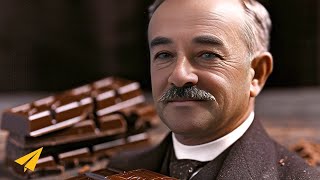
Milton Hershey went from a penniless teenager with a $100 loan to building a $5 billion chocolate empire. He spent a decade failing at candy ventures before switching to mass-produced chocolate, becoming the first to make it affordable in North America. He kept workers through the Great Depression instead of replacing them with machines.
Chapters
Welcome back for another edition of Modeling the Masters, where we look at the successful strategies of famous entrepreneurs. My name is Evan Carmichael, and I wanted to start off by thanking everybody who watched the last episode on Harley-Davidson. We've received almost 3,000 viewers so far, and I wanted to continue the tradition today by talking about another successful entrepreneur, Milton Hershey. Now, while you may know Hershey Foods today for its $5 billion in revenue, 11,000 employees, and all of its chocolate bars, when the company was first started It was started by a young entrepreneur, Milton Hershey, who was 18 years old, had no money to his name, and had to borrow $100 from his aunt just to get the company off the ground. So today we're going to learn about 3 factors that led to his success. Lesson number 1 is be persistent. When Milton Hershey first got started, he moved to Philadelphia, started a new candy store, and he worked 15-16 hour days every day to get the business off the ground. He would make his candy overnight and then during the day go out and sell it. After 6 years of trying and trying and trying, the company eventually failed. So he thought, I'm going to keep going, I'm going to try it again. He moved to Chicago, started the same business, that also failed. He didn't give up, moved to New Orleans, tried again, failed again, closed down the business, started up again in New York, tried to get the business off the ground, was starting to get a few sales coming in. But then he had his entire shop and inventory robbed by a group of street children. So he had to again declare bankruptcy, shut down the business, and after 10 years of trying and trying and trying, he didn't give up. He started new businesses again and eventually was able to build the successful company that we know today. Most entrepreneurs give up way too easily. I'm not suggesting spend 10 years of failure to try to get your business off the ground, but don't quit at the first sign of trouble. You may have to try something new, you may have to move to a new market, bring new features in, sell to new customers. Don't give up at the first sign of failure. Most entrepreneurs fail not because they have a bad idea, just because they give up too quickly. Lesson number 2 is innovate. After trying the same thing over and over and over again in 4 different cities, after 10 years, Hershey decided, I gotta try something different. So the big innovation that he did was he moved from caramels to chocolate. In 1893, there was a new machine that was on the market in Europe that could help mass-produce chocolate. So he decided the future was in chocolate, he was gonna do something different, he was gonna stand out from everybody else, and he was gonna be the first guy to make chocolate through a machine. Up until that point, chocolate was available but was handmade and for people with a lot of money. It was a luxury item. And by using the machine, he was able to mass-produce chocolate Similar to what Henry Ford did for the automobile, Hershey was able to do for the chocolate industry. So finally he realized, I gotta do something different, I gotta get out there, I gotta innovate. And he was the first one to bring mass-produced chocolate to the North American market, which is one of the main reasons why he was able to achieve such success. So look at your own business. Are you doing something different? Are you standing out from the market? Are you being innovative? Do you have something that is unique that nobody else has? Because if you're doing the same thing that everybody else is doing, selling the same product, same service in the same way, then you could spend 10 years of your life like Milton Hershey did trying and trying and trying and not getting anywhere. It's not until you stand out and do something different that you're really going to be able to take your company to that next level of success. Lesson number 3 is treat people with respect. When Milton Hershey, after 10 years of failure, came back home, his parents actually disowned him. They didn't want anything to do with him. They thought he was a failure. He spent 10 years and all this money basically wasting his time in their opinion. So he had nowhere to go. The only person he was able to call on was actually one of his former employees, Henry, who gave him room and board, who helped pay for him to be able to bring his equipment back from New York so he can start up shop all over again. And it was only because he treated his employees so well prior that he was able to call on them to be able to help him out when he really needed help. He believed in that philosophy even when he got richer and was doing a lot better with his company. The classic example is in 1929 when everything crashed, started the Great Depression. He was in the process of building new constructions for his little town and somebody came to him with an invention. It was a steam shovel. They said this steam shovel can help you save a lot of cost, it can cut the work of 40 employees and have one person do the job of 40. And he said, look at what's going on in the economy these days, get rid of the shovel, hire the 40 workers. And he was able to build up a lot of community support because of his philosophy of being able to continue to give back, help others, and be respectful. So think about your own business, think about the people you see in your daily lives, your employees, your partners, your investors, your customers, the media, anybody who you come across, your next-door neighbor. Try to treat them with respect because you never know when you're going to need to call on their help someday for your business. I hope you've enjoyed this edition of Modeling the Masters. I wanted to remind you that Milton Hershey started the business as an 18-year-old kid, didn't know anything, had no money, a $100 loan from his aunt to get the business started, and he was able to build it up where now it's a $5 billion company with 11,000 employees. You can achieve the same results with your business if you really want to. Follow the lessons from Milton Hershey. If you are persistent, if you innovate, and you treat people with respect, you too can build a great company. I hope you've enjoyed this edition. If you want to learn more about famous entrepreneurs, you can check out our website at evancarmichael.com, and I've recently launched a new blog as well. The link is listed below. That just talks about the famous entrepreneurs and how to model the success of Famous Entrepreneurs. I also wanted to thank our sponsors Fantamedia for all the great video work that they've done on these episodes, and I look forward to seeing you at the next edition of Modeling to Masters.