How to Make Your Passion Pay Off | Quentin Tarantino's Advice in 20 Minutes
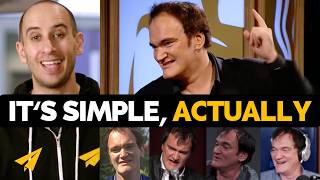
Quentin Tarantino says passion matters more than formal training, and a director's job is to have a vision and hire people who execute it. He refused rewrites to protect his scripts, worked with Samuel L. Jackson to layer classic film references into scenes, and treats audiences like an orchestra, shifting them between laughter and horror.
Chapters
I'm a big fan of action and violence in cinema. I always said that almost as if it was one of the reasons Thomas Edison invented the camera was to film violence, alright, because it's so good. You don't have to go to school. You don't have to know a lens, you know, a 40 and a 50 and a— fuck all that shit. Crossing the line, none of that shit's important. I want to make movies that people will watch them and that will make them want to make movies.
Hello, Believe Nation, I'm Evan Carmichael. My one word is believe, and I believe that entrepreneurs are going to solve all of the major problems of the world. So to help you on your journey, today we're gonna learn from American writer, director, and actor Quentin Tarantino, and my take on his Top 10 Rules for Success Volume 2. Rule number 5 is my personal favorite, and I'd love to know which one you guys like the best. And as always, guys, as you're watching, if you hear something that really resonates with you, please leave it down in the comments below. Put quotes around it so other people can be inspired, and when you write it down, it's much more likely to stick for yourself as well. Enjoy.
I would have actually got first credit position on Natural Born Killers if I had allowed it. But I was so pissed off that they rewrote my work. I believe in integrity, and I did not want my— I didn't care about the residuals or any of that stuff. God forbid anyone thought that that was my screenplay. And you feel you made that clear? That was absolutely clear? Well, and then not only that, oh, I attacked Oliver Stone in the press. How dare you rewrite my shit? Well, that's standard Hollywood practice. Fuck Hollywood practice. You don't do that to me. You know? And the whole point— you know, we've actually made it up since then, but the whole point, though— That must have been a conversation. No, it went a long time. For a long time, all right? We got drunk together and it was fine, all right? But, you know, but the point— I wanted all of Hollywood to know, do not buy Quentin's script unless you're gonna do it. If you bring another writer, I'm gonna attack you. You don't have to know how to make a movie. If you truly love cinema with all your heart and with enough passion, you can't help but make a good movie. You don't have to go to school. You don't have to know a lens, you know, a 40 and a 50 and a— all that shit. Crossing the line, none of that shit's important. If you just truly love cinema with enough passion and you really love it, then you can't help but make a good movie.
I was just adding up the money you generated for a lot of important people in Hollywood, Quentin, and my rough guesstimate is about $1. $1,400 million.
Little over that, over that, more than that. Wow.
Yeah.
That's, that's gross. And that's, you know, what I actually, what I'm the proudest of about that is I don't do commercial movies per se with the right quotes around it. I mean, I just do my own thing that interests me and then ended up, end up developing a following that people actually support it. So the fact that I actually do it out of these crazy little ideas that I have that I write down is, is, is pretty cool. I'm a big fan of action and violence in cinema. I always said that almost as if it was one of the reasons Thomas Edison invented the camera was to film violence, alright, because it's so good. And the genres that I'm attracted to tend to be genres that deal freely in that kind of stuff. And it has to be done well, because if you don't do it well, then it actually has no effect. What I'm about is playing the audience. Like, I feel like I'm the orchestra conductor and the audience's reaction are my orchestra. And the sounds you make are my instruments and your feelings are my instruments. And so it's like, I wanna, so it's like, laugh, laugh, laugh, stop laughing. Stop laughing. Okay, now be horrified. Be horrified. This is horrible. This is horrible. This is horrible, horrible, horrible. Laugh. And that's what I want to do. That's what I get off doing. And to me, when someone does that to me, I've had a good time at the movies. Before I ever made a movie, when I was thinking about the movies I wanted to make, one of the— I don't even think I 100% knew what my aesthetic was then, but I knew I wanted to be part of this and I wanted to make a contribution. And the closest thing that I knew about what I wanted to do was I remember thinking, I want to make movies that people will watch them, and that will make them want to make movies.
Well, that, that worked.
And that actually ended up kind of working. And there was this neat aspect. And I think it started coinciding with my, you know, with my career and the rise of the independent film movement in general, in the '90s. That there was this aspect that I actually think that young people were, in decades earlier, they might have picked up a guitar and started a garage band. They actually felt that they could express themselves more by trying to make a movie. And I think that ended up kind of happening to some degree or another. You know, Sam Jackson has appeared in probably, in one degree or another, in more of my movies than any other actor. And there's really nobody who says my dialogue the way Sam Jackson does. I think we have one of the most fruitful and rewarding relationships between actor and director in cinema. As much as it's fun to work with him as a director, I really do think it's the way he interprets my material as a writer that really is the key to our relationship. There's an aspect to my dialogue where It's not poetry, but there's a poetic quality to it. It's not— it can be musical. Oh, absolutely. Yeah, I'm not writing songs, but there is a musical quality to it. It's not stand-up comedy, but there is a comedic rhythm to it. And he gets all those notes. He turns it into the poetry, he turns it into the music, he turns it into, uh, the almost Richard Pryor routines, all right, that is, uh, required of him, uh, in a way that nobody else does. How does Quentin Tarantino direct you when you're in the film?
Quentin is— Quentin will come in and describe a scene to you in terms of like 6 different films.
Yeah.
So it'll be, well, the first part of the scene is the opening shot from The Good, Bad, and the Ugly, and then you get to this other thing and it's Days of Wine and Roses, and then And then you go from that into the— and then you did that Road Runner cartoon, right at the end, that Road Runner thing where he's falling down the cliff and he looks back up. That's the moment. That's the moment. And then he'll go, "All right, you ready? Action." And then right in the middle of your scene, he'll laugh out loud. And you know, you go, "Excuse me?" "Cut." And he'll go, you know, or if He's quiet. He's behind the camera going— Oh, that was awesome. That was awesome. Print that.
Print that. It's like Mr. Enthusiasm. I like jumping off from the idea of like you take a big genre, like say Westerns, or you take a genre like war films. And that's one. That's a huge genre. It's not just Westerns, they're not just war films. There's a bunch of subgenres inside of those. And that's what I like the most, are subgenres. And then bouncing a bunch of those off of each other. And the thing is, I never want to play them— I'm never playing them straight. I always want to transcend them. I just want to use them as a jumping-off point to do something else. But I don't want them to be an art— some pretentious artistic art film meditation. On the genre. I want to go and do it my own way. So I want to give you the same pleasures, but kind of go to a different drummer. Hence, you know, Reservoir Dogs is a heist film where you never see the heist. Inglourious Basterds, the genre I was starting off working with, was a bunch of guys on a mission movie. And it kind of is that, but it's beyond that. There's other things involved.
The New York Post has declared a bit of a print jihad against Quentin Tarantino.
Apparently.
Yeah, yeah. Does that concern you at all? Is that a badge of honor?
Oh, I don't care about the New York Post. I mean, they can say whatever they— but they've made it pretty clear where they're coming from.
It is, yes.
All right, you know, so they can say whatever they want. And like I said, as long as I don't Google my name, then it's just you're mentioning it right now and I can slough it off. If I make myself read every single article, then I'll get heartsick. The biggest influence that I was holding on during the writing was I was always was a big fan, and I've been a big fan, especially in the last 6 or 7 years. I've watched a lot of them, of the Western, American Western TV shows from the '60s. And one of the things about those Western TV, like The Virginian and Bonanza, Gunsmoke, one of the things that was interesting about those shows in particular is the ones that I like to watch are usually ones that have guest stars. That I'm a big fan of. But the thing that was interesting about these guest stars like Vic Morrow or James Coburn or, uh, any of these fellas when they would show up— Charles Bronson— is, um, these guest stars would show up, the story would be about them, and they were always— there was an unknown quality about them. We didn't know who they were. They weren't just the blacksmith in the town. They were always entering the town, and then at some point in the first act you would learn something about their past. They had an interesting, shady, controversial past of some kind, and you didn't know how true the story was that you heard or not true the story was you heard, but you didn't really know about them. And usually it was a situation— the whole second half of the story was, are they a protagonist or are they an antagonist? Is Michael Landon going to end up being his friend and help him by the very end, or is Michael Landon going to end up killing him at the end because he's a bad guy. That concept of a character became very, very interesting to me, and I thought about what if I could take 8 of those characters and trap them in a room during a 3-day blizzard where if they try to leave, certain death. So they have to deal with each other. They all have a backstory. We can't trust a thing they say, and we can't trust anything that they say they are, and we just have to figure it out as we watch the story. Yet there is no Doug McClure, there is no James Arness, there is no Michael Landon, there is no moral center, there is no hero that you can gravitate towards. There only is these guest stars. No one could trust anybody else, and the paranoia amongst the characters was so strong And it's trapped in that enclosure for so long that the paranoia just bounced off all the walls until it had nowhere to go but the fourth wall, out into the audience. And that was what I was trying to achieve with Hateful Eight, was to bounce that paranoia around until it has nowhere to go out but here. I'll sing the, uh, okay, I will do the Roy Orbison song. Listen to me, people, try to understand. You may be a soldier, woman, child, or man, but there won't be many coming home. No, there won't be many coming home. There may be 20, maybe 10, maybe none, but there won't There'll be many coming home. Whoa, let Star Wars beat that. Yeah, exactly.
Thank you guys so much for watching. I hope you enjoyed. If you want to get your pick of who I should profile next in the top 10s, check out the link in the description and go and cast your vote. I also want to give a quick shout out to Paul Benoit Duvoisin from entrepreneurs100.com. Paul, thank you so much for so much for picking up a copy of my book, Your One Word. I really appreciate the support, man, and I hope you're enjoying the read. So thank you guys again for watching.
I believe in you.
I hope you continue to believe in yourself and whatever your one word is. Much love.
I'll see you soon.
You have films, though I feel that way about Jackie Brown, for me, you know, it's Reservoir Dogs and Pulp Fiction and Inglourious Basterds that sit with me, that I still feel visceral. I mean, I like 'em all, but that I still feel viscerally.
As much as I love Jackie Brown, and as much as I invested in it, and I think the investment paid off with the way I focused in on the characters and stuff, and how great it was to do an Elmore Leonard adaptation in a way that I was proud of, I wasn't put on the earth to make Jackie Brown.
No, no, no, that's right.
Yeah, I was put on the earth to do what I'm doing right now.
You were put on the earth to make 848.
And the most influential piece of film criticism I've ever read of my aesthetic that applied to me very young, I remember reading it at Philippe's, that French sandwich place. I read it, I had one of Pauline Kael's Kael's books, and I'm reading her review of Band of Outsiders, also known as Bande à Part, which I named my company after. She's reviewing Godard's movie, and she says, "It's as if a couple of movie crazy young Frenchmen were in a coffee house, all right, and they've taken a banal American crime novel, and they're making a movie out of it based not on the novel but on the poetry that they read between the lines. And when I read that, I was like, that's my aesthetic. That's what I want to do. That is what I want to achieve. Because I knew what I wanted my movies to look like. I knew the, the ones that I wanted them to look like. I wanted them to look like Blood Simple or something comparable to that. But I didn't know how to do that. I didn't know how to not do this, make it crappy, amateurish. I didn't know how to do that. And so that was this sword of Damocles hanging over my head during all my talk and all my aspirations of being a director is Would my stuff look pathetic, or would it look beyond professional, but would it look good? And I didn't— because I had no technical knowledge, I didn't know how to do that. So there always was this sword of Damocles. I mean, I figured everybody who spent time on a movie set tried to make their movies look good. The worst ones I'd ever seen, I'm sure they worked really hard on them. What could stop me from being different from them. I wrote a script called Reservoir Dogs, and we got the money to make the movie. And when I was in pre-production, I sent the script to the Sundance Lab for the director's program, and I got accepted into it. And that was a tremendous opportunity. And part of the thing of the Sundance Lab is they'd have all these really wonderful professionals come in and, and talk to you and talk about your film, and you get they watched the stuff that you did and they'd give you advice and you could ask them questions. And we're there for like 3 weeks. And so one week a whole group of professionals would come in and you spend the whole week with them, then they'd FO, and then another group would come in and then spend another week with them, and then they'd FO, and then somebody else would come in. And the second week group of resource people was Terry Gilliam, at the height of his fame. On the first day he was there, they put me together with Terry Gilliam, and we had a little lunch by the picnic tables there. And he'd read the script and he liked it, and so we were talking. So while I was there talking to him— well, this is a visual director. This is a visual director when he did Brazil. He didn't capture lightning in a bottle. He knew what he was doing, and he executed it, and then he executed it again in Baron Münchhausen, and he continued to execute it. So he knew what he was doing in this regard. So he was the guy to ask this question to. The way I asked it was, Well, Terry, you have a vision. You have a direct cinematic vision in your movies, and it goes from movie to movie to movie. And you can see that. How do you do that? And he goes, well, Quentin, Maybe because you've never really been on a movie set before, maybe you don't understand exactly how it works. So let me explain it to you a little bit. Quentin, it's not your job to create your vision. It's your job to have a vision. And then it's your job to hire talented individuals, hire talented artists who understand your vision, and you articulate it to them, and then they take your vision and they create it. And by them creating it, you, you You part it back a little bit, you add a little bit to it, but your vision is still a two-dimensional vision. They will take the different elements of your vision and make it three-dimensional. And then you'll get back more than you gave them, and then you'll know even more what you're talking about and what you're seeing, and then the vision will get filled in. You think you have to do everything, and you don't. You don't. Need to know anything about sewing to have wonderful costumes in your films. You just need to express what you want to the costume designers. You don't need to have an engine— a degree in engineering to have magnificent sets in your pieces. You need to describe what it is you want. You don't need to know how to take a bunch of different light stands and put them together to create a specific lighting effect. That's not your job. You don't need to know any of that. What you need to know is you need to have a vision, and you need to know how to express it, and then you let the other people take it and do it for you.
So let me give you the one word secret to happiness. One word. This is all you need to be happy.
The most important word ever. If you had to think of One word that's most important to you, or that sums you up, or that would be kind of like a little beacon. Hey, Believe Nation!
If you want to know what the most important one word is for Tony Robbins, Gary Vaynerchuk, Oprah Winfrey, will.i.am, and Howard Schultz, I have a very special secret video for you. Check the description for details.
More from Evan


How the Biggest Mistake in History Created A Trillion-Dollar Empire | Sergey Brin



9 Machiavelli Principles That Force People To Respect You | Machiavellian Philosophy



The First 10 Words That Instantly Ruin A Sales Conversation | Vanessa Van Edwards

The Top 1% Mindset Behind The First $5 Trillion Company | Jensen Huang (Nvidia)

