How to MASTER Communication | Expert Tips in 24 Minutes
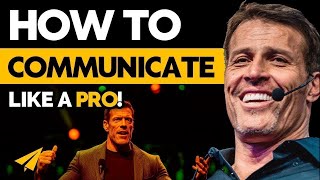
John C. Maxwell, Julian Treasure, Les Brown, Robin Sharma, Matt Abrahams, and Tony Robbins break down communication mastery. Julian Treasure's HAIL framework covers honesty, authenticity, integrity, and love. Les Brown explains how storytelling answers the three questions people ask: who are you, what do you have, and why should they care. Tony Robbins teaches matching and mirroring to build instant rapport.
Chapters
Good morning, Believe Nation. Today we're going to talk about 5 ways to improve your communication skills.
Connecting increases your influence in every situation. For the foundation of the teaching today, I want to make sure that we really have a grasp of why connecting with people is so vital. So if you'll go to the very first sentence in your notes, the number one criteria for advancement and promotion for professionals is an ability to communicate effectively. That I do believe. I think the ability to connect and communicate is the number one criteria for success with your family, with your marriage, with your children, with your friends. In the workplace, the marketplace, in the community. If you have the ability to connect with people, if you can communicate and connect, not just communicate, it takes you and literally gives you and I a decided edge over others in the advancement of what we're trying to accomplish.
I'd like to suggest that there are four really powerful cornerstones, foundations that we can stand on if we want our speech to be powerful and to make change in the world. Fortunately, these things spell a word. The word is "hail," and it has a great definition as well. I'm not talking about the stuff that falls from the sky and hits you on the head. I'm talking about this definition: to greet or acclaim enthusiastically, which is, I think, how our words will be received if we stand on these 4 things. So what do they stand for? See if you can guess. The H: honesty, of course. Being true in what you say, being straight and clear. The A is authenticity. Just being yourself. A friend of mine described it as standing in your own truth, which I think is a lovely way to put it. The I is integrity. Being your word, actually doing what you say, and being somebody people can trust. And the L: is love. I don't mean romantic love, but I do mean wishing people well, for two reasons. First of all, I think absolute honesty may not be what we want. I mean, my goodness, you look ugly this morning. Perhaps that's not necessary. Tempered with love, of course, honesty is a great thing. But also, if you're really wishing somebody well, it's very hard to judge them at the same time. I'm not even sure you can do those two things simultaneously. So, "Hail." Also, now that's what you say, and it's like the old song, "It is what you say, it's also the way that you say it." You have an amazing toolbox. This instrument is incredible, and yet this is a toolbox that very few people have ever opened. I'd like to have a little rummage in there with you now, and just pull a few tools out that you might like to take away and play with, which will increase the power of your speaking. Register, for example. Now, falsetto register may not be very useful most of the time, but there's a register in between. I'm not going to get very technical about this for any of you who are voice coaches. You can locate your voice, however. So if I talk up here in my nose, you can hear the difference if I go down here in my throat, which is where most of us speak from most of the time. But if you want weight, you need to go down here to the chest. You hear the difference? We vote for politicians with lower voices. It's true. Because we associate depth with power and with authority. That's register. And we have timbre. It's the way your voice feels. Again, the research shows that we prefer voices which are rich, smooth, warm, like hot chocolate. Well, if that's not you, that's not the end of the world, because you can train. Go get a voice coach. And there are amazing things you can do with breathing, with posture, with exercises to improve the timbre of your voice. Then prosody. I love prosody. This is the singsong, the meta-language that we use in order to impart meaning. It's route one for meaning in conversation. People who speak all on one note are really quite hard to listen to if they don't have any prosody at all. That's where the word "monotonic" comes from, or "monotonous," "monotone." Also, we have repetitive prosody now coming in, where every sentence ends as if it were a question, when it's actually not a question, it's a statement. And if you repeat that one over and over, it's actually restricting your ability to communicate through prosody, which I think is a shame. So let's try and break that habit. Pace. I can get very, very excited by saying something really, really quickly, or I can slow right down to emphasize. And at the end of that, of course, is our old friend silence. There's nothing wrong with a bit of silence in a talk, is there? We don't have to fill it with ums and ahs. It can be very powerful. Of course, pitch often goes along with pace to indicate arousal, but you can do it just with pitch. "Where did you leave my keys?" "Where did you leave my keys?" It's a slightly different meaning in those two deliveries. And finally, volume. I can get really excited by using volume— sorry about that if I startled anybody— or I can have you really pay attention by getting very quiet. Some people broadcast the whole time. Try not to do that. That's called sodcasting. Imposing your sound on people around you carelessly and inconsiderately. Not nice. Of course, where this all comes into play most of all is when you've got something really important to do. It might be standing on a stage like this and giving a talk to people. It might be proposing marriage, asking for a raise, a wedding speech, whatever it is. If it's really important, you owe it to yourself to look at this toolbox and the engine that it's going to work on. And no engine works well without being warmed up. Warm up your voice.
I can say to you, continue to do what you're doing and working on yourself and working on your mindset and your presentation power. Because once you open your mouth, as he said, the world will now know who you are. Your ability— and write this down— to tell your story is key. It's major. And how you present yourself one-on-one. Why is that important, Mr. Brown? Because when you meet someone and you want to do business with them, people are asking 3 questions, one-on-one, small groups, or large groups. They're asking, who are you? What do you have? And why should I care? That's what they're asking. Because in the business where you are, trust is important. Am I correct? Confidence is important. Am I correct? Is there a lot of skepticism around the industry because of things that have happened? A major investment that people have to make. Am I correct? So now they're looking at you. Who are you? And so your ability to tell your story— who are you? What do you have? Your ability to communicate that in a way that will connect with people, in a way that will expand their minds, in a way that will touch their heart, in a way that will cause them to say, this is the person. This is the person that I want to put my trust in. This is the person that I believe in this major decision that our family is about to make now that we should go with. How many of you know that's real? Raise your hands, please.
One of the things I observe is simply this: a lot of people are very careless with their language. And so, you know, there's a huge shift. You can either be a victim or you can be a leader, but you can't be both. And if you look at someone who is a victim, a lot of their victimhood comes down to the words they use. I mean, the words you use either lift up your energy, the words you use either make you more creative, the words you use either allow you to do world-class things, or the words you use deny your talents. The words you use could reduce your energy. The words you use could hurt your leadership. So you have a choice every day at work and at home and out on the streets with strangers. You can develop a victim vocabulary or the language of leadership. And in this Mastery Session, I want to walk you through some of my insights on those. Well, words are powerful. I mean, words have destroyed nations. I mean, think about the great dictators. Their words of hatred, their words of toxicity, their words of breakdown caused the people around them to do sometimes incredibly terrifying acts. And then you look at people like a Nelson Mandela or a Martin Luther King Jr. or a Mother Teresa. You look at the great business builders, you look at humanitarians, you look at a lot of the great artists, and they were so careful with their words. And their words lifted people up. And that's really what great leaders do. They use the language of leadership. You look at a victim and they say things like, "This is a problem. I've got a problem right here," or, "I'm really scared about this," or, "I hate that client," or, "I hate this work," or, "I'm sick of this day," or, "I'm exhausted," or, "I don't like that," or, "She never likes me." It's literally the language of toxicity. And the words you use really are like a context or a framework or a stained glass window on the way you see the world. I mean, here's a game-changing insight: you see the world not as it is, you see the world as you are. You see the world through a lens, and your language forms that lens of belief. I mean, your lens of belief and your personal filter on reality is not really a true filter on reality. It's just the filter on reality that has formed as a result of all the words you've picked up from the moment you were born. So when you were a little baby, your mom and your dad used the language that they were taught when they were kids to use. And if they use the language of victimitis, and if they use the language of victimhood, like, well, you know, You can't do this, I hate this, I'm tired of this, money doesn't grow on trees, be ordinary, if you're successful you'll be hated. All that messaging that we pick up from our parents and the media and the world around us and our peers, the little kids that we used to play with in the playground or the friends that we had as teenagers, that will either lift us up or tear us down. So I guess what I'm trying to say, and hopefully I'm making the point clearly for you, but we see the world through this personal filter, and a lot of this personal filter that drives our performance and our behavior is really constructed from the words that we've picked up and then the words we are taught to use. And so the right angle turn for you to create exponential energy, mindset, productivity, creativity, results in the world, results in your life, comes down to, in part, a really intelligent use of your words. And like I said at the beginning of this mastery session, most people are really unconscious about their words, and that's why most people are not getting rare air results. So what are some of the words I encourage you to shift from? Well, don't talk about what you hate to do, talk about what you love to do. Don't talk about problems, talk about opportunities. Don't talk about what makes you tired, talk about what makes you inspired. Don't talk about your past, talk about your future. Don't talk about what broke your heart, talk about what opened your heart. Don't talk about what dispirits you, talk about what you are fueled by. Don't talk about the things within your life that are not working, talk about the things in your life that are working. Don't talk about your pain, talk about your pleasure. And you know, if I were sitting with you right now coaching you, I mean, I am coaching you, and what I would encourage you to do as soon as I finish this Mastery Session is pull out your journal. And if you're not journaling, please start journaling, because journaling is a ritual you want to install into your days. Joan Didion said this: I don't know what I think until I write it down. Think about that. I don't know what I think until I write it down. And so in your journal, after this mastery session, pull out a fresh page and draw a line down the center of the page and write about the language of victimhood and the language of leadership, leadership, and start to write down all the words you use and the sentences you employ that really are speaking, that are really victim speak. And then in the other column, I want you to start writing down the language of leadership. The language that as of today you will be committed to using so that you start to use the language of someone who's world class. And I've given you some examples, but doing that exercise will make it really clear. And as you know, clarity breeds mastery. Bottom line, The bottom line is this: you are built to be a leader. You are not constructed to be a victim. And once you get your words right, you are going to start noticing daily shifts in your energy, your focus, your momentum, your confidence, and your output. And when you start getting those words right, you start lifting your professional life, your personal life, to a whole new level of wow. And guess what? What you are meant to do.
Many nervous speakers distance themselves physically. If you've ever seen a nervous speaker present, he or she will say something like this: Welcome, I am really excited to be here with you. They pull as far away from you as possible because you threaten us, speakers. You make us nervous, so we want to get away from you. We do the same thing linguistically. We use language that distances ourselves. It's not unusual to hear a nervous speaker say something like, one must consider the ramifications Or, "Today we're going to cover step 1, step 2, step 3." That's very distancing language. To be more conversational, use conversational language. Instead of "one must consider," say, "this is important to you," "we all need to be concerned with." Do you hear that inclusive conversational language? Has to do with the pronouns. Instead of step 1, step 2, step 3, "first what we need to do is this," "the second thing you should consider is here." Use conversational language.
Rapport is power. Earlier today we said anything you want to achieve, anything you want to learn, master, experience, there's somebody out there who has a life experience, the understanding, the network, the capital, the thing you need to be able to achieve it. But they're not going to give you what they want, or they're not going to give you what you want, rather, and need until you first give them what they want and need. And you're not even going to find out what they want and need until you first get in a relationship of rapport. If you don't do that, you're never going to learn anything. Rapport is power. What is a relationship of rapport? Rapport means total responsiveness between people. When someone is totally responding to you and you're totally responding to them, you're in rapport. There's that connection. It's that spark that happens in certain communications or relationships. Now everybody wants to create rapport. Or have it, but most people only get rapport with people who are like whom? Themselves. And they lose with everybody else, which means you got a very limited world. So we want to take it to a different level. So let's say, for example, if I said to you right now, guys, I want you to go out to a local restaurant or bar, and I want you to meet somebody, and I want you to develop rapport with them, a connection with them. How many feel like you could do that, no problem? Say aye.
Aye.
And if you're not raising your hand, you're probably Selling yourself short. Of course you could. How would you do it though? You'd walk in this restaurant or bar, you meet somebody, and you'd engage them in conversation by asking a few what? Questions. Now, is it possible to ask a few questions and have a conversation go poof and just die? Is that possible? Yes or no? So questions don't create rapport. Questions are a tool we use to dig for something. What are you digging for when you ask these questions? You're trying to find something in what? That's right. So write in your notes, rapport is created by a feeling of commonality. Rapport is created by a feeling of commonality. Rapport is created by a feeling of commonality. When we people, when we feel like we have something in common with someone, there's a spark. Now, here's the problem. If rapport is created by a feeling of commonality, Most people try to get rapport by using words. But you've already learned something. What percentage of our communication skills are words? What percentage? 7%. 7%, which means you're leaving out 93% of your skills. Which is why most people don't get rapport with a large number of people. What do you do? You walk in a restaurant or a bar and go, "Hi, what's your name? Where are you from? Why are you here?" And the person says, "My name's Habib. I'm from Iraq." I'm a terrorist. I'm here to kill people. And you go, "Amazing. Me too." No. See, words don't always work, do they? But there is something that always works to get rapport, and it's something called matching and mirroring. Matching and mirroring. Now, matching and mirroring came about 35 years ago when— we've all done matching and mirroring our whole lives. But the person who pointed it out was Milton Erickson. Dr. Erickson was a genius. What he did was, he was a medical doctor, but he also was a psychologist and a hypnotherapist, probably the best that ever lived. And people would come to see him who'd try to change everything anywhere else in their life, nothing would work. They'd see him for one session, he'd handle it. And the reason is because he understood something. He understood that you have both a conscious mind and a subconscious mind. And he knew the subconscious is more powerful. It's the part that makes your heart beat 100,000 times a day without having to think about it. So he knew if he could influence your subconscious mind, he could change anything, and that's what he did. But here's how he did it. He had polio, so he was in a wheelchair. So he spent an enormous amount of time studying people. And he began to notice something about human beings, that when human beings got together, if they got in rapport, a relationship of responsiveness, they became like each other in a variety of ways. What he called, they mirrored each other. Now I've taught this for 25 years, so I'm sure you've heard of it. I've written it in my books and it's been taught in a variety of other areas now. But it's one thing to know it intellectually or to understand it. It's another thing to know it while you're doing it. That's what I want to get you to do tonight so you have a real experience of it that you won't forget. But here's the basis of it. People like people who are like whom? Themselves. And people don't like people who are not like themselves. To be more specific, write this down. People like people who are like themselves or who are like how they would like to be. People like people who are like themselves or are how they would like to be. People like people who are like themselves or how they would like to be. So question, I'd like you to think of someone you really, really like a lot. And then if you would, raise your hand if this person is either like you or they're like how you want to be. If that's true, raise your hand, say aye. Of course, that's why you like them. Now think of someone you don't like. I'm sure you like everyone, but if you once were an unspiritual person and felt these feelings, somebody you don't like, raise your hand if they're not like you or they're not like how you want to be. If that's true, raise your hand, say aye. And that's the opposite. People don't like people who are not like them or are not like how they want to be. That's the bottom line of it. So this concept Erickson noticed, he used it in the following way. Watch me. If you came in to see Dr. Erickson, instead of talking to you intellectually and trying to get through to you, he'd go right for the jugular by getting your nervous system connected to him, getting rapport. So if you came to him and you said, "Dr. Erickson, I don't know, this is a waste of time. I've tried everything and I don't know, I think I should just go." He would do this, he'd go, "I'm sure it looks that way on the surface, but you haven't tried this, so you haven't tried everything." "and I think you should stay." And the person would go, "Huh, something about this guy I like. You know, he's not over the top, you know what I mean? He's like really real. There's just something about him that feels down home and real to me." Right? If you came to see him and said, "Dr. Erickson, I've tried everything. It's a waste of my time. I'm out of here." He'd say, "You sit down. You haven't tried everything. You've not done this before. You're staying right here." I'm right here. Guy goes, hey, I like this guy. He's got some spunk. Kick ass. Maybe he could do something. See, he became like the people he was communicating with, and what it was is whatever they put out, he sent the same message back, like biofeedback, and it entrained them to him so that when he then told their unconscious what to do, their brain just did it. That was his power.
So my personal take on this, on improving your communication skills, skills comes down to authenticity. I think there are definitely tricks and tools and ways to position yourself that can work, but at the end of the day, for me, it's about being authentic. Whether that's talking to somebody one-on-one and communicating just with them, or whether that's one-to-many like this for you guys, or in front of a group, or doing a presentation, I think the authenticity is super important. And so if you're talking to somebody, why— you know, if you're trying to show appreciation, you're trying to thank them for something, Then tell them what it actually means to you. If you're getting on stage and talking about your product or service, tell them what that actually means to you, whether it's the product itself, whether it's the opportunity to be there. Just being more you, being more human, showing more emotion, and being authentic, I think really matters. I think too many people have surface-level conversations. What's the first thing that you always tell somebody or ask somebody when you meet them? It's, well, how you doing? 'How was your weekend?' And you fall into the same pattern of talking about stuff just to fill the void and not actually get to anything deep and meaningful. Where if you can get into the practice of really being authentic, of listening to somebody or expressing concern or sharing what you're excited about with emotion and not just staying at that surface level, again, whether it's communicating one-on-one or communicating to a a group, I feel like it's really important. And I don't know that I am necessarily the best communicator in the world, but I've always had more success in getting my message across when it's coming from here. And when I can try to express that, even though I use the wrong words, even though I use the wrong gestures, even if I'm, you know, nervous or awkward, when I'm saying something that is deeply meaningful and personal to me, when I'm that authentic, then the message tends to connect that much better, and I hope it helps you too. So thank you guys so much for watching. I made this video because Shivam Aurora asked me to. So if there's a topic you'd like me to cover in the next edition of Believe Life, leave it in the comments below and I'll see what I can do. I'd also love to know what you learned today. What was the most important lesson that you took from this video? What changes are you going to make in your communication skyles— skyles— styles? Or what are you going to try out? What's something new, different that you're going to try to change after watching this video? Leave in the comments below and I will join in the discussion. Finally, I want to give a quick shout out to Tamara Campbell from TamCampPhoto.com. Go check her out. Tamara, thank you so much for buying a copy of my book. Really, really, really means a lot to me. She's got tons of energy and fire as well, so that was a fun conversation we had on email. For those of you guys who are interested in getting that potential shout out on a future video, make sure to pick up a copy of the book and email in your seats so we can keep track and send you the bonuses too. Thank you guys so much for watching. Have an amazing day. Continue to believe, or whatever your one word is, and I'll see you soon.
More from Evan


How the Biggest Mistake in History Created A Trillion-Dollar Empire | Sergey Brin



9 Machiavelli Principles That Force People To Respect You | Machiavellian Philosophy



The First 10 Words That Instantly Ruin A Sales Conversation | Vanessa Van Edwards

The Top 1% Mindset Behind The First $5 Trillion Company | Jensen Huang (Nvidia)

