How to MASTER Habit Change | Leo Babauta's Insights
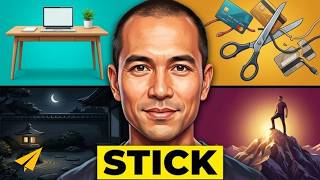
Leo Babauta, creator of Zen Habits, shares ten rules for habit change: start with curiosity, begin imperfectly, focus on one small change at a time, and use accountability groups with real consequences. He treats failure as a signal to adjust your method, not proof you're weak, and says purpose acts as a compass when motivation dips.
Maybe there's more to learn. Maybe there's a next step. If I could start from a blank slate, what would I do? I'd say start, you know, quick and dirty. To let go of commitments and say no to things. I've done one where I would get a pie in my face if I didn't stick to it. That can help us get through that dip. Even if you dive off that cliff, you're gonna be okay. Don't keep doing the same thing over and over, right? Having that trust, you can't buy that. You become addicted. That's your dopamine hit.
He's a blogger, journalist, and published author. He's the creator of a blog called Zen Habits. Time magazine named Zen Habits at the top of its list of the top 25 blogs in 2010. He's Leo Babauta, and here are his top 10 rules for success.
So actually, I had someone on Twitter— I asked people like, what's the one change that has helped you the most? And one person's— I really love this philosophy because it matches up with mine, which is that he replaced opinions with curiosity. And I love that because to me, a lot of people get to this point where they think they know something. And when you think you know something, that's when learning ends. Right, you're done. You're done. But if you just think, okay, I might know something, but let's find out more. Maybe it's wrong. Maybe there's more to learn. Maybe there's a next step. And there always is more to learn. And so that's, to me, if you just start with curiosity rather than like, I think I know it, or I don't need to know it, or there's no way I'm gonna know it. Yeah. You know, that's— That's a much better place to start and it's fun. Like learning new things and trying new things. It's really important to look at your habits as a— if you're a new entrepreneur or been doing it for a while, I think we tend to fall into these routines, right? And that routine is a lot of times if you don't do it consciously, it's a routine that just happens to build up over time. You might be busy checking Facebook and Twitter and all your stats and everything else so that you develop this routine of quickly checking through everything online. What that means is that's just through building that up over time, that routine of checking everything. What that means is that you don't have time for the creation, the part that I think, for me at least, is really important. I think it's good to sometimes just step back and take a look at what happened. The habits you've created over time and say, "What can I do more consciously? If I could start from a blank slate, what would I do?" and start to change those to build those consciously. What I found though is that a lot of times what we do is we try to implement an entire system of habits all at once, this new thing that we read about, and it collapses after a little while and we go back into our old habits. One of the problems with that is that we're actually implementing a whole series of habits at once. Again, if you start a new morning routine, you might actually be doing 5 to 10 different habits one right after the other. So you're chaining together a bunch of new habits and that's great for like a week or so and then it collapses. I've seen that so many times. I've done it myself plenty of times. What I found is that doesn't— that's not very effective. Some people can make it work but most people are not going to succeed at that. So what you really want to do is keep doing what you've been doing that's going to keep the boat afloat. But if you want to start to make changes, start making little changes one at a time. To get going, a lot of people are afraid to just get started. They want to have it perfect and perfect design and everything like that. I say start quick and dirty. Just start. Just start writing posts and the posts be as useful as possible. And then help think about what your readers' problems are and help them solve those problems. So don't let that kind of fear of getting started stop you. Just start. We all have the same amount of time in the day, but it's just we have filled the day up with all these things that we think we need to do, like commitments. We've, you know, one thing I was coaching soccer because I thought that was important for my kids. I was on the board of the PTO at my kids' school because I thought that was important. But I realized that I was spending time doing stuff with other people instead of the actual kids. So I realized if I let go of those commitments, even though I thought they were important, I'd have time then to actually spend with people who are important to me. So you learn to let go of commitments and say no to things so you can say yes to the things you really want that are really important to So I had to— I mean, sometimes it's simple as like just an email saying, "I can't do this anymore. I don't have the time." And you feel like you're going to disappoint people so you don't want to say no to them. But you know what I learned? Life goes on. They figure it out. If you have a group around this habit change, all of a sudden you now have a whole different environment that gives you a different feedback system. So if you're going to— if you say— if you tell your group, and this has to be a group of people that you actually care about their opinion. 'cause otherwise you'll just forget about it. But if you care about their opinion, and let's say it's 5 to 10 people, and you say, "I am going to write every day before I check email, or I'm gonna pay you $10,000," right? If you told people that, you would definitely do it. Or, you know, I've done one where I would get a pie in my face if I didn't stick to it. Things like that, or I'm gonna donate to the political party you don't like. Or you're going to have to eat some factory-farmed meat or something. Exactly, something you definitely do not want to do. Actually, for my book, you know I'm a vegan, I promised you and some other friends that I would eat a beef burger, not just a veggie burger, if I didn't have this book done by the end of the year. So I was motivated to get up and start writing. Anyway, so commit to this group. Create a consequence that you definitely are not going to— you don't want to have and you're definitely not going to fail. So when you do the habit, you get the positive benefit of getting to report back to them. Even as you do the habit, you're thinking, "Oh, I get to tell Corbett that I'm going to do this or that I did this." So that's positive feedback for doing it. Then if you didn't do it, you have negative feedback and have to tell your group that I didn't do it and that would be shameful and you don't want to look bad. The eyes of your peers, and you probably have to eat the burger or get the pie in the face. You wouldn't want to do that. Now you've just reversed the feedback loop with that very simple change in your environment. I think a lot of times we have a dip in motivation, and if we have a purpose, that can help us get through that dip. It also helps guide us as we— because there's tons of decisions that we have to make on a daily basis. And over the long term. And if you have some kind of purpose, that kind of gives you a little bit of a compass. And that has helped me tremendously in the last 7, 8 years since I've been doing this. Even if you're just starting out, you haven't gotten to that place where you're like all confident, you're in this place where you're like, you're in this little comfort zone, you know what you're doing, and you don't want to venture out. Or maybe you've gotten that confidence and then you hit that cliff or that door that's like really scary, and what do you do then? And what you've developed, and I think what I've developed too, is just— it's not a confidence that I know everything, but a confidence that even if you dive off that cliff, you're going to be okay. Yeah. And that's— I think that's really the crucial thing, is learning it doesn't matter if I fail, it doesn't matter if I don't know anything, it doesn't matter It doesn't matter if I stumble around in the darkness not knowing what I'm doing. I'll be okay. And there's really— I mean, that's the confidence that you need. You know my story back in 2005 when I was stuck with all these bad habits and I couldn't make any changes. I kept trying to change them all at once. I would change my entire diet, which diet is actually a series of habits. I would change my entire exercise routine. I would try and quit smoking. Try and be productive and stop procrastinating, wake up early. And I would do all of these at once and I kept failing. I couldn't understand why. And it wasn't really that it was me. A lot of times I would internalize it. Actually, all the time I would internalize it and think I have no self-control, I'm not disciplined, I'm not good enough, I'm not strong, I'm just weak. And so I feel bad about myself and develop this negative self-image and basically destroy any trust that I had in myself. Really, it wasn't a problem with me. It was a problem with the method. What I'm proposing is instead of failing over and over at creating a whole bunch of habits at once or one really big habit instead of a small one, instead of failing at that, change the method. If you failed, don't keep doing the same thing over and over. You got to make some changes. Take that failure as a lesson and adapt your habit change and be smarter. Do it in a smarter way. This image, this public image that we try and create either for ourselves or for our business, I mean, it's not real, first of all. But second of all, if you let that image crumble and have cracks and stuff and show the honest reality of things, people like that. I agree. And they start to trust you because you're honest. And what you and I know is that that trust is more valuable than anything else. It's more valuable than getting a click to subscribe or share or buy. You know, having that trust, you can't buy that. And the only thing you can do is be trustworthy and be honest and be real. And if you have this veneer of this public image that you you have. And I'm preaching to the choir here, but hoping other people will hear it, is, you know, that is fake and people can sense that. People have intuition about whether this person is just giving you a marketing pitch or if they're giving you the real deal. And if you give them the real deal, they start to trust you because they know you're sincere. You're not just trying to, you know, get their money, which most people are are trying to do online. And if you are one of the few who aren't, you set yourself apart as trustworthy, honest, sincere, and someone who is there to genuinely help them rather than You just— you become addicted. That's your dopamine hit. I'm totally addicted to helping people change their lives through habits. Through mindfulness and all these other things that I've been working on. But I don't think that I have done all my work on that yet. I think there's a lot that I have to learn about helping people. I think there's a lot of people out there who I haven't reached yet. And so that really is what gets me up in the morning.
Thank you so much for watching. I made this video because Harold Kuhn asked me to. So if there's a famous entrepreneur that you want me to profile next, leave it in the comments below and I'll see what I can do. I'd also love to know which of Leo's top 10 rules meant the most to you. Leave it in the comments and I'll join the discussion. Thank you so much for watching. Continue to believe, and I'll see you soon.
More from Evan


How the Biggest Mistake in History Created A Trillion-Dollar Empire | Sergey Brin



9 Machiavelli Principles That Force People To Respect You | Machiavellian Philosophy



The First 10 Words That Instantly Ruin A Sales Conversation | Vanessa Van Edwards

The Top 1% Mindset Behind The First $5 Trillion Company | Jensen Huang (Nvidia)

