How To Master Twitter for Your Business | 5 Winning Strategies
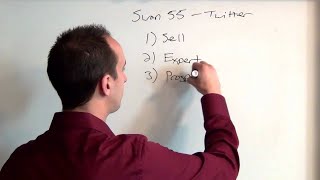
Evan Carmichael shares five Twitter strategies for business: stop pushing product links, build authority by sharing industry insights, prospect by responding to relevant tweets, connect with influencers and partners, and keep customers loyal with personal touches. Relationship-building beats hard-selling.
Chapters
Hi, I'm Evan Carmichael. Welcome to another edition of Ask Evan. In today's episode, I'm going to answer a question from one of my forum readers, Swan55, who was asking about Twitter and how to use it to market your business and your products. So, a quick story about me on Twitter. When I first saw the service, I thought it was pointless and I wouldn't use it. I saw people talking about their cats and where they're eating lunch, and I didn't really care about that. But then I did a quick search for my name and found that people were talking about me on Twitter, and they were sharing content from my articles and talking about what I was up to on Twitter, and I wasn't part of the conversation. So that's what got me to join, and at first I was just listening to see what people were saying and recognizing champions and thanking people. And then I started to get more involved and started posting and started to become an expert and thought leader. And I found a lot of value from using Twitter for my business. So I'm gonna share with you 5 ways that you can use Twitter to market your products, and hopefully you can use some of them to grow your business. So the first one is you use Twitter to sell. And I haven't had experience really with this, and I don't really believe in using this method, but I wanted to put it up there because that's what most people think at the start. And this method is basically you're pushing links out and you're just promoting your product out there, you know, however many times a day you wanna put out there. Sometimes I'm doing hundreds of posts every day with affiliate links or links to your own products. And, you know, you're hoping somebody's doing a search and you're coming up right away 'cause you posted it so recently and they go and they land on your page and sign up for your newsletter or buy your product. I don't have a lot of experience with that. I don't know how much it works. I know when I see those, I never click on the links and I don't go and buy those products. But if people are doing it, there's gotta be some money, some money in it. So that's something you can explore, but I don't recommend it. I prefer using Twitter as a way to build relationships with people, and from there you can generate some business. So the next one is become an expert. And here what you're doing is you're trying to establish yourself as a thought leader for whatever industry you're in. So for me, I talk about entrepreneurship, and I'm seen as an expert in entrepreneurship, and people follow me on Twitter to hear what I have to say about entrepreneurship and articles I'm reading and famous quotes that inspire me and new content we're coming up with, and that's a reason to follow me on Twitter. And then from there, people want to do business with me because people want to do business with the leaders and the experts in the industry. So you can use Twitter to establish yourself as an expert in whatever industry you're in. So You didn't mention what you were selling and what products you were trying to market, but whatever it is, I try to set up a schedule of tweets to go out to showcase how you're the most knowledgeable person in the world about whatever product it is that you're selling and how useful it can be for people. And then from there, people become interested, they look at your profile, they look at your website, and they want to come up and buy your products or services. So it's a little bit of a longer strategy to establish that expertise. But you're attracting higher quality clients who will likely buy more from you, stay longer, refer more friends, get you into the media, on and on and on and on. So definitely worth it in my opinion. The third way you can use it is to prospect. And what you're doing here is you basically look for keywords that people are typing in who are potential customers for you. And you can do it by location as well, so if you have a physical location You can geo-search, so you can say within, you know, 20 kilometers or 20 miles of whatever location, or just in whatever city or whatever country. And you're looking for people who are tweeting about certain keywords, and then you can respond to them. So an example, if you had a coffee shop, you could, you know, search for the word coffee and see what people are tweeting. And if somebody is, you know, within 10 miles or 10 kilometers of your location and are saying, I really need a coffee, then it's an opportunity for you to connect with them and introduce yourself. And so start building relationships with them. For a while, I was even tracking the keywords entrepreneur and help, or business and help, and people were asking questions online on Twitter, and I would just start responding to people and start building relationships with people. There wasn't necessarily a business model, it was just something that I am passionate about and really enjoy doing. And I now I haven't done it because I get so many questions coming at me that making these videos takes up a lot of time and I don't really have the time to do that anymore. But it was a great way to start making some important connections at the beginning, and if I had something to sell on my site, if I answered their question, really helped them out, they're gonna go to my Twitter bio, look at my link, click on my website, and if I had a product, some of them would buy it. So it's a great way to start introducing yourself to people who are potential customers for you. Number 4 is connect. And what you can do here is you try to introduce yourself to people who could have a meaningful impact on your business. So connectors, media, potential partners, influencers, people who could refer business to you or say good things about you that would lead to business coming into your company. And you can use Twitter as a great way to be able to connect with them. So you can introduce yourself to them, you can tweet out some of the messages that they're writing. You can comment on some of their tweets. So basically, if people are doing it on an ongoing basis, and I notice it online too, people who often respond to my tweets or retweeting what I'm writing, I notice them. And if it happens enough, then I'll usually click on their site and I become curious in what they're doing. So if you do it enough times, if you've kind of identified the people who you want to go after and introduce yourself to, that could be a great way to get on their radar screen and prompt some kind of dialogue and introduction to be able to then hopefully do some business together longer term. I also use Twitter when I'm first connecting with people who I'm meeting locally. So if somebody is in Toronto and I've scheduled a meeting with them, I'll quickly see if they have a Twitter account or not to then be able to connect with them and learn a little bit about them before I end up going and meeting with them. So a quick example is meeting with a potential client down town here in Toronto, and I researched the person's Twitter account and found out that she really liked a certain bakery that was close to her office. So on my way down, I stopped off at the bakery, picked up some treats, and brought them to the meeting. And so it's her favorite bakery, you know, lots of treats, so the meeting started off on a great foot and went well from there on as well. So it's a great way to kind of learn a little bit about the people, the research into them before you meet them, and allows you to kind of gear your conversation towards things that maybe you have in common that you can kind of get in there faster and make that connection a little bit more easy. So that's number 4. And then the last one that I would use it to do is update your customers. So here people will post news updates or different updates about what's going on with the business, and it's a great way for customers to kind of keep track of what you're up to what you're doing. Now this only works if you have customers who actually care about your business, right? If you're doing the first one and all you're doing is selling, you're not gonna have people who are actually following you and care about your updates. So you have to make sure that you have a loyal fan base, and from there you can use the updates to kinda keep in touch with them. One thing that we'll do with— on the update side at least— is we'll post information about what's going on on our website, but then we'll also try to follow some of our customers and look for ways to recognize them. So what we try to do is send a brownie every week to somebody on our list, and we look for ways on Twitter to be able to do that. So an example, one of our authors or customers was on Twitter and posted that she couldn't go to work and she had to work from Starbucks because the air conditioning on a very hot summer day was broken at her office. She was working from Starbucks. So we saw that, we, you know, responded by Twitter, and then we sent her a brownie in the mail to say, you know, "Hope the air conditioning gets fixed soon, and here's some sweet treats to keep you going while you're working at a Starbucks." And she was really grateful, and the fact that people were connecting on Twitter and that we saw that post and cared about her enough to respond, that helps us stand out, and it's easier to win these customers over for life, and doesn't take a lot of work, and it's also fun to do. So those are some of the ways that we've used it, and hopefully through those stories is something you can do for your business as well. If you guys like the video, I'd love to hear your comments if you want to leave one under the video, and I always love seeing those thumbs ups if you can leave one under the video. It helps me know that you guys like these and I'll keep making more for you. So thank you, look forward to hearing from you, and we'll see you in the next episode.
More from Evan


How the Biggest Mistake in History Created A Trillion-Dollar Empire | Sergey Brin



9 Machiavelli Principles That Force People To Respect You | Machiavellian Philosophy



The First 10 Words That Instantly Ruin A Sales Conversation | Vanessa Van Edwards

The Top 1% Mindset Behind The First $5 Trillion Company | Jensen Huang (Nvidia)

