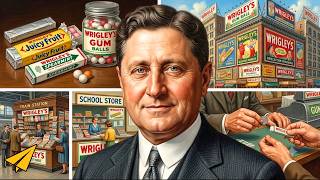
William Wrigley Jr. turned $32 into a chewing-gum empire by giving away free premiums to build loyalty, then doubled down on advertising during a recession. He mailed gum to phone-book owners and placed cards on public transport, eventually selling over 10 billion sticks a year.
Chapters
Hi, I'm Evan Carmichael, and welcome to another edition of Modeling the Masters. I believe that the fastest and most effective way to grow your business is to model the strategies of people who've already done what you're trying to do. So today we're going to look at how a young man cashed out his life savings of $32 moved to a new city, opened up a new business, changed businesses 2 times, eventually found his winning ticket, and built a multi-billion-dollar company. This is the story of William Wrigley Jr. and the top 3 lessons that you can learn from his success. William Wrigley Jr. was a US chewing gum entrepreneur and founder of the William Wrigley Jr. Company in 1891. He was 29 years old when he used his life savings of $32 to move to Chicago and start up his own soap manufacturing business. He started manufacturing and selling soap, but with poor sales, Wrigley began offering a can of baking powder for free with each soap purchase. Soon Wrigley realized that his baking powder was more popular than his soap, so he switched to manufacturing baking powder full-time and instead offered free chewing gum as a bonus. And in an all-too-familiar pattern, Wrigley quickly saw his chewing gum bonus become more popular than the baking powder, so he switched businesses again. Wrigley passed away in 1932 at the age of 70. The company he founded went on to become the number one maker of chewing gum products in the world, with over 16,000 employees and revenues in excess of $5 billion in 2007. In 2008, Wrigley was acquired by Mars Incorporated for $23 billion. By experimenting with different businesses and by listening to his customers, William Wrigley Jr. was able to turn a $32 investment into a multi-billion-dollar company. To help you supercharge your growth, here are 3 action items you can learn from William Wrigley Jr. Action item number 1: Give something extra. People love free stuff. It can either be used as an incentive to get them to buy more or as a surprise to reward their loyalty with you. If you're able to give something little away for free that your competitors don't, it can be a great way to build a relationship and win the ongoing business your customers. It also doesn't have to cost too much, or even anything at all. Focus on the high perceived value items instead of actual cost. William Wrigley didn't have much money to start his business, but he had what most successful entrepreneurs have: enthusiasm, energy, and creativity. He used his talents to differentiate himself from all the other soap manufacturers. He asked himself what he could do to make people want to buy more from him instead of going to his competition By listening to his customers, he came up with the idea of giving away free premiums whenever someone bought from him. It not only increased his sales, he also used the strategy to end up in a completely new and vastly more profitable business. According to Wrigley, "Everybody likes something extra for nothing." Action Item #2: Don't focus on immediate profits. As entrepreneurs, we're often strapped for cash. And looking for ways to make our businesses pay off right away. The trouble is, usually the quick cash grabs are detrimental to the long-term success of our business. Whether it's discounting your price to drive short-term sales, taking on business that doesn't align with your goals but pays well, or working with unprofitable clients because you get money right away, usually the short-term influxes of revenue don't help us build our businesses into sustainable companies. William Wrigley always took a long-term approach with his business. By giving away free extras, many thought Wrigley had lost his mind and would soon be out of business. Instead, Wrigley realized that he had to plant the seeds for his company's long-term success, even if it meant sacrificing his profitability in the short term. According to Wrigley, I've sometimes been asked what the single policy has been most profitable in our business. I've always unhesitatedly answered, "Restraint in regard to immediate profits." That has been not only our most profitable policy, it's been pretty nearly our only profitable one. Action Item #3: Believe in yourself. You won't get very far in business if you don't believe in what you're doing. You have to know that the product or service you're selling is really going to help people and it's your job to help them realize that. If you can't get excited about what you're selling, then it's going to be really hard to get other people excited about it. William Wrigley believed in his ideas and wasn't afraid to take bold steps that hadn't been tried before. In 1907, the American economy was in a recession, and Wrigley decided he would launch a new flavor of gum: spearmint. His competitors had already tried and failed to make spearmint successful, but Wrigley believed he could do it. His strategy was to almost triple his advertising budget despite the tough economic times, and he bought up over $1.5 million in advertising for $284,000 because advertising prices had fallen in the recession. The result? His revenues soared and Spearmint soon became the best-selling gum in America. According to Wrigley, "A man's doubts and fears fears are his worst enemies. He can go ahead and do anything as long as he believes in himself. So remember, give something extra, don't focus on immediate profits, and believe in yourself. To finish up this video, I wanted to share one of my favorite true stories about William Wrigley Jr. and some of his best quotes. Always thinking about how to promote his products, in the 1920s, William Wrigley placed cards promoting his gum in every bus, subway, and train car in the entire country. On top of that, he twice sent 4 sticks of gum to every person in the phone book across the US, reasoning that if someone had a telephone, they could afford to buy his 5-cent gum. He was right. By 1922, the company was selling over 10 billion sticks of gum each year. Thank you for joining me for another edition of Molly the Masters. If you liked the video and want to see more, please give it a thumbs up below. I'd also love to hear your thoughts if you want to leave a comment below the video, and stay tuned for the next episode.