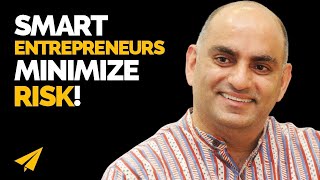
Monish Pabrai argues successful entrepreneurs build low-risk, high-return ventures, not high-risk bets. Microsoft started with under $50,000 in external capital. Start part-time while keeping your job, invest your time instead of savings, and go full-time only when the side business covers your living expenses.
Chapters
Synchronized. Did you just wink at me?
Yeah. Why? Why is that bad?
I don't know, it's kind of weird.
Ah, Jesus Christ, this is what I work with.
Good morning, Believe Nation!
Today's message is minimize risk. Over to you, Monish Pabrai.
People think that entrepreneurs take risk and they get rewarded because they take risk. In reality, entrepreneurs do everything they can to minimize risk. They are not interested in taking risk. They want free lunches and they go after free lunches. And so if you study any number of entrepreneurs from Ray Kroc to, you know, Herb Schultz at Starbucks and to even Buffett and Munger and so on, what you'll find is that they've repeatedly made bets which are low-risk bets which have high-return possibilities. So they're not going high-risk, high-return. They're going low-risk, high-return. And even with Bill Gates, for example, the total amount of capital that ever went into Microsoft was less than $50,000 between the time it started and today. That's the total amount of capital that went into the company. So Microsoft, you cannot say was a high-risk venture because there was no capital deployed. But it had high uncertainty. Bill Gates could have gone bankrupt or Bill Gates could have ended up the wealthiest person on the Forbes 400. And he ended up at the extreme end of the bell curve and that's fine. But he did not take risk to get there. He was comfortable with uncertainty. So entrepreneurs are great at dealing with uncertainty and also very good at minimizing risk. That's the classic great entrepreneur.
So what do you think?
I think that it's interesting the way he defines minimize risk. He defines it as they— it was a low risk, high return kind of thing. I think the way that I see risk personally is any kind of uncertainty, especially when all the people around you think it's not a good idea. So I think that as an entrepreneur, as someone who wants to go out there, open a restaurant, start a clothing line, even if you have all the investment, the risk is you're taking a chance. You can be, you know, usually you're going out of your comfort zone. Sometimes you're going out of your profession, leaving your full-time job to risk something, even if you have the capital that financially you will be secure for the next little while. The risk is that out of the comfort zone and trying something new.
For me, I preach this a lot on the channel. I don't believe you should invest your money into stuff. I don't want to see you invest your hustle, your energy. You know, I hate, I hate so much seeing entrepreneurs mortgage their house, cash in their retirement savings to go all in on this business idea that they have because I'm going to sell alligator t-shirts and they're going to be amazing, right? And then, and then it doesn't work, right? That sucks, right? And so I would say that to minimize your risk, you're not putting your dollars in, but you're investing your time, your energy, your hustle to try to make something work, right? Like, you— it may take you a little bit longer to get to where you go, but your chances of success go up dramatically because you only get one shot if you're going to cash in your life savings, and you can never be sure that this is going to be the one to go to. The other way that I talk about it too is I don't think you should quit your job and go full-time on your business. I'm a big believer in starting a business part-time, sort of on the side. Ideally, you have a job where you're learning and getting paid to make mistakes. You're getting mentored. Go work for a company where you feel like you're going to learn, not just for a paycheck, but you're developing and growing yourself. And then start your business on the side. And when your side business is making enough money for you to survive, not like go buy Lamborghinis, but survive, like I can pay the internet and I can pay my food bills, right? And I can, you know, I'll buy his protein shakes and, right, survive. Then you can quit your job and go all in on your business. Because too many people quit their job too soon, and then 3 months later they realize, I'm out of money, I gotta go back and get a job. And so I think for me, what I take from it is the financial risk. Like, I will invest insane amounts of love and energy and be up till 4 in the morning working on something, trying to get off the ground, and it may never ever get there, but I'm not investing my dollars into anything until I've shown that I can earn. So like, prove to yourself that you can make money before you start spending it. So the question of the day today is, how do you define risk? Interesting. Leave it in the comments below, we'll join in the discussion. Thank you so much for watching, have an amazing day, continue to believe, and we'll see you again tomorrow morning for another shot of espresso.
I wake up every morning, with espresso, keep me going.