How to Overcome Your Fears in 31 Minutes | George Carlin’s Revolutionary Approach
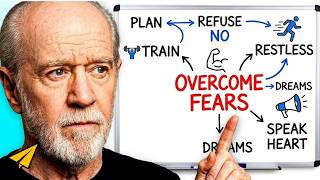
George Carlin on building a comedy career by ignoring what others thought, writing down every idea, and refusing to play by the rules. He got expelled from school, the Air Force, and the Boy Scouts, then turned that rebelliousness into a career that let him question everything from private property to golf courses.
Chapters
And I quit school at 9th grade. I had great marks, I was a smart kid, but I didn't care. They weren't teaching what I want.
I didn't give a shit.
It's important in life if you don't give a shit.
It can help you a lot.
I'm an entertainer first and foremost, but there's art involved here, and an artist has an obligation to be en route, to be going somewhere. There's a journey involved.
The verge of failure that we're on is because two wonderful qualities that made us a successful species, cooperation and competition, are way out of balance.
We decided to quit radio because we'll go to Hollywood and become stars.
He was an American comedian, actor, social critic, and author. He's widely regarded as one of the most important and influential stand-up comedians of all time. He was known for his black comedy and his thoughts on psychology, politics, religion, and various taboo subjects. He's George Carlin, and here's my take on his top 10 rules for success. Rule number 1 is my personal favorite, and I'm curious to figure out which one you guys like the best. Also, as George is talking, if he says something really meaningful to really moving or inspiring, try to copy and paste it into the comments below and put quotes around it so other people can be inspired as well.
I was a victim of my own success, and I did some Ed Sullivans I hate. On those Ed Sullivan shows, I began to realize— not just there, everywhere, all these shows—
I didn't fit.
And here's what I was missing. I was missing who I was. I began with a dream of being Danny Kaye, which is a very mainstream dream. It's very middle America. It's a people pleaser job. And I dreamed a path that was traditional. Comedian, uh, disc jockey, comedian, actor, big success. A mainstream dream. Meanwhile, what I really was, was an outlaw and a rebel because I had lived that kind of life. I got kicked out of 3 different schools. I got kicked out of the Air Force. I got kicked out of the choir. I got kicked out of the altar boys. I got kicked out of summer camp. I got kicked out of the Boy Scouts. And I quit school at 9th grade. I had great marks. I was a smart kid, but I didn't care. They weren't teaching what I want.
I didn't give a shit.
It's important in life if you don't give a shit.
It can help you a lot.
So I didn't give a shit. And I was this kind of, I was a pot smoker when I was 13. We broke the law, we broke into cars, we broke into offices, we broke into Columbia University, we broke into stores. We did all sorts of unlawful things. And I was that kind of person. I was one who swam against the tide of what is expected and what the establishment wants from us. But I didn't know that about myself, 'cause this dream blinded me. This dream was about America, about the path that we all follow, the middle of the road, middle class America, mainstream, we'll dream. And meanwhile, I'm sitting there like this, you know, fuck those people, fuck that shit. Look at this stupid shit.
No, I don't wanna be in the bunny number.
Can I get outta the bunny number, please?
I don't wanna put on that fucking uniform, you know?
And I didn't know this This dissonance was inside me, and in the period this is happening, all through the '60s, the counterculture was forming. The free speech movement started in Berkeley. The hippies were growing into a force, and peace, love, power, flower power, pot smoking, anti-authority. See, bing, bing, bing, bing, anti-authority. Throw over the establishment. Burn down the math building?
Wow! Ding, ding, ding, ding, ding, ding, ding.
So I gravitated toward that because I was that person really. And the people I hung around with were that way.
The musicians I knew in the late '50s had gone through that transition.
Suddenly they looked different and their music changed. And I'm listening to people like the Buffalo Springfield, I'm listening to Bob Dylan, I'm listening to these people and I realize these artists are using their talent to project their feelings and ideas, not just please people. And I suddenly was able to see my place and to realize I was in the wrong place. You see, in 1967, the Summer of Love, the peak of the hippie movement, I was 30. I was entertaining people in nightclubs who were 40, and they were at war with their kids who were 20. There was a generation war.
I was in the middle of it.
I was 30, 20, 40. And I'm going, I said, "What the fuck am I doing over here? These are the people that will at least understand me and give me a chance." So it took 2 years. I didn't go to the mountain and come back different. I didn't do a Bobby Darin. I didn't do a whatever, those people who just go away and they're back new suddenly. I took 2 years to change and it happened on television. So it was, I had denied that part of myself and finally it came into full flower. And I never became a really big success. Until that. I probably had 200 television appearances by that time, and I still wasn't realized as a writer-comedian, as a comedian. By that I mean I hadn't let myself grow into that, and I found out later I was more than just a comedian.
This was a turning point in my life, and it's one that people should know about. When I was a young boy, I was a mimic, and I could imitate people in the neighborhood, authority figures, teachers, shop owners, other parents, cops on the beat, and people on television. Yeah, I could do little imitations. They were largely imitations of other people doing imitation. That's how you learn to do Jimmy Cagney. You see another guy do it on stage and you say, "Oh, okay," and you copy him. It's easier 'cause they point out the highlights of speech, but neighborhood stuff. I was kind of the class clown in school, and then after school I was kind of like the neighborhood wise guy, one of the neighborhood wise guys, on the street corner, and I would gather a little audience because I would put together little routines. I had little parodies that I did. I lifted things, everyone steals from comedians when they're starting, so I would steal imitations in Humphrey Bogart and Jimmy Cagney and Peter Lorre, and I would do fake commercials that I had heard or read in Mad. Well, Mad Comics came along a little bit later. There was another magazine called Thousand Jokes, And I put together little routines and they would say, "Georgie, hey Georgie, do that thing about such." And I would stand up and do it and it would come out differently each time. And I developed this ability to stand up in front of a group of people and get their attention and get their approval. That was important to me apparently. When I was a little kid, I'd go to my mother's office and she'd say, "Imitate Mae West, do the imitations, do the imitations." And I would do the imitations for the ladies in her office and they would laugh. Noticed, I don't remember noticing this per se, but I must have noticed that this got me the attention of adults. Because don't forget, I was alone in that house most of the day. When I wasn't in school, I came home and I was alone. I got the attention of these adults and I got their approval through their laughter. They were more or less saying, "Good boy, George. Good going.
Way to go.
Yes, he's good. He's cute. Ain't I cute? Ain't I clever?" That's what this job is. So as a youngster, I wanted to be a comedian. I was probably only 8 or 9 or 10 years old when I began to form an idea that I wanted to be in the movies like Danny Kaye and like Red Skelton. And I called that being an actor, but it was actually being a comedian. And pretty soon I found out the word comedian and I wanted to be a comedian. And when I graduated from 8th grade, the last thing I graduated from, by the way, my mother asked me what I wanted and one of the brothers at school, Brother Conrad, had told us that he can get a clergyman's discount on cameras. So I asked him if he could get a clergyman's discount on tape recorders. Now this was 5 years after the Second World War, tape recorders had come out as consumer items, but they were as big as a small Buick. They were large, they were like this big, and you had to buy them in a showroom up above the street, they weren't on sale in stores. I bought this big Webcor, long story, and I'm keeping it long, that I used it to do voices and do little sketches and skits and fake radio shows and fake newscasts commercials. And I, I used it to more or less train myself for the thing I wanted to do. My mother was very progressive to have bought me that as a graduation present. I mean, it was— she was a, she was a far thinker to see that in me and, and go ahead and foster that and reward that, even though she wanted me— she didn't want me to follow it, but she knew it was a healthy thing for me to be doing.
Why do you still care enough to keep— you're at a point in your life where you could go back, you could do your month in Vegas, and Florence Henderson could open up, and you could go and, and hit a couple of balls and then pinball. Why do you still care so much?
Well, I'm not comparing myself to any of these people, believe me. But you wouldn't say to Picasso, when are you gonna put those brushes down? Get rid of the canvas, you've done it. I'm an entertainer first and foremost, but there's art involved here, and an artist has an obligation to be en route, to be going somewhere. There's a journey involved here, and you don't know where it is, and that's the fun. So you're always gonna be seeking and looking and going and trying to challenge yourself. So without sitting around thinking of that a lot, It drives you and it keeps you trying to be fresh, trying to be new, trying to call on yourself, calling yourself a little more, you know.
Write everything down.
You have to write. You have to write, write, write, write, write.
Write all your ideas down and classify them. My first boss when I was 18 told me that. He said, find a folder, put your ideas on paper. Any idea you don't think you can use it now, if it seems useful, put it down on paper and then classify it. 'Cause good ideas don't mean anything unless you can find them again. Yeah, you can't go through a pile of papers 10 years old of notes.
You have to—
now you can use a computer.
I had—
before that, I had index cards and things. You have to be able to find race, religion, business, government, politics, men and women, sex, you know, all the di— and then those categories, you break them down into categories. So organize yourself.
I think being on this planet, one of the first things people would say, if we were all dumped down here, let us say there were only 10 of us.
Right.
Dropped into this planet already formed, one of the first things we would say after a moment or two would be, "Is everybody okay? Let's get something to eat." And that should be the first thing any society says.
"Is everybody okay?
Let's get something to eat." And we don't because we have this private property thing.
Property.
Property rights over people's rights. And I just think that competition got the upper hand over cooperation.
This species was successful—
As part of the American experience?
No, as part of the human species. The human species. The verge of failure that we're on is because two wonderful qualities that made us a successful species, cooperation and competition, are way out of balance now. Competition is everything. Cooperation happens after a flood. Happens for a few days.
Everybody goes back to work. Yeah, it did.
It did happen after Hurricane Katrina. That's right.
And we need to get that balance back. If we can get that balance back, there's hope.
You've always been a planner. Yeah.
You had this optimistic— Georgie Plans, they called it.
This optimistic attitude that if you planned it well enough and you meant well, it's going to happen. You believe that.
Well, I would only plan things I felt, you know, that obviously, that I wanted and thought I was qualified for. But this is the good example of this career planning when I was a kid. I said, well, first I'll be, first I'll be, see, I wanted to be an actor. I called it actor because I saw them in the movies and I knew they were movie actors. So Danny Kaye and these guys, I thought actor. Okay, so first I'll be a stand-up comedian. And don't forget, when I was a kid, the only place stand-up comedians worked was nightclubs. Those kind of really more or less sophisticated places places, uh, where, um, where you saw in the movies, you know, and people danced and there was a singer and it was a comic. And, um, and I never got into those places. I was too young and it wasn't in my world. So I knew about comedians from radio and from television later, but movies when I was a youngster. So I aimed at that and I thought, well, the way to get there would be to first become I can first get into radio. That would be my first move because then I could practice using my voice and I could learn to speak and do a lot of these things without an audience directly in front of me, which is the usual thing in radio. They're not sitting in the studio. And therefore I wouldn't be as nervous or afraid and I could kind of build up my confidence and then I could become a stand-up comedian because by then there were further venues for comedians, I thought. Then I can be a stand-up comedian and then I can go, then if I'm really good, be good at that, then they have to let me in the movies. And that was the way I looked at it. They had to let me in the movies. And that was the plan. And it became more sophisticated as I went through 13, 14, 15 years and, and started to actually think of ways to go about it.
Don't take no for an answer. If it's—
if you're not working—
if it's not working well that night, it's not you, it's the audience. Blame it on the audience. Because if it worked on Friday night, It ought to work on Saturday, and if it doesn't, it's their fault. It's oversimple, but you know what? It works as a formula. Just go on and do the Sunday night show and forget Saturday night.
Keep kicking them in the nuts.
Gotta have luck in this world. Part of it's your genetic makeup.
That's luck.
And then what you do with it is also partly genetic, because hard work is genetic. The desire to do hard work, the willingness to work hard, and be determined and not be turned aside, that's all genetic too. It can be altered a little and reinforced, but some of the people who had so much edgy promise, they died young. I mean, Lenny Bruce, Sam Kinison, Andy Kaufman in his way, Freddie Prinze, John Belushi, Bill Hicks, and it's just, I don't know, of course Bill had a natural disorder of his own, I think so did Andy, but it's not always behavior, but sometimes it's just genetic. But it's just that I think there's a degree of luck and intellect involved in giving up things that hurt you. The drug and alcohol thing, it seems to me, comes down to this. Drugs and these things are wonderful. They're wonderful when you try them first. They're not around for all these millennia for no reason. First time, mostly pleasure, very little pain. Pain, maybe a hangover. And as you increase and keep using whatever it is, the pleasure part decreases and the pain part, the price you pay, increases until the balance is completely the other way and it's almost all pain and there's hardly any pleasure. At that point, you would hope, then the intellect says, "Oh, oh, this doesn't work anymore. I'm going to die and I'll do something." But you need people around you who can help you And you need something to live for. You have to have something to look forward to to bring you out of it. You know, there's a lot of people don't have a lot to live for and they're sort of stuck in some—
I was out of a job for a while and then I got called down to Fort Worth where another guy from radio in Shreveport had moved on, a sales director, and he wanted me for their station in Fort Worth. So he brought me down there. So number one station, I got the homework shift, 7 to midnight.
Took all—
I answered my own phones, took all my own requests and dedications, and suddenly one day Jack Burns showed up from Boston. He says, he says, "I'm going out to give Hollywood one last chance at me." That was his attitude, which is the way to look at things. And his tires were bald, so he— luckily a news job had opened that day, and he got that job, and he was my nighttime newsman. And you know the rest. We went down to an after-hours comedy joint, which was really a coffee house, called The Cellar in Fort Worth, and we did impromptu sketches every night, impromptu skits and two-man stuff, and it was so successful, we left radio. We said, screw this. You know, we had great jobs. We were making like $300, $400 a week. It's 1960, and we're in Fort Worth, a good market, and we could have gone on from there, but we decided to quit radio because we'll go to Hollywood and become stars. Because we have this filthy act that we did.
Filthy!
It was just— and in those days, filthy comedy was not— didn't have a market for it at all. And there we were, how naive but how wonderful when you're in that age period, to just get in my newly bought Dodge Dart Pioneer with the tinted windows and the AM/FM radio and drive to Los Angeles on spec. You know, on speculation. We had about $300, and we got lucky out there. We got lucky. I got lucky every time I turned around.
Well, when you went out there, you got a job at a club.
Yeah, we— well, no, what happened was this. First, we went out there and we were looking to see how we could get into show business. We knew we had this act we had written, and in the daytime we'd write stuff and learn it. It was terrible. So, um, we would go to places and look at other people, and we would hang around Dino's on the Strip and figure Frank Sinatra might come in. We hung around the Brown Derby one night, and Rock Hudson came floating through. And, you know, we just— we were just using up our money. And one day we went back to the apartment, and the rest of our money had been stolen out of the sock drawer. Good hiding place, George. And we had no money. So we thought, well gee, we hadn't counted on that. And we had vowed not to work, just to go straight into show business. We didn't want jobs, none of that bellhop stuff, none of that carhop, none of that stuff. We won't go into radio out there. But what happened was the only thing we knew was radio, and the only thing we really felt we deserved was radio. The biggest, the second biggest market in the country, I mean, it was sheer lunacy to expect to just get into that market. But we went around, we went around, we went first to KFWB, WKB, number 1 in the market, top 40 station. And they, we didn't have tapes or anything, they didn't want us, you know. So we're walking along, we see this radio station, KDAY, right near Hollywood and Vine. It's actually Selma and Vine, between Sunset and Vine and Hollywood and Vine. We walked in there, and that's where my star on the Walk is now out in Hollywood. I had them put it out in front of that radio station, it's kind of nice. We went in there and they were looking for a morning comedy team. I mean, it's just all luck, you know? You just get lucky and you're on a roll. They were looking for guys like us. We did a tape for them, they loved us. They called us the Wright Brothers instead of our real names. They called us the Wright Brothers. Did a big publicity campaign, ads in Variety, full-color ads and everything, and put us on the air. And here we are on the air about, let's see, it would only have been about 2 months after we got there. And it was just sheer madness, you know, there we were.
That wasn't good enough for you?
No, no. What we did was still work on the act. We're gonna work on the act, 'cause this is only a stepping stone, you know. And now we're making about $500 a week each, you know, and that's good and we're great, but we're practicing this act after hours. This was also a daytime station, by the way. Even though it was a 50,000-watt and it had a big signal out on the West Coast, it was a daytimer. And we went off the air at sundown and in the studio, we would work on these routines. We were getting serious now. And nearby, about 2 blocks away, was a coffee house. That was the way for us to get in. They were now coffee houses. It was the era of the beatniks. And coffee houses liked offbeat entertainment. And we knew we could get in there and do our stuff for the owner maybe and get a shot. Just get a hootenanny shot. Get a single shot, you know. And we went over there. He liked us and he hired us. For 2 weeks, and we're still rehearsing our act, and a guy came walking through the studio, 'cause it was an office building, and you could see the studios on your left, and there were little offices here. He was a song plugger. He was a guy who used to do PR for songwriters and stuff, and record labels, and he saw us, and he used to be the road manager for Rowan and Martin, and he says, "I think you guys could make it, you know?" So we gave him our, we became, he became our manager. We went in this little coffee house. They held us over for 6 weeks, Lenny Bruce came in and saw us. Mort Sahl came in and saw us. And based on that, Lenny Bruce, we got a contract with GAC, one of the biggest agencies in the country. They had New York offices, Chicago, and Beverly Hills offices. And we got into nightclubs where we quit radio again.
We quit, we said, "No, sorry about that, we've got something to do." And we went on and began a career that worked out very well.
2 years together, we were on The Tonight Show with Jack Parr That October, we drove out of Shreveport in March. We drove out of Shreveport in March, and that October we were on NBC television at night on the biggest show for a comedian. It's just stupid, you know. But man, it can happen.
It can happen.
By the way, speaking of American values, are we about due to start bombing some small country that only has a marginally effective air force? Seems to me like we're a couple of weeks overdue to drop high-explosive explosives on helpless civilians, people who have no argument with us whatsoever. I think we ought to be out there doing what we do best, gang— making big holes in other people's countries. I hate to be repetitious, but God, we are a warlike lot, you know. We can't stand not to be fucking with somebody. We couldn't wait for that Cold War to be over, could we? Just couldn't wait for that Cold War to be over so we could go and play with our toys in the sand. Go play with our toys in the sand. And while we're not invading some sovereign nation, or setting it on fire from the air, which is more fun, then we're usually declaring war on something here at home. Did you ever notice that? We love to do that, don't we? We love to declare war on things here in America. Anything we don't like about ourselves, we have to declare war on it. Don't do anything about it, we just declare war on it. We got a war— it's the only metaphor we have in our public discourse for solving a problem. It's called declaring war. We got a war on poverty, the war on crime, war on litter, the war on cancer, the war on drugs. But you ever notice there's no war on homelessness, is there? Nah, no war on homelessness. You know why? There's no money in that problem. There's no money in that problem. Nobody stands— it's true— nobody stands to get rich off of that problem. You could find a solution to homelessness where the corporate swine and the politicians could steal a couple million dollars each, you'd see the streets of America begin to clear up pretty goddamn quick. I'll guarantee you that. I will guarantee you that. Now, so, I got an idea for homeless. You know what they ought to do? You know what they ought to do? Give the homeless their own magazine. Give them their own magazine. It would make them feel better for one thing. That's a sure sign of making it in this country. Every group in group in this country that makes it and arrives at a certain level has its own magazine. You have Working Mother magazine, Black Entrepreneur magazine, Hispanic Business magazine. In fact, any activity, any activity engaged in by more than 4 people in this country has got a fucking magazine devoted to it. Skydiving, mountain climbing, snowmobiling, backpacking, bungee jumping, duck hunting. Shooting someone in the asshole with a dart gun, jacking off, they probably have a magazine for that. I'm sure they have. I know they have a magazine. Walking. Walking! There's actually a fucking magazine called Walking. Look, Dan, the new Walking is out. Here's a good article: Putting One Foot in Front of the Other. Give them their own magazine. Give them. 'Give the homeless their own magazine.' You know what you call it? Better Crates and Cartons. Then when they get finished reading it, they can use it to line their clothing. That's a good sound business solution. That's the kind of answer you get from a conservative American businessman. He says, 'Yeah, let them read it. When they get finished reading, they can use it to plug up the holes in them piano crates they all seem to like to live in.' A good sound practical conservative American business solution.
Business solution.
I'll tell you what they ought to do about homelessness. First thing, change the name of it. Change the name of the condition. It's not homelessness, it's houselessness. It's houses these people need. A home is an abstract idea. A home is a setting. It's a state of mind. These people need houses— physical, tangible structures. But where are you going to put them? Where are you going to build them? Nobody wants you to build low-cost housing near their People don't want it near them. We got something in this country, you've heard of it, it's called NIMBY. N-I-M-B-Y. Not in my backyard. People don't want any kind of social help located anywhere near them. You try to open up a halfway house, try to open up a rehab center for drugs or alcohol, try to build a little home for some retarded people who want to work their way into the community, people say, "Not in my backyard." People don't want anything near them. Especially if it might help somebody else. Part of the great American spirit of generosity we're always told about.
Pfft.
Big generous American nation. Ask an Indian about that. Ask an Indian how generous this country is, if you can find one. You gotta locate the Indian first. We've made them just a little difficult to find. Or if you need current data, select a black family at random and ask them how generous this country has been. People don't want anything near them, even if it's something they believe in, something they think society needs, like prisons. Everybody wants that, right? Everybody wants more prisons. That's the new answer to all of our problems. Lock a lot of motherfuckers up. Everybody wants more prisons. They say, "Build more prisons!" But not here. But why not? What's wrong? What's the problem? What's wrong with having a prison in your neighborhood? Well, it seems to me like it would make it a pretty crime-free area, don't you think? You think a lot of crackheads and You think the murderers and pimps and hookers are gonna be hanging around in front of a fucking prison?
Bullshit!
They ain't coming anywhere near it! What's wrong with these people? All the criminals are locked up behind the walls, and if a couple of them do break out, what do you think they're gonna do? Hang around? Check real estate trends? Bullshit! They're fucking gone! That's the whole idea of breaking out of prison, is to get the fuck as far away as you possibly can. Not in my backyard. People don't want anything new. Them, except military bases. They don't mind that, do they? No, they like that. Give them an army base, makes them happy. Why?
Jobs.
Jobs. Self-interest. Even if the base is loaded with nuclear weapons, they don't give a fuck. They say, well, I'll take a little radiation if I can get a job. Working people have been fucked over so long in this country, those are the kind of decisions they're left to make. I got just the place for low-cost housing. I have solved this problem. I know where we can build housing for the homeless. Golf courses. Perfect. Golf courses. Just what we need. Plenty of good land in nice neighborhoods. Land that is currently being wasted on a meaningless, mindless activity engaged in primarily by white, well-to-do male businessmen who use the game to get together to make deals to carve this country up a little finer among themselves. I am getting tired, really tired. I am getting tired of these golfing cocksuckers in their green pants and their yellow pants and their orange pants and their precious little hats and their cute little golf carts. It is time to reclaim the golf courses from the wealthy and turn them over to the homeless. Golf is an arrogant, elitist game and it takes up entirely too much fucking room in this country. Too much fucking room in this country. It is— it is an arrogant game on its very design alone. Just the design of the game speaks of arrogance. Think of how big a golf course is. Golf course is. The ball is that fucking big! What do these pinheaded pricks need with all that land? There are over 17,000 golf courses in America. They average over 150 acres apiece. That's over 3 million acres. That's 4,820 square miles. You could build 2 Rhode Islands and a Delaware for the homeless on the land currently devoted to this meaningless, mindless, arrogant, elitist, racist— racist! There's another thing. The only blacks you'll find in country clubs are carrying trays. And a boring game for boring people. Did you ever watch golf on television? It's like watching flies fuck. And a mindless game. Mindless. Think of the intellect. Think of the intellect it must take to draw pleasure from this activity. Hitting a ball with a crooked stick and then walking after it. And then Hitting it again. I say, pick it up, asshole. You're lucky you found the fucking thing. Put it in your pocket and go the fuck home. Go the fuck home. You're a winner. No. No chance of that happening. Dorko in the plaid knickers is gonna hit it again and walk some more. Let these rich cocksuckers play miniature golf. Let them fuck with a windmill for an hour and a half or so. See if there's any real skill among them. Now I know there are some people who play golf who don't consider themselves rich. Fuck 'em! And shame on them for engaging in an arrogant elitist pastime. Hey, here's another place we could put some low-cost housing: cemeteries! There's another idea whose time has passed. Saving all the dead people in one part of town? What the hell kind of a superstitious religious medieval bullshit idea is that? Plow these them up, plow them into the streams and rivers of America. We need that phosphorus for farming. If we're going to recycle, let's get serious.
Thank you guys so much for watching. I made this video because HH Goodfella asked me to. So if there's a famous entrepreneur that you want me to profile next, leave it down in the comments below and I'll see what I can do. I'd also love to know what of George Carlin said had the biggest impact on you and why. Which rule resonated the most with you, leave it in the comments and I will join in the discussion. Finally, I want to give a quick shout out to Yusuf Naderi. Thank you so much for picking up a copy of my book. It really, really, really means a lot to me. For those of you watching, if you want a chance at a shout out in a future video, make sure to pick up a copy of the book and email in your receipt so we can keep track. Thank you guys so much for watching. Continue to believe, or whatever your one word is, and I'll see you soon.
More from Evan


How the Biggest Mistake in History Created A Trillion-Dollar Empire | Sergey Brin



9 Machiavelli Principles That Force People To Respect You | Machiavellian Philosophy



The First 10 Words That Instantly Ruin A Sales Conversation | Vanessa Van Edwards

The Top 1% Mindset Behind The First $5 Trillion Company | Jensen Huang (Nvidia)

