How to Take Bold Risks | Unlocking Opportunities in 13 Minutes
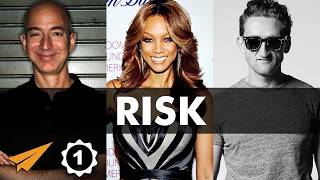
Tyra Banks, Sam Walton, and others explain why bold risk-taking drives progress. Tyra left modeling to launch a TV career. Sam Walton opened a store in a new shopping center. NASA jumped from sub-orbital flight to the Moon. The speakers argue smart risks, taken early before obligations pile up, lead to growth even when they fail.
Chapters
Risks.
Risky.
Risk.
Risks.
Risks.
Risks.
Risks.
Risk.
Whatever it is that you want to do, there's going to be risk in your life, and risk is a necessary component of progress. I don't know how you can make any pioneering movements in the world of any kind, whether they be the geographical physical exploration that I've just been talking about, whether it be, you know, a more cerebral exploration of a scientific field, or I bet you could ask that question of every speaker here, and I bet that every speaker here has taken substantial risks, whether it be intellectual or otherwise, to achieve what they're, you know, what they've done.
The smartest business decision I ever made was retiring from modeling and doing it in a big way. So I was a Victoria's Secret Angel one of the first angels, and I retired really big. Tyra's last walk, doo, doo, doo, doo. You know, tomorrow night, doo, doo, doo, doo, 8:00 PM, doo, doo, doo. And I walked away in a really big way, and I did that so that I wouldn't be tempted to go back. But I realized, yeah, I'm not sure if that was the smartest thing to do because I had a new talk show back in the day, Tyra Show. It had not been renewed yet. America's Next Top Model was brand new, had not been renewed yet. So here I am putting all of my eggs into this basket, not knowing if I had, you know, a true future with this new television production and producing and hosting. So good decision, but I look back, I'm like, hmm, very risky.
Very risky, but sometimes those are the decisions that pay off the most, right?
Yes, high risk, high reward. Yeah.
When I look back at my career, I see all these tangents, and the tangents that have always yielded success were the ones where there was no established path, no defined route for me to take, but I went down it anyways. And through that kind of exploration, I always discovered something new. And those, those new things, those new entities, whether they be movies or ideas or things in my personal life, have always proven to be the most rewarding for me. Life shrinks and expands in direct proportion to one's willingness to take on risk. And I think when it comes to exploring, the act of exploration is the act of assuming risk. The greater risk-taker is the greater explorer.
As a business grows, the natural tendency would be to take fewer risks and to be cautious and to have contingency plans. But in a business that's changing very quickly or one that you want to grow, you actually need to be explicit about accepting risk. One of the people who work with me kind of described it this way. I was sort of encouraging this person, hey, let's try this, why don't we do this, how about this? At some point he kind of came back and said, "So what you're telling me is you want me to try to do 10 things, and if I only get 8 of them, you'll be OK with that, if I don't get all 10, versus having 5 things and doing all 5 perfectly." That's exactly right. We want to accept some experiments.
I think risk is important for every company. I think it is the essence of entrepreneurship, whether you're the smallest company in the world or like Google, the second largest company in the world, to We take smart risks all the time. I run this experiment frequently with groups where I give them two choices, Choice A and Choice B. So Choice A is you get to deliver $1 million of bottom line value to your company this year, guaranteed. Choice B, you get to deliver $1 billion of bottom line value to your company this year, but only with one chance in 100. So everyone does the mental math. I say, who wants Choice A? Nobody raises their hand. Who wants Choice B? Everybody raises their hand. It's got an expected utility that's 10 times higher than Choice A. And then I say, "Who here believes that your boss wants you to choose Choice B?" And not a single person in the room raises their hand. I mean, these typically are large multinationals who want to be innovative. And then I say, "You don't need a lecture on innovation. You need a new boss. You need a new context." I really think that it's the context that matters. We all inherently understand that taking Smart risks is the right thing to do. Now, what counts as smart and what counts as a risk is different in different parts of a company or companies of different sizes. You know, you can tolerate a PR fiasco much easier if you're a tiny company because no one's watching you than if you're a large company, for example. So the calculus is different, but the principle is still the same. The only way to stay sharp, to stay growing, to stay relevant is to take smart risks all the time.
Our first astronaut, Alan Shepard, who flew a suborbital flight, followed Gagarin by only 3 weeks. After Shepard's flight, it took only 7.5 years for us to launch Apollo 8 to go out and orbit the Moon. Um, they went to the Moon on the very first manned flight of the big Saturn V. Now, can you imagine today NASA developing a brand new, huge, big advance rocket, and the first time people fly on it, blub blub blub, they go to the moon, or they go somewhere we've never been before? That puts in perspective the kind of risks that we were taking, and those who put themselves in a position to take enormous risks are those that have breakthroughs. And those that have research results.
Now is the time to take risk. You don't have kids, your obligations— well, sorry, you probably don't have kids. But as you get older, your obligations increase. And once you have a family, you start taking risks not just for yourself but for your family as well. It gets much harder to do things that might not work out. So now is the time to do that before you have those obligations. So I would encourage you to take risks now. Do something bold. You won't regret it.
The chain store bug had already bitten me. Alright. It wasn't long, as soon as I could afford it all, I started casting around for another location. And where was that? Fayetteville on the square? It was that little 18-foot store. The Shotgun, 1952. 1952. We got the store in Fayetteville started, didn't we? Right. And it became very successful. So then one day I got a call from Ben Franklin and they said, hey, we got a store in Kansas City. And, uh, You remember the story? I certainly do. And I thought, well, if I've got to go to Kansas City, I got to get me an airplane. And I had never flown. Probably first looked at it in '53, I'd say. And this was our first venture in a shopping center. Yeah, and there were practically no shopping centers in 1953.
That's true.
That's exactly right. And this was something entirely new and different, and everybody was skittish of it. No one else wanted the franchise. That's right. Another one of those situations. And Bud said, "Well, I'll take half of it. I think I can put enough money together to get half of it." I said, "Well, if you can, I'll try to do my part, and we'll go up there and we'll just take another gamble." Sure right, and it was a gamble. It was out 20 miles from the Kansas City city limits. Time we got the store open, why, it was a winner from the day we opened. I mean, it was the best profit store. I know one year it made $30,000, which to us was more money than we'd ever heard or ever dreamed about being able to make out of one story.
He moved to the inside line going towards the first corner. I just chased him then, and he opened the gap. And knowing me like he does know, he must realize that if there was a gap, I was going to try to overtake him. And, and, and under those circumstances, he should never have opened a gap in the first corner and then come back again. Because by doing so, he opened the gap, gave the gap, and then closed it. And in that circumstance, there was no way to avoid an incident, right?
But that only happened, Ethan, because you saw the gap, and I accept that, you're a racer. But a mature racer has to also think, if he closes the door again, we are going to have an accident. And in fact, that was a high-speed entry, so it could have been a very serious accident.
Absolutely.
So wouldn't it not have been would have been more prudent under those circumstances to have at least seen that the gap was potentially going to close?
Not at all. He was in a position where he could never, under no circumstance, put his car anywhere near mine in a difficult position. Because if we happen just to touch, just to touch, and have a wing damage or a wheel flat tire, he had everything to lose. So, and under those circumstances, my understanding was that he would never move against me in the first corner. And I was very surprised when I found myself with him moving the car over mine.
So in that case, you were calculating that he would give way, that he would let you through?
Of course, he would not close the way he did. From the moment he made the initial room he would not come back and close the door again.
A calculated risk.
Of course.
Risk. There is no chance to evolve and progress without taking risk. I feel like it's the necessary element to self-development, you know, like it's the key to living life to the fullest. Risk, according to Webster, is the chance of injury, damage, loss, the failure of your expectations. But I realize that it's also the opportunity to learn and gain the fulfillment of your desires and dreams. When I think of risk, or just what risk means, I feel like I might think of being afraid, or— when really, risk is a way to overcome what you fear. You can be afraid to risk something or everything because you don't want to lose what you have, because you're afraid you may fail or think you can't handle it, or whatever the case. You'll spend so much energy and time trying to keep what you have instead of progressing into something new. Everything changes. Nothing stays the same forever. Nothing. From business to personal, everything in between. I realize that you can't be afraid. A lot of us aren't all the way satisfied but are scared to lose security in what we do have. Like I might not be able to get a better job or a better partner, etc. Or even as bad as prison is, you know, there are people who don't want to leave because they're afraid of what's on the outside or being able to succeed. The number one thing I gotta remind myself sometimes and remember is that Life is here not to survive but to live it up, you know, to expand, to grow. When you settle for what's familiar or safe, it's because we forget that God is our security. God is creating all this, and that's the only security, you know. You could try and find security in people, in jobs, or anything man-made, but there's no point because everything is designed to change, including you. We want songs like Memories, Desire, One of These. You can keep Guap. Most people who have successfully taken risks and succeeded have failed too, but the point is you learn from every lesson, you learn from every risk. Change is always exciting. It's always exciting when you know God is involved. The world is designed for change. Don't ever be afraid to take risks.
So thank you so much for watching.
Okay guys, we would like to know which clips you like the most. Leave your comments at the bottom.
We're gonna join in the discussion.
Thank you so much.
Continue to believe, and we'll see you soon.
More from Evan


How the Biggest Mistake in History Created A Trillion-Dollar Empire | Sergey Brin



9 Machiavelli Principles That Force People To Respect You | Machiavellian Philosophy



The First 10 Words That Instantly Ruin A Sales Conversation | Vanessa Van Edwards

The Top 1% Mindset Behind The First $5 Trillion Company | Jensen Huang (Nvidia)

