How to Take CRITICISM & Improve Like Virat Kohli | 11 Minutes
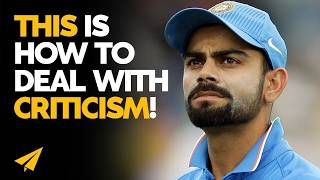
Virat Kohli used early criticism to improve and reclaim his place on India's cricket team. Evan Carmichael explains how to treat criticism as a counselor, not a jailer: stay open to feedback but filter it through your own judgment, test ideas, then act without overthinking.
Chapters
Good morning, Believe Nation! Today's message is: Take criticism. Over to you, Virat Kohli.
When I was criticized first, first time I played for India, I was criticized for not being disciplined and not being that focused. As I had to be. So I ignored that in the first part because I thought, okay, I'm gonna perform, so all these things don't have to bother me. But yeah, I mean, if someone criticizes you, it's better to actually, you know, take the criticism and look into it. If something's wrong, you try to correct it rather than just being blunt and just ignoring the world. And yeah, I looked upon it because I was out of the team after that for a while. And I sat and I analyzed what I did wrong and improved on a lot of things. And it was good that I decided to take that criticism and actually change the stuff I needed to.
I think criticism is a double-edged sword. I think on the one hand, if all you do is listen to other people, then you're never going to be really who you are, right? You're just going to be living to other people's expectations. You're going to be doing things because other people tell you that that's what you're supposed to do. And that is never gonna be the path for you to really be amazing at something. But on the other hand, you don't have all the answers either, right? You have a path that you're going down and you need help to figure it out. And you're gonna make mistakes. Not everything you do is gonna be perfect and amazing. And so it's being able to understand the difference, being able to understand what the feedback is that's gonna help you get to the path that you want and ignore the rest. I think it's really important that you use criticism as a counselor, but not a jailer. A lot of times people use criticism as a jailer, where they're afraid to do something because somebody else doesn't agree with them. Because somebody thinks that your video is bad, now you're not gonna post it. Now you're never gonna post another video again because of one person's opinion. And I've had people tell me that some of my videos are bad. My famous story about how the little man was created industry executive said that the video was too long and should be cut down, and here it is over a million views later, coming up on 2 million views. You know, I didn't listen to him. He's the expert, but I didn't listen to him because it felt like I needed to go and do this, even just to prove to myself, even just to try it. But there's been other times when industry experts have given me advice on how to be a better speaker, how to be a better YouTuber, how to come up with better points, how to be a more effective on stage. And so being able to understand the difference between the feedback that will help you grow and the feedback that won't, I think is important. And that comes from experience. And it comes from being able to listen to your gut, right? Trust in your heart. Almost all of the feedback that I've gotten from people that have made me better was almost never exactly what I needed to hear. I had to take their advice, try it, If you're unsure, if you think maybe it's just your ego getting in the way, then try it and see how it works. And I always had to make a tweak to it. I remember I had a media coach for 2 years helping me with my videos, helping me get better, helping me improve on camera. And all of her advice was so amazing, but always seen through her own lens. And I always had to take that advice and adjust it. I would try what she asked me to do, and I never succeeded at doing it. It felt uncomfortable, it felt awkward, it felt like it wasn't me, but I appreciate the push. And from that push, I hit a wall, and then I swerved and made my way through. I grew, and I had to figure out on my own how to make what she was giving me, that advice, and make it better, make it more me, 'cause she can't be me to make me better. Just like when you model success. If you look up to Steve Jobs or Oprah Winfrey or Bill Gates or Martha Stewart or any of these entrepreneurs that we profile on this channel, You can't do exactly what they did because you are not them. You need to take what they did, apply the lessons, and tweak it to make it your own. And then you're gonna have that success. And so I think a lot of entrepreneurs are really stubborn. I think that's a, a really good trait a lot of times. But I think that stubbornness can also hold us back from hearing feedback that can help us become better. I like to say that I'm open until I'm not. At the start of any project, I'm really open to feedback. If I don't know what I'm doing, I have a goal, I want to accomplish this goal and I don't know how to do it, I'm very open to feedback. You have an idea to help me get better? Amazing, let's hear it. You're an industry expert? Awesome. You, you've never seen this before, but you still have an opinion? I want to hear it. I'm collecting as much information as possible until I make a decision, until I'm certain, until I know that this is the path I want to take, and then I'm not open. Then I'm closed, then I'm— this is what we're doing, at least for now, right? Like, I need to test it out like this. This is the plan. Let's stick to it. If it doesn't work, we'll adjust. But for now, I'm done with the feedback. Let's take some action. And I think too many entrepreneurs just hold themselves back, either from their stubbornness to not take in the feedback, or all they do is take in the feedback and that holds them back from actually taking any action. Because they're afraid of being judged so harshly the next time. Use feedback as a counselor and not a jailer. So my question of the day today is, what was the single best piece of feedback you've ever received for your business? Leave it in the comments below. I'm going to join in the discussion. I'm super curious to see what you guys have to say. I also want to give a quick shout out to Peter Borsner. Peter, thank you so much for picking up a copy of my book, Your One Word. It really, really, really means a lot to me. Thank you guys so much for watching. I believe in you. I hope you continue to believe in yourself and whatever your one word is. Much love, and I'll see you again tomorrow morning for another shot of espresso.
I wake up every morning, espresso keep me going.
Hey, Believe Nation, for those of you who want a little bit more about taking criticism, here's a few bonus clips that I wanted to share with you. I hope you enjoy.
I am one who always welcomes criticism. And I encourage people, you should welcome criticism and be bold enough to give criticism. If the criticism is coming out of benevolence, that I want that someone is criticizing me so that I can become better, then it is always welcome. But if someone is criticizing just out of jealousy or trying to pull someone down, then that is not good. Then that is coming from a malefic mindset. So constructive criticism, I feel everyone should welcome. Criticism with compassion, criticism with love is the most adorable thing, and it should always be welcomed.
You need to get in a community where you can get feedback. You need either a coach who can give you some direct one-to-one feedback or community of friends who you just go out with. Maybe you go to lunch with them once a month, you share everything you're doing, they give you some feedback. Or you shoot a video, you send that video out to everybody, get some feedback on it. You create a PowerPoint, practice it with 5 people before the big meeting. Like, get back in the game where you have a community of people who are giving you advanced feedback before you release it. Feedback before you do it so that you get smarter at all of this because you know what, nothing makes a dream come more into life than when you start getting feedback from other people about your movement toward the dreams. You know, before I shoot a big sales video for one of my online courses, I'll send it out to 15, 20 people and get feedback and then I'll often go reshoot it again, you know, or I'll put it out into my community and I'll see the clicks, the conversions and say, it's not, let's do it again. And it's that willingness to get feedback that will keep keep your dream alive. Because look, if it's just in your mind and you're just doing it by yourself, but you never actually get a positive community giving you constructive feedback towards it, it will never be that— that it will never be in the social realm. And when it is in the social realm, it feels more real, you know, when people actually comment. I mean, it's one thing to be an artist and in your studio painting for yourself all day. That's great. But once you get some feedback on it and constructive feedback, you become— you get that self-awareness and that social awareness to contribute and create at another level.
Experience in your business is important, but experience is a bias, and much of the biases people have from being— understanding a business is not useful. And I was going back to what's useful advice to giving notes. So I always say, have some people on your team who understand the industry you're entering or attacking, but be driven by original thinking. And what's more important than experience is the rate of learning, right? Some entrepreneurs I find respond negatively to critique. I think entrepreneurs should look for critique, and people who agree with you are not being useful to you.
Well, you know, I have to say, you know, all that criticism that came out, it ended up being kind of a good thing, because one of the things that I wanted to do is I wanted to actually start a conversation about slavery, about America's role in it, and to actually take an audience member from the 21st century and stick them in the antebellum South and see what it would— and have a sense of what America was like back then. And so even the people that have been— have criticized the movie, and a lot of people don't like it, and I can understand that. A lot of people do like it. And they've been kind of going back and forth. And that back and forth is really what I really wanted for the end of the day of this movie. And I hope that actually even continues for the next few years.
If you have ever dealt with self-criticism in writing, and if so, how have you done it? Like, how have you dealt with it?
Well, I deal with it every day. You want it to be the best that it can be, and so my assumption is always that what I've written first needs to be improved, and sometimes when it's really bad, it has to be scrapped. I'm not sure that's what you mean. The process that I go through with a book is, First draft, second draft, polish, and I can polish every day's work so that I can produce a clean manuscript at the end of X number of months, or in the case of a book like 11/22/63, a little bit longer, but you know, that was like a historical novel, and that was a lot like work. Work. And I still got this huge stack of books about the '60s and Kennedy and Oswald in the corner, and I don't even try to look at it. It gives me the horrors. But you have to be careful, and you have to be willing to take outside criticism too, from editors, and the more successful you are, The more you need to try to do the right thing. That's all I can say.
Thank you.
More from Evan


How the Biggest Mistake in History Created A Trillion-Dollar Empire | Sergey Brin



9 Machiavelli Principles That Force People To Respect You | Machiavellian Philosophy



The First 10 Words That Instantly Ruin A Sales Conversation | Vanessa Van Edwards

The Top 1% Mindset Behind The First $5 Trillion Company | Jensen Huang (Nvidia)

