How To Think Bigger | Lessons from Robert Rodriguez in 16 Minutes
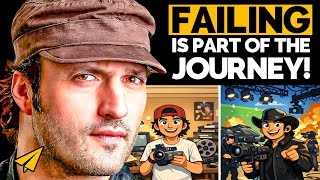
Filmmaker Robert Rodriguez shares principles from his unconventional career: think bigger than the mainstream, act before waiting for inspiration, and learn from failure. He made his breakout film El Mariachi as a one-man crew on a shoestring budget, then built his own media empire with the El Rey network.
Chapters
Everyone is doing the same thing. Everyone's competing in the same realm. You have to think much bigger. There's a lot less competition up there. There's nobody up there, actually. Don't wait to be inspired to do the action. You have to do the action first, and then you'll be inspired. And I say, in the ashes of all your failures, if you look close enough, you'll find keys to success.
He's an American filmmaker, screenwriter, and musician. He directed the action film El Mariachi, which grossed $2 million against a budget of $7 million. $77,000. He's a friend and frequent collaborator with Quentin Tarantino. He's Robert Rodriguez, and here's my take on his top 10 rules of success. Rule number 10 is my personal favorite, and I'm curious to figure out which one you guys like the best. And as always, guys, as you're watching the videos, if you hear something that really resonates with you, please leave it down in the comments below and put quotes around it so other people can be inspired as well. Also, as you are writing something down, it's much more likely to stick stick in your head too. Enjoy.
There's this book called The One Thing. Have you seen that? It says you should just do one thing. And I go, well, I shouldn't even bother reading that. That doesn't apply to me. But then I thought about it. It's like, well, I do one thing. I live a creative life. Everything you do, you apply creativity to it, whether it's the way you meet with a friend and make them dinner, or you do stuff with your kids, and then when you go and you're working on an idea and you're doing music at the same time while you're on the set, and you're never in a block because you're always actually in a flow. If you don't live your life creatively and then you set aside some time at night to go write your novel, you're gonna get a block because you're not in the flow. But if you apply creativity to everything in your life, everything is available to you to where you suddenly can paint. Like, you'll see paintings I did with the actors. Actors, even though they're very creative in the acting world, they didn't think they could paint. So I made them paint, and then they saw that they were able to, because when you're in a creative flow, you can do just about anything. So it's all about living a creative life to where you can't possibly ever get blocked because you're always— okay, well, I'm not— I have an idea for writing, so I'm gonna go cook something, which is art you can eat, you know, and you're serving it and you're eating and consuming it and you're creating, and you go back and you do that. Does that make sense? Yeah, there's no— there's no structured boxes around it. There's no— it's like a lifestyle. Alienation between work and play. It's all play. But thinking completely different is the key. If everyone is competing on one level, you got to think at another. Like, for instance, like, I'd always wanted to get in television, but TV is so— it was always so crowded. Everyone's trying to get in on Friday night on NBC. So what do you do when everyone— I've always heard this advice, and it made sense only recently— when everyone is doing the same thing and everyone's competing in the same realm, you have to think much bigger. There's a lot less competition up there. There's nobody up there, actually. So— Find the hole to fill it instead of trying to go into other people's territory. Yeah, so like, "I can't get my show on TV." I know. I'll own a network. Then I can put on any show that I want. And how many other people are going up for a network? You know how many other people applied for that network? How many? It was a lot, and then it wasn't a lot. 100 people in the whole country. In the whole country, 100 people threw in an idea for a network and showed a presentation. It's not a lot of people. That isn't a lot of people for how many people are here. It's a lot less people than in this room. So, when you think about that, think about how can I show somebody, how can I get someone's attention? Everyone else is at the festival. Don't go to the festival. Go some— think of something bigger. I mean, go to the festival, but think also something else beyond that. Don't rely on the festival because then you're just crossing your fingers. You gotta hit it from other ways. And that promotes much bigger thinking. I always say aim high. 'Cause if you aim just at the festival, you might hit it and you might just hit lower. But if you aim really high, you might still just hit the festival, but at least now you got a chance that you'll hit there, there, or like straight up. So try to think as big as you can. You can't just wait for inspiration to act. That's the biggest mistake people make. Don't wait to be inspired to do the action. You have to do the action first and then you'll be inspired. So what I would do is I would sit there and draw out the comic and I would come up with it. But some days I'd come home from school, sit down and go, "I'm just going to wait for the inspiration to hit me. I'm going to wait for the idea to come fully formed. And when I got a joke, then I'll go draw it." And I would sit there for maybe 3 or 4 hours and then go, "Alright, screw it. I got to get up and do this. I got to do the process. I got to sit there and just start drawing. I don't even know why or how I'm going to get there." And then two things would come together and it would be, "Oh, there's an idea. Oh, there's the first panel. There's the second panel." And then it would come together. Always. It would not take very long. I would fight that process so much because what was I doing? I was waiting for inspiration before I acted. It's always the other way around. Act first, then the inspiration will come. Draw first, then the inspiration will come. Just start shooting, then the inspiration will come. Just start moving, then the inspiration will come. Don't wait. So many people wait or tell you they're going to write this novel or they're going to do this or they're going to make this film. They never do it. Because they're waiting for all this stuff to come to them. It comes through doing it. Somebody was telling me, it was actually an actor, was about to do a short film and he'd been sending me the script saying, "I'm still working on it." It was a really great idea. It's kind of, you know, a big little production for him to do, big little. And then just recently I said, "Are you doing it?" He goes, "Yeah, I still think it might be too ambitious. I think I'm gonna do maybe something easier." I go, "No, do the more ambitious one. You're gonna hate yourself if you go do the easier one and you're dicking around with that. You're gonna be wishing you had done the more ambitious one. Do the more ambitious thing always first." And you should always have some self-doubt Otherwise, it's a walk in the park, ain't worth doing. If it's that easy that you're not gonna be questioning yourself constantly, am I doing the right thing? Is this too big a task for me to handle? Am I not strong enough? Then you know you're in the right direction. If you say, I'm a fraud, they'll figure me out, I'll never be able to do it again, that's an artist's thought processes. You're an artist. If you're thinking like that, you're on the right track, 'cause they all feel that. So there's always some success that can come out even out of your failures. In fact, probably your biggest successes will come directly from your failures. You should almost take that— Winston Churchill's quote is my favorite: "Success is moving from one failure to the next with great enthusiasm." You should be very enthusiastic about your failures because you're going to learn something. You're going to go that way when everyone else is going that way, and you're going to stumble, but you're also going to stumble upon something that no one ever thought of. So, you know, you just keep going and keep going, and you're going to fail and then rise up and fail again, and that's the journey. Up and down, man. I looked at it afterwards and I thought, "Okay, anthology films never work." But I love the short film format. That's what I grew up on, that's what Bedhead was, that's what I've done all through college. I believe in that format. I think the way they're doing anthologies isn't correct. 4 different directors, that's— no thematic, um, real tie to it. 4 stories, it's too many. The 3-act structure, classical 3-act structure, Three. A group of three. Rule of threes in comedy. It always comes in three. I bet if I did an anthology with three stories and a wraparound with the same director, not multiple directors, it could work. That was Sin City. I tried it again on Sin City. Second key from that movie. So looking back now, it's easy for me to look and go, okay, but back then I was lost in the woods. I thought I had made a wrong choice. I thought I had followed my voice, and I go, I am I need to question my voice. Don't question your inner voice. That's the part that's wiser than you. That's the part that you are not going to be able to consciously ever figure out until you look back on it like a history book and read the map. So you have to trust your inner voice and cultivate that down to the point where you can be playing cards and going, I know that I'm the queen because my inner voice told me to. You've got to, you know, really fine-tune that gift. It's within all of you. So you make this little film with some money that you got from selling your ass in the medical community. At what point does— you put together a VHS cut, if I remember correctly, right? Yeah, I cut it at the public access station on 3/4-inch, and then I made VHSes. And your idea was like, I'm gonna sell this in the— I was going straight to Spanish video market. That's the main thing I'd tell people. My goal was to just go double my money. I didn't know it was gonna overperform. And these cats were like, "We can turn this into a real feature." Well, what they wanted to do was we were gonna remake it as Desperado. And they said, "Well, before we remake it, let's test the movie that you made already on $7,000. Let's test it to an audience and see, 'cause it might be a downer ending." They tested it, and it tested great as it was. And they said, "Let's take this to festivals." And I was like, "No, I made it for $7,000. I didn't mean for anybody to watch this. Give me $2,000. I'll reshoot half of it." I didn't want them to show that one, 'cause that was just one I was just I was trying to get it out, and I learned a big lesson from that because I was only making it as a throwaway film. It came out better than the films I did on purpose. No. So if you throw things away like that and don't make it precious, you'll come up with stuff that you probably wouldn't have thought of if you were on, you know, you're on. El Mariachi, was that shot on 16? 16mm. So it's like now it's like the camera that you carry around in your pocket is a better camera than you were probably scrapping to get back in those days. Yeah, I mean, I tell people if I shot the same movie today, it would probably be like a $700 movie, not a $7,000. Most of that budget went to— majority of the budget to film, buying the film, processing it, transferring it to video. So, yeah, you could shoot the same movie for nothing today. How many crew were on that? I was the whole crew. Oh yeah, I was literally the sound guy, I was the camera guy, I was the lighting guy. Directing. 'Cause I didn't know if I could sell it, so I didn't want to spend more. It was already a lot costing years to do it, and I knew kind of what I could do just by myself. So is it hard going from one-man crew to then giving all those responsibilities to other people, or is it just a load off your mind? Well, that's why I still do a lot of jobs myself. I actually ended up enjoying those, so I still I write, produce, direct, edit, operate the camera, I do the sound mix, I do the score. I mean, I still do a lot of those jobs, 'cause I discovered that on the first one, that it was just so fun. And now I think a lot more, it's a lot more relatable to people today. I was on that new age where I was coming in, I learned on video, learned on digital, then I shot film, and I applied what I learned on digital to film, which was just do it yourself. You know, so many people today now shoot that way, 'cause they shoot digital. But that was unheard of in the film world to do it that way. You always needed like 200 people. When you wake up every morning, you need to know why. Start with why. What are you right now? You're students? That's what you do. How do you do that? You go to school. Is anybody taking online courses, or is it all classes like this? Classes like this. That's how you do it. So many people start from what they do to how they do it. Very few people think about why. You got to start with why. So let me explain why that's important. Because when you know why you're doing something, you can attain things much better and much clearer. Your decision-making becomes much more important, much more— much easier too. Apple, for instance, does it like perfectly. When you have a computer company that just makes computers and they say, what do you do? I make computers. How do you do it? I use the highest grade of technology, the coolest coolest gadgets that'll speak to you. That's how we do it. Do you want to buy a computer from me? No. Apple starts the other way. They start with why they're doing it. We think different. We think you think differently too. We think you're an individual. When you see one of our ads, there's not 10 people enjoying our computer, there's one. We want to make product that speaks to your individuality. How are you going to do that? Well, already you believe that. Like, yeah, I'm an individual. I think differently than other people. I want something that speaks to me. Customized to me. How are you going to do that? We use the best technology. We make the sexiest equipment that you're going to want. What do you do? I sell computers or I sell phones. Do you want one? Yes. Talk about why. Why are you doing it? So when people wanted to compete with me with the network and they didn't get the network and they say, why did we not get the network? I said, well, why did you want to do a network? It comes down to always like a business reason. Well, I made a bunch of movies and we don't have a TV deal. And if I had a network, then I could sell my own movies to myself and make money that way. Well, then it's not good enough. You know, you don't deserve to be there. You got to have a good reason why you're doing it. So if you clarify why you're doing anything, you'll find the rest of the success comes much easier. I remember I gave this talk to a group of entrepreneurs, and this one woman raised her hand. She goes, well, you're real positive, but what do you do? What do you tell yourself when you just wasted a year and a half of your life doing something and it didn't work out? And I told her, "That's a real negative way of looking at it." I did that already, right? Why didn't you— why— can you rephrase the question and then ask me again? 'Cause it's just you're looking at it really negatively, first of all, so I didn't even wanna answer it that way. So, you asked her— So, she thought about it and she said, "Well, I learned an important lesson the hard way." And I said, "That still sucks. No wonder you don't wanna move forward, 'cause you feel like you've done something wrong, 'cause it didn't work out the way you you had predetermined you wanted it to work out. You have to look at it a different way. If you feel like you want to do something, you should just step forward. It may not work, but you're gonna hit a step in your career and in your development that you could not have taken had you not gone that way before you can get over there. And I say, in the ashes of all your failures, if you look close enough, you'll find keys to success. If you're a very negative person, all you would focus on is, "Wow, I have a really bad movie on my resume that I wish I had never done." But if you're a positive person, you will go, I'm so glad I took that step that most people would not have taken because that got me to a place that no one else could follow.
Thank you guys so much for watching. I made this video because Higher Images Official asked me to. So if there's a famous entrepreneur that you want me to profile next, leave it down in the comments below and I'll see what I can do. I'd also love to know what did Robert say that had the biggest impact on you? What are you going to take from this video? And immediately apply it somehow to your life or to your business, leave it down in the comments. I'm gonna join in the discussion. Finally, I want to give a quick shout out to Daniel and Alex. Thank you guys so much for picking up a copy of my book, Your One Word, and making that awesome tribute website for it as well.
I really, really, really appreciate it.
So thank you guys again for watching. I believe in you. I hope you continue to believe in yourself and whatever your one word is. Much love. I'll see you soon.
Usually you're always hurting for money and a budget to put any ideas together. So if you make this cool sketch, you're like, okay, well, we'll never afford to be able to make this. Well, it's the opposite with this. We'll have like a whole team ready to make that vision come to life. And the whole idea is that it's your vision, because I've done my part and now I'm waiting for those missing pieces because I love collaborating with people because you're always wondering what part they're going to bring, whether it's an actor or someone you interact with. They bring a piece of magic that you couldn't have generated yourself, and you take it and you run with it, and you're so excited, you know, to incorporate their ideas. Yeah. Now, now, you had a plan though. The remarkable thing to me was at 22, 23 years old, that your plan was completely laid out. I mean, as a— in reading your book, you know, you knew I was going to take this amount of money. Your plan was to make 3 El Mariachi movies. Yeah, well, the thing is You wanna get somewhere, you really gotta set some goals for yourself. They won't ever happen the way you plan, but at least you'll set forward on a positive, you know, in a positive direction that may take you someplace better by accident. You're working on things now that are, I mean, huge. Like you're running an entire network. You're running the El Rey network now. Yeah, but it's a matter of scale, not technique. It's the same technique, but you're just doing it, you know, you're only really just scaling up. You really, like you have Rooster Teeth. It's like you create a beast And then you gotta feed the beast or the beast consumes you. And by creating for that beast, you actually come up with things that you never would have done otherwise. And you're really proud of, like our network, we have to, we had to fill it. I got a network, I own a network, but it's empty until you fill it. So we had to fill it with From Dusk Till Dawn. I had to come up with a show called The Director's Chair. I had to go, you know, Lucha Underground and you just start filling it up. And then you're so proud of these shows and so proud of the content, just like, as proud as y'all are anything that you've come up with, it was because you had this destination that you had to fill. So I would suggest to anybody who wants to go create, create a beast first, then feed the beast. There you go.
More from Evan


How the Biggest Mistake in History Created A Trillion-Dollar Empire | Sergey Brin



9 Machiavelli Principles That Force People To Respect You | Machiavellian Philosophy



The First 10 Words That Instantly Ruin A Sales Conversation | Vanessa Van Edwards

The Top 1% Mindset Behind The First $5 Trillion Company | Jensen Huang (Nvidia)

