How to Turn Failure Into Your Competitive Advantage | Reed Hastings’s Advice in 18 Minutes
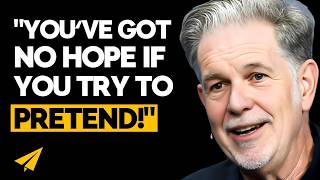
Reed Hastings explains how Netflix turned failure into strategy, from the Blockbuster wars to a price-increase backlash he owned. He describes culture as something to improve, not preserve, and says the company operates at the edge of chaos to fuel creativity.
Chapters
You've got no hope if you try to pretend to be Reed Hastings or Mark Zuckerberg or Bill Gates.
Life's short.
I mean, you know, why are we doing this? We're like, we want to have a difference. We think of ourselves like alchemists. We take in money and out comes joy. I would say I've always believed that a strong mission statement's really important, and I have to say we've never succeeded at it.
He's an American entrepreneur and philanthropist. He's the co-founder and CEO of Netflix, and he serves on the board of directors of Facebook and a number of other nonprofit organizations. He has an estimated net worth of over $1 billion. He's Reed Hastings, and here's my take on his top 10 rules for success. Rule number 1 is my personal favorite, and make sure to stick around all the way to the end for some special bonus clips. And as always, if Reed says something that really resonates with you, please leave it in the comments below and put quotes around it so other people can be inspired as well. Enjoy.
You have to be authentic. I mean, you've got no hope if you try to pretend to be Reed Hastings or Mark Zuckerberg or Bill Gates or whoever you want to think your CEOs are that you've met. You know, that is crazy. And you've got to really get comfortable with yourself, your strengths and weaknesses. People are inspired by authenticity. And I'm just surprised how many people feel like they're acting. And/or try to act. And you may be a really quiet person, and that's fine. But if you have that fierce will, that desire for the institution, the company, to be great, and your own role in that is secondary, and you authentically express that in whatever ways you do, then you'll be greatly accepted, okay? And so that's all it takes is to be authentic and not try to be something else, and to fundamentally care at your core about what's good for the company company. And if everybody knows and you act in the notion of what's good, as best as your judgment can tell, what's good for the company, they will see that and people will follow you and they won't be cynical. It's when you hide things, it's when you pretend. If we don't, if we're not creative enough, if we don't push it hard enough, you know, we've got to have some failures. And so we don't really want to have all hits. I'm clearly glad the first ones are hits. But, you know, the sign that you're right at the edge of chaos, the edge of creativity, is that some stuff doesn't work.
Now why do you want to be there? 'Cause networks don't want to be there.
Life's short.
I mean, you know, why are we doing this? We're like, we want to have a difference. You know? And so it's innate. It's wanting to push the edge, to create something that people are proud of and that they enjoy. We collect this year about $8 billion of customers' money. So thank you, all of you, for giving us your money. And what we do is we say that money's in trust to create joy. We have to turn that into the most joy possible. And so we look and we say, for every show, if a show cost $100 million, how much joy, how much viewing did it create amongst all of you? If it cost $50 million or $200 million, of course you want different amounts of joy. And so we look at it as how much joy can we create of your money? And if we turn it into joy effectively, then you're happy and you tell your friends and we grow and then we have more money next year. To turn into more joy. So we think of ourselves like alchemists. We take in money, and out comes joy. I would say I've always believed that a strong mission statement's really important. And I have to say, we've never succeeded at it. It's like this odd thing. You know, we've had them every year for 15 years, and they're constantly different. And now we're all so cynical. We're like, come on, we're trying to make people happy. I mean, that's the fundamental thing in consumer service. You know, we're trying to be better. And us and Disney and mission aren't that different. There's a bunch of different tactics at it. But we're an emotional product. We cater to the things that are important but not necessary. And I love that part about it because when you're selling milk or penicillin, you're selling something somebody needs. And we get to sell something you want, okay, that you choose to do because it's really cool. It's human to be entertained and connect to people over entertainment. And so we celebrate that a lot and we want to change the industry. But in terms of like a mission statement like so many companies have. Facebook talks about a more connected and open world. And then you see that phrase again and again and again. And it's a powerful mantra. We don't have an equivalent. And I think we probably would have been stronger if we do. In the early days, it was to connect people with movies they'll love. And it's okay, but it's kind of like the long, kind of awkward phrase, connect people with movies they'll love. And it's just not punchy. And then so like we used it, we had t-shirts, you know, and then it didn't really motivate anyone, didn't really stick. But we knew we were trying to make people happy with DVDs and then eventually with streaming and original content. So it didn't hold us back much.
What I find interesting about you, the way you conduct your business, is that when stuff doesn't work out, you apologize. You go and say, "I made a mistake," and all that. What is that, the first time you had to go out there and say sorry? This was wrong. And it was, I remember with the increase, the rate increase, right? And then you were like, ah, forget about it. Like, what was that experience like for you as a boss when you were like, I have to go and own this?
Going through marriage counseling 20 years ago was really how I moved to become a better manager and leader. Really? And yeah, you know, this marriage counselor was able to get It helped me to see that I was often lying to myself and to my wife, you know, saying, "Oh, family's the most important thing," and I'd stay at work all night. And that the value of honesty is that people can take honesty, even if it's not necessarily what they want to hear, if it's really sincere. So then the question is, Reed, what do you do to not lose a culture if you believe you've got a great one early on? Yeah, I mean, one of the most common questions a new employee asks is, "How do we preserve the culture?" And I say, well, to preserve something, to pickle it, is the wrong solution. We're not trying to preserve the culture. We're trying to make it better. And it's materially better than it was 5 years ago. And I'll cite a couple of specific examples. And then say, well, your job, in addition to doing your role, is to figure out how do we get even better. Because it's only when you struggle to get better that you really keep it vital and alive. So you always have to be saying, yeah, it's pretty good culture. But I'm sure it can be better. How can we be better? And so it's that struggle to improve that keeps it fresh. You know, we're pretty good at movies and TV shows. And so the competition that we worry about is the substitution. You know, again, when people are spending time on Snapchat or Facebook Video or YouTube, it's not Netflix or some new app that isn't yet invented. And so in the long term, you have to believe that movies and TV shows will be sort of like the opera and the novel, pretty niche businesses, and human entertainment will have moved on to something new. So yeah, we're getting really good at movies and TV shows. We're in the beginning of a great run on that. But in the long term, there'll be substitutes. There's substitutes for everything that come up. And then the ultimate challenge for us is, can we figure out that, of what that new form of entertainment is? Is that VR? Is it gaming? Is it AR? In '03 and '04, we're growing really fast. '05, Blockbuster attacks. And so we thought we were very clever. We came up with a number of ways to counterattack. And remember that everybody's got every DVD. Basically the same— Blockbuster and us had the same content offering, because it's non-exclusive licensing to get DVDs. So we could differentiate on our service fulfillment levels were 99% and theirs were 89%. But that's like a really abstract— for a customer, you know, thinking of signing up doesn't mean anything, right? And then they discounted massively, so it was like half our price. And so we were losing share. So, We were struggling with what to do about it, so we did 3 or 4 big efforts. One is, in the end of '05, we added Netflix Friends, which was our own social network. Remember in '05, Facebook's just on a few universities, okay? So our own social network amongst our members, and if you enabled each other, you could see what each other were renting and rating. And we thought, "Wow, the viral effects of this would be really powerful," etc. We added ad sales. Back in the day, it was like a Yahoo! Type banners and you could have— we could have— we sold banners above the choosing interface. We added used DVD sales on our site to consumers. So, of course, we had some excess DVDs from 4 years ago, so we added an operation to sell them for $4 a pop and it's a different logistics, but we added all that. And we added Red Envelope Entertainment, which was a group that we brought in to buy DVDs, buy films out of Sundance and similar festivals to then publish them on DVD. So getting into content. So we did these 4 efforts and each one, you know, was a dozen people, 15 people, and made us feel great. I mean, the employees loved them because, you know, here was a tangible thing that was not just 98% versus 89%. Here was the thing that they couldn't do or weren't doing and was a differentiator, right? And wasn't management so clever? And we went through these waves of battles in '06 and '07. And in the end, we won. They ended up closing down their online thing and 2 years later going completely bankrupt. But we looked back and none of those 4 efforts made any contribution to our victory. And one by one, we had closed them down along the way. Every single one of those 4. And so in hindsight, we realized when attacked, we should retreat to do the core better and not try to broaden the surface of attack, essentially. And it was a great lesson for us of focus. And so now when people say, aren't you getting into news or sports? We're like, absolutely not, you know, and we're really confident of our answer. Like movies and TV shows on a global basis, enormous market. And so, we're much less subject to being prone to go off and chase the shiny object to try to have something in a checklist to differentiate and to trust. And in hindsight, if we had just gone from like 98% perfect to 99.9%, we would have done a lot more for the business. And, you know, and it's hard work. It's operational logistics, how to get DVDs not to break. I mean, the amount of polycarbonate analysis we had to do is all this stuff. We would have beaten Blockbuster sooner than we did. Well, let's talk about values. High performance, freedom, responsibility, context, not control. These are obviously not mouthed. It seems like that if you want to do well at Netflix, you have to subscribe to the values, and if you don't, you're out. Yeah, and the reason that we publish our culture deck is so people can figure out before they come to Netflix, is this the right fit for them? Well, what's intriguing for me, because you're a competitive guy, is I looked at everything that you sent out in the last 5 years, and I would like to think that you've told me in to replicate Netflix, but no one can. Why is that? You know, it's probably a little like Starbucks. Doesn't seem that hard to make coffee, and yet one, one coffee chain is amazing around the world. So there's a lot of heart and passion that goes in it that doesn't come across in the words. It's the execution. It's the people at Netflix. You know, China is a very special place. And if you look at the big tech companies, Apple's done very well. Microsoft hasn't lost too much, and Google's you know, lost a lot. There's quite a bit of variation despite all three of those being talented, long-term oriented companies. And when you look at Apple, one of the amazing things is when they did the iPhone, they negotiated and talked and built relationships for 6 years before the iPhone was allowed to come to China. So from 2005, 2011, and that took a lot of patience. And now that's one of their largest markets in the world for the iPhone. And so what we take away from that is a sense of great patience. So it may be soon that we have a license in China, or it may take a couple of years, but we're going to be very patient. And we're looking forward to a time, you know, a decade or two decades from now when the Chinese middle class will want and embrace the kind of content that we have.
Thank you guys so much for watching. I made this video because Luke asked me to. So if there's a famous entrepreneur that you want me to profile next, Leave it in the comments below and I'll see what I can do. I'd also love to know which of the 10 rules had the biggest impact on you and why. What change you gonna make to your life or your business after watching this video? Leave it in the comments and I'm gonna join in the discussion. Finally, I want to give a quick shout out to one of my TDS instructors here, Felipe. Felipe, thank you so much for picking up a copy of my book. I hope you enjoy. I love the picture that you posted on Facebook. And yeah, enjoy the reading over the holiday break, man. So thank you guys again for watching. I believe in you. I hope you continue to believe in yourself. And whatever your one word is. Much love. I'll see you soon.
Up till 2002, all we focused on was survival. And then once we got public and were profitable, we started thinking, wow, this thing might last. And the cruelest irony would be to not want to work there, you know, to let it become a place we didn't want to be. And so we tried to think through what do we really care about? And we realized what we really care about is working with incredible people on hard problems, and that that was the essence. So we should organize everything around supporting that, of working with, you know, just incredibly talented people. And so that led us to freedom and responsibility, because incredible people don't want to be micromanaged. And the idea is that we manage through setting context and letting people run. You got to have the right people, you got to reinforce that with values, setting context about what the company is trying to achieve, But the idea is to build a system where amazing amounts of service improvement happen in the marketing, in the content, in the technology, in the user interface, without direct intervention of me. And so some companies operate by, you know, the product genius at the top, and we all know these companies and this whole motif of, you know, to be a great CEO, you've got to be the great product person who really, you know, and it's intoxicating and fun. But you're building incredible amounts of dependence on yourself. And eventually, you know, how well I know how Turkish consumers consume Netflix, you know, it's not that well. And so you're much stronger obviously building a distributed set of great thinkers. People know that, but in the past what they've done is try to make everything a process. They said, okay, I don't want it to be a genius, so we're going to organize a process for everything. And these once in a while you heard, we're going to dummy-proof it. It's going to be such a good process that anybody, this was the IBM thing, Then if you dummy-proof the process, you only get dummies to work there, to do the process. That's why we're so opposed to that, instead so focused on giving people great freedom, realizing there'll be mistakes, but there'll be a lot of positive achievement too.
Can you give some examples of that? I mean, you talk about it generically, it sounds great, but what are some specific examples?
I take pride in making as few decisions as possible, as opposed to as many as possible. And so when something significant changes in the content, or the House of Cards purchase, you know, Ted explained it, it was a huge purchase at that time. It was a half an hour conversation, you know, we went back and forth. I said, "Are you really sure? It's a great bet?" "Yes, let's do it." You know, it wasn't like me reading the script and me meeting with Kevin Spacey and, you know, or equivalent samples on the marketing, or equivalent examples on the product and the evolution there. So, It's creating a sense of, I wanna make a difference and I can make a difference. And if that's what the leader gets excited about, is that other people are making a difference, and you've got the right people. You gotta be super demanding. So the, you know, one part is freedom and responsibility, the other part is a high-performance culture, where we say adequate performance gets a generous severance package. And so, you know, we look at it and we say, we wanna be like a major league baseball team. And you know, you've only got so many positions on the field, and if everyone is not incredible at what they do, then you're not going to win. So you turn over a lot of people. And so we turn over a lot of people. I feel like, you know, we give people a fair shot. And, you know, we hire pretty openly and they know what they're getting into. But we're looking for people who, for whom freedom and responsibility works because they do incredible work.
Cult is part of the interviewing process. Do you have essentially a culture check? Yes, but not like a checklist. Culture is always something that we interview for, of kind of curiosity. And it's easy to find people who say, "Oh, I read the Netflix culture deck. I love it. I really want to be there." What's harder is, "Well, what are the main things you disagree with and why?" And when we get a blank stare, we're like, "Okay, not really a first principle thinker." And when they say, "Well, I thought the way that you didn't talk about how to acculturate and, you know, if I'm not great on day 3, am I out? You know, or is there, you know, do you look at it like an athlete where it's over some, you know, time period to prove yourself? And if so, what's that time period and why haven't you clarified that?" Then we're like, "Oh yeah, that's a good insight." First principle thinker. So we're looking for people who are curious, typically self-confident, and they're not— they're questioning everything around them.
More from Evan


How the Biggest Mistake in History Created A Trillion-Dollar Empire | Sergey Brin



9 Machiavelli Principles That Force People To Respect You | Machiavellian Philosophy



The First 10 Words That Instantly Ruin A Sales Conversation | Vanessa Van Edwards

The Top 1% Mindset Behind The First $5 Trillion Company | Jensen Huang (Nvidia)

