How to Win at Leadership | Lessons from Lee Kuan Yew
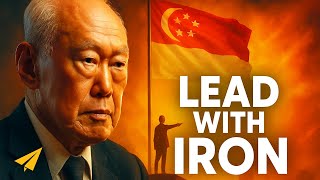
Evan Carmichael breaks down ten leadership rules from Singapore's Lee Kuan Yew, including staying competitive globally, learning from mistakes, recognizing your talents, and maintaining physical fitness. Lee emphasizes discipline, hard sacrifices, and pragmatism over ideology as keys to long-term survival.
Chapters
I've spent a whole lifetime building this, and as long as I'm in charge, nobody's going to knock it down. They are cowards, that's what they are. Cowards. They switch the lights off.
Hello, Believe Nation. My name is Evan Carmichael. My one word is believe, and I believe that entrepreneurs will solve all of the world's major problems. So to help you on your journey today, we're going to learn from the first Prime Minister of Singapore, Lee Kuan Yew, and my take on his top 10 rules for success. Rule number 2 is my personal favorite, and I'd love to know which one you guys you guys like the best. And as always, as you're watching, if you hear something that really resonates with you, please leave it in the comments below. Put quotes around it so other people can be inspired. You might win a prize as well. And also, when you write it down, it's much more likely to stick for yourself as well. Enjoy!
The present generation below 35 has grown up used to high economic growth year after year, and they take security and success for granted. And because they believe that all is well, they are less willing to make sacrifices for the benefit of the others in society, and they are more concerned about their individual and family's welfare and success. Not the community's or the society's well-being. But this is very dangerous because things can go terribly wrong, terribly quickly. These people are simply not aware of Singapore's vulnerabilities. All they read about is that Singapore is either number 1 or number 2 as the most competitive country. Number 1 or number 2 as a seaport or airport, or has number 1 or number 2 as the airline. And from time to time they complain that we are driving the people too hard, making life too stressful. So why not settle for number 3 or number 4 or number 5? Does it matter? My answer is Yes, it does matter. For if we are not near the top in competitiveness, there is no reason why we should have a seaport at all, or an airport, or an airline. When I set up my Singapore dream, I was a young man of 20-plus, was for a democratic society, Keen, vibrant, a united people, a society based on justice and equality, which will achieve happiness, prosperity, and progress for the nation. 30 years ago. My colleagues' younger, more dreamy eyes settled the words of our pledge. We did not focus our eyes on our navels. Or we would have missed that rainbow in the sky. We pursued it. And that was how we came to build today's Singapore. For the young, let me tell you, the sky has turned brighter. There's a glorious rainbow that beckons those with the spirit of adventure. And there are rich findings at the end of that rainbow. To the young and to the not so old, I say, look at that horizon. Follow that rainbow. Go ride it. Not all will be rich. Quite a few will find a grain of gold. Dig it up. I am quite determined. I may not be able to do it this way, but don't believe I've given up. I will think of some other way to get there. I think it's necessary because if you lack that determination, then you're not going to achieve. You will not be able to deliver. I am able to get ideas across to people in simple ways and persuade them to my point of view. If not the first time, then the second, the third, the fourth time. I don't give up. Eventually I swing them around.
Deng Xiaoping is a great man. He fought a great revolution. He saw The product of that revolution turned sour. He was fortunate to live long enough, and he had the courage to say, no, we changed course. Let's learn. Let's stop trying to do everything by ourselves. So they started importing and buying Boeing 707s. So they bought Tridents instead of trying to manufacture their own aircraft. Eventually they will, but it will take 2, maybe 3 generations. That's how we succeeded, because we have open minds, common sense, a lot of analysis, Careful weighing of the odds. Make a firm decision, monitor it, implement it, modify as it goes wrong, abandon if it is no good.
Life is what you make of it. You're dealt a pack of cards. Your DNA is fixed by your mother and your father, and you may be siblings, but you will get different parts or parcels of the DNA. Your job is to make the best of the cards that have been handed out to you. What can you do well? What can you not do well? What are you worse at? Now, if you ask me to make my living as an artist, I'll starve, because I just can't draw. It wasn't in my father or my mother or my great-grandfathers and grandmothers. But if you ask me, to do mathematical question or to argue or point out, I'll get by. That's the cards I was handed out and I make use of them. Don't try and do something you were not favored by nature to do.
I can tell you that when I met the SIA pilots, I didn't meet them on TV. I met them face to face, so 5 feet across the table, so they can see me and see whether I'm still vigorous, able to campaign and take them on. Whether it's worth taking me on. And I offered them two choices. Either you argue, you stop this intimidation, which is what it was, bringing SIA right down, disrupting services, ruining its reputation, millions of dollars worth of advertisements and sales ruined within a matter of 2 weeks. I gave them a choice. Continue this and I will, by every means at my disposal, teach you and get the people of Singapore help me teach you a lesson you won't forget. And I'm prepared to start all over again. 'Or stop it, get back to work, restore discipline, then argue your case.' Took them 65 minutes and they decided, 'Okay, it isn't worth the fight.' Why? Because they know they'll lose. They know that I'm prepared to ground the airline. They know that I can get the airline going again without them. And let there be no mistakes about this. Whoever governs Singapore must have that iron in him or give it up. This is not a game of cards. This is your life and mine. I've spent a whole lifetime building this, and as long as I'm in charge, nobody's going to knock it down. We have so much at stake. We have gone so far to secure the country. I say rally around and keep these evil forces— you see, they are so ashamed of themselves, they have switched the light off. Look at that. They are cowards, that's what they are. Cowards. They switch the lights off. Look at that. Are these men who are going to lead you to peace and prosperity or to ruination and perdition? Look at them. God knows what they are doing in the dark. When I say this, they succeed on the basis of intimidation. And I say, if they make the error that we are easily intimidated, then they have a lot to be sorry for. Because, you know, we have so much at stake, we can't afford to be intimidated.
Why do you have so little faith in the ability of your people, so well educated, to make intelligent judgments on diversity of ideas, on competing news. I have been in office for now 29 years. I have won 7 general elections since my first in 1959. I think that qualifies me at least to be able to say that I do know Singapore better than the questioner. Your father and grandfather's generation lived a hard life. Very few people had homes of their own. In Chinatown, you have cubicles, 8 or 10 people in the room. Sharing 4 bunks because they do shift work, save money. If you lived in those conditions and you get a flat, 1 room, which is what we started with, communal bathroom, communal kitchen, running hot and cold, water closet, that's from the lowest depths of the ship to a deck with a window with a pothole and air coming in, and from that to go to a 3-room or 4-room or 5-room flat, you go up to the higher levels of the ship. And finally now, we've got executive flats and condominiums. That means you're on a cruise ship at the very top. Now, I have watched my grandchildren grow up, and they are growing up much more comfortably than my children. My wife and I made them— made sure that they became self-reliant and not somebody would pick up their balls for them. As Prime Minister, I was given a house at Sri Temasek, So I took them there one day to play, and Sri Tamasic is on the high ground. They were playing with a ball, the ball rolled down, and the butler ran about 50 or 60 yards to pick up the ball and bring it back. My wife and I watched that and said, "No, no, if we stay here for 5 years, My children will grow up believing that life is like that, that somebody will always pick up balls for them. We stay at home. And I think that's been good for them. And that is the problem we face today. Many of the parents who are in these HDB flats started like the people in Chinatown. They understand what it is to be poor. Today's children do not understand what it is to be poor. But you can intellectually and emotionally understand that if you don't make the same effort, you go back to where you were.
We've made mistakes. We put money in UPOC, in Jurong, secondhand machinery. We were young then, we were new in the game. They sold us secondhand machinery. We didn't know. We lost money. We wrote it off, but we learned. Human beings are not like computers. You know, you can take one computer bank, plug the terminals, and all the data from one computer bank can go into another. But human beings start with fresh minds. You get a newborn child, he grows up. Completely blank. Input from parents, input from friends, input from teachers, but no input is as vivid, as long-lasting as his own experience.
How do I describe my inner motivations, my proclivities? If you want me to have a go, I would say I'm consistent. I don't say one thing today and another tomorrow and change again day after tomorrow. It's not that I'm inflexible. There are circumstances where the situation is altered and I'm prepared to say, this no longer applies, but on the whole I stay consistent. I had 3 journalists write up a book of my speeches, and I asked them at the end, what was the dominant theme you found? And the 3 of them said, Consistency throughout all the 40 years in public life. What I said at the beginning, throughout all that period, the theme stayed loud and clear. That made it simple because you know where you stand with me and you know what I want to do. Looking back, the day on which independence was declared was not one that really called for celebration. Rejected by the Federation of Malaysia, Singapore or faced a future of seemingly insurmountable obstacles. You see, the whole of my adult life I had believed in Malaysia, in Merjah, and the unity of these two territories. You know, it's a people connected by geography, economics, and ties of Kinship. Would you mind if we stopped for a while? I am nobody's stooge. I am not here to play somebody else's game. I have a few million people's lives to account for, and Singapore will survive.
Thank you guys so much for watching. I made this video because Amit Gupta asked me to. So if there's a famous entrepreneur that you want me to profile next, check out the link in the in the description and you can go and cast your vote. I'd also love to know which clip resonated the most with you. What lesson are you going to take from this video and immediately apply to your life or to your business somehow? Leave it down in the comments below. I'm really curious to find out what you have to say. I also want to give a quick shout out to Brian Tracy. Brian, thank you so much for picking up a copy of my book, Your One Word, and posting the review on your Facebook page. I really, really, really appreciate the support and I'm so glad that you enjoyed my book. Thank you guys so much for watching. I believe in you. I hope you continue to believe in yourself and whatever your one word is. Much love. I'll see you soon.
What's the most important change and most significant change in your way of thinking about the world over the last 20 years? That the impossible can happen. I never thought that the Soviet Union would implode so easily. And I never thought that the Chinese would abandon their communist system and move into the free market so readily. It was unthinkable 20 years ago. Both has happened. The world has changed. And it's not clear exactly how it's all going to— No, it is not exactly clear when it will happen. Exactly. But that it will happen now in the long term, 50 to 100 years, yes. And the center of gravity is shifting to Asia. Must be because the population's there. That talent pool of 1.3 billion people plus the Japanese, the Koreans, and the Vietnamese and the others, it can match Europe and America. But that talent pool was inert, did not have science and technology, did not care about science and technology, but now, Everything that you do, Asia is doing. I ignore polling as a method of government. I think that shows a certain weakness of mind, an inability to chart a course. Whichever way the wind blows, whichever way the media encourages the people to go, you follow. You're not a leader. If your message is one of despair, then you don't— you should not be a leader. You must give people hope, hope of improving their condition. There are moments, of course, when you feel very down, either because you're physically down or emotionally down, or because the world the world has turned adverse against you. I think when you are in that condition, the first thing you do is to get a good night's sleep, then get a swim or chase a ball, get the cobwebs out of your mind. I believe, and I've practised this, for all these years in politics, that if you're not fit, you're going to make mistakes. Physically fit. You must stay physically and mentally fit. I exercise every day. I used to jog, swim, play golf. Golf more for relaxation, just to get away from the smoke key conference rooms. It's part of the balance you keep. Now, I cycle, I swim, even when I travel. And since the last 10 years or so, I've learned to meditate. Because it's one way of calming yourself. It takes practice. I had a doctor teach me. He was a Buddhist, and he retired, and he spends his time helping people to meditate, especially those with terminal illnesses, you know, to take life calmly. And I think at the end of say, 20 minutes to half an hour, my pulse rate can go down from 100 to about 60. I mean, you can feel yourself subside. I mean, you still your mind, you empty your mind, then when you are rested, You resume quietly. You still got the same problems. Maybe you sleep on it, come back, look at it for a few days, and decide maybe there's a better way of solving it, or talk to some friends, get some ideas. But if you are not in good shape, you're going to make mistakes, and that's disastrous.
More from Evan


How the Biggest Mistake in History Created A Trillion-Dollar Empire | Sergey Brin



9 Machiavelli Principles That Force People To Respect You | Machiavellian Philosophy



The First 10 Words That Instantly Ruin A Sales Conversation | Vanessa Van Edwards

The Top 1% Mindset Behind The First $5 Trillion Company | Jensen Huang (Nvidia)

