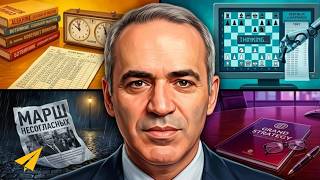
Garry Kasparov shares ten principles for success: constantly evaluate your strengths and weaknesses, learn from failure, trust your intuition, and review your decisions like he reviews every chess game. He retired from chess at Linares 2005 to pursue new challenges, and argues there's no universal formula for winning, only a personal blend of talent, work, luck, and joy.
Chapters
He's a Russian chess grandmaster and former chess world champion. He's considered by many to be the greatest chess player of all time. He became the youngest ever undisputed world chess champion at age 22. He's Garry Kasparov, and here are his top 10 rules for success.
It's very important, and I also come back to chess, to learn how to recognize your own strengths and weaknesses. This is in fact the vital part of preparation for a big match and for anything in life. We always try to study our opponents, we always try to study the battlefield, we always try to study all the circumstances surrounding our venture or endeavor, but very often we forget to study ourselves. And this is very important because any choice of a ground for battle or, you know, type of strategy we want to employ depends on our recognition of our strengths and weaknesses. And this is a process of constant reevaluation because life is changing very fast and our opponents looking at our success, studying it and trying to be smart and outsmart us eventually. And we can look at the history and just to find a number of situations where the— The inability to recognize strengths and weaknesses led to an eventual disaster.
It's up to us what we want to do with our success. Because, you know, eventually, you know, if we are successful, we just have to make a conscious decision what's next. And for me, there was always a next station because I was— it was not enough for me just to win. I wanted to make a difference.
It could also remind us of the success of Alexander Bell, the inventor of telephone, who had a stack of notebooks where he recorded every failed experiment. So, if you work really hard, you can find the winning spot even, you know, in the midst of your numerous failures. I think the ex-speaker of US House of Representatives, Newt Gingrich, hit the right points when he said that perseverance is the hard work you do after you get tired of doing hard work you already did.
I think that, again, from my perspective, patience, it's your ability to also accept failures. Because very often today, even from kindergarten, and of course in schools, and of course in colleges, and of course at the workplace and businesses, we hear, "Oh, failure, failure." You know, failure is nothing but failure. Well, failure is inevitable step towards success. If you don't take a risk, how can you be sure about rewards? Especially if you're looking for something big, you know, you want to do something that never happened before. You're looking for breakthrough innovations. It's like the sort of a moon project, something that is something for the blue skies. It means you have to enter uncharted waters, sort of untested territories. And again, for me, patience is also a willingness to accept failure, defeat, and to try again. I learned that, you know, it's never late to learn. So that's why, you know, even at age 37, you can learn from younger generation. And that was a very important lesson, not only for the remaining 5 years of my chess career, but also for for future years because I just recognize that flexibility is a fundamental quality for success.
We should learn how to trust our gut, intuition, because in most of the stories I looked at and in most of the quotes I collected, I didn't see people picking up intuition as the crucial element. Of the success. While in my profession, in chess, intuition is virtually everything. Because chess, some people don't recognize it, is a mathematically infinite game. The number of moves in the game of chess, all the moves, contains 120 zeros, which is more than the number of seconds since the moment Big Bang created the universe. So how can you find your way, you know, in this ocean of possibilities? And of course, how a man can fight a machine that could calculate tens and tens of millions of positions per second? Intuition. Because it's all about decision-making process, and we never employ calculation as the main tool. It's 1% of calculation, even less, and 99% of our understanding, of our ability to find intuitive ways. To compare incompatible, material versus quality, time versus material. So intuition plays a key role and we have to trust our intuition, our instincts, because in life also we have many opportunities where we cannot foresee all the consequences and there's only one choice, it's just to trust your gut. Because when we win, we forget that there are a lot of people who are losing and those who are losing, they are analyzing, they're trying to find out the reasons for their loss, the mistakes, and if we do nothing, If we rest on our laurels, they'll come back after us next time. And I was on top of the world of chess for 20 years because I was very good, even relentless, in challenging my own success.
And did you go over all your games?
Absolutely.
The ones you succeeded and the ones you failed? Absolutely, yeah.
Because even the game we won always contained mistakes, inaccuracies. It's inevitable. It's— I can hardly imagine one brilliant game with no mistakes, which means that on both sides. Yeah, on both sides.
But the trick is noticing when the other guy makes a mistake. Absolutely.
Yeah, if we won, most likely is because our opponent made the last mistake. But he made the last mistake and he's definitely analyzing the game and he'll find what we did wrong in the previous stage of the game. So what is important is to find it first and to make sure that next time when he's trying to actually surprise us with something, we'll be one step ahead. I made a conscious decision that Linares 2005 will be my last professional event. And today I played my last professional game.
Is there a maximum age, or can you be a chess champion if you want to be at 65? It's a very demanding game, so you have to spend time at the computer analyzing, preparing new ideas, and then you just play under this heavy pressure. So we just— it's, um, it's, um, it It sucks a lot of energy out of you. And players in their 20s or early 30s, they definitely have a physical advantage over older competitors. I probably would be able to play a few more years. But I made a decision to retire, and it was not just overnight, you know, at the end of the tournament in Spain, in the city of Linares. But just beforehand, I thought I— I already made enough difference in the game of chess. So just making difference was important. I just recognized that maybe it's time just to move on. So just to start changing my life before it's too late. So you can't stay in chess indefinitely because you need— everybody needs challenges. So, and I thought about other challenges.
Is there any universal recipe for success? I don't think so. I think we're all unique and it all depends on us. So what kind of ingredients, and there are similar ingredients, we'd like to put into our own magic formula. When we look at the examples from the history, look at the success stories, we could find different definitions of success. For instance, Mikhail Botvinnik, the 6th world champion, World champion, known for his notoriety and called the patriarch of Soviet chess school, probably the greatest scientist in the history of chess. So his formula was very solid, very much on the ground: talent, good health, strong nerves, fighting spirit, and good work ethic. It worked. Thomas Edison, was even duller. He said, "Success is 1% inspiration and 99% perspiration." But just, you know, look at the different side of the equation. Alexander Pushkin, the greatest Russian poet, considered to be the father of the modern Russian language. It's the man who with the lightest touch of genius could produce the best pieces of Russian literature ever. He was a man of joy, he was a gambler, he was even a rake, always lived in the red ink. So his formula is quite different: genius, luck, and experience. It also worked.
Thank you so much for watching. I made this video because one of you asked me to. So if there's a famous entrepreneur that you want me to profile next, leave it in the comments below and I'll see what I can do. I'd also love to know which of Garry Kasparov's top 10 rules meant the most to you? Leave it in the comments below and I'll join in the discussion. Thank you so much for watching. Continue to believe, and I'll see you soon.