I Analyzed 50 Self-Made Millionaires: Here's What They All Do
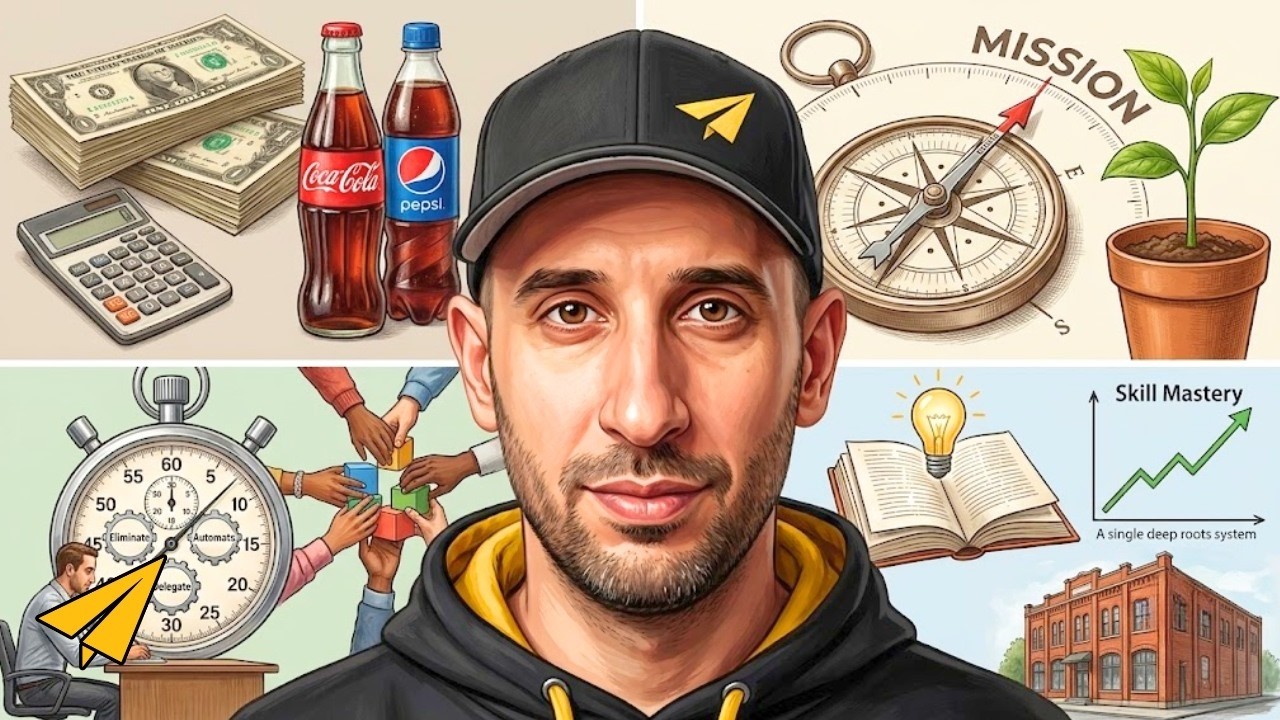
Evan Carmichael breaks down eight habits shared by 50 self-made millionaires: adopt a wealth mindset, master one skill, save 20% of income, automate investing, protect your time, build a tight circle of 50 relationships, read 30+ minutes daily, and anchor everything to a mission. He also reveals why 50 failed businesses collapsed and six cognitive traps that sabotage high-IQ people.
Chapters
Getting rich in America is far more ordinary than anyone ever told you. Can I get rich if I just have a salary, do you think? Yeah, you can. If you want to make a couple million dollars, 100%. Can everybody do that? It's only not accessible to you if you're a lazy piece of shit that wants to do nothing. I think earning money is one of the simplest things I ever learned, and it's one of the most misunderstood things. I went through the research on America's self-made millionaires, and 80% of them are the first generation in their family to ever be rich, according to Dr. Thomas Stanley and Dr. William Danko's National study in The Millionaire Next Door. I was raised on a farm with my grandmother, um, for the first 6 years of my life. If you'd asked me at the time if we were poor, I probably would have said no, because when you are living it and you don't know anything else, you think that's the way life is. My car was my home where I'm going to live. Got a blanket, a pillow in there, and all the other stuff went in the trunk or in the other seat. Uh, and then to eat, I figured out a way to eat off $2.50 a day. So this isn't really about money for you, it's about whether you get to decide what your life looks like, or whether you spend the next 40 years letting a paycheck decide it for you. The paycheck is one of the most sinister plots ever pulled upon a human being. If you need a paycheck, you've sold your soul. Your time is limited, so don't waste it living someone else's life. There's a woman named Ann Scheiber who spent her whole career as an auditor at the IRS, and she was passed over for promotion again and again, never once earning more than about $4,000 a year. When she retired in 1944, she had a small pension and around $5,000 in savings to her name, and that was it. That's the whole pile. She lived quietly and frugally in the same tiny rent-controlled New York apartment for decades, and to anyone passing her on the street, she just looked like a little old lady with almost nothing. When she passed away in 1995 at the age of 101, the world found out she had turned that $5,000 into an estate worth $22 million, and she left every penny of it to fund scholarships for young women. She never won the lottery. She never started a company. She simply bought shares in strong brand name companies that she understood, like Coca-Cola, PepsiCo, reinvested every single dividend, and then did the hardest thing of all, which was to leave it alone for 50 years while it compounded. Nobody handed Anne a dollar of it. She built it one careful decision at a time with habits so boring that the people right next to her never even noticed. And when I sat down and looked at 50 self-made millionaires to see what they actually have in common, Anne wasn't the exception. She was the rule. The same patterns showed up again and again in the retired auditor and the billionaire. And that's exactly why this is so good for you. Now, you might be thinking, okay, that's a nice story, but that woman had 50 years to let it grow and you don't have that kind of runway or that kind of patience. So try to hear me on this because it matters more than almost anything that I'll say today. The research doesn't say that you need a high salary or a head start or a rich uncle. It says you need to do a small set of specific things consistently, starting from wherever you are starting today. The Federal Reserve found that there are now around 16 million millionaire households in the United States, which is roughly 1 in 8 American families, and the vast majority built it themselves. The reason this feels out of reach for so many people— it's not your income, it's that nobody ever showed you the actual pattern, so you've been guessing. So let me show you the pattern, because once you see what these people repeat over and over, you can't unsee it, and you can start running it this week. If you've been here before, drop a hashtag #believe in the comments below so I can feature you here in a future video. And if you're new, welcome to Believe Nation, the only channel that helps you believe in yourself daily, one video at a time. Believe. Decide it's yours first. So before any of them had a single dollar of proof, they decided they were allowed to be wealthy. This might sound soft, and especially as point number 1, but it's the most important one on this whole list. So Stay with me. Henry Ford said it best: If you believe you can do a great thing or you believe you can't, you're right either way. The self-made millionaires I studied didn't wait to feel rich before they started acting like an owner of their own future. They switched the order that you've been probably living your whole life. They became the kind of person who builds wealth first in their identity, and then the daily actions followed naturally from that identity. So being leads to doing. When you wake up already seeing yourself as someone who is fully responsible for your own financial life, You stop buying things to look impressive to strangers and you start buying assets to actually become wealthy. And this is the part that almost nobody talks about. The research on self-made millionaires found that they score sky high on emotional stability and they're comfortable being different from the crowd. They had to be because acting wealthy and looking wealthy are opposite habits and they chose to actually be it. So that one shift, that deciding that it's yours before your bank account agrees, is the foundation underneath every other habit that I'm gonna give I'll give you today. Your circumstances right now are a good start, and your only job is to decide that you're meant for far more than them. The bird sitting on the branch isn't afraid of the branch breaking because her trust isn't in the branch, it's in her own wings. That's the mindset that you're building. So you need to stop needing your situation to be perfect because your confidence lives in what you're capable of, not in what you currently have. Get killer at one thing. So self-made millionaires, they got genuinely great at one thing before they ever tried to do everything. There's a popular floating around that you need 7 income streams or 25 streams of income to get rich. So people go and they start 7 mediocre projects at once, and then they wonder why none of them ever take off. The self-made millionaires, they did the opposite. They went all in on becoming genuinely excellent at one skill or one business, and they let that one thing become the engine that funded everything else later on. So think about this like an edge of a puzzle you're working on. You build the borders first, you get one strong frame locked in, and then the middle pieces become easy to fill in. And Schreiber mastered exactly one boring strategy: owning great dividend companies and never selling them. And she ran it for 50 years straight. The richest investors alive will tell you the same thing, that they got wealthy by going deep on one approach and refusing to get bored with it. The multiple streams of income that you hear about are real, but they show up at the end of the story, not at the beginning. They come from owning one thing so completely that it overflows into the next. So pick your one thing right now. Get so good at that you become the obvious choice in your own little corner of the world. The person that people call first. Depth beats spread every time, especially in the early years when your energy is your most limited resource. Spend less than you make. Okay, so this is the habit that built Ayn's $22 million empire, and you can copy it starting with your very next paycheck. They live below their means while they were building on purpose, and they never apologize for it. Dr. Stanley's research found that the typical self-made millionaire invests close to 20% of of their income every single year. His study even found that more than 6 in 10 of them could tell you precisely what their household spends on food, clothing, and shelter each year. That's not something glamorous, and that is the entire point. These are people who could easily afford the flashy car and chose the reliable used one, who could afford the giant house and chose the sensible one, so that the gap between what they earned and what they spent could go straight to work for them. So you don't have to live like a monk for the rest of your life. You just have to win the early years by keeping that gap wide as you can and pointing it at assets instead of stuff that impresses people that you don't even like. Every dollar you don't spend on looking rich is a dollar you can spend on actually getting rich. The discipline you show in the next 24 months is what buys your freedom for the next 40 years. Also, if you want to take real action after this video, I made a free worksheet just for you. It covers the top lessons from today, gives you space to write your biggest takeaways, and helps you build a simple action plan. It's 100% free. Just click the link in the description below to go grab it. And I'll see you there. Make your investing automatic. Self-made millionaires, they set their investing on autopilot so their own emotions could never get in the way. So here's a stat that surprised a lot of people when I found it. Dr. Stanley found that fewer than 10% of millionaires are active traders who buy and sell within a single year, and that a full 42% of them made zero trades at all in the year before they were surveyed. They are not glued to the screen, reacting to every scary headline and every hot tip that they get. They set up a simple system where a fixed percentage of every dollar that they earn, often around around 10% gets routed straight into long-term investments before they can even feel it leave. And then they let time and compounding do the heavy lifting for them. This is leverage of the quietest kind. Your money keeps working at 2 in the morning while you sleep, every weekend, every holiday, never calling in sick, never asking you for anything. And the discipline to leave it alone is its own kind of superpower, because the urge to panic and sell is what wrecks the results of almost everyone who tries. The ones who win at this aren't the smartest about the market. They're the ones who took themselves out of the decision entirely and let the machine run on pilot. So set up the automatic transfers this week, even if it's tiny, and then protect it like it's sacred. Guard your time like gold. Self-made millionaires fiercely protect the one thing they can never make more of, which is their time. The self-made people that I studied valued their time almost infinitely over their money, and they run their days through a simple filter that I like to call eliminate, automate, delegate. So first, they eliminate the roughly 80% of activities that keeps them busy but broke, the stuff that feels like work but never actually grows anything. And then they automate whatever piece of software or bit of AI can handle for them on repeat. And then they delegate what's left over to someone else, even if it starts with just one virtual assistant for a few hours a week. What they keep for themselves is the small, precious slice of work that only they can do, the work that actually multiplies the money. And you can start this today with nothing but your own calendar. So look at everything that you did last week and ask which of it a wealthy version of you would have eliminated. Automate it or hand it to somebody else. Then go reclaim those hours and spend them on the 1 or 2 activities that genuinely build your future. Rich people aren't busier than you. They're just ruthless about what they refuse to do because they understand that every hour spent on low-value work is an hour stolen from the work that makes them become free. Build your circle of 50. Self-made millionaires understand that relationships are the highest form of leverage that you will ever have. The richest people don't grind away way, alone in the corner, hoping that someone discovers them. They deliberately build a small circle of the right people who can send life-changing opportunities their way. So one of the things that I do in our Movement Makers program is I teach making a list of the 50 people in your world who could refer real money or open up real doors for you over the course of a year. And instead of cold pitching them or begging them for scraps, you invite them in, you make them look good, you start a show, you serve them first, you build a genuine relationship, you invite to interview them before you ever ask a thing. The wealth follows the trust, always in that order. And it's not just who you know, it's what you offer them. So the premium things that people actually pay for come down to a few simple words: community, convenience, customization, and real coaching. And the self-made build their relationships and their offers around delivering exactly those things. When you become the person who gives before you ask for anything in return, doors start to swing open that money alone couldn't open. So you cannot do everything yourself, and none of the 50 millionaires that I studied ever tried to. They surround themselves with people who raise the ceiling on what was possible, and then he did the same thing for others. Never stop learning. Self-made millionaires, they never stop feeding their own mind because the self-made treat learning like a job that never ends. So there's a researcher named Tom Corley who spent 5 years studying the daily habits of 233 self-made millionaires, and one finding stood out for me above the others. A full 88% of them read at least 30 minutes every single day for self-education. So books on their craft, biographies of people that they looked up to, anything that made them just a little bit sharper. Among the people in the study who were struggling financially. Only 2% did the same. That gap is pretty big, and it compounds over the years exactly like money does. The self-made pour hours into their own education long after school is over and the tests have stopped, because they know that the highest returning asset on Earth is this, right? The one sitting between your ears. They chose a biography over entertainment and one hard book over 10 easy distractions on purpose every day. So build that habit starting today. Read 20 pages a day, watch a YouTube video that's educational a day, take a course that you've been putting off, get close to the people who are 10 steps ahead of you and learn how they think. You don't have to be the smartest person in any room. You just have to refuse to stop getting better because the version of you that keeps learning is the exact version that eventually gets wealthy. Anchor it to mission. This last one here holds everything together, and it's that for these people, the money was never the actual point. So when you study them up close, self-made millionaires, almost none of them got out of bed every day just chasing dollars. They were chasing a mission, a problem that they were obsessed with solving, a family that they were determined to provide for, a mark that they wanted to leave on the world. The money is just a way of keeping track. And here's why that matters, I think, in the most practical way, because a mission is what gives you the staying power to run these boring habits for 10, 20, 30 years long after your motivation is gone and like people aren't clapping for you. Even the most successful people I studied spent a huge chunk of their days fighting doubts and fighting their fears, and only a small slice of their time them feeling unstoppable. The mission is what carries them through the doubt. Your purpose comes from your pain, from the exact thing in your life you never want anyone you love to go through. When you build your wealth on top of a reason that big, then the frugality stops feeling like sacrifice and it stops feeling like waiting because every dollar is buying you something that you actually care about. So if you have the ability to build this kind of life, then you have the responsibility to do it. If you can, then you must. You're closer than you think. So when I lay all 50 of them side by side, Yourself a Millionaire, the pattern is, is pretty simple. And that's maybe the best news that you'll hear all week. Decide that it's yours. Master one thing. Spend less than you make. Invest automatically. Guard your time like gold. Build real relationships. Never stop learning and anchor it all to a mission that's bigger than money. None of that requires a rich family, a genius IQ, a lucky break. It requires you to start and to keep going when it's born. And the best time to start? How about right now? You're far more capable than your current bank account is whispering to you right now. And the quiet, ordinary, almost invisible habits that built every one of these fortunes are sitting right in front of you as well, waiting for you to simply pick them up and run. And congratulations, you're one video closer to who you're meant to be. Believe. I also analyzed 50 failed businesses, and here's what killed every single one of them. Almost every business that dies gets killed by the person who started it, not the market, market, not bad luck, and not by the economy. Unfortunately, and one does have to be focused on the short-term and money coming in when creating a company, because otherwise the company will die. Apple suffered for several years from lousy engineering management. I have to say it. And there were people that were going off in 18 different directions, doing arguably interesting things in each one of them. Good Engineers. Lousy management. Successful businesses have to satisfy a real need, a need that people will actually pay to have fulfilled. Now, you may have an idea, you may love your product, you may love your service, but if that product or service doesn't fix a specific problem, your business will fail. Nearly half of new businesses fail within their first 5 years according to the U.S. Bureau of Labor Statistics. 22% of business startups fail in the first year, and 50% of new businesses fail within the first 5 years. And what's really on the line here, it's not just your business, it's the years of your life that you're about to pour into it, and whether they add up to something that lasts or disappear like it never happened. Take a wild success like Airbnb everybody knows about. Well, that company was famously passed on by many smart investors because people thought no one's going to rent out a space in their home to a stranger. Of course, people proved that wrong. But one of the reasons it succeeded, aside from a good business model, a good idea, great execution, is the timing. That company came out right during the height of the recession when people really needed extra money. Your time is limited, so don't waste it living someone else's life. So I went deep on 50 businesses that died, and I kept coming back to Sam Walton. Before he built the biggest company money on the planet. Sam was a nobody running a single Ben Franklin variety store in Newport, Arkansas, pulling in about $20,000 a year. He worked harder than anyone in town. He obsessed over low prices and treating customers right, and he turned that little rented store into one of the most profitable shops in the whole region. He did everything right, and then he lost it all. Sam didn't own the building, he only rented it, and when his landlord saw how much money that store was making, the refused to renew the lease to Sam and handed his entire business to his own son. Just like that, the best store in the area was gone, and Sam Walton had nothing to show for years of work except one pretty brutal lesson. You have to own the land. You have to own the building. You have to own your foundation. Anyone else might have walked away right there. Most people do. But Sam didn't. Your purpose comes through your pain, I think. And Sam's purpose got forged the day he lost that store. With his wife Helen pushing him to start over in a new town, he sold what was left, moved to Bentonville, and in 1962, he opened the first Walmart. He built it on everything that loss taught him. Today, Walmart pulls in $648 billion a year, and about 90% of Americans live within 10 miles of a Walmart store. Your setbacks do not have to be permanent. It's only permanent if you stop. Sam turned the pain of losing one store into creating 10,000. More. Okay, so here's what you might be thinking. Your business might be different. You know, your idea is better. You care more. You'll outwork everyone around you. So those 50 dead businesses have nothing to do with you. I get it. But here's what hit me when I studied them. Almost all these founders thought the exact same thing. They weren't lazy people. A lot of them were brilliant. A lot of them were working 80-hour weeks. What killed them was not a lack of effort. It was a blind spot. One weakness that they never saw coming. Exactly like Sam Walton. Not owning his building. Effort doesn't save you from these blind spots. Seeing it does. So let me walk you through the blind spots that killed all 50 businesses so you can find yours before it's too late. Killer number 1: running out of cash. The first killer is running out of cash, and it took down more of these businesses than anything else. Here's the part that scares most people. You can run a business that looks profitable on paper and still go broke because profit and cash are not the same thing. Profit is a number on a spreadsheet at the end of the month. Cash is what's actually in your account on Tuesday when your payment is due. Your expenses show up fast and on time. Your payroll, your rent, your ad spend, your software, they all, they get paid with clockwork. They're showing up. Your customer payments, they show up usually slower, 30 days, 60 days, sometimes 90 days later. That gap in the middle is where businesses often bleed out, and you can be growing the whole time it's happening. It gets worse when a founder hits one good month and treats it like this is the new normal. I've watched people spend tens of spend thousands of dollars on fancy equipment after a single strong week and then get wiped out the next month because they had a slow month and because they kept zero reserve. I watched a coaching company hit almost $4 million a year in revenue and still have to shut its doors. Almost $4 million. They ran out of cash because they spent too much on ads, paid the team too much, built a structure that they couldn't sustain, and never looked deeply at their accounting. And if you're trying to build the whole thing on $87 or $99 a month product Listen, because the capital burns out before the idea burns out. Low-ticket models often need massive scale. They need huge customer service and they get hammered by refunds and chargebacks. So here's what you can do. Watch your cash, not just your profit. Keep at least 3 to 6 months of expenses in reserve. So one slow month can't end you. Know your numbers cold. I know it's hard for some people every week, not just once a quarter, once a year when it's already too late. And sell something with enough margin to actually fund the business. So I don't like decisions that make me feel weak, and nothing makes you feel weaker than checking your bank account and realizing that the money is already gone. Killer number 2: building something nobody wants. The second killer here is building something that nobody actually wants. This one is pretty sneaky because it feels like progress, right? Your head's down, you're building something, you're quietly creating, and you add another feature, and it feels like that you're being productive because you're busy and you're busy and, and you're shipping. And then you take it out to the markets and like nothing happens. And I did this with my very first software company. I spent months building a feature that I thought was incredibly cool, right? We took it to market, like, nobody wanted it. Nobody. All that time, all that work was gone because we built in a vacuum and never asked a single customer if they actually needed this thing or not. The fix here is so simple that it's almost embarrassing. It hurts. Go find a customer first, then build around what they actually need. So talk to 10 real people in your market before you build anything. And don't ask them if they like the idea. Ask them the problem that keeps them up at night and what they've already tried to pay to solve. Then Sell it before you make it. Take a deposit, pre-sell the spot, get a real credit card payment for the promise of the thing. If real people won't pay you for the promise of it, they won't pay you for the finished version either. It's a lot harder and you just saved yourself a year. Get honest about the problem that you solve, because if you don't solve a real problem, you do not have a real business. Entrepreneurship is about solving problems. You have an expensive hobby. And one more addition here, chasing small broke customers and hoping they grow rich with you. They won't. Don't pick customers who can actually afford you right now, who have the budget to pay you what you're worth today, right now, and build for them. Killer number 3: the right things in the wrong order. Okay, the third killer here is doing the right things in the wrong order. A lot of these businesses, they didn't die because the founders were doing dumb things. They died because they were doing smart things in the wrong sequence. And I see it all the time. A founder with no steady revenue decides to build a massive global brand or launch a low-ticket online course before they've ever built a simple high-ticket engine that brings in real money every single month. So they spend a year on logos and funnels and fancy websites and content while your bank account slowly drains, and not one of those things is actually paying your bills. The order matters more than the effort. So phase 1 is something higher ticket that generates steady cash. One offer, a clear customer, enough money per sale that a handful of clients keeps your lights on. That cash funds the team and the systems you need to survive everything that comes next. Only once that engine is steady do you earn the right to go to Phase 2, the lower-ticket courses, the products that end up scaling. And then only after that you build Phase 3, the big brand, the global audience. Get steady money coming in first, and everything you build on top of it gets so much easier because now you're building with money in the bank instead of running on your savings and investments. When you try to skip that first step, it's like you're, you're building a house and you're trying to create the second floor before you've even built the foundation. And you know how that ends. Killer number 4, no systems, no scale. The 4th killer is having no system. A friend of mine, Nick Peterson, likes to say, nail it, then scale it. And this is also a powerful idea in the book, The E-Myth Revisited, which is that most small businesses fail and most franchises can succeed. So think about why is that? A franchise runs on documented repeatable recipe that almost anyone can follow. Walking into any location of a big franchise and you get the same result because the magic is written down in a playbook that anyone can run instead of just locked inside one person's head. The average founder does the opposite, right? You keep shooting from the hip, you keep trying to do the entire business inside your own head. And if you never write it down, your killer recipe, then two things happen, and both of them can be completely fatal. First, you can't scale because you are the bottleneck for everything, right? Ever, ever feel that you're the bottleneck? Every decision, every fire, uh, every customer waits on you. And second, anyone you hire operates at a lower level because they're guessing at what you do instead of following a proven process. And then you decide hiring doesn't work when really you just never gave people the recipe to follow. So I think being leads to doing. So start being the kind of owner who builds the systems even when it's just you. Write down exactly how you get a customer step by step, how you deliver the work step by step, how you keep them happy and get them to refer to you step by step. Turn the magic in your head into a checklist your team can run without you standing over them. The day your business can win without you in every single room is the day it stops being this fragile little egg and starts being worth something. Killer number 5, keeping the wrong people. The 5th killer is keeping the wrong people. This is tough. This one is hard because it's personal and it costs you twice. Founders hold on to underperformers, the team members who are barely treading water, the friends you had from high school, the people that you might have started with. You hold onto them long after you should have let them go because firing usually feels cruel and hiring again feels pretty exhausting. But every single day you hold onto someone who's just okay, you give up the chance to bring in somebody great A players are in limited supply and you've got a seat filled with someone who's just the wrong person. A B player doesn't just do B-level work, they block the A player who could have had that seat. And the other side of this is maybe even worse, putting good people in the wrong roles. If you take someone whose gift is starting new creative projects and bury them in, uh, monotonous, boring, repetitive grind work, they're gonna burn out and fail and it's not their fault. You put them in the wrong seat and then blame the person. So match the work to the person's natural strength. Give the starters the new projects and the finishers the systems, and be brutally honest with yourself about what's actually moving the business forward and who's just kind of still being busy. That's a good start, but now I want you to go further than good. We build a team where every single seat is filled by someone who is excellent at that exact job, and watch how much lighter the whole thing gets carried. Killer number 6, the best kept secret. The 6th killer is just being the best kept secret in your industry. You can have the highest quality product in your entire market and still lose to a mediocre competitor who just simply cracked the content code because best known beats best every time. If nobody knows you exist, your quality literally does not matter because they can't buy what they can't find. And this might be a little uncomfortable. A lot of founders hide behind their branding, their funnels, the logos, the pretty websites, because all that work feels like work while letting them avoid the one thing that actually pays the bills: asking for the sale and collecting the payment. It's so much more comfortable to redesign your homepage for the 80th time, than to look someone in the eye and ask for their credit card. I watched a friend of mine spend $70,000 in a single year on polished thought leadership content and get basically zero results to the point where he almost quit creating content completely. The content alone didn't save him because without a clear ask, it's just, it's just expensive time that you're putting out every week. So put yourself out there every single day, tell people exactly what you do and who you help, and then make the ask. The money is on the other side of the ask. Ask. And the only way you get good at asking is to ask more often. Killer number 7: built on rented land. So the 7th killer is building your whole business on land that you don't own. So remember, uh, Sam Walton losing that store because he only rented the building? The modern version of his mistake, it's everywhere, and it is deadly. You build your entire business on top of one thing that you don't actually own, like one social media algorithm, one marketplace, one big client who makes up 80% of your revenue. When I looked at those 50 failures, more than half of them were dangerously concentrated on a single platform or a single customer. And the day that the algorithm changed or the terms changed or that one client walked away or went under, the business that took years to build was gone in a week. It feels completely fine when it's working, right? You're on top of the world, which is exactly why so many smart founders miss it until it's too late. The platform giveth and the platform taketh away, and you don't get a vote, right? So own your foundation, own your email list, because that's an audience nobody can just delete or take out for under you. Own the direct relationship with your customers, not just the, the followers on a page that you've rented. Spread your revenue so no single channel platform or client can end you by changing their mind on a Tuesday. Build on ground you actually control the way Sam Walton swore he would do the day he lost that first store. Killer number 8: quitting right before it works. The 8th killer— oh, this is so tough— it's quitting right before it works. When sales slow down, founders panic and fall straight into a scarcity mindset. They start slashing prices, offering payment plans they can't afford, chasing any customer with a pulse and making desperate decisions that dig the hole deeper instead of actually helping them climb out. And a huge number of them give up the exact moment that success was just around the corner. MrBeast, Jimmy Donaldson, made 130 videos before he ever cracked 10,000 views. 130 videos! Imagine a version of him who quit on video 129, one away from the breakthrough, convinced that it's just never going to work. That person never becomes MrBeast. It shows up in small ways too. You send one email, you don't hear back, and you decide, oh, they're not interested when the truth is the win was 3 follow-ups away with just a busy person who doesn't hate you. They're just busy. Success lives in the consistent repeated effort, the boring follow-ups that everyone else is too proud or too scared to do. I think if you have the ability, then you have the responsibility. If you can, then you must. So when that voice shows up and it's telling you, hey, you should quit, treat it as a signal that you're close and push for just one more time. So just build a little momentum and protect your belief like it's the most valuable asset that you own. So here's what I I really want you to hear. Every one of these 50 businesses died from something the founder could control. That's not bad news, that's actually awesome news. It's the best news that you'll get all day because it means survival is in your hands, not, not the market, not the government, not the president. I love this quote about a bird on a branch isn't scared of the branch breaking because her trust isn't in the branch, it's in her wings. So trust your wings. Go find your blind spot and fix it before it finds you. Now let's learn why you're smart but not unsuccessful. Your intelligence is the reason you're not successful. Being smart might actually be holding you back. Every day I see brilliant people with sky-high IQs lose to others with half their talent. Why? Because intelligence alone doesn't automatically translate to results. If you keep letting your smarts run the show, you'll watch those average people, the ones who show up consistently and push through, leapfrog right over for you. And the worst part? The world misses out on your genius. The woman who should have cured cancer might be stuck in a dead-end job because she didn't believe in herself or take action. Think of the tortoise and the hare. The fast, cocky hare, the smart one, took a nap thinking he had the race won. The slow but steady tortoise kept going and crossed the finish line first. In real life, too many smart people act like the hare, so confident in their brainpower that they get complacent or overcomplicate everything while the less assuming tortoises quietly grind out the win. Being the hare might feel good at first, but it doesn't win races. I learned that the hard way. In my early 20s, I had a shot at a life-changing deal selling my first company for millions of dollars. I was trying to be the smart kid with a detailed plan, and I overplanned everything. I spent months crafting the perfect business business plan instead of actually doing something. And guess what happened? A big company came looking to buy businesses like mine, but we weren't ready to move. It came down to my company and our biggest competitor, and we lost. And that competitor of ours got bought for $40 million while I was still polishing my plan. $40 million! That stung. I could have sold my business for $40 million, but I missed my shot because I was being too perfect. That failure woke me up. I realized my smart plan was really just fear in disguise. Fear of making a mistake. Fear of it not being perfect. Perfectionism is really just fear. We call it diligence, but really you're just scared. I decided to become a recovering perfectionist after that. Now, when I get a great idea, I force myself to act on it immediately before my brain can come up with 20 reasons to wait. I learned that a half-assed plan that you actually execute is better than a perfect plan that stays in your head. Now, at this point, you might be thinking, Evan, are you saying I should stop being smart? Am I supposed to dumb it down to succeed? No, I'm not saying abandon your brain or act recklessly. I'm saying you have to change how you use your intelligence. Right now, your smarts are running the show and running you into a wall. You probably pride yourself on being the smartest person in the room. But is that working out for you? If you're so smart, why aren't you where you want to be? The truth is, raw intelligence without execution intuition gets you nowhere. You have to get out of your head and into action. Being smart is a gift, but if you don't pair that gift with courage, with discipline, with hustle, it will absolutely hold you back. Don't let your ego or fear of not looking smart keep you from growing. The only thing worse than being seen as not smart is being full of potential and never actually achieving anything. So yes, keep your intelligence, but put it to work for you, not against you. So let's talk about how to fix this. Let's turn your intelligence into an asset instead of a liability. Ability. Here we go. Why smart people struggle with success and how to turn it around. Number 1, you overthink everything. Smart people can get stuck in analysis paralysis. Your brain sees 20 angles to every problem. You can imagine every possible outcome, and all that analysis leaves you spinning in circles. Sound familiar? You plan and you plan and you plan, and nothing actually happens. Meanwhile, someone with half your brain power, just picks a direction and goes. They get results while you're still in your head. Here's the deal. Thinking about doing something and actually doing it are completely different things. No matter how brilliant your idea is, you must act on it. Studies in cognitive psychology even show that excessive deliberation can lead to worse decisions because you start second-guessing yourself and overcomplicating simple choices. Choices. So what's the solution? Decide and go. Give yourself a deadline to make a decision and then execute. Trust your intuition and start moving. You can adjust course as you go. Remember, real progress happens in the real world, not in your head. Don't let overthinking murder your momentum. Number 2, you're chasing perfect and it's slowing you down. This was my curse. In school, you might have been the kid who got A's, who set super high high standards in life and business. Those high standards can actually cripple you. You rewrite the opening chapter 7 times and never publish the book. You tinker with your product endlessly because it's not good enough yet to launch. Guess what? Perfect is the enemy of progress. Successful people execute and then iterate. Unsuccessful smart people keep polishing a draft that never sees the light of day. Here's how one entrepreneur put it: you can't refine what doesn't doesn't exist. You can't improve a product that never launched. Average performers often beat perfectionists because they're willing to put out good enough and then improve later. My own $40 million mistake was due to perfectionism. I waited and wanted the perfect plan, and I was too late. Learn from my mistake. Launch messy. Embrace mistakes. Done is better than perfect. And remember that urge to be perfect? It's really fear. Perfectionism is fear in a tuxedo. It looks respectable, even admirable, but it's killing your success. So punch fear in the face by putting out your work, flaws and all. Progress beats perfection every time. Number 3, you rely on talent instead of work. This one stings, but I've seen it so often. Things come easy for you, right? School, jobs, picking up new skills. You're used to being the best with minimal effort. Meanwhile, others had to grind to get good, and the result is you never developed the discipline and habits that success actually requires. Maybe you breezed through school without studying, studying, so you never learn how to truly study or struggle. You prided yourself on pulling off last-minute miracles or acing presentations with no prep, and it worked until now. So when you finally hit something hard, something that doesn't come instantly, you stall or quit because you don't have the tools or grit to push through. Psychology research backs this up. People who think intelligence is fixed tend to avoid challenges that might prove them wrong, but those who believe abilities grow with effort are the ones who and persist when things get tough. So natural talent might open the door, but discipline, resilience, and grind get you to the finish line. If you've coasted on talent, it's time to be humble and get to work. Being smart is not an excuse to be lazy. Embrace the beginner's mindset. Push yourself to do the uncomfortable drills, the boring repetitions, the late-night study sessions. Hard work beats talent when talent doesn't work hard every single time. Number 4, you get bored and lose focus. So let's get real, highly intelligent people get bored easily. Your brain craves novelty and big ideas. Once you figure something out, doing the actual work feels tedious. You love planning the project but hate the day-to-day grind of executing it. And I get it, but here's the reality: most success is built in the boring middle. The book that you want to write, 5% is the exciting idea and 95% is sitting down day after day banging out words words or editing. And that business you want to build, the concept is thrilling, but actually building it involves 1,000 tedious tasks, paperwork and emails and routines. Not exactly fun or intellectually stimulating. The smartest people often struggle here. Isn't this work beneath me? No, this work makes you. Consistency is the secret weapon of the average. Those who succeed are willing to do the uninspiring stuff consistently without constantly questioning, is this worth my genius? If boredom is killing your momentum, fix it by reframing the boring stuff as a challenge. Can you show up and execute even when it's not exciting? That's your new game. Also, systemize your life. Build routines and accountability that keep you moving forward even when you're not feeling it. The ability to do boring things consistently is incredibly valuable. Master it and you'll leave the dabbling geniuses in in the dust. Number 5, you live in theory, not reality. Smart people often fall in love with theories and big picture ideas. You might design elegant strategies in your head, craft perfect models of how things should work. But then here's how things do work in real life, which is usually much messier. If you're too attached to the ideal scenario, you can become disconnected from actual reality. So for example, you might refuse to launch a product until you understand every aspect perfectly, or you insist on a plan going exactly as imagined. And when it doesn't, you freeze. Meanwhile, less brilliant people are adapting on the fly and they're getting results. So what's the fix? Embrace reality and adjust. Don't let your beautiful theory stop you from getting your hands dirty. Maybe your strategy should be tweaked. That's fine. Maybe your hypothesis was wrong. Learn and you pivot. Actionable data comes from the real world, not the daydreams. So don't wait for conditions to match your mental model. Get out there, try stuff, and adjust to the feedback. Remember, your ability to learn and adapt beats your ability to pontificate. Stay grounded and stay flexible. Number 6: You undervalue emotional intelligence and help from others. Success is not a solo brain game. It's a team sport. If you're brilliant but can't work with other people, you're going to hit a ceiling fast. Maybe you've told yourself, others just slow me down, or no one can do it as well as I can, right? Classic smart person trap. The truth is, someone with average IQ but great people skills will outrun a genius who alienates others. Businesses, careers, life— they all run on relationships. If you struggle to communicate, to collaborate, or to ask for help, that's a major blind spot. And I used to try everything alone and not admit weakness. It nearly broke me. I was too embarrassed to tell anyone that I was struggling, and that loneliness almost made me quit. I learned that if you don't ask for help, you end up stuck and isolated and far more likely to fail. So don't let the pride or social awkwardness sabotage you. You don't have to be an extrovert or the life of a party. I'm not. Just develop the skills to connect and communicate. Listen more. Be curious about others. Find mentors and accept their advice. If you lack some of the soft skills, learn it. Being smart means you can grow here too. Remember, being right isn't enough. You have to bring others along if you want to do something big. And if you have a big dream, you'll definitely need others. So start valuing emotional intelligence as much as book intelligence. It's not soft. It's the glue that holds your success together. Okay, now let's bring this home. We've identified the traps: overanalysis, perfectionism, coasting on talent, lacking a follow-through, living in theory, and flying solo. These are natural tendencies of a powerful mind. But if you leave them unchecked, they become big bear The great news is you can overcome each one. Self-awareness is step 1. If you've nodded along or, or winced at any of these points, you're already learning where to improve. Step 2 is to work with your tendencies instead of against them. Build systems and habits to counteract your weak spots. For example, if you know that you overthink, set strict deadlines or accountability partners to force action even when you're in your head. If you're a perfectionist, Set good enough goals. Deliberately release version 1.0 of a project when it's 80% there, just to prove to yourself the world doesn't end if it's not perfect. If you get bored, gamify the process or tie boring tasks to a deeper mission that actually fires you up. Practice doing things before you feel fully ready for them. This starts to train you to gather real-world feedback. And if going it alone is not working for you, find a co- a community, a partner who can push you and keep you accountable. And most of all, shift your identity. Don't see yourself as the smart one. See yourself as the bold one, the action taker, the lifelong learner, the resilient fighter. Yes, you're smart. So use that brain to strategize ways to get out of your comfort zone instead of clever excuses to stay in it. My mom used to tell me, if you have the ability, you have the responsibility. If you can, then you must. And that hit me hard and stays with me. Your intelligence is a gift, not just for acing tests or impressing people, but for making an impact. If you're capable of more, you owe it to yourself and the world to do more. I know there's genius inside of you. Everybody has what I call Michael Jordan level talent or genius at something. Don't let it go to waste because of fear, laziness, or ego. Break the patterns. Do the uncomfortable work. The world needs what you have and you deserve to fulfill it. Fulfill the measure of your potential. To learn how to get rich from zero and beat the odds, check the video right there next to me. I think you'll love it. Continue to believe, and I'll see you there. Most financial advice is designed to keep you trapped in the middle class forever. Where are you going to spend your time? Your energy is one of the most important decisions you get to make in life. I went to school, and what they pounded in me was the poor person.
More from Evan


How the Biggest Mistake in History Created A Trillion-Dollar Empire | Sergey Brin



9 Machiavelli Principles That Force People To Respect You | Machiavellian Philosophy



The First 10 Words That Instantly Ruin A Sales Conversation | Vanessa Van Edwards

The Top 1% Mindset Behind The First $5 Trillion Company | Jensen Huang (Nvidia)

