I hate PAPERWORK - #EvansBook ep. 14
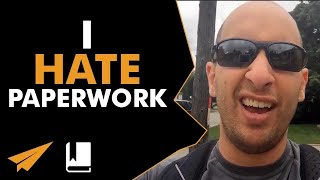
Evan Carmichael complains about the mountains of paperwork his publisher requires, including lengthy agreements and multiple copies that slow everything down. He argues excessive legal documentation creates mistrust and compares it to a prenup. Carmichael prefers informal, trust-based deals with his long-time team over formal contracts.
Chapters
I hate paperwork. I hate it. I hate it. I hate it. I hate paperwork so much. I hate it. Can you tell that I hate paperwork? I hate it so much. Hey guys, welcome to another book update video. I'm a little upset today because I had to do paperwork. And in the context of this being a book update video, with the publisher you have to sign an agreement, right? There's an insanely long agreement that you have to sign. And it outlines your relationship. Great. And I signed it and sent it off, and then we had to make a change where it's under my company instead of under my personal name. And just for that is another 4-page agreement that I have to sign 3 copies of and send it in. And for the past 3 weeks, it's been sitting on my desk, and my agent's calling me, and my literary agent's calling me and saying, Evan, are you going to sign the agreement? We need to get it in. And, you know, this is in advance, with the book, a nice advance, and I don't get that advance, and my agents don't get any piece of that advance until I've actually sent in all the paperwork. And I'm just, I'm so frustrated that I have to do this, that taking the walk to the end of the street, which is what I'm doing right now— today's the day we're actually sending it in— just drives me nuts. And because I'm doing what? I'm doing more important things, right? Like, hey, I'm actually writing the book. Anyway, today's the day it happens, and just as a general rule, I'm not a big fan of paperwork. People who've been on my team for years have not had to sign agreements. Somebody's waving. Have not had to sign agreements with me. We have an understanding. We have an understanding of what a relationship is going to be. And it's worked for me. And I get how some of you may think that's crazy. And you may think, I've been screwed over before. I've had people rip me off. I need to have everything down in writing. And I think that creates just a culture of mistrust. And for me, it's kind of like having a prenup agreement. You know, I haven't had a prenup agreement in my marriage, and I don't know if you guys do in yours. And some people recommend it. And I'm sure when I'm saying don't do paperwork, you know, all the lawyers who are watching are freaking out right now. I think if you build a team where people trust you and you care about them and you have an understanding together, that's what you need to get started. And if you have some light paperwork because that's what you need to do, then fine, that's cool. But like, some people spend so much time just creating paperwork that you don't allow yourself to actually get work done, right? That's why it bothers me, because it gets in the way of getting work done. And so I'm getting it done today, but again, you know, I've walked away from deals because there was too much paperwork. And if I didn't care so much about this book and giving it out and having something for you guys that I think would really add a lot of value, then I might walk away from it, you know? Send this mail in. No, you can't do it online. No, you can't sign. It has to be mailed in. Drives me nuts. Anyway, so thank you for listening to my rant. I feel a little bit better now. Believe Nation, coming to the rise. Thank you so much. So, yeah, I want to know what your thoughts on paperwork are. Leave that in the comments below, and we're going to get to your questions. So last week I did this from San Francisco on only a couple hours sleep. And I super appreciate you guys being supportive and, uh, hanging in there with me. So a couple questions came in. First one is from Eddie. Eddie writes in to say, looking forward to reading your book. I'll pre-order your book any day, believe.
Thanks, man, really appreciate that support.
Next up, Jarhead: have fun in California. At what point you get assigned a manager?
So I quickly talked about this while I was in San Francisco, was, uh, I got a YouTube manager and I was gonna go Okay, so while I was walking, my iPad ran out of space because I filmed all of those videos for you guys in California. And so I'm going to finish up answering your questions about the book. Jarhead, have fun in California, man. At what point did you get assigned a manager? So in, uh, in my last book update, I talked about going to California partly because I got assigned a YouTube manager who is helping me with my channel. At what point? I want to say it happened 3 weeks ago. I had maybe 85,000 subscribers. Maybe 90,000 subscribers, no, probably 80,000 to 85,000 subscribers. Yeah, so again, I'm lucky. Most people don't get one until they're way, way, way ahead of me. Tamara Weeks, most innovative channel. I agree, that's a compliment coming from YouTube. Congratulations. Thanks, Tamara. What does it mean to have a YouTube channel manager? Congratulations on that too. That's a great question, and I'm not fully sure, to be honest. It's really just having a point of contact at YouTube. I think if, if, you know, if I have a problem, a question, something I need help with, then I have somebody that I can reach out to directly who can hopefully help me through that process. Typically how they work is they, they set up a Google Hangout with you. And so I had a Google Hangout with him and then he said, I want to schedule more time because it's such an innovative channel. I want to talk to you more. And he invited me to San Bruno at their Hertz office to go meet with him. So that's why I went down. And then she finished with, I would never have known that you only have 2 hours sleep. Glad we energize you. It's really true. I get anxious when I don't get my videos out for you guys and knowing that that I'm helping answer questions really. It's the best part of my week. It's the best part of my week. Zeno N, be careful with that ring. You better not lose it. It's true. I do play with my ring a lot. We did have one video where I jumped off of a runway and it fell off. And then we were like, where's my ring? I gotta find it. But so far so good. I don't know. It just helps me whenever I'm thinking. It just, I like having the distraction. I don't know. I guess doing something with your hands for me, at least allows me to be more creative. Paul Chan, this is something new I learned, using Google Hangouts to record the conversation and process instead of writing everything less. Thanks and please sleep more. Yeah, thank you for the sleep comment. Yeah, I love using Google Hangouts, one, to try to give information for you guys, so as I'm learning, hopefully you guys are learning that process too. But then also I use it personally and I have a lot of private videos as well that just so I can refer back to them and have content there, or if I'm showing how I do something and want to share that with my team, I'll do a screen capture and put it on Google Hangouts. It's really an amazing way to kind of record things in a video format. Insaf, with regard to writing your nonfiction book, have you checked out Ryan Holiday's way of writing, which he learned from Robert Greene? Watch Ryan's interview on Inside Quest. Thanks for that. I have not heard of Ryan Holiday or Robert Greene, so I will check those things out. Aquaticy, Aquaticy, you're in my neck of the woods. Welcome to the Bay Area. Thanks. I am back home now, but I had a blast. It was a record heat in LA and it was insanely hot and we were sweating all over the place, but San Francisco was awesome, nice cool breeze, and we had a really fun time. I got a question for you. A few years back, I landed a book deal with a well-known publisher that was very hot to publish my book, but when the contract arrived, the terms were barely one notch above work for hire. We went back and forth over the contract for a few months. Ultimately, I walked away from the deal because I was pouring out my extensive knowledge and experience into the book and getting very little for it. I've been a bit soured on publishers since then. For a while I toyed with self-publishing, but I understand the importance of having a major publisher putting its muscle and effort behind your product. Do you have any tips on working with a publisher and negotiating a contract that is beneficial to both of you and them? This is a great question, and, uh, I have a couple thoughts. One, for most books, I don't think publishers do a lot in terms of the marketing muscle. And so even for my book, a lot of it's going to depend on me being out there marketing it, promoting it, selling it. And I'm not relying too much on the publisher to do that. And so the publisher really helps with, I guess, getting into stores, with the editing, with the whole book creation process, but they're not the greatest at marketing it for you. So I wouldn't look to a publisher to help with that, regardless of if you're doing self-publishing that's on your own or working with a big publisher. In terms of getting a deal, the two things that I found helpful are: one, having an audience. Right? A lot of publishers now are reaching out to people where they're just trying to close any deal and they're expecting you to pay a certain amount up front in pre-orders and that's how they're funding the book process, which I don't know, might be a little slimy. But if you have an audience, then they're willing to pay a premium for that. Right? And so I have an audience and I would encourage you to now build up your own audience, build up your own community so that when you have something that you can create, there's an audience that will buy it from you. And two, I found having an agent really helped me where we'd lined up meetings with publishers back to back to back to back to back. She had all the connections, and in two days we met with all the major publishers and got a bidding war happening basically. Whereas one, interviewing them to see if there's a fit, to see if they understand what I'm trying to do with the book, to see if I think I can work with them, and then what kind of terms would be negotiated. And so my agent took care of negotiating the terms but also putting one publisher up against another in a tight time frame to get the deal signed. Kind of like a real estate transaction. You want a bunch of people in a bidding war for your house. That's what my agent did for me on the book. And so prior to that, I had some contacts with publishers, but I wouldn't have been able to line up all of those meetings with exactly the right person to get the price kind of going up and up and up. So I think working with an agent will also really help you. Next, Malik. Evan, thank you so much for answering my video resume question and for your answering everyone else's questions during such a busy sleep-deprived time for you. Your answers and feedback have been very helpful for me. I love learning from your answers to other people's questions too. For a YouTube channel manager to sing you as one of the most innovative channels he's ever seen is mind-blowing and inspiring. Congrats. I'm humbled to be able to support you in my small way as a BTA-er. Thanks, man. I appreciate it. I wrote two short Kindle books earlier this year and found the process very difficult. I think I'm still trying to figure out a good process for writing. My questions for you this week are, 1. When you're traveling, do you edit your own Evans Book videos and upload them to YouTube yourself, or do you upload your raw footage to a shared folder and have your editor edit and post them later? I'm trying to get better insight into your specific process for this part of your work. So, when I first started my channel, I was doing everything myself. I was filming, I was editing, I was publishing. Now, even when I'm home, even when I'm in Toronto, all I'm doing is being the guy behind the camera. Sorry, in front of the camera, not behind the camera. Jason's behind the camera. Some of them I do myself. The TGIM I do myself because it's on the spot and there's no editing. The book ones typically where I'm walking on the street and I have my iPad open. The family ones would be me, but everything else, most of the videos, the espresso, the top tens, the lunch and earns, I am in front of the camera and usually Jason films them and Christina, who's my editor, will edit them. I usually send the files to Christina via Google Drive. She downloads them, she will name them, she will upload them to YouTube, she'll put in the description and the tags and all that stuff. So at the end, I'll do a final check to make sure I like everything, but for the most part, the majority of my work is just being in front of the camera. When I go away, I don't bring Jason with me, you know, I can't pack him in a suitcase. So, uh, I do my own filming right? So most of them were on my iPad, which is why I ran out of space and I have to do this video with Jason today. Sometimes I bring my camera with me. I have a, a Canon video camera that I record myself as I'm walking. So some of those videos were done by me too. But that's what happens when I'm traveling. I am now the cameraman and also the guy in front of the camera. But I'll still take all the videos and give them to Christina, and she will edit them and put them up. So I don't— I'm thankful for that, cuz that's a Crazy ton of work, and she's way more skilled at it than I am. Number 2: In writing this book, do you feel you've defined a process for efficiently writing future nonfiction books? Are you considering continually writing books, like say a book a year? That's a good question. Probably? The publisher wants me to. The publisher wants a relationship where it's an ongoing commitment, where there's multiple books coming out. It's a lot of work. And I think I've defined a process that works for me. I think I got that process actually pretty fairly early on where I start kind of high level, what's the main theme of the book, and then how am I breaking down into sections, and how I'm breaking those sections into chapters, and then how does each chapter look and each page look. That I defined pretty early on, pretty much before I even started writing, and we've stuck to that. There hasn't been really many changes. Having my team help me too with some of the research and some of the quotes and doing some of the interviews with me is also really helped alleviate the stuff that I'm not as passionate about. So my short answer is probably, but I'm hedging a little bit. I'll see how the first one does, see if I like it. For me, it's really a challenge of opportunity, right? There's so many opportunities I can work on. Writing the book takes up an insane amount of time. And should I be doing that, or should I be hosting a TV show? Should I be investing into businesses? Should I be starting an incubator? Should I be creating an entrepreneur cafe? Should I be making Toronto the best city in the world for entrepreneurs? Like, there's a lot of demands on my time from a business point of view, and I have to decide where is it going to have the biggest impact. And number 3 is, the book turning out as good as you hoped it would be? I'm pretty happy with it. By next week, I should have the rough draft finished, and then I'm going to be editing, going through, going through, going through. It's going to refine, but So far so good. I'm really excited. Next up, Dominic Scupino, who asked, hey Evan, it's, it's awesome how guys from YouTube notice all the hard work, your creativity you put in. You're a true inspiration. I do have one question. It's not exactly about book, but similar. I want to get people to sign up for my free online video happiness course I created where I can give them way more value than just in YouTube. I tried Facebook, Twitter, YouTube vids, but still have low attention and people are not willing to sign up. What would you recommend to get more people in? I think the free course gives tremendous value and I want to help them as much as possible. I think what you need to do is kick up as much noise in your industry as possible. That's my business model, is basically kicking up as much noise in my community, which is the entrepreneur community. So for you, it would be looking at, you know, who, who's your target audience? Who are the people who most need to be happy? And you could say everybody, I guess, but if you look at who watches my videos, there's outliers, but it's mostly people who are like me. It's mostly people who are around my age who are kind of like me. They resonate with me the most. And so I would start with the people who are kind of like you and try to target them with a lot of amazing free content, right? I'm putting out 3 YouTube videos a day, right? So from there, at the end, I'll have a newsletter subscription, I'll have a YouTube subscription, and I funnel a lot of people through my newsletter, and then I invite people to join my webinars, and I invite people to join the Twitter chats I'm doing and the Google Hangouts that I'm doing. And when I have the book, I'll invite people to hopefully buy the book, right? You guys want to buy the book. And I think that's really it. I think people underestimate how much work goes into building a relationship, right? And responding to comments and feedback and being active and being engaged. I think you gotta, you gotta add more value. You gotta make the videos and the— what your tweets and your Facebook stuff better. I think with Facebook, content is getting harder to rank on its own organically. You have to do a lot more targeted advertising with dark posts. Twitter It's more reaching out to people and being a part of their community and responding to their tweets. And YouTube, it's more putting out quality content, right? Like, maybe your content isn't good enough yet, and that's kind of a harsh, honest truth. Like, you look at my videos at the start, they were okay, but they just weren't good enough. And as I practiced more, I got better. As I did more videos, I got better. And you will too. So you have to make more consistent content, improve the quality of it, and then have a strong call to action to join your newsletter, give them something free that they can get from your newsletter, and in there then you can upsell your, your course on happiness. Last question from Ali: I need to find an autobiographer to help me write a book. Who should I contact? That's a tough one. That's a very personal relationship, right? It's one, somebody that you're now sharing really detailed information about yourself to. If you want to be a good autobiography, it's got to dig deep into you and not just be surface-level stuff or people won't be interested. Two, it's somebody that like you gotta work with them a long time, right? It's, you're gonna meet with them a lot. You're gonna, you're gonna, it has to be somebody you're feeling comfortable with. Even like thinking about how I got Jason to help me with the videos. I demoed and tried out 2 other videographers before him just to see, 'cause I'm gonna be with you every week. I need somebody who is on my vibe, who, you know, gives me energy too, who understands what I'm trying to do, who believes in the mission. And the first 2 people were okay, you know, the technical skills were okay. I feel like it's raining. It's raining a little bit. But it's got to be somebody that you can work with for an extended period of time because writing an autobiography is no joke. And then somebody who has the skills, right? Somebody who can actually write. Somebody who can— the hardest thing that I found in working with writers is somebody who can match my voice, right? Training somebody who can match your voice, the way you would say things, is tough. Now in terms of finding that person, It's not just putting up an ad and saying, "Hey, do you want to write my autobiography?" I would look at, one, people that you already know. I would start spreading the message to your network, to your friends, and say you're looking for this because there may be somebody in your circle who could do it. Or just by letting them know, they may know somebody, right? Like friends of friends who might be able to be a good contact for you. And two, I'd be looking at books. Look at other autobiographies. Look at other books that have been written with somebody and see which books you like. Like, which autobiographies do you love to read that were either ghostwritten or written with somebody? And find out who that person is and contact them. And what I try to do is set up a mini trial where you're, you're working with them on one small part of the book and see who, who gets it. Like, who do you riff with? Who is asking you the right question? Who's giving you the right energy? Do a bunch of mini trials because somebody could look great on paper, but until you actually start working with them, you don't really have a sense of if they're going to be a good fit for you or not. So that's it. A lot of questions. Thank you guys so much. If you have more questions about my book, the book writing process, leave it in the comments below and I will answer it next week. Thank you guys so much for watching. Continue to believe, and I'll see you soon.
More from Evan


How the Biggest Mistake in History Created A Trillion-Dollar Empire | Sergey Brin



9 Machiavelli Principles That Force People To Respect You | Machiavellian Philosophy



The First 10 Words That Instantly Ruin A Sales Conversation | Vanessa Van Edwards

The Top 1% Mindset Behind The First $5 Trillion Company | Jensen Huang (Nvidia)

