Improve Sleep NOW! | Simple 8-Step Plan
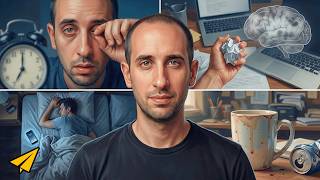
Evan Carmichael and experts explain why 7-8 hours of sleep matters: both too little and too much increase risks of heart disease, obesity, and diabetes. They outline an eight-step plan including consistent bedtimes, a dark cool bedroom, no screens before bed, limiting caffeine after 3 PM, and regular exercise.
Chapters
Good morning, Believe Nation! Today we're going to talk about why and how you can get more sleep.
Tired? We all know the feeling. Irritable, groggy, and exceptionally lazy. Chances are you didn't sleep enough last night, or the past few nights. But what exactly is enough sleep? And more importantly, can you ever catch up on it? While the very function of sleep is still debated by scientists, we do know that it's necessary to function efficiently and productively. After all, we spend 24 years of our lifetime sleeping, it had better be important. Researchers have tested how much is required each night by assigning groups of people to 4, 6, and 8 hours of sleep over extended periods of time. After 14 days, those with 8 hours of sleep exhibited few attention lapses or cognitive issues. However, those with 6 or 4 hours of sleep showed a steady decline. In fact, after only 2 weeks, the 6-hour group showed a similar reaction time to a person with a blood alcohol concentration of 0.1%, which is considered legally drunk. The 4-hour sleepers suffered even more, occasionally falling asleep during their cognitive tests. In both groups, brain function decreased day by day almost linearly with no sign of leveling off. Scientists have dubbed this cumulative effect as sleep debt. So, can we recover from it? After a night or two of little sleep, studies show that the body and brain can fully recover with a few nights of good sleep. However, with long-term sleep deprivation on the scale of weeks to months, the recovery of cognitive function is much slower, requiring many more nights of quality sleep. On the timescale of months to years, it's unknown whether brain function can be fully repaired or if it causes permanent damage. Paradoxically, with chronic sleep deprivation, your sleepiness, or how tired you feel, does eventually level off, meaning that you become less and less aware of your objective impairment over time. So, how long should you sleep? Most studies tend to show that 7 to 8 hours of sleep is the average ideal for humans. Apart from the cognitive issues, individuals who consistently sleep less than 7 hours a night have an increased risk of heart disease, obesity, and diabetes, not to mention a 12% higher risk of death. On the flip side, studies have shown that while sleeping more than 8 hours does not impair brain function, it also carries an increased risk of heart disease, obesity, and diabetes, and a 30% increased risk of mortality. So, too much sleep Early sleep may also be a bad thing. You may have heard the saying "the early bird gets the worm," but when it comes to humans, do morning people really have an advantage over night owls? Does one come out on top as more intelligent or successful than the other in this battle over bedtime? The somewhat surprising truth is that we have little say in sleep preference as it's almost entirely genetically predetermined. Chances are if you're a night owl, it was likely passed down from an ancestor who was also a night owl. And from an evolutionary perspective, it makes sense. Having individuals with varying sleeping patterns would allow for better protection of a group throughout the day and night. Instead of everybody sleeping at one time, some people naturally stay up later and some wake up earlier, aware of threats or predators while others sleep. But considering most modern societal activities happen between 9 AM and 5 PM, it may seem clear that night owls are put at a disadvantage. And researchers have actually coined the term "social jet lag" to describe the sleep deprivation many experience to accommodate social norms. For night owls, this social jet lag feels like living in a different time zone every single day. Considering chronic sleep deprivation has a direct effect on brain functioning, it's no surprise that studies report night owl university students have lower overall grades. Not to mention, early birds tend to display more positive social traits, such as being proactive and optimistic, and are less prone to depression or addictions to nicotine, alcohol, and food. And we can see these traits represented physically in the brain, particularly the white matter, which helps neurons communicate. Night owls exhibit significantly less white matter, and as a result, there are fewer pathways for feel-good hormones such as serotonin or dopamine to travel through. But it's not all It's not all bad for the late-nighters. In fact, they tend to be much more creative, have been found to have higher cognitive abilities, and are known to be risk-takers. What they lack in white matter, they make up in cortisol levels. This stress hormone gets your body ready to face an immediate threat, contributing to their risk-taking behavior, which studies show can translate into opportunities and potentially much more financial gain. Furthermore, even though morning people can be very energetic right after waking, they tend to lose steam faster than night owls throughout the day. Both sides perform equally well in reaction time tests an hour after waking, but after 10 hours of being awake, night owls perform significantly better. Your inner clock is regulated by many proteins which are created from various genes in your DNA. Studies have even shown that a single change of the genetic code near a gene called "Period 1" can result in an hour difference in your waking time. As crazy as it seems, scientists also found a correlation between these same genes and your time of death. The early risers were more likely to die around 11 AM, while the night owls were more likely to die before 6 PM. What about teenagers, you say? It's true, most tend to be night owls due to the hormonal changes during puberty, but this tends to wane out into your genetic default as you enter adulthood. So while there may be some truth to early birds getting the worm, night owls aren't exactly lagging behind in life, they're just lagging behind in time.
[MUSIC] I think that really the most important first step is to acknowledge that sleep is important. It's like anything else. If people will sort of reflect on it and say, hey, you know what, sleep is not a luxury, it's not for the lazy, it's not, you know, something that I'll do later, but it's really important and meaningful and will improve the rest of my life, that's the first step to getting better sleep.
Yeah, because you have to give it that importance. If people say, I'll sleep when I'm dead, then they're negating it.
They'll die sooner.
They'll die sooner, right, and then they're not on a regular sleep schedule either because they're not giving it It's important. So let's talk about the regular sleep schedule.
So, you know, there are a number of really simple things that people can do that can meaningfully improve their sleep. And it's funny, when I think about it, I tell people, you know, those of us who have kids, the stuff that we do for our children to encourage better sleep, if we would simply do those things ourselves, we'd benefit immensely. So, you know, our kids get a regular bedtime. Why? Because our bodies love repetition and predictability. And patterns. And so going to bed at the same time every night, waking up at the same time every morning is really ideal, and it facilitates better sleep.
Okay, that's a good point right there. Is there anything else we can do in that category?
Sure.
So what else do we do for our kids? We establish bedtime rituals, right? Our children get a bath, a story, a kiss, good night.
Mm-hmm.
Those rituals can be very powerful and reinforce good sleep and make it easier to obtain good sleep. So, you know, for adults, do some light reading, some quiet stretching, have a cup of chamomile tea, take a warm shower, something enjoyable, relaxing that you can do on a regular basis, and it really helps your body and your mind realize, hey, it's time to transition from my multitasking, really crazy, overextended day to this sort of blissful, tranquil world of sleep. You need that little transition, and a bedtime ritual can really powerfully do that.
I like that, treating it kind to say, like, you wouldn't give your child a big sugary snack or keep them up past their bedtime. You know that's a recipe for disaster. Why would we do that to ourselves?
Exactly. You kind of ease into it with a repeatable, predictable ritual.
Also nutritionally, do not eat a bunch of carbohydrates before you go to bed. Sugars, grains, pastas, rices, even beans and fruit. Lower your carbohydrate consumption before you go to bed. That's why I suggest for dinner doing organic vegetables, nuts and seeds, and organic meat. So organic meat, vegetables, nuts and seeds, those are the things you should really be eating before dinner, not a lot of other stuff. The other thing I recommend is if you are consuming caffeine, don't consume it after 3 o'clock in the afternoon. Hey, a little bit okay is for breakfast if you're doing some green tea or even some organic coffee, but when you do it later in the day, Caffeine has a 12-hour half-life, which means 12 hours it's going to stay in your system. So if you're drinking that at 4 o'clock, it's not out of your system until 4 AM the next day. And so really it's important that really you only do caffeine if you're going to do it first thing in the morning, not later on in the day. The other thing that's really important in terms of sleep patterns is making sure you're getting proper nutrients. Magnesium in studies has actually been shown to help you sleep better. So have omega-3 fatty acids. So load up on foods high in magnesium like nuts and seeds and raw dairy products. Also in foods containing omega-3 fats like grass-fed beef, flaxseeds, chia seeds, salmon, fish oil, taking a cod liver oil supplement. All those things can be vitally important when it comes to sleeping well. And the last thing here is exercise. I found when I'm exercising, I sleep a lot better that night, especially when I'm doing Burst training or weight training can actually help you sleep better as well.
Make your bedroom a haven for sleep. The first critical thing is make it as dark as you possibly can, and also make it slightly cool. Very important. Actually, reduce your amount of light exposure at least half an hour before you go to bed. Light increases levels of alertness and will delay sleep. What's the last thing that most of us do before we go to bed? We stand in a massively lit bathroom We're looking into the mirror, cleaning our teeth. It's the worst thing we could possibly do before we went to sleep. Turn off those mobile phones, turn off those computers, turn off all of those things that are also going to excite the brain.
So the more time we spend in bed awake, not sleeping, the more time it drives home the message to our brain and to our body that the bed is the place for tossing and turning, not the place for sleeping. If all the time you spend in bed, if most of that time is spent sleeping, you know, you train yourself, you program yourself that that's what the bed is for. On the other hand, if you're spending a lot of time awake, what you end up doing is the opposite. You end up programming yourself to be awake, which is why a lot of times people can feel really, really tired, then they get into bed and their mind starts going and they don't quite know why.
I've been there. Okay, but now if you just can't sleep, does time really matter?
So this is a really important question. Time during the night can be a slippery thing. Sometimes it feels like an hour's gone by, but it's only been 5 minutes. But on the other hand, sometimes it feels like only a few minutes have gone by, but it might have been half an hour. Well, the problem is the more time you spend in bed awake, not sleeping, the more likely you're going to develop some sort of insomnia. So what you need to do is once you hit around 20, 30 minutes, maybe a little more depending on who you are, you've gotten to the point where that sleep is not happening. It's best to just get out of bed, do something else for a little bit, just try again in a little while.
Okay, so if 30 minutes have passed, get up and do something, but what, what kind of activity would you be doing in the middle of the night exactly?
So you want something that's not too exciting, um, because you want to be able to put it down in 30 minutes or 45 minutes or however long you want to give yourself before you try again. So if you get too engrossed in it— so if you're someone who gets engrossed in a book, that might not be the best idea. But if you're someone for whom a book relaxes you, it's a great idea. Also, you might want to avoid doing work because sometimes when people pick up the computer and start working in the middle of the night, a lot of time can go by and, uh and you might end up waking yourself up a little more and it might be hard to get back to sleep. Also, don't do anything that involves turning on the bright lights. So if you're using a computer or something, make sure the lights are pretty dim so that it doesn't wake you up too much.
Yeah, that's a good point, especially with all the social media we have and all the gadgets. But now that sounds like we're kind of giving up on the idea of getting any rest because we're getting up. Is that the case?
No, you're not saying, you're not giving up. What you're saying is you're being realistic, that sleep isn't happening right now. And the more you chase after it, the further away it's going to get. What you need to do is let that anxiety go. Let that stress go. Just accept the fact, okay, sleep is not going to happen right now. But if you're going to sleep well later, you need to give it a break and try again later. If anything, you'll end up sleeping more in the long run. In the short run, maybe a little less, but you'll end up sleeping more in the long run because you're going to be programming your brain. That the bed is for sleep, not for wake.
Your thoughts, you got to get them under control. The way to do it is be in a place of gratitude. Just say thank you. That's it. When you get into bed, just say thank you to your God, to your Creator, to yourself, to the world, to the cosmos, whatever your personal faith or beliefs are. Just go, when you think about anything, if you think about anything, is just be grateful. Just think about all the things you're grateful for in your life. Don't think about all the things you need to do tomorrow that's gonna whack you out. Just think about the things that you're genuinely grateful for in life because you know what? A happy heart rests well. So if you can just be happy and grateful for the things that you do have in life, the person and the choices you've had in your life, the blessings that are all around us all the time, the good things that have gone on in your life. Just think about those. It'll help you fall asleep much more peacefully and easily. You'll drift out just fine. Wake— set your alarm for 8 hours later before you go to bed so you know you're getting that time, and try to do it. If you wake up early, just lie in bed thinking about all the things you're grateful for in life. Maybe some of the things you have to do as you wake up to slowly wake yourself up. Don't wake up and immediately check your screens. That sets the anchor and it trains your brain.
Gotta get up, gotta handle, gotta handle, gotta handle.
And that's why you're waking up too early often and kind of freaked out and you can't stop because you're actually conditioning your brain to get up and check all these things. Don't do that. When you wake up, instead have a morning ritual that doesn't include checking into everything. Check into yourself. Think about your thoughts, Maybe stretch your body, do your exercise, your workout, then plan the day and get at it. If you keep these things in mind, if you actually practice them, you'll start to have a whole new experience with sleep. You'll feel better about it. There'll be less pressure about it. You'll sleep great. You'll wake up great. You'll start to feel more energized, more engaged with your life, more enthusiastic because you actually, for the first time, feel rested, clear, ready to tackle on the day, you'll get to experience what we call the charge life.
If you want some sounds that will help calm you down and fall asleep, here are 5 soundtracks that might help you. Thank you guys so much for watching. I made this video because Rishi Kaur TV asked me to. So if there's a topic that you want me to cover in the next edition of Believe Life, leave it in the comments below and I'll see what I can do. I'd also love to know how much sleep are you getting? Is it enough? Is it not enough? Are you gonna change that now after watching this video? Leave it in the comments below. I'm really curious to find out. Thank you so much for watching. Have an amazing day. Continue to believe, and I'll see you soon.
More from Evan


How the Biggest Mistake in History Created A Trillion-Dollar Empire | Sergey Brin



9 Machiavelli Principles That Force People To Respect You | Machiavellian Philosophy



The First 10 Words That Instantly Ruin A Sales Conversation | Vanessa Van Edwards

The Top 1% Mindset Behind The First $5 Trillion Company | Jensen Huang (Nvidia)

