Josh Groban: The Only Way To Succeed in Music Is To Stay True To Yourself!
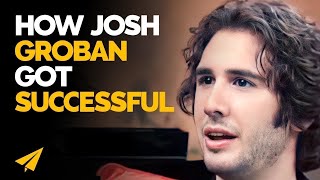
Josh Groban shares his rules for success in music, starting with authenticity over industry formulas. He recalls filling in for a 45-year-old opera star at 17, surviving a vocal crisis mid-show in Milwaukee, and deliberately seeking fear-inducing challenges like recording a Broadway album to stay sharp.
Chapters
You try harder and harder to kind of fit into a mold, and I think that what they don't realize is that you're the only one that's you.
I tend to overthink things until, until the idea becomes pointless.
If you feel like what you're doing is becoming a formula, break the formula.
He's an American singer, actor, and producer. He was the USA's best-selling recording artist in 2007. To date, he sold over 25 million records. He's Josh Groban, and here's my take on his top 10 rules of success. Rule number 1 is my personal favorite, and I'd love to know which one you guys like the best. And as always, guys, as you're watching the videos, if you hear something that really resonates with you, please leave it down in the comments below and put quotes around it so other people can be inspired as well. Also, as you are writing something down, it's much more likely to stick in your head too. Enjoy.
The people that I really look up to are those people that kind of did it their own way, kind of people that let people come to them and ignored the hype and just went ahead and tried to come up with their own personality musically. It's a little bit of a harder path, especially with the way that the industry is now, but I think that ultimately if I can be looked at not as a genre but as, "Oh, I just like— it's just Josh. I like Josh," then that would be a great goal for me. If I can look back and hopefully have a long career and look back and say that I did everything the way I wanted to and just kind of stay true to myself. That's the one thing I think most new artists need to kind of realize is that, you know, that you try harder and harder to kind of fit into a mold, and I think that what they don't realize is that you're the only one that's you, you know. If you just embrace that 100%, you'd be the most unique thing out there because there's nothing else like that. So, you know, it's hard to do, but if you can kind of keep that mentality, I'd like to try to do that.
Anybody that says that, you know, they had their big break, you know, it winds up being because you're in the right place at the right time, but it's the preparation meets the opportunity. And so, and a lot of times that opportunity, you don't know that that's the opportunity when it happens, you know. And for me, meeting David, singing with Celine that night, I originally said, I don't think I can do this. Thank you, but, but no thank you. Because I, you know, I was, I was scared.
I was terrified.
I was 17 years old and I had to fill in the shoes of a 45-year-old opera superstar, you know. And I was thinking to myself, well, you know, I just, I just don't want to mess up, you know. So, and he called me back and he said, no, you don't understand, I'm not asking you, you know, you're not going to let me down. Get your butt over here. And, uh, and so, so I went, and, and that was one of the one of the first things that really taught me that it's about really throwing yourself into the fire and taking those risks. And so to a certain extent, it's been a huge rise, but at the same time, I still very much feel like a student of it, and I'm learning every step of the way.
So the album was out there, and it started to gain some momentum, or— I mean, I'm going— It started to change. I don't know, because I was going to Virgin Megastores when they still existed and, like, you know, putting on sunglasses, not that I needed them at the time, and kind of saying, "Do you have that Josh Groban CD?" You know, "I'm looking for it everywhere, and I just can't find it.
What a lovely young voice he has." And they're like, who's that, Josh Brolin?
I didn't know he sang. And so they would have to pull— I'd keep finding that they'd have to pull it out of storage from way, way down in the depths of— So then you get right on the front.
Yeah, exactly.
Yeah.
It was Bed Bath Beyond. I was in the beyond section. I was like way down, this will never sell section. So they would pull one out for me.
And I was like, oh, excellent.
You really should put these out in front. And so it went from that to— and I had done a number of different things. I'd sung on the Olympics. I'd been on the Rosie O'Donnell show who was very supportive early on. It wasn't until 2020, uh, wound up kind of doing a story about me. Um, it, it was a, uh, I think primarily based on a wonderful New York Times piece actually that came out, um, where you guys kind of wrote a, you know, really wonderful article. And, and they, uh, they said, we want to do a story, we want to interview you, we want to connect the dots. So what they did was they kind of basically said to that 2020 audience, you've seen, you've seen them here, here, here, and here. Here's where you can ask for a CD, and here's his name, and here's his face, and here's his hair. And, um, and there— and, and that, that was the light bulb that the country kind of turned on. And I went from being 148 on the charts the week prior to being number 8 the next week.
Wow.
It was that fast. And, and Oprah followed, and then it was all she wrote.
Are you critical about your music? I'm pretty hypercritical. I'm really hypercritical about it.
Um, I tend to overthink things until until the idea becomes pointless.
So one of the other things that I've learned in my 3-album career is— A lot. Yeah, exactly right, is to let things go. Sometimes you just need to let them, let the child out into the world.
When you go into write tracks, do you, you know, is it a process where it just flows naturally, or do you sit down and go, okay, well, this is the type of song I want, this is the type of people I want it to connect to?
Yeah, I think it's kind of hard. It's very hard to generalize what type of audience I'd want to connect with. I can only write music and find music that affects me in some way or triggers a memory or a story in my own head. And being as that we're all human, you'd like to assume that if you've been there and you've gone through it, other people will too. I think the only time when you do miss, when you miss the mark is when you sing stuff that's dishonest for you thinking that, oh, you know what, I'm not really feeling it, but I'm sure a whole lot of other people will. And they're on to you. You know, it's one of those things where, you know, if I find a song or write a song, even if it feels like it's more of a general message or universal message, sometimes those are the songs that need to be sung.
It's been said many times, perhaps first by a Roman philosopher, that where preparation meets opportunity is what some people call luck.
And what's interesting is that I definitely had the opportunities. I didn't think the preparation part was ready. Like I said, when I started junior high, I was a late bloomer. I was 13 going on 9, you know. And when I think about the fact that I was really given my first push by that first teacher, that's wonderful. That was at 13. And I was signed to a major record deal at 17. That's not a lot of time. To figure it all out and to all of a sudden be thrust on a world stage, from first solo to first album. So I had to kind of be a professional and a student at the same time. And I would say that my first— if my fans go back and YouTube any of those promo clips from my first record, you can see behind the eyes that I am absolutely terrified. There is a major fake-it-till-you-make-it psychology going on there.
Well, but fear can be a great motivator.
It can. It absolutely can. And I think that sometimes When you're in this business for long enough and it starts to feel like another day at the office, you actually need to actively search out where that fear came from and find it again. That's where the risk-taking happens. That's where deciding to do a Broadway record out of nowhere happens, is what, what can I do to make me scared again? And it can be good.
When that first record came out, we weren't writing it for radio. We weren't producing it really for any, even for our label at the time. You know, we, we didn't know what, if we could break even, if we could sell maybe 50,000, 60,000 copies We will have had a nice run. And in some ways, that vision hasn't changed at all in the making of the next 6 records. It was really simple, which was that David and I had a really great connection. He knew what my voice did best at the time. And I wanted to move people with singing. I just wanted to find music or write music, which I didn't wind up doing until later, that made me feel— made other people feel the way I felt when I listened to great singers that I really appreciated. And listen to music that I appreciated. I grew up, you know, going to, you know, the LA Music Center.
My parents brought me to a lot of great things.
And I would walk out of there with chills, just feeling very different than the ordinary fan. I wasn't just humming it and wearing the hat. I was— I wanted to be that vessel at some point.
When things start being handed to you, when you start getting mass media and things start becoming a little easier in terms of getting attention, the risk factor involved and the thing that you have to really watch out for, and I think it's the reason why there's a lot of music out there after a while that just for whatever reason you can't put your finger on it, but it's just not as inspiring to you anymore as when it started, is just that it's easy to kind of rest on that. And one of the things that I've really wanted to pay homage to the success with is to, is to not, you know, keep the security blanket around you. If you feel like what you're doing is becoming a formula, break the formula and try something that hasn't been done before and work with people and try new things that really put the opportunity out there for failure. And I think that when you do that, that's when the most exciting things happen.
When I lost my voice, it had nothing to do with those things. It had nothing to do with having had a bit too much to drink or anything like that. I had an allergic reaction to something that I ate beforehand, and my warm-ups were perfect, my sound check was flawless. I went out there, and after my third song, half of my voice was a whisper.
Where was this and when was it?
Milwaukee.
I'll never forget it. Probably 2005, maybe. 2006.
So you're on stage.
I'm on stage in front of 18,000 people. And I remember there's no worse feeling than just— this wasn't just, "Oh you've worked your voice too much." Oh, you're having trouble hitting that note; you're just a little tired. This was la-la-la-la-la-ha-la-la-la-la-la-la-la-la-la and went oh okay something's up, something is wrong here because the rest of the day it was just fine. So, it was probably the scariest, one of the scariest things I ever had to do was level with 18,000 people and say, "All right, here's what's up. I've got a frog in my throat tonight. I think I'm catching something. And I'm gonna take 15." I said, "I've got a couple of options here tonight. I can lip sync the rest of the show." No, boo! Okay, all right. We won't do that. All right. I can cancel the show after 3 songs.
"Boo!
No, no, no." Okay, all right, well, I don't want to do that either. Or I could take a few minutes, figure out what the heck is going on, and come back and finish the show for you guys.
"Yay!
All right, thanks Milwaukee. We'll be back." And I walked off stage and I worked with my voice coach a little bit, who thankfully was on the road with me at that time, and flushed my system out with water and just Had tea and water.
Hydrated, right?
Hydrated like crazy. And through really slow scales and lots and lots of water, I was able to tightrope walk those notes back into my throat that night. Then the thing that really was the struggle, more than the vocal, was getting my head back that night, having the confidence. Because once it's not there for you, there's so many similarities in singing psychology to sports psychology. When I watch a figure skater who's just fallen, for instance, and then they have to go and do a triple axel 5 seconds later. How do you have the confidence to land on that knife edge after you've just fallen down? And it's the same kind of thing. And I went out there and the voice got stronger and stronger and stronger. People were singing along. And by the end of the night, I was hitting the high notes again. And I thought, "Oh, God. This review is just gonna be the worst review of all time. This is just, this is gonna be the worst." The worst thing anybody's ever read. Barely a mention. Ah, he felt a little sick, he left the stage, came back, blew everybody away.
Bullet dodged. That was—
but that was a great learning experience and something that I would like never to have happen again. And it really is about having the inner strength, and that just comes from experience, to regain your own momentum.
It's a really nice thing if somebody wants to shake your hand, tell you a story about a song that meant something to them, or in one case there was a cardiac anesthesiologist on on the express train, and she just comes to New York for fun, and she's in DC, and said that I was like the number one requested CD for patients who needed to relax before they're put under for surgery.
Oh my God.
That is lovely. I mean, that was like almost a compliment, you know? Wait, wait, I think that qualifies as a compliment. I think it does too.
Yes, it totally does.
I don't think the Ramones ever got that. It puts me right out, let me tell you. So it's fascinating. I was sad that it was her stop because I wanted to talk to her more, you know, but it's cool. I always meet interesting fans, and I would never want to lose my ability to interact with the city.
Because you look like the son that the mother who receives the CD for Christmas wants to have.
Spot on.
I think it's bad for families because they then see their own sons as less good than you. I wish my son was a pop/opera crossover artist rather than working in a call center. Anyway, what I'm asking you, all I'm asking you, is that you look into camera 5 now and say to sons thinking about buying their mothers Josh Groban albums, say, don't do it. Just talk to your mother and let her know that you're a good person too.
Sons and daughters of England, I urge you not to purchase my record. Do something nice. Make a card. Buy a puppy for her. Chocolates. There are really so many things that you can do to make your mother happy than buy a Josh Groban CD. So please, from Josh Groban, stay away.
Thank you guys so much for watching. I made this video because YouTuber Peter Hollens asked me to. So if there's a famous entrepreneur that you want me to profile next, leave it down in the comments below and I'll see what I can do. I'd also love to know what did Josh say that had the biggest impact on you and why? What are you going to take from this video and immediately apply to your life or to your business? Leave it in the comments. I'm going to join in the discussion. Finally, I want to give a quick shout out to Zeno Nuenhaus. Thank you so much for picking up a copy of my book, Your One Word. I really, really, really appreciate the support and everything you've done for Believe Nation as well.
As well.
So thank you guys again for watching. I believe in you. I hope you continue to believe in yourself and whatever your one word is. Much love. I'll see you soon.
You know, I was a little bit not prepared for the edge, I think, that high school would bring at the beginning of that period. And so, yeah, when you're a sensitive kid, when you're interested in starting an improv class and not joining the football team, there's some bullying too. And also just the workload gets different. I wasn't prepared for the difference in academic work. I mean, it was a lot to take on at once.
Yeah.
Well, looking back on it, Did that have a lasting effect on you?
Well, sure. I mean, you have to develop a thick skin. You have to find what your defenses are. In my case back then, it was humor, you know. I think that the class clowns are always the ones that are a little feeling a little lost and need to build that shield. So I think that any comedy that I do now certainly stems from having to fight back in my own way back then and having to deal with my own insecurities back then. I think comedy comes in to defend that a little bit. And also, when looking back on it, I wouldn't want to repeat that time in my life for anything in the world. But I also know that I learned so much during that time, and I'm glad I didn't peak in high school or junior high school. I'm glad that I needed to take the time to be awkward, to figure out that the things that were you know, considered the cool thing wasn't what I was up to. So, okay, what is it that I'm gonna do? I've gotta find my own identity. I've gotta find what makes me tick. I can't rely on throwing the long pass. I've gotta find that thing that is going to make me tick. It was a music teacher that finally did it for me. It was somebody that said, "You've got a voice." Pulled me out from the back of the choir. I was terrified. Said, "You're gonna sing this song." And after I sang my first solo, half of the kids that were at that thing, they came up to me and said, "Man, that was good.
Man, that was really good." You remember what it was, that solo?
Yeah, it was "Swonderful," Gershwin's "Swonderful." Swonderful, smarvelous. And—
I like that. Would you mind doing that again a cappella and give me a little more of it?
You should care for me, soft night. It's paradise, what I long to see. You've made my life so glamorous. You can't— what is it? Me for feeling amorous. So wonderful, it's marvelous that you should care for me.
Oh, well done.
Thanks. I mean, I just, I love Gershwin.
I love those songs.
And it was, you know, it was fun. My parents hadn't heard me sing before, and they were, you know, crying. And it was my first feeling of like, okay, this is, yeah, you could do this. This is your communication.
More from Evan


How the Biggest Mistake in History Created A Trillion-Dollar Empire | Sergey Brin



9 Machiavelli Principles That Force People To Respect You | Machiavellian Philosophy



The First 10 Words That Instantly Ruin A Sales Conversation | Vanessa Van Edwards

The Top 1% Mindset Behind The First $5 Trillion Company | Jensen Huang (Nvidia)

