Life Upgrade: Transform Chaos into Order with Simple Daily Habits | Jordan Peterson
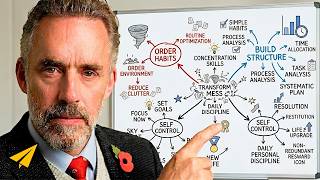
Jordan Peterson discusses how to build a better life through concrete habits and personal responsibility. He argues most people should pursue stable vocational work with integrity rather than high-abstraction jobs, recommends self-authoring tools to make a plan, and explains how depression responds to social connection and purposeful work. He uses biblical stories to show why distributed local leadership matters more than centralized power.
Chapters
You should be careful with your words, because when you use them, you're doing one of two things. You're either creating what's good, or you're doing the opposite. I know no one who hasn't been radically successful who isn't radically expert at communication. And that also means they're radically expert at thought, because mostly we think in words. And so, and when you write, you're learning to think. And when you're using the language that you strive to master, you are literally generating the present and the past out of the future in the direction you're aiming at. That's what you're doing. That's what consciousness does. And so you want to have respect for that. You want to take your place in the world. You better learn how to use your tongue. Hey, it's Evan Carmichael, and I make these videos because I want to wake up and feel like today is going to matter, that I can do something special. And the way that I get that feeling is I see people who are doing amazing things, and in watching them say amazing things and do amazing things, it makes me feel like I can do amazing things too. So I hope that this video helps you feel like you can do something amazing today as well. So today, let's get some incredible motivation from the one and only Jordan Peterson. Enjoy. One of the chapters in my books is, is focused on putting your house in order. It's like, well, how do you start? Make your bed. You know, it actually took me quite a long time in my life before I made my bed regularly in the morning. Most of my life was pretty good order, but that was one thing I didn't have in order. My clothes in my closet as well. All that's in order. Not all of it. I'm cleaning out some drawers right now. But look around and see what bugs you in your room. Just look. It's like, okay, I'm in my room. Do I like this room? No, it bugs me. Okay, why? Well, the paint's peeling there and it's dusty there and the carpet's dirty and that corner's kind of ugly and the light there isn't very good and my clothes closet's a mess, so I don't even like to open it. Okay, that's a lot of problems. That sucks. That's a lot of opportunity. Pick something and fix it. Something that bugs you. Yeah, but not too much. So the rule is, Pick something that you know would make— pick a problem, pick a solution to it that you know would help, that you could do, that you would do. So you have to negotiate with yourself. It's like, well, I won't clean up this room. How do you know? I've been in here for 10 years and I've never cleaned it up. It's like, well, obviously that's too big a dragon for you. Would you clean one drawer? Find out. And so imagine now you want to be happy when you open that drawer and you think, well, that's stupid. It's like, is it? Maybe it's your sock drawer, which I cleaned up in my room the other day, by the way. You're gonna open that every morning. That's like 30 seconds of your life every day. Okay, so that's 3 minutes a week. That's 12 minutes a month. That's 2 hours a year. So maybe your life is made out of— you got 16 hours a day. Let's figure this out. 5, 12 in an hour, 12 in an hour. 144 in 12 hours. Yeah, let's say 200. 200 5-minute chunks. That's your life, ladies and gentlemen. Jordan Peterson did just some math how many 5-minute chunks there are in a day, and I got pretty sure that's pretty accurate. It's approximately right. So you got 200 5-minute chunks, and they repeat. A lot of them repeat. So if you get every one of those right— they're trivial, right? Who cares what my sock drawer looks like? It's like, fair enough, man, but that's your life. The things you repeat every day, the mundane things. Think I could get all those mundane things right. That's the game rules. It's like now all the mundane is in place. Now you can play because all the mundane is in place. You're going to find the meaning in your life by adopting maximal responsibility. That's going to be extremely difficult because you're so bloody useless. You can't even get your own house in order. And you're going to be called upon not only to get your house in order, but to do that well enough so some woman can stand having you around for more than like 15 minutes in the back of a car. And then maybe you're going to have to do it so that you could be a good father to a family and a pillar of the community. And that's not just empty words. Like, if you do that nobly, there'll be something to you. And then when the storms come, You won't be blown over by the first 4-foot wave. And young men think, huh, mean I could be something that wasn't blown over by the first 4-foot wave? They think, oh, well, that's inspiring. Maybe that's worth doing a little work towards on the off chance it might be true. And the thing about it is, it is true. So it's not that difficult once you understand it to make a case for it. It's true. And it is also true that you grow in proportion to the weight you take on voluntarily. And it's also true that we have no idea what the upper limit to that is, right? So, you know, you, you've met remarkable people in your life. People can do remarkable things. And there are inevitably people who take, who took on remarkable burdens. And because they did that, their development was forced by necessity. They were forced by necessity to grow beyond what they were. And who knows what the limit to that is? Strive to put yourself in a position where you can actually make choices. And that's actually a good guiding principle throughout your life. You know, maybe you're being oppressed at work. Certainly possible. And I know that there are people who are in such dire situations that in some sense they're trapped. I've had lots of clients like that, right? So I make allowances for the fact that now and then you get into a situation you just can't get out of. And that's real hell. Forget about that for the time being. If someone is pushing you around, you need to be able to say, No. Well, so let's think that through. You need to know what no means. And no means if you keep doing this, something you do not like will certainly happen to you. That's what no means. Now, I'm not trying to make that into a threat, but it is a threat. No means no implies it implies a border. Well, in order to say no, you have to be able to put up the border. And let's say you have a job and you need the money, and maybe you have a family and you have no other options. Your no isn't very useful because what have you got to back it up? And maybe you think, well, I'll stand on moral principles and I'll quit my job. Well, great, but what are you going to do for money? And how about your family, right? That's a big problem. And so when I had clients in that situation, that was usually a 2-year campaign, something like that. It's like, well, how's your resume look? And that's usually a dismal question for people because it's full of holes and they haven't updated it for 5 years and they're embarrassed about 2/3 of it. It's badly written and they've hidden it in some corner of their computer where they don't even want to look. And so haul it up. Let's go through it. Can you fill in the gaps. Is there some way that you can make yourself more marketable so that you have options? And we could lay out a plan to see how that might be possible. Maybe you're afraid of applying for a new job because you have to send out 50 resumes to get one bloody interview, and that's annoying and time-consuming. And then maybe you don't have any real confidence in your interview abilities. Well, time to fix all that up, or you stay under the thumb of the tyranny. Those are your options. And that's not a good option, because if you are under the thumb of an emerging tyranny and you don't set yourself up to withstand it and push back or leave for somewhere better, then it will definitely get bigger and you will definitely get smaller. And no matter how bad it is now, it's going to be way worse in 5 years. Also, to make sure you're actually taking action after watching this video, I've designed a special free worksheet just for this video. The worksheet will highlight all the lessons learned in this video, as well as pull out our 3 favorite learnings and quotes that will inspire you to actually do something. The worksheet will also give you space to write down what your key takeaways are and your specific plan of action to make sure you're getting results. If you want the worksheet designed specifically for this video, absolutely for free, there's a link in the description below. Go click on it and start building the momentum in your life and your business. I'll see you there. You don't have to think except when you're failing, because the purpose of thinking is to calculate a new trajectory. And if the trajectory you're, you're pursuing is producing the desired results, then your theory is intact. Well, then the question emerges, which is, well, how much failure is necessary to make you think? And that's actually a moral question. That's a question of willful blindness. You know, if you're awake and alert and if you're humble in the classic virtuous sense, you're always trying to figure out where you're insufficient and to rectify that, right? In many Christian prayers, the Jesus Prayer, for example, is a reminder that The Orthodox cite that continually, chant that continually, is a reminder that you're insufficient in your current form and you should be looking for what would rectify you. That's the practice of humility. And the advantage to that practice is that you can make micro repairs instead of staying stubborn till the apocalypse happens and then collapsing. Now, in the, in the story of Moses, what happens to the Pharaoh, who's a tyrant, is that the crisis emerge and then magnify, right? They just get worse and worse and worse and worse, and he utterly fails to respond. And the consequence of that is that his entire society is devastated. The firstborn are all killed, and the Red Sea floods and destroys the, uh, the what, the military might of the Egyptian Empire. Well, they say the people perish without vision. What is hopeful vision? Well, hopeful vision is what you're working toward. You know, you think, well, if I could have things this way in my family, in my life, in my community, that would be worthwhile. I could get on board with that. Well, your vision of the future that attracts you and also provides you with security and direction, orientation, that unites you with others, that's your hopeful vision. And you perish without that. Hopefully through discussion and negotiation, we could develop something approximating a collective hopeful vision that we could all be on board with. Like part of that for me is, well, how about if we work as hard as we can as quickly as possible to ameliorate absolute poverty, provide inexpensive energy as widely as possible everywhere in the world and lift people out of the poverty that, what would you say, compels them to adopt a cataclysmically short-term vision of the world? Now, you know, you might say, well, that's not priority number one. It's like, fair enough. We could have a discussion about what priority number one might be. But that's, for me at least, an element of what might constitute a hopeful vision. And I think it's a realistic one too, given that rich people care more about the planet. They can afford to. Part of the reason that people go watch anti-heroes and villains is because there's a part of them crying out for the incorporation of the monster within them. Which is what gives them strength of character and self-respect, because it's impossible to respect yourself until you grow teeth. And if you grow teeth, then you realize that you're somewhat dangerous, and— or maybe somewhat seriously dangerous, and then you might be more willing to demand that you treat yourself with respect and other people do the same thing. And so that doesn't mean that being cruel is better than not being cruel. What it means is that being able to be cruel and then not being cruel is better than not being able to be cruel. Because in the first case, you're nothing but weak and naive. And in the second case, you're dangerous, but you have it under control. And you know, a lot of martial arts concentrate on exactly that as part of their philosophy of training. It's like, we're not training you to fight, we're training you to be peaceful and awake and avoid fights. But if you happen to have to get in one— and I guess the philosophy also is, is that if you're competent at fighting, that actually decreases the probability that you're going to have to fight, because when someone pushes you, you'll be able to respond with confidence. And with any luck— and this is certainly the case with bullies— with any luck, a reasonable show of confidence, which is very much equivalent to a show of dominance, is going to be enough to make the bully back off. And so the strength that you develop in your monstrousness is actually the best guarantee of peace. There's this old story in King Arthur where the knights go off to look for the Holy Grail, which is either the cup that Christ drank out of at the Last Supper, or the cup into which the blood that gushed from his side was poured when he was crucified. The stories vary. But it's basically a holy object, like the phoenix in some sense, that's representation— a representation of transformation. So it's an ideal. And so King Arthur's knights, who sit at a round table because they're all roughly equal, go off to find the most valuable thing. And where do you look for the most valuable thing when you don't know where it is? Well, each of the knights looks at the forest surrounding the castle. And enters the forest at the point that looks darkest to him. And that's a good thing to understand, because the gateway to wisdom and the gateway to the development of personality, which is exactly the same thing, is precisely through the portal, portal that you do not want to climb through. And the reason for that's actually quite technical. This is a Jungian presupposition too, is that, well, there's a bunch of things about you that are underdeveloped, and a lot of those things are Because there's things you've avoided looking at, because you don't want to look at them. And there's parts of you you've avoided developing, because it's hard for you to develop those parts. And so it's by virtual necessity that what you need is where you don't want to look, because that's where you've kept it. And so— and that's why there's, you know, an idiosyncratic element of it for everyone. Your particular place of enlightenment and terror is not going to be the same as yours, except that they're both both places of enlightenment and terror. So they're equivalent at one level of analysis and different at another. So anyways, back to fiction and what it does. It distills truth and it produces characters that are composites. And the more they become composites, the more they approximate a mythological character. And so they become more and more universally true and more and more approximating religious deities. But the problem with that is they become more and more distant from individual experience. And so with literature, there's this very tight line where you need to make the character more than merely human, but not so much of a god that— you know, one of the things that happened to Superman in the 1980s— Superman started out as He's got a heavenly set of parents, by the way, and an earthly set of parents, and he's an orphan like Harry Potter. Very common theme is that when Superman first emerged, he could only jump over buildings, you know, and maybe he could stop a locomotive. But by the time the 1980s rolled around, like, he could juggle planets and, you know, swallow hydrogen bombs, and, you know, he could do anything. Well, people stopped buying the Superman comics because how interesting is that? It's like Something horrible happens and Superman deals with it, and, and something else horrible happens and Superman deals with it. And it's like, that's dull. He turned into such an archetype. He was basically the omniscient, omnipresent, omnipotent God, and that's no fun. It's like God wins and then God wins again and then again God wins. And you know, so then they had to weaken him and different ways with kryptonite, you know. So green kryptonite kind of made him sick, and red kryptonite, I think, kind of mutated him, if I remember correctly. And anyways, they had to introduce flaws into his character so that there could be some damn plot. And that's something to think about, you know. There's a deep existential lesson in that, in that your being is limited and flawed and fragile. You're like the genie, which is genius in the little tiny in the little tiny lamp, you know, this immense potential but constrained in this tiny little living space, as Robin Williams said when he played the genie in Aladdin. But the fact that you have limitations means that the plot of your life is the overcoming of those limitations, and that if you didn't have limitations, well, there wouldn't be a plot, and maybe there would be no life. And so that's part of the reason why perhaps you have to accept the fact that you're flawed and insufficient and, and live with it and consider it a precondition for being. It's at least a reasonable— it's a reasonable idea. It's one thing I did in 1985, '82, '83— '82, I swore that I would stop lying. I said I'm gonna try not to say anything I know to be untrue. You know, that doesn't mean I swore to tell the truth. Because truth, that's hard. But you can consciously stop lying when you know you're lying. You can stop doing that. And that has been revolutionary for me. And one of the things I've really realized in recent years, and this is very much worth knowing, is that many times when people speak to each other, they have an agenda in mind. You know, you want something from someone, maybe you want a job, and you want to craft your image to get the job, right? So you say what you need to say to get what you think you need. The problem with that is, what do you know about what you need? You're so accurate about that, are you? And you think you know what you need exactly, and so you're going to falsify your utterances to bring about the desired end, and you're going to use the other person as a target of your manipulation. Well, that's like you write an essay because that's what the professor wants to hear. It's like you don't do that because you don't falsify your words, because hypothetically they're divine and the whole stability of the state rests on them. Hypothetically, and maybe really too. And so you don't do that. And so instead you strive to tell the truth, and maybe that's an aim too. And then it's an adventure, because I'll tell you one thing, if you tell the truth, you have no idea what's going to happen to you, because you have to let go of that. It's like, I'm going to say what I think, and then what I'm going I'm going to assume faith. I'm going to assume that whatever happens, if I am telling the truth, is the best thing that could happen. Because the truth brings about what is best. And even if it looks hard for me, because it might be, you know, because people take the easy way out often when they lie. Even if it looks bad for me, that doesn't mean it's bad. It just means I don't see the whole— I don't see the whole picture. And you know, if you believe that the truth will set you free, and that there is such a thing as the truth, and that the truth is redemptive, then you're pretty much stuck with that conclusion. But one of the remarkable things about that, and this really is worth knowing, is that if you do that, you will have your adventure. Right? That's the Abrahamic adventure, you know? The call from God that justifies your life because of the excitement of what you're doing. And the truth does that. And then If it's the truth, man, it's your adventure. Because what bloody adventure are you having if you tell someone else's story? It's not yours. And maybe if it's not yours, it's not good enough for you. And then you suffer, and then you're bitter, and then you're cruel, and then you're resentful. That's not good. Or you get arrogant. So you break up your life, you know, into practical your career, your education, your intimate relationship, your marriage, your friendship. Hopefully your intimate relationship and your marriage are the same thing. Your use of time outside work, your civic duty, you know, and you develop an image for yourself, a vision for yourself on all those fronts, and assume that you can have, with the proper sacrifices, what you need and want. And then I'll say something interesting about that, because that's the pursuit of of goods in a practical way, right? And what's valuable in a practical way, in an implementable way. And you pick those pathways and you dedicate yourself to their optimization along any of those axes. And then you learn to optimize an aim. And then you see, once you've learned to optimize an aim across a set of goods, you start to aim at what is— what unites those goods. Because that's what makes goods good. It's whatever is common across a set of goods. That's the highest good, or a higher good. And so by practicing any good in any rigorous sense and making the proper sacrifices in that direction, you simultaneously learn to approach the good that is the sum or the essence of all those proximal goods. And I would say that the essential insistence in Christianity is that the good that unites all those goods is the same good that's reflected in the image of Christ, which is an image of acceptance of the suffering of life and the necessity of serving the lowest as the highest calling. And that's something, and it might be true, like really, actually 100% true, more true than anything else. And I actually think it is, partly because the freest societies that we have, that the world's ever known, the most successful societies, are predicated on precisely that idea as an unshakable foundation, a self-evident truth in the case of your country. And so it might be true, and if it is true, and if that is real, then why in the world would you ever attempt to do anything else? And it's kind of earth-shattering in some sense to take this with real seriousness, you know. It's all very frightening. If you're not afraid of that, of that vision, you know, and what it implies for you and your soul, then you didn't understand it. But it's also an unbelievably— what would you say— endlessly promising vision of what your life could be. And you know, you might think, well, I need a life so rich that I can justify its suffering. And that's really asking for something, because there's no shortage of suffering in life. And it's— no one thinks their own suffering isn't real. And maybe there's a possibility that there's some aim that's so high that the attempt— that the attempt alone to move in that direction is of sufficient value to act as a panacea for the suffering. And so you could say at the end of your life, "Oh my God, that was so hard. It was worth it." And so that's the choice you make at the crossroads. If you have any sense. The more accurate a measure you take of someone's political beliefs, the more you find that personality is what's predicting them. And I think that's a reasonable thing to think about because, you know, you have to— you have to figure out ways of simplifying the world, right? Because you just can't do everything. And so people are specialized. They have specialized niches that they occupy. You could think about them as social niches. A niche is a place where your particular skills would serve to maintain you. And so if you're extroverted, you're going to look for a social niche, because you like to be around people. And if you're introverted, you're going to spend much more time on your own. And so, if you're an introverted person, for example, you're gonna want a job where you're not selling, and where you're not surrounded by groups of people who are making social demands on you all the time, because it'll wear you out. Whereas if you're extroverted, That's just exactly what you want. And so the extrovert sees the world as a place of social opportunity, and the introvert sees the world as a place to retreat from and spend time alone. And it turns out that both of those modes of being are valid. The issue, at least to some degree, is whether or not you're fortunate enough to match your temperament with the demands of the environment. And I suppose also whether you're fortunate enough fortunate enough so that you're born in an era where there actually is a niche for your particular temperament. Because it isn't necessarily the case that that will be the case. Imagine that all of these temperamental dimensions vary because of evolutionary pressure, right? So there's a distribution of extroversion, a normal distribution. Most people are somewhere in the middle, and then as you go out towards the extremes, there are fewer and fewer people. And what that means is that on average, across large spans of time, there have been environments that match every single position on that distribution, with most, most of the environments matching the center, because otherwise we wouldn't have evolved that way. And so sometimes being really extroverted is going to work well for you in a minority of environments, a minority of niches, and sometimes it's just going to be a catastrophe. I suspect, for example, that if you live in a tyrannical society where any sign of, of, of personally oriented activity is likely to get you in trouble, that being extroverted and low in neuroticism wouldn't be a very good idea because you're going to be mouthy and happy and saying a lot of things, unable to keep your thoughts to yourself, and you're going to be relatively fearless. Now, I don't know that for sure because we haven't done the studies that precisely match temperamental proclivity to environmental demand, but you get what I mean. Don't make a plan that is what you should do, even though it will be what you should do. Make a plan that outlines a future so that you could sit back and say, look, if I had that future, then all the horrible things that are going to happen to me are going to be worthwhile. That's what you want. So you want to think this game is worth playing despite its tragedy. That's what you've got in life. Enough meaning to serve as an antidote to tragedy. All right, now, and then you generate a strategy. And then the other thing you should do if you're not very industrious— industrious— is discipline yourself. And so what do you do with that? Eat 3 times a day at regular meal times. That's a good thing to practice because that starts to put some stability into your life. Get up at the same time. I would highly recommend all those young people out there who are listening, like, you want to get a jump on life, get the hell out of bed in the morning. You know, as I've got older, I've got up earlier and earlier. Now that's partly because you don't need as much sleep, but it's also partly because I've got more and more disciplined. Like, get up early in the morning and get your things done, man. Learn to get up at 6 in the morning and you'll be one deadly creature, especially if you can get to work. You'll have half your damn day done by the time other people haul their sorry asses out of bed. And so that's a massive, massive advantage. Look, Will Ferrell— Warren Ferrell, not the comedian— Warren Ferrell, the author, he outlined data in Why Men Earn More, which is a book I would recommend, by the way, showing that if you work 13% longer hours, you make 40% more money. It's nonlinear. So you think, why is that? Well, imagine you had 10 employees and one of them works an extra 10%. It's not much. Well, how often is that person going to be promoted? Assuming you have a clue as a boss, it's like you're going to look at the 10 people and you're going to think, oh, that guy's always here like 45 minutes early. It's like, why don't we give him the promotion? Obviously, right? So these small edges that you can manage like that— work an extra 10% or extra 13%— have non-proportional payoffs. That's part of the Pareto distribution. So get, get your sleep cycle organized so you get up in the morning. Learn how to do it. No excuses. I'm too tired in the morning. I don't like mornings. Who cares? That's not relevant. It's like discipline yourself so you can manage it. Schedule your meals because that's a good disciplinary routine. And then learn to use a calendar like Google Calendar. Most of you, many of you out there do not use a calendar. Okay, a calendar is not a prison. And it's not a tyrant, not if you use it properly. A calendar keeps anxiety at bay. It makes sure that you do what you need to do, which is important because otherwise you fall behind. But if you use it properly, though, it also helps you plan what you want to do. So I could say, well, lay out your damn calendar and design the days you would like to have. That's what your calendar is for. So you can put in all sorts of things in there you want to do, and that would would be good for you. And that's a really good, really good way to start being more industrious. Make a plan. You need a plan for 3 years. You need a plan for the next year. You need a plan for the next 6 months. You need to plan for the next 3 months. You need a plan for the week. You need a plan for the day. You need to plan for the hour. All of that, all of that. I make lists constantly of what I have to do, and they're like Daily, weekly, monthly, yearly. Right now I can't look out more than about 6 months, you know, because my life is too complicated and chaotic. But, but you need a vision of who you could be, what character you could have. 3 to 5 years out, you can't go much farther than that because life is too unpredictable, I think, to make vision that's longer term than that. Subject to— there's too much chance associated with it to spend a lot of time on. Maybe you can stretch it to 5 years, and in rare cases you can have a 10-year goal, but it has to be pretty low resolution. But you want plans at all those levels of resolution. You want to write the things down. And what— because what are you going to do? You're going to stumble around and get, get what you need? You're going to stumble around and be useful to other people? And it's useful to be useful to other people, you know. They want to work with you then. They want to do things with you. They want to have you around. They trust you. They open up opportunities for you. And if you stumble around like you're blind, you're not gonna get anywhere. And then you're gonna suffer, and then you're gonna be bitter, and then you're gonna be cruel. So that's a bit— that's hell. That's a bad outcome. So unless you want that, don't aim for it. And/or aim for the opposite, because that's how you get out of it. You should treat yourself like you're someone responsible for helping. And the first question is, well, why don't you? And the answer is Well, there's a lot wrong with you, you know, and it's hard to exercise enough love and care in a deep and non-naive way to care properly for something like that. It's an encouragement to assume, to act out the proposition that even if life is as difficult as it seems to be, and if you're as vulnerable and weak in a fundamental sense as you definitely are, and characterized by this terrible propensity for the infliction of voluntary suffering on yourself and others, and that destructive tendency, that there's still something within you that's so remarkable and so aligned with order and being in the proper manner that you can climb above that, let's say like Abel, and that you can make the proper sacrifices and that you can set yourself right and you can set your family right and you can set the world right, and that the mere possibility that that might occur, that that might be within the realm of potential means that you have a moral obligation to exercise the responsibility to take care of yourself as if you're something that matters. And that if you did that properly, it might turn out that what you did would matter, that it would matter to you, that it would be meaningful in the way that things that matter are meaningful, and that it would matter to everyone around you. If you've explicitly formulated a set of goals and you're pursuing them, then you've adopted the responsibility to act in a certain manner to make those goals realize themselves. That's, that's responsibility that you've adopted rather than responsibility that's been imposed on you, assuming that you've thought through the goals and you find your spirit in harmony with those goals. you can consult your resentment. I think that's a very useful step. If you find yourself angry and bitter about the things that you are responsible for doing, then that's an indication that you might be operating under some unhealthy compulsion, that you're rebelling, and that's the reason for the resentment against the insistence that you act in a certain way. Although it's also possible that you're just immature and that you're rebelling against the discipline that's necessary to attain the goals that you genuinely do want to attain and that are valid and that you are, what, actively engaged in constructing. So you have to get that straight. And some of that's a consequence of thought. And again, some of that's a consequence of of discussion with other people with whom you're intimate enough to have a conversation like that. And perhaps they have conversations about similar things with you, if you're fortunate. When you were possessed by those ideas, you might have been at least partially authentic, because one of the things you might ask yourself is, well, were they stepping stones to a better you? You know, people get possessed all the time because they admire certain ideas, and sometimes that admiration impels them into a kind of apprenticeship. And so they were stupider before they got possessed by that idea. And as they transformed themselves across the apprenticeship cycle, say being apprenticed to this fad-like idea, they learned something from it. So, you know, you might have learned and grown as a consequence of what possessed you. Now, you know, it's possible that a lot of that spoke to the development of parts of you that you don't wanna develop. That they spoke to your malevolence and spoke to your desire to manipulate and all of that. And you have to sort that out. But look, I also don't think it's all that easy to figure out when you're authentic. That's subtle. Your felt sense of confidence in your words when you're not trying to win is something like your ability to judge your authenticity. Are you saying this to achieve a local end? Or are you saying this because you have thought deeply and this is the best expression you can manage of a deeply held conviction? That's a lifetime. It's a lifetime of work, or it's a lifetime work to sort those things out. The best I could come up with was in my first book. Well, the first of the more popular books. In 12 Rules for Life, don't lie. Now, not lying is not the same as being authentic exactly, because as your question highlights, it's not that easy to tell when you're telling the truth, right? Because, well, what the hell do you know? It's certainly not the truth what you know. It might be your best approximation, but it's certainly not the truth. And you're by no means unerring in your ability to discern when it is that you're even speaking your truth, because that's so complicated. You just have to practice doing that continually to get anywhere near good at it. It's years and years of effort, of stringent moral effort, to begin to manage that. But I do believe that people can tell, by and large, when they're outright lying. And they can stop doing that. They can stop saying things they know to be false. And so that's the most obvious impediment to authenticity is outright lies of commission. Stop engaging in those. Stop saying things you know to be false. Now that begs the question, how do you know them to be false? Well, that's complicated. Sometimes that's a feeling of repugnance at your own words. Sometimes it's a feeling of touchy embarrassment. So that if people call you on what you say, you get disproportionately angry. Sometimes it's knowing a set of facts that you haven't let affect the way you think or present yourself. You know, you're purposefully keeping yourself in the fog as per rule 3 of Beyond Order. Those are all things you have to sort out for yourself. But I think it starts with an act of faith. And which is at least in part why religious systems insist upon faith. And faith isn't belief in something that no one sane would believe. You know, that's a misapprehension of faith. Faith is something like a decision that truth serves the good and the good is worth serving. And so therefore truth is worth serving. That's an axiomatic proposition. And you can debate its empirical justification. And of course, we wouldn't be tempted into temptation if we couldn't debate its empirical justification. Because the objection is, yeah, and what exactly does truth buy you that falsehood wouldn't buy you better? And if you don't think that you're tempted by that counterposition, well, then you don't know anything about temptation, because that is the temptation of the counterposition. Position. So, and it's powerful temptation. That's why it's a statement of faith that, that, that conquers it. It's a decision. So you probably were possessed by an idea, but maybe there was something in you that was striving to be authentic, and maybe you can speed that process of transformation along by vowing, by taking a vow And that's adopting a religious commitment, which is I'm going to serve truth and the good despite the proximal cost. And that's a statement of faith because you're staking your life on that, right? Because every decision you make from here on in will be affected by that decision. So it's a fundamental decision. And hopefully that will guide you in your endeavor so that your possession by cultural fads, which might be a necessary part of your apprenticeship, will be temporary and serve this zigzagging path to something that's better for you in the future. Pick something, aim at it. As you move toward it, you'll get wiser. Then maybe your aim will change. That's okay, but at least it'll change in an informed way. It's like discipline yourself in one dimension See what happens. Well, that's exciting. And I think that's something that's open for everyone. You can do that. I shouldn't say that 'cause I don't believe that. I think you can find yourself in a situation that's so dire that there's no escape from it. But that doesn't matter because this still, this is the hero myth might not be the best we have might not always work. But it's still the best we have. And the fact that it might not work doesn't mean we should throw it away. It's still the best we have. I mean, everyone dies. And so we fail in some sense. The fact that a symphony ends doesn't mean that it wasn't worth listening to. You look where you think it's important to look. So I'll say that again. You look where you think it's important to look. Where you think it's important to look. And that means that, well, a hierarchy of importance is no different than a hierarchy of value. They're the same thing. A hierarchy of priority is the same as a hierarchy of value. And a hierarchy of priority and a hierarchy of value and an ethic are all the same thing, right? Because you're going to look at what you believe to be of cardinal importance. Otherwise, you look— well, if you're talking to someone, and you look at their feet, that's not going to be going very well, right? First of all, they're not going to be very impressed with you because they actually want you to look at their eyes. And that's because we communicate value with our eyes and we do that directly. Our eyes have even evolved to do that. Our eyes have whites around the iris so that you can see where people point them, because it's that important to know what people think is important. We see the world through a structure of value, and I think that a huge part of that structure of value is actually derived from the entire set of texts, entire set of texts and their interrelationship that have the biblical corpus at their base. And so it seems to me that you— I think you can make a pretty damn strong case, maybe on scientific grounds, that you can't see the world except through the lens of the Bible. Like, literally, you actually can't see it. Now, if it's not the Bible, it might be some other corpus of texts, but it might be— it isn't. And if it was, well, is it going to be a corpus of texts that we share? Because if it isn't, then we can't share our perceptions and our values. And if we can't share those, then we fight. Those are the options, right? We either stabilize our hierarchies of value in some way that we agree upon mutually, or we fight. That's— or we're unbelievably chaotic and confused, and that'll just produce fighting in any case. And so we have this structure of texts built from the bottom up. It's predicated on the biblical narratives, and the texts exist in relationship to those underlying narratives and derive a fair bit of their meaning from the meaning of the underlying narratives, and vice versa. And so then, the biblical— is it possible that biblical truth is the sort of truth that is the precondition for truth? Right? Because you think, well, it's religious people make the claim, people of the Bible make the claim the Bible is true. Well, there's all sorts of different kinds of truth. That's an interesting claim, but it's not very elaborated. It's insufficient. And you know, often what happens to Christians when they debate skilled atheists like Richard Dawkins is they treat the Bible like it's a scientific theory, and Dawkins just mops the floor with them because it's actually not a scientific theory compared to scientific theories. And so as soon as you go there, well, it's like a scientific theory, it's like, no, it's not. It's not. And so does that mean it's not true? Well, it means that if the only thing you you think is true as a scientific theory. But I don't think that you can practice science except within an ethical framework that's not in itself science. And so it's possible that there is a deeper truth than the scientific truth, which is the ethic that has to be there a priori before you can even begin to do science. We should make much more of an effort to ensure that kids are unbelievably proficient readers, and a lot of that is going to involve early automatization of letter and phoneme and syllable and word recognition. So because what happens is when you teach a child to read, first of all, you teach them the alphabet and the sounds. And we have an alphabetic language, thank God, because it makes things much simpler. And so you teach them the letters and then the 2-letter combinations and then the 3-letter combinations. Then they can sound out syllables and then they get words. But it isn't until you can can read phrases automatically at a glance that you can read for content and pleasure. And so a lot of kids get stuck, especially if they don't come from particularly literate homes where all of this is sort of taught, maybe starting at 12 months when they're first dragging a book around and becoming familiar with the book as an object, right? Before they even learn to read. You gotta get kids through that automatization phase, and that requires intense mass practice. And that's not that intrinsically interesting, right? But if you can get them to the point where they can read for content, well, then it starts to become interesting— just as interesting, let's say, as going to a movie or perhaps playing a video game. And so that has to be made an absolute priority. And, and the fact— if the faculties of education were doing their job, they would have produced technology to solve that problem for virtually every child, because it is Only a matter of practice. Smarter kids will learn faster, but with enough practice, pretty much everybody is going to get there. So, and then there's the marketing issue. It's like, well, why should you read? Well, do you want to be stupid? You want to be stupid? What happens when you're stupid? You walk into walls because you don't see them. And if someone comes along who's more educated than you, more literate and cannier, they'll just You'll lose, man. You'll lose. And you'll lose too because you can't think properly. So you won't aim at the right things, and you won't be informed by the great individuals of the past. And you need that. We're historical creatures. This isn't optional. So part of it has to be marketing, for lack of a better word. It's not really that. It's an explanation. Why be literate? Because it makes you It helps you become who you could be. Helps you move out into the world and have your great adventure. And to bring people along. God only knows what you can do if you've got your words lined up properly. And young men would listen to that if someone who knew what they were talking about was telling them that. As you found out. If you want an answer to the first question, which is, "How do I find the person who's right for me?" You actually start by asking the second question. Which is what can I bring to the table for someone else? And if you're really good at bringing something to the table for someone else, hey man, people might be lining up to be your partner. And if they're not, then you might think, well, maybe I'm just not bringing the right thing to the table. And that's worth thinking, especially if you're desperate, you're lost, and you're alone. It's like, hmm, maybe I got this wrong. And I, you know, I usually sort of top that with the suggestion that even if you did find person who was perfect for you, and they're that perfect, what makes you think they wouldn't take one look at you and run screaming away? And they likely would if they were that perfect, because, you know, really, are you that much of a catch? And if you think you are, you know, that might be part of the problem. So, so look, so that's one, right? Intimate relationships. So I would say to you at the crossroads, develop a vision for your relationship. How do you bear the suffering that is at the crux of life without becoming tempted and embittered? That's really, really difficult. Now, you know, someone might point out, go ahead and be bitter, see where that gets you. And if you have any sense, and generally people have at least some, they know that being sick and bitter is worse than just being sick. And that being right, it's worse But it's a very hard temptation to avoid. Sometimes you want to be bitter just out of spite in some sense, because things are so terrible, all you've got left is your willingness to shake your fist, you know, and say, "Well, you know, really? Is this like this many poisonous snakes? Really?" That's like, maybe I could have learned with just 1 or 2, not 100. So, but we're stuck. We're all stuck with that. And I think we're stuck with it at every level of our life in some sense is how do we maintain a high order moral orientation in spite of suffering and malevolence? Yeah. I first started to understand that what we perceive in some real sense isn't exactly material reality. And partly that's because that's actually impossible. And I mean that technically. And that's something we could go into in great depth because that realization paralyzed a number of fields. It really started to come to the forefront in many fields in about the early 1960s, especially in AI, when the AI types started to try to make machines that could see the world in some sense like we do and then act in the world. And what they instantly realized was that, oh, There isn't just something there that we see. This is way harder than we ever possibly imagined. In fact, it's so hard that it looks like it might be impossible in some sense. So how the hell do we do it? And like, we still don't have robots that can move around the world like we do. Sure, sure. Endless generations. I'm not sure, maybe it's improved. The last time I looked at this in great detail, we didn't have robots that could fold laundry very efficiently either. Yeah, well, a lot of these so-called simple things like seeing, Well, it's half your brain. It takes you half your brain to see. And most animals— like, we see way better than almost all animals. Eagles, raptors. Really? Because we have bald eagles in my backyard. Yeah, they can see. Their eyes are the same size as yours, and they have two foveal spots. Eagles, falcons, they're the animals that can see better than us. But other than that, it's us. And it's half our brain. Just to see. Well, so why? Well, you're a physicist. You understand that reality is composed of levels of being, right? From the subatomic up to the cosmic. It's like, well, first of all, how do you specify the proper level of analysis? Well, one of the things that's quite interesting psychologically is that we have short words are generally used to describe things that manifest themselves to us at our level of analysis. Cat. We see a cat. We don't see a species. We don't see cat subparts. We see this cat. Well, why? Well, that's the level that's most biologically relevant to us given our embodiment. That's an evolutionary answer. And so we see— what we see, first of all, what we see a lot of is memory. But we see something that's overlaid on the world. We actually see the overlay. And hopefully it reflects what's underneath, and generally it does, and it's a hell of a shock to us when, when we make a perceptual error. But I see, I— and then I started to learn, especially from reading Jeffrey Gray, that we, we also see the world within a motivated frame. And he was influenced by Norbert Wiener, who was one of the world's first cybernetics scientists, essentially a great influence on AI. Yeah, and Grey never talked about narrative, but the frame that he described that we see, and in animals as well, basically has a point A and a point B. So we're always moving towards a goal if we're mobile animals. And I thought, "Oh, well, the description of the movement from point A to point B, that's the simplest unit of meaning. That's a story." And then I learned that a better story is a story about how stories transform. And so those are actually perceptual frames of reference that transform. And then I understood that if you don't have respect for the transformation process above all else, then you can't transform your perceptual frames when necessary, and then you can't adapt to error, and that destroys you. And so that's, that's all part of that. The truth is redemptive, right? And this is, this is another of the great accomplishments of Freud, because Freud shed new light on the logos in some ways, right? Because Freud understood that True speech heals, right? I mean, that's his entire therapeutic approach, is bring people in and don't disturb them when they're trying to tell you something. Let them say anything. Absolutely. And that's what he told his clients too, is like, say whatever comes to your mind, right? No matter how off-color, off-putting, embarrassing, shameful, Aggressive, sexual. Find out who you are. That's the first draft. Lay yourself out on the table. And while he had them lay themselves out on a couch, he hid from his clients so they couldn't— he was afraid that if they saw his face, they would censor themselves by watching his emotional reactions. So he sat off to the side of his clients so they could just say what they had to say with no interference. And You know this because you're an educator, but people cannot organize themselves and come to who they are without laying themselves out. And they can't lay themselves out without thinking or talking. Most people think by talking. In fact, you learn to think by talking. You can't talk if no one listens. Most people, most people have no one to listen to them. I want to tell you a little bit about how to conceptualize free will, I think, first, because it's obvious that we don't have infinite free will. Our choices are constrained in all sorts of ways. And I think part of the reason that there's a continual discussion about free will in the philosophical literature is because just conceptualizing the issue properly is extraordinarily difficult. So I like to think about it, at least in part, the way that you think about a game. You know, if you're playing a game, obviously the game has rules. So if it's a chess game or a basketball game, then there are things that you can do and things that you can't do. And so it's a closed world in some sense. But the fact that there are things you can't do when you play a game also seem to open up a universe of possibilities for things that you can do. So chess obviously constrains you to a board and to a certain number of men and to a certain pattern of rules. But the strange thing is, is that when you put in those rules— because rules sound like limits, they sound always like things you can't do— but when you set up a constrained world like that and you lay out a system of rules, what you do is open up an infinite a near infinity of possibilities. Same with music. Music has rules, obviously. And if you follow the rules, then you can make an infinite variety of music. And so there's a very interesting dynamic that's hard to understand between constraint and possibility. And there's a deep idea that's associated with that, that I read in some Jewish commentary on the biblical stories. That I, I read a long time ago, um, talking about the relationship between God and man. And the idea was that God— imagine a being with the classical attributes of God: omniscience, omnipotence, and omnipresence— all-seeing, all-knowing, and all-powerful. What does a being like that lack? And obviously the answer is nothing, right? Because by definition, those three traits provide for absence of limitation. But then that's exactly what's lacking, is limitation. And there's some strange connection between limitation and— and I was saying, say, limitation that's rule-governed, as I mentioned before, and the opening up of possibility. So it isn't necessarily the case that— now, determinism and limitation aren't exactly the same thing, but they're analogous and they need to be discussed us together. Okay, so now, so that's the first thing, is that whatever our free choice is, it isn't limited. It's, or it's limited, it's deeply limited. Now here's another thing. If I take my arm and I go like this, you see, I'll do that again. Now you see there's a movement like that, and then my hand stopped just before my, my other hand. Now it takes a certain amount of time for the neural messages to go from my brain to my arm and back. And the time it takes my hand to go like this and stop is actually shorter than the time it takes a message to get to my brain and back. So what that means is that when I plan this movement, which is called a ballistic movement— it's called a ballistic movement because it's like a bullet. Once you let it go, it's gone. There's no calling it back. I've actually organized the neurological and the neuromuscular sequences that enable that action before it's implemented. I set all that up and then it's released and the whole thing cascades. And so once the action has been released, let's say, then I don't really have any free will because I can't stop it. Now, so you think about that. It looks like there's a temporal gradient with regards to free will, is that as you look out into the future, Perhaps the farther out you look into the future, the farther down the road, let's say, the more free your choices are. But the closer they get to implementation, the more they become deterministic, governed by standard causal processes. And there's some transition point where they change from being what we would describe as choice— that we haven't got to free choice yet, but at least to choice— there's some transition point between between that and ballistic movement. It's not all that happens though when they eat the fruit of the tree of the knowledge of good and evil, because it's not called the fruit of the tree of the knowledge of nakedness. It's called the fruit of the tree of the knowledge of good and evil. And I thought about that for a tremendous amount of time. It's like, what in the world? Because I assume these old stories make sense. You know, it's a game I play. It's like, they're old, they've been around a long time, I'm not sure why they're there, But there they are. They're at the basis of our culture. Like, many, many of the stories that we depend on depend on them. Our whole culture grew out of their roots, let's say. And so I assume that our ancestors, who managed to survive conditions that would have done a lot of us in very rapidly, I can tell you, were a lot smarter than we think. And that the mysterious processes that produced these stories and compelled us to remember them are a lot more psychologically significant than we generally tend to presume. So I give them the benefit of the doubt, and try to understand why it is that they might make sense, instead of assuming that they don't. And that's not easy, as they're complicated stories. And so I thought about this nakedness-knowledge of good and evil idea for a very, very long time. Like about 20 years. Puzzling it out. What the hell's the relationship? Between discovering that you're naked and discovering good and evil. And then one day, mostly because of studying totalitarianism, totalitarianism and the atrocity, the proclivity for people to commit atrocity in the service of their group belief, or maybe just because that's what they were like, clued me in. And I thought, I see, this is one of the things that really makes people What makes people different than animals? It's like, you know, it's one thing to realize that you're naked. To realize that you're naked means that you know that you're limited in time and space, that you're mortal, and that you're subject to degeneration and to social humiliation and to your own harsh judgment. All of that nakedness, to know that you're vulnerable against the world and definitely a source of shame because of that. And a felt lack of self-sufficiency. And no wonder, no wonder. It's understandable. But the other thing is, is that this is— and this is the rub— it's like if you're out in the veldt and you're not being very careful and a hungry lion jumps on you and eats you, you don't really think of the lion as evil. I mean, you might right at that moment, but you know, Philosophically, it's not evil. It's just hungry. And as soon as it's not hungry, then it goes and has a sleep, and it's not up to some malevolent trick. It's, it's done for the day. But human being, that's a whole different sort of creature. And because human being is capable of doing terrible things to someone else, and consciously so, think, well, what's the connection between that and naked of loneliness itself, and it seems to be this, is like, here's the thing, is that once I realize that I can be hurt, you know, I have a self-conscious model of my own vulnerability, then I can generalize that to other people. I can think, "Oh, this is interesting. Here's how I can be hurt by myself. Here's how I can be hurt by society. Here's how I can be hurt by nature and by the unknown." And what that implies is that, well, you can be hurt with exactly the same mechanisms. And that immediately becomes part of my, what would you say, my repertoire of ability. And then all of a sudden, the world is no longer a walled garden and a well-watered place, but it's a moral story because With that ability to inflict suffering comes the knowledge of good and evil. As far as I'm concerned, those are identical propositions because now we have the choice, a deep choice about how we're going to treat ourselves and each other. We can inflict tremendous pain and suffering on each other in a very voluntary and conscious manner. In a way that no other animal can manage. And that's the dawning of the moral sense, that capacity we now have to choose to mitigate or exaggerate suffering. And, and that's not all, but it's a huge part of it. Of course you're going to be disenchanted because you were young and naive. And so being disenchanted is part of maturing. But the next part of maturing is to move forward optimistically as an axiom of your faith in mankind and yourself as a recognition of your moral obligation to do so, right? So now your eyes are open. You see, well, you know, there's a snake in the garden and Cain is your brother. Well, yeah, it's always been that way. Welcome to reality. So what do you do? You allow that to make you corrupt and nihilistic? Not if you think that it's the corruption and the nihilism that's the problem. So you're obligated to be optimistic in some sense despite the evidence. And that's faith. So, you know, pick up your cross and stumble uphill consciously. And you bring back optimism in human relations by structuring your own to the best of your possible ability, and that'll expand outward as you become more competent, move through your life. Be productive, generous, kind, discerning, wise, educated. You be a good father to everyone, not the tyrant that resentment breeds in your own heart. And that's an act of moral courage. And that's real maturity. So, and if you want an adventure, well, there's one for you, is habit. The maintenance, the development maintenance of good practices, habits. If you find yourself dissolute, neurotic, if your tendency, if your thought tends in the nihilistic direction, and you tend to fall apart. Organizing your life across multiple dimensions is a good antidote. It's not exactly thinking. Do you have an intimate relationship? If not, well, probably you could use one. Do you have contact with close family members, siblings, or children, or parents? Or, or people who are even more distantly related? If not, you probably need that. Do you see your friends a couple of times a week and do something social with them? Do you have a way of productively using your time outside of employment? Are you employed? Do you have a good job, or at least a job that is practically sufficient and that enables you to Work with people who you like working with, even if the job itself is mundane or repetitive or difficult. Sometimes the relationships that you establish in an employment situation like that can make the job worthwhile. Have you regulated your response to temptations, pornography, alcohol abuse, drug abuse? Is that under control? I would say differentiate the problem. There's multiple dimensions of attainment, ambition, pleasure, responsibility, all of that that make up a life. And to the degree that it's possible, you want to optimize your functioning on as many of those dimensions as possible. You might also organize your schedule to the degree that you have that capacity for discipline. Do you get enough sleep? Do you go to bed at a regular time? Do you get up at a regular time? Do you eat regularly and appropriately and enough and not too much? Are your days and your weeks and your months characterized by some tolerable repeatable structure that helps you meet your responsibilities, but also shields you from uncertainty and chaos and provides you with multiple sources of reward? Those are all the questions that I would decompose the problem into. The best way to avoid falling back into nihilistic behaviors and thinking If you're looking for certainty, the reality of suffering is certain. I mean, what do you accept as evidence above all else? That's a good question. That's a hard question. But I would say pain is up there. It's very difficult not to believe in the reality of your own pain. It's somewhat easier not to believe in the reality of other people's pain. That's not so easy either, you know, but it's— your pain seems to be undeniably real. And so it does beg a question, which is, you know, if pain is undeniably real, is that which overcomes pain even more real? And I think that's, in some sense, that's the idea that lurks behind the idea of the resurrection. People have like 3— well, they have 4 fundamental fears. One is fear of their own inadequacy and malevolence. That's a big fear, man. That can really do you in if you confront it accidentally and fully. Happens to soldiers sometimes in battle when they find themselves doing things they can't believe they do. And then we're afraid of society. That would be the oppressive patriarchy because society judges us harshly and mercilessly in many ways, and we don't like to plummet in the— what would you call it? We don't like to see our reputation savaged in front of the groups that we identify with. It's extraordinarily hard on us emotionally for that to happen. Which I wrote about, for example, in Rule 1, which is a chapter, at least in part, that details out the fact that the neurochemical systems that track your comparative status in competence hierarchies also regulate the balance between your positive and negative emotion, such that if you suffer a social defeat, your proclivity to experience negative emotion radically increases. Increases and your proclivity to experience positive emotion radically decreases. And people seriously do not like that. And it's no wonder, because who wants to be completely overwhelmed with sadness and bitterness and anxiety and resentment and disappointment and frustration and grief, and then also devoid of happiness? You know, it's the very definition of hell. And if a status defeat will increase that probability, then we will fight very hard to maintain our status positions, which we certainly do. That's another fear. And then, of course, we have the fear of nature, and we should, because of course nature, despite being the environment and this thing that we should be striving to protect and maintain, is also trying with all of its might constantly to make us ill and old and kill us, and is generally very successful at all three. And so there's every reason to be afraid of nature. And, you know, one night alone in the bush will pretty much convince you of that. And then people are also afraid of the unknown. And so those are the big categories of terror that human beings face. To be naked on stage is to face at least 2 or 3 of those simultaneously. Don't falsify your words to please anyone, including the professors. You know, you think about it, so you think, well, I need to get the grade, so I have to tell him or her what they want to hear. First of all, you're probably not wise enough to be that cynical. You know, there are plenty of professors who are ideologically possessed, but most of them aren't entirely so, very rarely. That's the case for everyone. And you have to be pretty twisted as an academic to not recognize something of quality even if you disagree with it. And so I have to write what they want to hear might mean I can't write. So if I take the easy route, I raise the probability I won't fail slightly. And that doesn't justify your cynicism. It just means it's direct outward instead of being direct inward, which would be the proper thing to do. And then the next The next thing you might think is, what exactly are you learning to do at university? Maybe your goal at university, when it is to some degree ideologically addled, is to learn how to tell the truth in the face of opposition. And maybe if you practice doing that for 4 years, you really get an education. When you organize your perceptions around a goal, that provides a container for your negative emotions. So if I want to walk across the stage because I think that getting to the other side is preferable to being here, so that's a hierarchy of value. That place is better than this place. Then when I observe myself undertaking the actions that will get me to that place, that's comforting and provides security because it shows that the structure that I'm using to organize my perceptions and to reduce the world to a manageable to manageability is sufficiently accurate so that I can implement it. And so we seem to inhabit those structures all the time. Whenever we're looking at the world, whenever we're interacting, we specify a goal. And so that's an ethical enterprise, and we organize our emotions within the specification of that goal. And then we produce hierarchies of goals. So, you know, you go to you sit down in front of your computer so you can write a paper, and you write a paper so that you can finish an essay, and you finish an essay so that you can get a grade in the class, and get a grade in the class so that you can graduate with a degree, and you do that so that you can get a job, and you do that so that you can be, what, a good husband, a good wife, a good citizen, and you do that so you can be a good person. There's a hierarchy of ethics that permeates the entire enterprise right from the microcosm up to the macrocosm, and I think that's something like the whole landscape of religious value with the outermost container. So be a good person, let's say, that's the ultimate aim of the religious enterprise. That's something like the imitation of Christ in the most fundamental sense, and all the things that you do within that are a reflection of of that, or you're confused and chaotic. And if everyone's doing that at the same time, then you have a society that's integrated and aiming up and capable of telling the truth. Something like that. Does that seem reasonable? And so, what's the proposition here? Well, I think when we describe these frameworks of perception, the name we give to the description of a framework framework of perception is a story. And I think the reason that we like stories so much is because we need to establish frameworks of perception in order to operate in the world and to allow ourselves to be integrated peacefully with other people. And so we're extraordinarily interested in anything that has a narrative basis. And the reason we're interested in that is because we're trying to build within ourselves and collectively, the structure that enables us to perceive the world without undue confusion and chaos, and in a manner that provides some value to us and some sustainability. That's the goal overall. And that seems to me to be the goal of the entire religious enterprise. And so, is it possible that— well, I guess that's the claim I thought I'd elaborate out a little bit today is that the Bible is true in a very strange way. It's true in that it provides the basis for truth itself. And so it's like a meta-truth, right? Without it, there couldn't even be the possibility of truth. And so maybe that's the most true thing. The most true thing isn't some truth per se, it's that which provides the precondition for all judgments of truth. And it seems to me that I can't see any holes in that argument, and I can't see any holes in it from a scientific perspective either, because I think we do know well enough now as scientists that the problem of deriving ethical direction from the collection of facts is an intractable problem. There's too many facts. There's an infinite number of facts. They do not provide an unerring guide for action. They can't. There's too many of them. They have to be prioritized. And as soon as they are prioritized, well, then you're in the ethical domain. And then that begs the question, what's the valid ethical domain? And the postmodern answer is, well, there isn't one. It's all the expression of domination and power, and I think that's nonsense. I don't think that's a tenable solution. I think that we stumbled onto the proper answer in some sense in our religious enterprise, which is that we aim at what's highest, or we don't. We aim at what's highest jointly, or we're divided. We aim at what's highest, and that gives meaning to all the things we do that are subordinate parts of that. We aim at what's highest, and that's what collects us and gives us structure, all of that, you know, singly and jointly. And that's all what we've been trying to communicate all these centuries, as we've been trying to communicate the whole religious corpus generation after generation, and to sort this out and to straighten it out and to try to understand it. And I think that's where we're at now. When you see people who are noble in spite of their suffering, it is ennobling, it is uplifting. Like, really, it is. And it's been striking to me, too, people want to be encouraged in that direction. I mean, part of the reason that my lectures, I would say, have been successful to the degree that they have been is because people find them encouraging. And that actually seems to work. Like, it seems to be positive. Because it isn't necessarily— Seems to be good news. Well, it seems to be. It isn't necessarily the case that that would be the case, you know, because it could have been that I would have said encouraging things to people. There's more to you than meets the eye, and you're capable of more than you're demanding of yourself. And, you know, if you took on your responsibility and faced the things that you're trying to avoid, that your life would be richer and better, and for you and for everyone around you. And the result of that could have been that thousands of people would come to me and say, you know, I I gave that a pretty good shot, and your advice is really awful, and everything is— well, seriously, like, I took on that responsibility, it just bloody crushed me, and I'm way worse off than I was before, and everything's gone to hell around me, and like, thanks a lot, buddy. And it's not like that's a completely incomprehensible possibility, but that doesn't seem to be what happens, is what generally happens is that young people in particular, but not only, come to me and say, look, I've been trying to take on more responsibility and to face the things I've been avoiding, and everything is way better. It's like, okay, well, hmm, isn't that something? You're on to something. Well, then you ask yourself, well, what's the limit of that? Because that's the religious question fundamentally, is, well, if you took on all the responsibility you could take on and you faced everything that you needed to face, what would you be like? Who would you be? And how would the world transform around you? And well, if the partial answer is, well, if I do that a little bit, things get a fair bit better, then the next question might be, well, what if you did that completely? And I don't think that's possible in some sense, right? It's like perfection is a horizon that always recedes. It isn't obvious to me what the upper limit of that is. And certainly we do see people, I mean, saints, let's say, right? It's a Francis of Assisi who kind of pushed the limit, and they— miraculous things happen around them, and maybe in the literal sense, and if not in the literal sense, close enough, you know, for all intents and purposes. And so that's heartening. I mean, I I tear myself apart about this in many ways because I think perhaps it's possible to take on too much responsibility and to crush yourself as a consequence. Maybe that's a sin of pride. Who knows? It's certainly possible. But my experience so far has been that when you see people bear their suffering nobly, there's nothing in that but good. That's something. And then when you see people take on more responsibility and decide that they're going to aim up and confront their suffering honestly and forthrightly, that their lives get better and the lives of people around them get better too. And so that's very strange as well, because it also means that the pathway to less suffering is through suffering. Right? And that's kind of— that would be hopeful if the world was constituted that way. It's like, well, there's suffering. How do you make it worse? Run away. How do you make it better? Confront it. Yeah, but it's suffering. It's like, yeah, but it's there. There it is. It's right there. It's a precondition for existence or something like that. And it's like you have something important to do as well. And you confront it. And that's the pathway to transcending You mentioned earlier that at times you're boiling inside. I certainly have experienced that personally. Now, anger, how would you distinguish? And I sort of intuitively know these are different, but I would struggle to maybe on the spot separate the two, anger and resentment, because one of your quotes that I have here in front of me with my notes is consult your resentment. It is revelatory. And I'd love to unpack that. But if you could walk us through. Yeah, well, in my new book, I have a chapter which is Rule 11. Do not allow yourself to become resentful, deceitful, or arrogant. It's kind of the evil triad as far as I've been able to determine. Resentment in particular. It's a bad emotion. It's useful. You can learn a lot by noticing that it occurs. Resentment tells you one of two things. One is that someone's treading on your territory and something needs to be done about it, or that you need to grow the hell up and stop complaining. And it's hard. It isn't necessarily obvious when you feel resentful which of those it is, but you need to figure it out because you can harbor resentment for for unlived life for a very, very long period of time. And all it does is corrupt you. It hurts you. It hurts you physically because it's a stressful emotion. Anger is a stressful emotion because your body hyper-prepares for action if you're angry because you might get into conflict. So, and that's a high, that's a dangerous situation. And so you burn off a lot of psychophysiological resources in anger. If you're resentful, there's probably something you need to say. There's certainly something you need to figure out. And so you can use it as a guide to further development. It's very much useful to aim at a resentment-free existence. And that means, I suppose, that you're taking up enough space. There's always a struggle between your domain and the domain of other people. Everyone competes for everyone else's attention. Everyone competes for everyone else's time. You compete for your own time. And if you're resentful, it's highly probable that, well, as I said, either you're not standing up for yourself sufficiently, or someone is legitimately on your case, in which case, well, you need to do something about that, or live with the consequences, which It's very unpleasant. It's not optimal. Sometimes I suppose it's unavoidable. But generally there's something that can be done about it. Maybe you need a new job. I don't know what percentage of human effort is spent in counterproductive activity. I'm not an absolute cynic about that. But I mean, when I talk to undergraduates, I ask them, how much How much time do you waste every day by your own reckoning? And it's somewhere between 5 and 8 hours. You know, it's a lot of time. Well, I usually walk through— I walk the students through an economic analysis of that. I said, well, you know, why don't you value your time at $50 an hour and calculate for yourself just exactly what you're doing to your future by your inability to discipline yourself. Thinking through. In any case, people do waste a lot of time, and they also act counterproductively a lot of the time. How do we as human beings think about reputation? And does reputation even matter anymore if anyone can try to tear your reputation down? Should we be focused on having a good reputation? Yes. Or— and how do we protect reputation? Yes, but you should— You should be more focused on deserving a good reputation. What does that mean? Don't do things you know to be wrong. And even if you— Don't lie. Yeah. Don't lie. Don't be careless. I mean, especially if you're— See, I'm fortunate, I suppose. I put all my lectures online. So virtually everything I've ever said to a student is— I mean, obviously not, but a non-biased sample of everything that I've ever said to students is available. Well, it hasn't come back to bite me. And that's hundreds of hours. Why? Well, because I've been fortunate enough not to have said anything fatal. And, you know, maybe that's because I'm careful with my words. I would say, I mean, we don't understand consciousness. We don't really understand its place in the cosmos, let's say, but I'm not qualified to answer such questions. I would say, though, that no one stops listening to a symphony because because they know it's going to end. And so I think in some sense our proper task is to find the meaning within the finite. When I had clinical clients who were consumed with such questions, because, you know, you can pick a time frame of evaluation that makes all your efforts futile, right? Well, the sun is going to envelop the Earth, I think it's 4 billion years, so like, get ready. It's like, well, what's the point of stopping this baby from crying when the sun is going to envelop the Earth in 4— well, yeah, you all laugh, right? But that laughter, you see, that's a sign of wisdom. You know that's preposterous. Why? I mean, that's the existential question, right? It's like, well, if we're all doomed to ashes and decay, why do anything? Well, I used the baby crying for a reason. I mean, who in the world is going to use that argument to not feed their baby? Well, why feed that thing? In 4 billion years, the sun's going to envelop the Earth. It's like, Wrong time frame, folks. And so what I would say, and I did say to my clinical clients, if you're adopting a time frame that makes what you're doing appear trivial, the problem isn't necessarily what you're doing, although it might be, and you have to ask yourself that question because perhaps you are engaging in something that's more trivial than you should be. The problem is that your mind, which is capable of leaping across evaluative frameworks has picked a time frame inappropriate for the task. So quit doing that. Instead, you could say, well, why don't you practice adopting the time frame that imbues your properly oriented action with the deepest possible apprehended meaning? And why would you not think that the fact that that meaning manifests itself with the proper choice of time frame, why wouldn't you accept the fact that's indication of a valid choice? It certainly feels like it. You know what it's like. You get engaged in something, a deep conversation, a piece of music, a piece of art, something you love doing, someone you love being with. You get engaged in that, you lose your sense of temporality. And you don't pop out of it and think, "Oh my God, I wish I would have used a time frame that made everything irrelevant because of my cognitive brilliance." You think, "Hey, we could do that some more. Like, how about all the time?" And that's a good goal. It's like, yeah, how about that all the time? And then you've got time right when you're engaged like that. And I would say that's a profound neurophysiological signal that you're in the right place at the right time, right? Because it's accompanied by a sense of deep well-being. And that's literally an antidote to suffering. I mean that literally. It's with many of my clients who were suffering. What we would strive to do was not so much make them happy, because sometimes that was impossible. They were so crippled in so many ways, often physically and in pain. But something meaningful that would keep them going and keep them from straying and keep them from thinking homicidal and genocidal thoughts, all of that. And meaning, that's the antidote to pain. Suffering. And the question is, well, how is that best to be found? Well, that's an empirical question. You have to look in your own life and see where meaning glimmers and then pursue that. Right? That's what Harry Potter is doing, by the way, when he's chasing the snitch. Just thought I'd let you know. And you know, you win the game if you catch that thing. Well, that's not exactly right. You get 100 points. You know, it'll do. If you lose your nature, then you have no purpose outside your own will. You can't lose your nature exactly. You can lose your higher order, integrated, purpose-driven nature. Here's some natures you won't lose: pain, anxiety. Like, you can lose your higher nature all you want and all of the negative elements of your nature will predominate, and you're not going to rationalize yourself out of pain and anxiety. This is the thing about those who believe life has no meaning. It's like, I see. So you think you can argue yourself out of your pain because pain's a meaning. Now, you might say, well, it's not a meaning I want to pursue. What does that have to do with anything? Pain is an undeniable reality. Well, if you allow your higher order self to disintegrate, you just, you disintegrate into a landscape characterized by pain, anxiety, and hopelessness. That's the metaphysical desert, by the way, right? That's the place you end up devolving into when your tyrannical presuppositions are disintegrated, which is why people cling to their tyrannical presuppositions because there's a mystery. Well, you don't want to end up in the landscape of pain, anxiety, and hopelessness. And I actually mean that technically, because what happens when you lose direction, the biological systems that mediate negative emotions signal loss of direction. That's what anxiety is. It's a signal of loss of direction. So if you lose higher order direction, you become anxious. Well, and you can argue with anxiety all you want with your atheistic nihilism, but it isn't going to go away, and neither is your pain. And so one of the things I've told my audiences is you have to be a fool if you doubt the reality of pain and anxiety, pain and terror, let's say. Are they real? Moving to somewhere good, that's a good thing. But getting the hell away from something terrible, that's also motivating. And so if you put that hell behind you and, you know, the promised land in front of you, you're kind of maxed out. Massively motivated to move forward through obstacles. And so, you know, we can't do any of this casually. It's not easy to stand up for what you believe to be right in the marketplace. And the way to do that is to mold yourself into someone who can do that. And there's nothing but good in that. It's difficult, but there's nothing but good in that. And almost all my clients, when we went through that process, it often took 2 years, sometimes longer. The invariable outcome was that they— no, not invariable. There was a time or two it didn't work exactly that well. Most of the time, people went on to far better jobs at far better salaries in a much more motivating position and were better for themselves and for their family. But it takes work, you know, like it's not just a matter of a casual objection. It's not good enough. It's not sophisticated enough. Free speech is not a right among other rights. It's the predicate of all rights. It's also the predicate of a functioning psyche. I mean this. I don't mean this politically. I mean it technically. It's the predicate of a functioning psyche, and it's the predicate of a society that can maintain its integrity and its adaptive flexibility simultaneously. And to say that, to say that is no different than saying that thought is the bedrock of adaptation. Now, if I can speak freely, I can express my thoughts, and so then you might think, erroneously that the reason I have free speech is so that I have the freedom to express my thoughts. And that's also not why I have freedom of speech, even though that's a corollary. I have freedom of speech so that I can think. Now, the reason that works, that is a technical definition and the truth is because It's twofold. One is you think in words. You think by internalizing dialogue. Most people can't think. They think by talking. You think by putting forward your viewpoint and then having it opposed by someone else. And then you might say, well, why should you put up with the opposition? And the answer is, well, what if you're stupid and wrong? Well, and the right response to that is, "Well, I am stupid and wrong. Please correct me." And because the alternative to being corrected in that way is death. Really. So here's how it works biologically. This makes human beings unique, by the way. So animals are much the same generation to generation. And if an animal acts out a conceptualization and the conceptualization fails dramatically, then the animal dies, and that's the end of the conceptualization. And human beings determined at some point in the past to take a slightly alternative route, or a radically alternative an alternative route. The part of our brain that we use to generate abstract thought is not a part of the brain that generates abstract factual representations of the world. So it's also not the case that you have freedom of speech so that you can discuss your facts about things in the world. That isn't how it works. What— the way it works instead is that You use your capacity for abstraction to produce abstracted variants of yourself. They're abstracted variants of the next iteration of you. You might put it that way. That's what a thought is. And then you test the validity, the viability of that abstracted representation of you by subjecting it to the criticisms that are analogous to the opposition that that would meet in the real world. So the reason that you call someone out on their stupidity is so they don't run headlong into a brick wall. And that's why you discipline your children. It's like, you have to stop thinking that way. Well, why? Because you'll act that way. Well, so what? I like to act that way. It makes me happy. So that'd be the hedonistic response. Well, if you act act that way, the world will object, perhaps the natural world, perhaps the social world, and you will fail, and that will be desperately miserable, and that will be much worse than the small pain that you're going to have to undergo if you just sacrifice your stupidity now. And so really, the progressives might say, you have no right, you have no right to hurt someone's feelings, and the answer is Well, you should hurt their feelings if the alternative is to let them die. And that's what you do. That is exactly what you do if you interfere with people's ability to think. Not only do you let them die, you doom them to death because their stupid ideas don't die and then they do. And the purpose of thinking, the purpose of thinking is to let your stupid thoughts die instead of you. The past authoring, you know, there's a good dictum from clinical psychology that it's better to voluntarily face your demons, let's say, or the dragons, right? It's, you put yourself in the zone of proximal development by adopting a voluntary stance of confrontation with complexity and threat. And one of the things we ask people in the past authoring exercise to do is to divide their life into sections, epochs, And then to write about the more emotionally compelling experiences, right? Both negative and positive. And yeah, that's quite difficult. And it does upset people. I mean, the research literature indicated most of this generated by Pennebaker and his— and the people who followed in his footsteps basically showed that if you do an autobiographical exercise like that, which is akin in some sense to both confession and to psychotherapy, is that the immediate consequences are negative. Because reliving those upsetting experiences is upsetting and can put you into a bit of a spin. But the medium to long-term consequences are very positive, both on the performance and on the mental and physical health front. And so you can think of self-author— all of those of you who are watching and listening, you can think of this selfauthoring.com set of exercises, the Self-Authoring Suite, as what would you say, as it's in some sense do-it-yourself, well, redemption, but certainly do-it-yourself psychotherapy. And, you know, maybe it couldn't substitute for extremely high-quality psychotherapy conducted by someone who really knows what he or she is doing, but it's a pretty damn good home activity if you want to set your life straight. How do you think through an idea? Well, the first question is, well, what bugs you? What's bugging you? This is such a cool thing. It's like, where is my destiny? Well, what bothers you? Well, that's where your destiny is. Your destiny is to be found in what bothers you. Why do those things bother you? There's a lot of things you could be bothered by, like a million things, man. But some things grip you, they bug you, and they might make you resentful and bitter because they bug you so much. Like, they're your things, man. They've got you. So then I look for a question that I would like the answer to, that I don't— and I would really like the answer to it, so I don't assume I already have the answer because I would actually really like to have the answer. So if I could get a better answer Great. And so that's the first thing. And that's like a prayer. It's like, okay, here's a mystery. I would like to delve into it further. Well, so that's humility. It's like, here's a mystery, which means I don't know. I would like to delve into it further, which means I don't know enough already. And then, then comes the revelation. It's like Well, what's a revelation? Well, if you ask yourself a question, it's a real question, do you get an answer or not? And the answer is, well, yeah, thoughts start to appear in your head. There's an interest there in children's stories then. Yeah. Where does that interest for you come from? Why have you focused on a screenplay and two books and this poetry? It's clearly— Well, you never know if you're pursuing something creative. You actually don't know why. Not really, because the creative pursuit is the discovery of why. In some— if you can say exactly why you're doing an artistic project, you're probably producing propaganda. Most of the time, if you're doing something creative, you discover why long after. And if it's a work of creative genius, it might take generations of people, hundreds of years, to discover why you were doing Because art really is on the forefront of cognitive transformation. I mean, literally and practically. Art, especially imaginative art, but any true art, it's not philosophy yet, right? But it's also not the unknown. It's right on the border. And that's where artists live, the open people by temperament. They live on the border between order and chaos. And they're farther out into the chaos. Which is why they often have chaotic lives and often can't catalyze an identity, right? Because they're also— one of the problems with being creative, and we're seeing that a lot of the people who have identity issues, let's say, in the modern world, they may have their psychological problems, and that's generally highly likely, but they also tend to be more creative. And the downside of creativity is that it's very difficult to catalyze identity. 'Cause you're mutable if you're creative. 'Cause you're not, by definition, if you're creative, you're not the same thing from moment to moment. And you see this in this insistence about the mutability of identity. Well, you know, you can be one gender one minute and another the next. It's like, well, yes, in some sense. But what the hell do you expect the people around you to do? Right? To keep up with your mutable transformations? Like, good luck. The first thing that you might want to consider is that the world is a very complicated place. Now, we've talked about this before, and the way that you handle— there's way too much complexity for you to handle in its entirety. So, for example, in a room like this, there's an endless number of phenomena that you could focus your attention on, right? From the sort of macro phenomena, which would be the overall say, color or appearance of the room to the microphenomena, which would be the details at the highest level of detail that you're able to perceive that litter the landscape anywhere. And so one of the problems that you have to solve when you're operating in the world is how you perceive the world. And we do that in part by making— I would say that we perceive low-resolution representations of the world, and we also confuse those with the world. So when I'm looking at you, I'm really looking at a low represent— What I perceive consciously is a low resolution representation of you, right? I only see the front of you to begin with. I only see your surface. And in some sense, you know, I even perceive you in some sense as a more or less uniform color. It's hard to tell exactly what color skin is. It's sort of a light pink, roughly speaking. But my perception is fairly— I don't know a better way of putting it than low resolution. And I seem to perceive you at the level of resolution that's sufficient— the lowest resolution that's sufficient to facilitate our interactions, because I don't want to clutter up my perceptions of you when we're just talking with excess detail. So there's lots of things about you I don't need to see. I certainly can't see any of your microstructures below the phenomenal level. Like, I can't tell without without tremendous further investigation what you're made of biologically, for example. And I certainly can't perceive the networks of society that you're engaged in, your family or the other sorts of networks that you're embedded in. I see you here now, the front of you, at low resolution. And you can tell that to some degree, and we've talked about this before, because if you see, say, animated movies that use very low-resolution representations of people, like South Park's a really good example, because the imitation, or the animation in South Park's very iconic and simple. It actually makes almost no difference to following the story. And so that shows you how iconic your perception really is. It can be replaced by very simple icons, and you instantly adapt to that. You know, so we can go and see the Lego movie, Batman Lego movie, for example, and the fact that it's Batman, which is an abstraction to begin with, and then it's made out of Legos, is almost irrelevant to following the plot. So some people have compared our perceptions to the user interface on a computer. You know, when you're interacting with your computer, you don't really interact, so to speak, with the computer. There are iconic representations on the screen of the computer that you interact with, and those represent— obviously they share some functional relationship with what's going on in the computer, but mostly they're there so that you using your perceptual structures, can interact with the computer in a manner that's easy for extremely intelligent apes, roughly speaking. Now, so one of the problems that you have to solve in the world, because it's so full of detail and so complex, is how do you actually see the world? How do you actually perceive it? And it isn't really self-evident that that's a problem, because you think when you look at the world that it just presents itself to you. But it's a tremendously complicated problem, and that's Partly why developing artificial intelligence systems that can actually see the world and act in it in any real way has proved to be a much more difficult problem than people had originally supposed. Because, you know, we were told maybe from the early '60s onwards that such things as speech-to-text or object recognition or robots that could operate in the world were only 2 or 3 years away. And well, I mean, we're in We're in a situation now where there are some fairly complicated robots built, but they're still really in their nascent form. And it's because perceiving the world and then figuring out how to act in it turns out to be a much more complicated problem than we originally thought, because the borders between things are not self-evident. And what level of resolution you should be perceiving things at for, say, maximal functional utility is also not self-evident. It's also tied up very strangely and in ways we don't understand, with the nature of your embodiment, you know. So for example, we tend to see things that are handy because we can pick them up and manipulate them and we can make use of them. And so to some degree, our brains are evolved to make the world manifest itself to us in a set of discrete usable tools. That's, that's a reasonable way of thinking about it. And they're discrete and usable because we have a certain kind of biological platform, you know, because we have hands and mouths and because we walk in a bipedal manner, then it's logical for us to break up the world in a manner that makes operating in this body maximally useful. But that doesn't mean that there's a straightforward one-to-one relationship between our perceptions of things and the things themselves. Quite the contrary. And that's partly— of course, we know that because with any perceptible object, like, I could conceptualize you as one thing, a thing for all sorts of purposes. But if I'm trying to solve a complex problem in relationship to you, it's going to be very difficult to determine how to conceptualize you. So if I'm— if you come to me because you're suffering from a psychological problem of some sort, then I have to figure out, you know, is it organic? Is it— is it there's actually something physiological wrong with you? And I need to know what level of analysis I would probably conceptualize you at. Is it psychological? Is it— and if it's psychological, is it functional? Like, do you lack the skills, or do you lack the ability to apply the skills, or is there something really gone wrong with your family, or maybe it's even a reflection of an overarching sociological problem? We know, for example, that when the unemployment rate goes up 1%, psychiatric hospitalizations go up 5%. And so then you might ask, well, you know, if you're— if there's a huge rise in depression and anxiety across the population, and at the same time there's a huge increase in unemployment, you have to ask yourself what level of perception would best be suited to solve that problem, because it isn't self-evident that it's psychological at the level of the individual. Anyways, my point is, is that perception is a very difficult problem. You're probably not particularly well suited for jobs that require a tremendous amount of transformation of thinking or a tremendous amount of abstraction. But that doesn't mean there are no jobs for you. And so jobs that are more stable and repetitive routine, let's say, you're better suited for vocational jobs. And there's vocational jobs play a remarkably important role in our culture. So, and hard work could get you a long ways. And so, I don't know what you mean when you say low intelligence. I mean, there are catastrophically low intelligence ratings, say 60 and below. It's tough to find anything that you're going to be able to be productive in doing. And I don't know what to do about that. Above that, hard work is gonna make a huge difference and aiming right. So aim at the vocational end of the distribution and put a plan in place and stick to it and work diligently at it. That's what you've got. You've got your ability to work and maybe you can capitalize on your other personality attributes as well. And as I said already in this podcast, you can do a personality test at understandmyself.com. I would also say, On my selfauthoring.com website, there's an opportunity for you to map out a plan. And that's one of the— to map out a plan to write about your past, but also to write about your present self. So the present authoring program enables you to do an inventory of your personality strengths and weaknesses. And there's a virtues analysis and a faults analysis. And I would say if you're leery about your future for whatever reason, you should do the virtues analysis. It's like, what have you got to offer? And hopefully you have the ability to work hard, and maybe you have other personality attributes that are important and that you could understand and then capitalize on. So I would say do the understandmyself.com personality test, do the virtues section of the present authoring exercise at selfauthoring.com, Put together a plan and aim at the vocational end of the job distribution. Don't despair. There's plenty of opportunity at that level for someone who's honest, which is a huge advantage, who has integrity, who's willing to work hard. I'm not gonna sugarcoat it. Life is harder at the shallow end of the gene pool, let's say, to use Scar's phrase from "The Lion King." We're all at the shallow end of the gene pool in some regard. So the cognitive end is— that's a rough hit. But general cognitive ability isn't everything, even though it's a lot of things. And so aim, integrity, hard work, a plan— that's what you've got. And so you have to make the best of it. It's a mistake to be fatally cynical about politics because For all the reasons there are to be fatally cynical about politics, there's much more reason to be fatally cynical about the conflict that will inevitably arise or the tyranny that will inevitably manifest itself if we can't handle the dirty business of politics properly. So I would say, don't become prematurely cynical. About it. The next thing I would say is, "What do you know?" And that's a very important question. It's like, what does it mean to get into politics exactly? Does that mean to seek political power? Does that mean to seek power? Well, first of all, you shouldn't be seeking power. You should be seeking competence. And in order to seek competence, you better know something. And so I would say, well, if you want to get into politics, you want to educate yourself, you know, in all the things you need to be educated in life. I mean, you can start to play the political game to familiarize yourself with it, but you know, it's not such a bad idea to— well, it's not such a bad idea to have a job for a while and maybe a career. And maybe it's not such a bad idea to have a successful career. Upon in which people are dependent on you so that you start to understand what that sort of responsibility means. And then maybe it's not such a bad idea to have a family because like human beings, mature adult human beings tend to have families and they transform when they have families because when you have children, then someone becomes more important to you than you are and you're not mature until that happens. And so that's necessary. And so I would say, well, make sure that if you're looking to get into politics, that you're even more looking to get into competence, and that you learn everything you can possibly learn that would make you a reasonably wise person by the time you attain whatever level of power you might— authority, let's say— you might be seeking. I mean, I've seen lots of people get into politics, you know, this happens with ideologues, And the way they ratchet themselves up the power hierarchy is by being more effective avatars, puppets of their particular ideological stance. And there's nothing about that that's useful. There's nothing in it that will solve any real-world problems, and there's plenty that will make it much worse. And so if that's what getting into politics means, I would say stay the hell away from it. But if it's a matter of developing your character character, and then at some point adopting your social responsibility, then go for it, and more power to you, because we need people who are competent and careful and truthful and courageous and forthright to enter the political sphere so that things don't degenerate and hopefully have some chance of at least maintaining themselves or improving. So there's— you need— what do you need to know? You need to be really good at at least one thing. You have to specialize. You have to be a great networker. You have to know a lot of people. You have to be honest. You have to be articulate. You have to, you have to have a vision. You have to have a strategy. You have to know something about history and economics and politics. Be good to know something about science. You know, you have to be a polymath of sorts before you should dare to enter that realm with any degree of confidence, because otherwise all you are is loose cannon, and you'll come up with global proposals to improve, improve the world, you know, by waving your wand that will do nothing but make everything worse. Physical attractiveness is a very complex trait. It's also, for example, it's a marker of health, and of course health is a prerequisite for success. So, um, I— you can't take attractiveness as a unitary dimension and measure measured it sufficiently accurately— wait, I should back up on that. No one that I know of has taken physical attractiveness as a unitary concept, measured it accurately, and then pitted it against IQ and the Big Five to see if it— to what degree it adds incremental validity to the prediction of long-term success. But physical— but, and so I can't give you a technical answer. You know, I can say, well, in a complex job over the long run, IQ accounts for maybe 20% of the variance in success, leaving 80% there for random events and, and the Big Five traits and connection networks and, and family background and all those other things, gender perhaps, that all the other things that determine success. Physical— we know that physical— that people who are physically attractive though are given the benefit of doubt by other people. They benefit from the positive halo effect. And the positive halo effect is the propensity of people to assume good things about someone if there is one outstanding thing about them that's easily evident that's good. And so if you stand up straight with your shoulders back— so that's Rule 1 in 12 Rules for Life— then people are going to see you as more attractive. If you're symmetrical, you're more attractive. If you're thin but not too thin, you're more attractive. Well, and then there's like good skin and good teeth and good hair and, and all of those things in proper proportions and youth. And there's a whole slew of things that, that, that feed into that. If you are characterized by a plethora of those features, then people are also going to assume that you're more competent and more, and more, more worth having around, let's say. But the problem is, is that you are So separating out the attractiveness from the things the attractiveness is correlated with is very hard. That's why you have to do multivariate analysis. That's multivariable analysis in any complex social science because a lot of these traits overlap. So, but you know, you can, you can, there's some, some things you can do about that. Postural adjustment is helpful to work out with weights. That's extraordinarily helpful. Really helpful. That, that increases, improves your posture and makes you more confident. And, and, and, and, and, and you can dress reasonably well and intelligently and all of those things to, to help yourself capitalize on whatever attractiveness you can muster. Young people always have a reason to be upset and cynical about the current state of affairs, and, and it's that way forever. And so it's useful, I think, to consider such considerations or such conceptualizations as the patriarchy in that light, because it's an archetypal truth that the social structure is corrupt and incomplete. And what that means is that it's something that you have to contend with every moment, in some sense, of your life. It's a permanent fact of existence. And to be upset that The structures, the social structures, or even the biological structures within which we live are incomplete and imperfect is to— and to take that personally, that, that's the worst part of it. To take that personally is a misreading of the existential condition of humankind, because it's always the case that what you have been given and what you live in is Degenerate and corrupt and in need of repair. And it's easier just to accept that because there's also a positive element, and the positive element is, well, you've been granted something rather than nothing. And maybe you haven't been granted pure hell, because especially in a culture like ours where many things actually function quite well, so there's room for gratitude there, even if it's a broken machine. It's not one that's completely devastated, and it's not absolutely hell-bent at every second on your misery and destruction. And it easily could be, because many societies are like that. And so the fact that we happen to live in one that isn't corrupt beyond imagining is something to be eternally grateful for. Canada had a good run. The United States had a good run. But sustaining free societies across the decades and across the generations is just too hard for human nature to bear. No, you're not supposed to agree with that. Well, two things. You know, the first thing is that man does not live by bread alone. So that's the first rejoinder. And the second is, with regards to difficulty, well, the only thing more difficult than contending forthrightly with existence is failing to do so. I'm not suggesting for a moment that this isn't difficult. I mean, part of the— what the Western religious tradition has done, and religious traditions in general to some degree, is to try to provide people with support from what's divine in their incalculably difficult efforts to deal with the unknown, let's say, the unknowable. Know that If you orient yourself ethically in the most fundamental sense, then in some sense you have the force of God on your side. And then maybe you can prevail despite the difficulty. And I think that's— I think that's right. I think it's— I think that's true. So, and you can ask yourself— I try to ask these questions seriously, you know, and I would also say that I've been driven to my religious beliefs, such as it is, by necessity. Necessity, not by desire. What do you want to have on your side when you're contending with the unknowable future and its vagaries? How about truth? How about beauty? How about justice? You want allies? Those are powerful allies. That's what the university is supposed to be teaching young people. It's like, you need some allies, man. Well, how about the pursuit of truth? Well, then the scientists have their say. And I would say on the economic front, well, how about the free trade between autonomous individuals? The free trade of goods of value between autonomous individuals. That's not such a bad thing to have on your side. These eternal verities. And then we could say, perhaps, that, well, there is a set of eternal verities, but they're all eternal verities, so they share something in common. Some good in common. All good things share some good in common. Well, what is that good? What is the good that they share in common? Well, for all intents and purposes, that's God. And you might say, well, I don't believe in that. It's like, well, I don't know what you mean. You don't believe there's any such thing as good? You don't believe there's any such thing as ultimate good? I'm not trying to make some ontological claim about an old man living in the sky, although I think that's a lot more sophisticated concept than people generally realize. That's not my point. My point is, you do have a belief. —whether you know it or not, it's a system of ethics—whether you know it or not, there's either something at the bottom that unifies it, or it's not unified. Which means you're aimless and hopeless and depressed and anxious and confused, 'cause those are the only other options. And maybe you don't know what that unifying belief is, but that doesn't mean that it's not there. It just means you don't know what it is. And so I'm trying to puzzle out what it is, you know. I can give you a couple of examples very, very briefly, because I won't— So I already mentioned the Genesis, the story in Genesis. It associates God with the force process that generates habitable order out of chaos, and attributes that nature, in some sense, to human beings. In the next part of the story, in the story of Adam and Eve, God is what people walk with unselfconsciously in the garden. So Adam doesn't because he's now ashamed and he doesn't walk with God anymore. But so what is God? Well, that's what you walk with when you're unselfconscious. So that's an interesting idea. And then you have the God that manifests itself— himself, let's say— in the story of Noah, and that's the That's the intuition that hard times are coming and that you better get your house in order. And you think, well, does that lead you, that intuition? Well, certainly sometimes if you have any sense, it's like, well, what's the nature of the intuition? Is that a spirit that animates you? Well, obviously, because there you are acting, and so you're acting out a pattern. It's a spirit that animates you. And so, and then there's the story of The Tower of Babel. What's God there? Well, God is that which you replace at your peril, because everything will come tumbling down. That's the Tower of Babel. It's like, well, is that true or not? You think about that for a week, especially in that light. You think, oh, definitely, if we put the wrong thing at the top, like Stalin, for example, then look out. And we've done that a bunch of times in the 20th century. I think, you know, Milton conceptualized Lucifer as something like the spirit of unbridled intellectual arrogance. It's something like Lucifer is the lightbringer, and he is engaged in a conflict with God, attempting to replace the divine. And that's pretty explicit in the story. And I look at that and I think, oh, that's a poetic intuition of the battle between secular— the secular intelligentsia and the religious structure. That's Milton's Prodoma. And what he sees happening is the intellect has become so arrogant that it will attempt to replace the divine and rule over hell. I think, yeah, well, that's the Soviet Union, man. That's Maoist China. We know, we know, we've got our theory. It's total. We've solved the problem and nothing's gonna change. Fair enough. If you want to rule over hell and you think, well, these societies are successful, it's a pretty odd definition of success as far as I'm concerned. You want to be successful like China? You know, that's why it's true that man does not live by bread alone. You know, a wealthy slave, that's no life, man. In this time of conflict around culture, how can people come together to oppose real power, real corrupt power at the level of the state and the corporation, to make them accountable and to create new models and systems? Well, I think that one of the things that's happened is that people, ordinary people, let's say, have not fulfilled their civic responsibility in the proper manner. So what's— I think what's happening, Russell, is that we're transforming our society into a literal Tower of Babel. And so a Tower of Babel is an abstract enterprise designed to replace God. To reach to the heavens, to become totalitarian. And its fundamental nature is the aggregation of power and responsibility at the top and the atomization of the citizenry. And that happens when the citizens abandon their intermediary responsibilities. And so in this seminar on Exodus that I just conducted, we talked about the principle of subsidiarity. Now, this is what happens in Exodus, and it's, it's very much worth delving into briefly, if we can do that. So Moses leads these slaves out of Israel, and everyone in the modern world thinks that's a hell of a good idea because you shouldn't be a slave and you shouldn't be a tyrant. And so we could think of that as a self-evident axiom. In some sense, you should be free. So you have to remove yourself from the tyranny of your own imagination, and you have to remove yourself from the tyranny of state actors. But the problem is when you remove yourself from tyranny is you don't get to the promised land. You go to the desert. And that's because everything falls apart around you when you drop your tyrannical presuppositions. And so then you're lost and aimless and fractionated. And so that's the situation that confronts Moses when he leads his people into the desert. They're not free. They're now, they're in the desert. They're just wandering aimlessly. And that's the position we're in right now. Now, what happens is that because the Israelites have no tradition of freedom and no internal order, they start fighting amongst themselves. And that's also what happens in the Tower of Babel. When people are too fractionated, they become unable to communicate and they all start speaking a different language. And that's certainly happening at the moment. And so Moses sets himself up as judge to adjudicate all the conflicts that the Israelites find themselves embroiled in in the desert. And so now he's sitting from dawn until midnight every day doing nothing but listening to people fighting. And he does this for years. And then his father-in-law comes along. He's a Midianite priest. So he's the archetype of the ethical outsider, a very common kind of character in the Old and New Testaments, like the Good Samaritan. And Jethro comes to Moses and he says, look, man, You got to stop doing this. And Moses says, why, essentially? And Jethro says, look, there's two reasons. First of all, you're wearing yourself to a frazzle. Nobody can take on that much responsibility and live. And second, you're denying the Israelites their destiny, and you're— and basically you're setting yourself up as an alternative Pharaoh in the desert by taking all the responsibility onto yourself. And so then he says, well, they decide, well, what, what should we do as an alternative? So this is the question: what's the alternative to tyranny and slavery? And Jethro tells Moses, divide the Israelites into groups of 10 and have each of the 10 nominate a leader, and then group the leaders together and have them nominate a leader, and make an intermediary hierarchy up to tens of thousands, and then allow them to adjudicate their own disputes at the most local level possible. and any disputes that can't be intermediated at those local levels that eventually trickle up to you, you can decide. And so this is a hierarchy of responsibility as an alternative to slavery and tyranny. And it's also the model for the— it's the model for the, for the later establishment of religious institutions. And so what do people have to do? They have to find a mate. They have to get married. They have to have a family. They have to engage in civic activity. They have to sit on their school boards. They have to run for local office. They have to join a business organization. They have to join a political party. Because imagine this: every bit of social responsibility you abdicate will be vacuumed up by a narcissistic tyrant. That's what will happen. That's what will happen. Those people are just waiting for that responsibility to be transferred into their power. Take on some responsibility. Do something for other people. You're doing something for yourself while you're doing that, even if you don't know it for sure, because you're a community across time. Find something to serve, somebody to help, someone to help, a job to find, a job. Do your best with the customers. Don't be above your job. You're going to get an entry-level job when you're a kid, or what else What do you want? You want to be the boss? What do you know? You don't know anything. You could be the boss of your job. You know, if you're working in a grocery store, you're working in a convenience store, assuming you're not working for terrified tyrants, you can be nice to the customers. You can develop your social skills. You can learn how to handle boss-employee relationship. You can be there 15 minutes early and leave 15 minutes late. Like, you can learn in an entry-level job, man. And I'll tell you, If you take an entry-level job and you learn and it's a reasonably decent place, you will not be in an entry-level job for long because everyone who's competent is desperate for competent people. And if you go and show yourself as competent, there'll be a trial period. But if you go show yourself as competent, all sorts of doors you didn't even know were there will start opening like mad. So you strive for competence, for craftsmanship. Yeah. Yeah. I've been really fortunate over the last 6 years because I've had a group of family members and friends around me. Who have their own independent viewpoints and want nothing from me, who constantly are interacting with me and making sure that I'm not, you know, wandering off the path in some manner that's untoward, you know. And there's been some pretty intense discussions about that at multiple times. But it is very useful to have people around you who, you know, who you talk through your strategy, the one you just laid out, and say, look, guys, I'd like you to keep 'Keep an eye on me. And if you think I'm striking some false notes or I'm starting to be, you know, the great wonderful Oz, the projection of the leader, that, you know, you can rein me in a bit.' And, you know, if you do put that goal to keep control of your tongue first and foremost in mind, then, and then you have people who can reflect that back to you, you know, you can stay on the proper track. You might ask why I would be concerned with bringing the history of the Bible to a more popular audience. We inevitably and must see the world through the lens of a story. A story is a description of the implicit structure through which we view the world and prioritize our perceptions and determine how to act. Now, because you can act in a very large variety of ways, that plethora of possibility has to be limited and focused. It has to come to a point. It has to have a destination. It has to have a moral. It has to have an ethic. And what a story is, is a description of an ethic of attentional and action prioritization. Peace is dependent upon us being brought together under the rubric of a single centralizing narrative, much of which is reflected in the meta-narrative that the biblical library constitutes. Do you have advice for people on how to find a way out? You're a man who has suffered in this way, perhaps continue to suffer in this way. How do you find a way out? The first thing I do as a clinician, if someone comes to me and says they're depressed, is ask myself a question. Well, what does this person mean by that? So I have to find out, like, because maybe they're not depressed, maybe they're hyper-anxious, or maybe they're obsessional. Like, there's various forms of powerful negative emotion, so they need to be differentiated. But then the next question you have to ask is, well, are you depressed, or do you have a terrible life, or is it some combination of the two? So if you're depressed, as far as I can tell, you don't have a terrible life. You have friends, you have family, you have an intimate relationship, you have a job or a career, you're about as educated as you should be given your intelligence, use your time outside of work wisely, you're not beholden to alcohol or other temptations, you're engaged in the community in some fundamental sense, and all that's working. Now, if you have all that and you're feeling really awful, you're either ill or you're depressed. And so then sometimes there's a biochemical route to that treatment of that. My experience has been as a clinician is if you're depressed but you have a life and you take an antidepressant, it will probably help you a lot. Now, maybe you're not depressed exactly, you just have a terrible life. What does that look like? You have no relationship. Your family is a mess. You've got no friends. You've got no plan. You've got no job. You use your time outside of work not only badly but destructively. You have a drug or alcohol habit or some other vice, pornography addiction. You are completely unengaged in the surrounding community. You have no scaffolding whatsoever to support you in your current mode of being, or you move forward. And then as a therapist, well, you do two things. Well, if it's depression per se, well, like I said, there's sometimes a biochemical route, a nutritional route. There's ways that can be addressed. It's probably physiological if you're— at least in part— if you're depressed but you have an okay life. Sometimes it's conceptual. You can turn to dreams. Sometimes to help people, because dreams contain the seeds of the potential future. And if your person is a real good dreamer and you can analyze dreams, that can be really helpful. But that seems to be only true for more creative people. And for the people who just have a terrible life, it's like, okay, you have a terrible life. Well, let's pick a front. How about you need— how about you need a friend? Like, one. Sort of friend. Do you know how to shake hands and introduce yourself? I'll have the person show me. So let's do it for a sec. So it's like this. Hi, I'm Jordan. And people don't know how to do that. And then they can't even get the ball rolling. What makes Jordan happy? And when was the last time you had the longest stretch of happiness? What caused it? Those two questions, I'm curious. Oh, I had a lot of happiness, I would say, when I was on tour. Okay. It was unbelievably exciting. I had some health problems during that period of time too, so there was a shadow there, but that made me happy on a continual basis. It was unbelievably exciting and engaging. I mean, people are happy when they're pursuing something that they find meaningful, deeply meaningful, especially when that's going well. On a day-to-day level, I find most of my happiness, I would say, well, in engaging conversation, that's for sure, but also with my family. And that's partly why I said what I did say in that clip that you showed earlier. What makes me most happy right now is when my family gets together. So that's my immediate family, my wife, my kids, and their spouses. And there's nothing buried underneath the rugs, and everyone's joking and laughing and playing, and it's peaceful. It's truly peaceful, and that does happen. I go to see my son quite often. He lives just up the street from me, fortunately enough, and I really like his wife. Jillian is her name, and Jillian and my wife Tammy have really tried to make their relationship, to perfect their relationship, to get rid of any of the clichéd mother-in-law, daughter-in-law trouble. And some of that was there to begin with, and they both decided, and I suppose we all decided consciously as a unit, that we're going to get rid of all of that and just stop it and try to have a really good relationship. And that really worked. And so now I go over there and they're happy, they're smiling, it's peaceful there. They're their little boy is laughing. He's playing with laughing. And so we had some people over for Easter dinner, my son and his wife and a couple of friends of theirs, and they had a little baby named Florence, and she was also the same age, and she was playing with laughing. So she would go, "Hahaha," and then this little— my grandson Elliot would go, "Hahaha," and then all the adults would laugh because these two infants were actually having a conversation with each other, a proto-conversation with laughter that lasted for about 10 minutes, and everyone was laughing about it. And well, there isn't anything better than that when there isn't all sorts of horror hidden underneath the carpets. You know, in this new book Beyond Order, I have a chapter called Don't Hide Things in the Fog, and it's about this. It's like wonderful things can happen if you straighten out everything that's hidden. In a family and get it out in the open. And then you have the opportunity then for some real peace and some real joy. And certainly that's at the moment where it's in those interpersonal interactions that I derive a lot of my happiness. And that's been life-saving. And then of course, this active engaged intellectual conversation, the sort of conversation that we're doing our best to have, that's also And the fact that I can share that with so many people and the responses are so positive. It's wonderful. It's amazing. I can't believe it. I was watching this movie King Arthur by Guy Ritchie. And when the new king, young King Arthur takes his sword, he has flashbacks to his evil uncle killing his father. And it's so terrible that he can't hold on to the sword. And I thought, well, what's Ritchie doing there? That's the case for all of us, isn't it? Because when we look into the past and we see our evil uncles, it's just a complete bloody catastrophic mess, isn't it? Slavery and genocide and war and oppression and like— and that's on all of us, isn't it? And it's always lurking there in the background. And so is that male power? Well, yes, in some ways. I mean, if you don't give a man a sword, he can't use sword, right? So not giving him a sword is one way of making sure he's peaceful, but it's not the optimal way. And besides, if you cripple men, they become far more dangerous. They become dangerous in a terrible underground fashion. Of course, the same is exactly true if you cripple women, but we're speaking particularly of boys because I suppose there's an education crisis among boys and young men. Well, You want to encourage that power because it's actually a tremendous force for good if it's brought under control. And so, but that's a hard thing to get right, and it also requires a lot of trust and work on the part of women because they want to— it's like Beauty and the Beast, right? Because Beauty entices that beast who's a real— who's real but uncivilized and dangerous. She sort of entices him into becoming fully developed and And that's what a woman has to do when she has that work project that she marries or has a long-term relationship with. But it's much better to encourage with faith and trust. I continually ask my— frequently, let's say, or yearly— ask my personality class attendees if they heard the voice of conscience, if they had a feeling, an emotion, emotional state, let's say, or a voice that informed them when they had done something ethically wrong and that perhaps made them guilty as a consequence. And it was essentially a universal experience. And that's the voice of society within, I suppose. That's one way of thinking about it. The Freudians would think about that as the voice of the superego. Carl Jung would take that conceptualization somewhat farther. He would've considered it the voice of the self, which is in part the voice of the ethic that's derived from the broader community insofar as that ethic is valid, let's say, but also in part the voice of the more thoroughly developed self that's still striving to be born. One thing you could say is that you experience violations of your conscience when you're not acting like the better person that you could possibly become. And so to some degree, that's your higher self upbraiding you for failure to develop in the appropriate direction. And that seems to me to be a reasonable way of conceptualizing it. Now, the one question might be, how error-prone is your conscience given that you're not omniscient? And I have an endless fascination with the movie Pinocchio, and part of that is because it taught me something very sophisticated about conscience. In that movie, Jiminy Cricket is given divine attributes. He has the same initials as Jesus Christ, for example, and he is deemed the voice of conscience itself by the magical properties of Mother Nature, essentially. But in the movie, it's necessary for the puppet who's still wooden-headed and still a marionette whose strings are being pulled by others, it's necessary for the puppet to engage in a dialogue with his conscience because both of them have to inform the other. And that seems to me approximately right, because I certainly saw people in my clinical practice and know people in my private life who seem to labor under a too authoritarian labor under the dictates of a too authoritarian conscience. Maybe that's the internalized voice of a relatively tyrannical father, for example, or exaggerated sensitivity to the moral pressure exerted by the broader social world. You have to attend to your guilt and your self-disgust and your self-contempt and your self-consciousness, you have to understand that the manifestation of those emotions might well indicate a moral failing on your part or a, a lack that needs to be addressed, while at the same time considering that it is not a straightforward matter to deal fairly with yourself. And you can be too tormented by your conscience, too rigid, too responsible, take on too much weight onto yourself, deny yourself in a manner that isn't sustainable, and so forth. That, that a moral code, a moral way of being, can become too rigid and and inflexible, and despite its putative aim upward, be something counterproductive. I think most of the way out of that, if there is one, is, well, careful thinking. You have to see what your conscience says. You have to see how you respond. You have to capture that voice and your responses, and you have to think it through. But most of that is done in dialogue with other people rather than as the consequence of internal thought. You know, if you have a dispute with your wife or your husband, your intimate partner, sibling, your parents, anybody close to you, and it's useful to for each of you in the dispute to ask yourself and the other person very seriously if you're at fault or if they're at fault, and for both of you to be able to contemplate that you might be at fault and so might the other person, and that it's in your best interest to sort out exactly who's made the error and where. And maybe it's both of you and maybe at different levels of analysis. I think the same might be said about your reaction to your conscience. It's not uncommon for me to talk to my wife, my kids, my parents, my friends, for that matter, about something I might be feeling. Maybe I'm guilty about something. I'm self-conscious about something. I'm angry about something. I feel impelled by my conscience to do something as a consequence. To change something, it's very helpful to discuss such things with other people, to say, look, here's what I think I did wrong and here's how I'm punishing myself, but I'm not sure that I'm not doing it in an exaggerated way. And you gather other people's opinions and listen to them carefully. And friends are extraordinarily useful in that regard. and that can help you calibrate it. So I think most of what we do to decide if our inner voice is healthy is discuss it with other people. And I believe, as I pointed out in my last book explicitly, that tremendous amount of our sanity is maintained as a consequence of social interaction. So you can't find your authentic self merely as a consequence of a journey within, I would say you, you're not— there's just not enough of you. You, you have to be informed by the broader social world. Because you made it this far in a video, I want to celebrate you. Most people start and don't finish. Most people never actually follow through. Most people say they want something, but they don't ever do the work to actually get it. But you are different. You are special. Believe Nation, you made it here all the way to the end and I love you. So as a special celebration, if you put a hashtag #believe down in the comments below on this video, I will showcase you and celebrate you somewhere on the screen in a future video because you are awesome. For some incredible Tony Robbins motivation, check the video right there next to me. I think you'll love it. Continue to believe and I'll see you there. Life is both sugar and and strict nights, so you better watch your coffee. Stand guard at the door of your mind. And the way he used to say that is every day, take 30 minutes of your day and read. Not the shit that comes to you today, not the clickbait, where you pick up a book
More from Evan


How the Biggest Mistake in History Created A Trillion-Dollar Empire | Sergey Brin



9 Machiavelli Principles That Force People To Respect You | Machiavellian Philosophy



The First 10 Words That Instantly Ruin A Sales Conversation | Vanessa Van Edwards

The Top 1% Mindset Behind The First $5 Trillion Company | Jensen Huang (Nvidia)

