Mark Hamill: Your Dedication is Connected to Your Success!
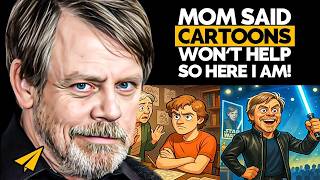
Mark Hamill describes how childhood obsession with cartoons and stop-motion led to a decades-long career in entertainment. He warns that rejection and unemployment are relentless, and that tenacity matters more than raw talent. For the Joker laugh, he stands and gestures, experimenting with different sounds until one clicks.
Chapters
I love the allure, the danger of working without a net. Somebody goes to work and actually makes a Daffy Duck cartoon, and I thought, "I want to do that." My mom would say things like, "Well, yes, honey, that is a very good Elmer Fudd impression, but it's not going to help you later in life with your profession." Hahaha! You know what? I'm going to go in there, give them the best damn Joker they've ever heard. Heard, and they're gonna really regret the fact that they can't hire me.
What's up, Believe Nation? It's Evan Carmichael. My one word is believe, and I believe that you have the ability to do something special that can change the planet. So to help you on your journey, today we're gonna learn from actor Mark Hamill and my take on his top 10 rules for success.
As a kid, I was just mad about the original King Kong. I loved all the stop frame animation, Ray Harryhausen pictures and horror and fantasy, you know, I loved all the black and white Universal films. I still do. When I realized, I think I saw a documentary on the Disneyland Show, which it was called then, where you saw Clarence Nash recording the voice of Donald Duck. I don't know if I was 6, 7, but it suddenly occurred to me, these things don't just emerge full-blown. Somebody goes to work and actually makes a Daffy Duck cartoon. And I thought, I wanna do that. I mean, I wasn't sure I wanted to be an actor. I thought I could, I didn't know what I wanted to be, but I certainly wanted to be in the business of going to work and having a colossal ape carry a woman up the Empire State Building. I thought, you know, it was just mind-boggling to me, you know, that somebody got to do that for their profession. I don't have a lot of people coming up and saying, you know, I should be on Broadway, you know, I do this and that, or I should be in movies or whatever. But lots of people say, oh, I could do cartoons. Listen to my Homer Simpson. You go, well, that is good. I like that. But it's, You gotta be dedicated, you know? It's not a matter of being able to do a good Homer Simpson and you're gonna have a career. It's hard work. I go to drama classes all the time, and I hate to be a buzzkill, but I try and talk kids out of show business. Seriously, I say, if there's anything you like as much as performing, even if you get into it academically and become a drama teacher, Or if there's something else you like, you can still do community theater, you can do amateur theater, you can still perform. But I'm telling you, if you get into it as a profession, you're in for a lifetime of rejection and unemployment. I mean, you could have a, you get 7 or 8 jobs and then you don't work for a year and a half. You know, you start running out of money, you have to go drive a cab or wait tables or something. It's a miserable profession, believe me. Please don't do it. And that's not just from the standpoint that, you know, obviously there's probably people in the audience more talented than me that will be stealing my jobs if they succeed. It's not that. It's just the fact that it is, it's only for the, if you can't talk someone out of show business, then they have a shot. I love the allure, the danger of working without a net. You know, it's one thing to be a tightrope walker if there's a net, as opposed to being a tightrope walker where you could plummet to your death at any moment. And that's the disconnect between someone who's rational and someone who's just crazy enough to go go into show business and stick to it no matter what. Tenacity is more, almost more important than talent. It's equally as important for sure. I really love what I do. I'm so lucky to be able to do what I want to do. When I was a kid, you know, I had a little tape recorder. I would tape, you know, I love the sound of people's accents. "Bella Lugosi, I never drink wine." You know, I thought, "Where's this guy from? Why does he talk like that?" Hearing the Beatles dialects, I love the sound of it all. And so I would be practicing, and my mom would say things like, well, yes, honey, that is a very good Elmer Fudd impression, but it's not going to help you later in life with your profession. I haven't played— no, I haven't played Elmer Fudd, but I love Peter Lorre, I loved that. Boris Karloff, I loved the way he spoke. I don't know where he's from, and he's got a slight lisp, but I love the sound. Laurel and Hardy. I said, where is this guy from? Before the internet, I know a lot of you can't remember this, but before the internet, you actually had to go to the library and look things up in books, which is very embarrassing, because I'm not really an intellectual person. I don't want to know about Russian history and ancient Rome. I said, you know, do you have any books on the Three Stooges? But, you know, I like having fun. When you see Mark become the Joker, when he's actually in the recording booth and doing these voices, he actually physically kind of twists himself and manifests himself into Joker. Mark, sometimes I think he actually is Joker. So he just turns up and he just knows nails it. In fact, we rewrote all the dialogue to really fit into where he was taking Joker. Surprise! You fell for the old sick Joker gag, Batman. One of the things that informs the Joker is his laugh. I remember reading the comic books, it was ha ha ha ha ha ha, but lots of ho ho hee hee ho ho hee. His laugh should be like a musical instrument. It should sort of illustrate his mood. It could be ominous and intimidating— Heheh! —it could be gleeful and wild abandon— Hahaha! But I didn't want to just have one rote laugh. Hahaha! I was driving into the first recording session thinking, "Now how did I laugh?" I'm on the freeways in Los Angeles. Woo-hoo-hoo-hoo! No, that's not it. Woo-hoo-hoo! No, that's not it. Now, I'm sure no one in Los Angeles would look twice at somebody. Look at that guy laughing maniacally in his car.
It's actually really fun to watch him perform the character because all of the other actors are all seated and Mark has to stand to do it, and he gets his whole body into it.
They used to kid me because I was the only one who would stand up. Yes, well, this is all tremendously boring. They had these little, you know, those separators that you see, like, for musicians so your sound doesn't bleed into other people's mics. And everybody's sitting down at their little music stands, and I just thought, to energize the character, to shake my fist, and I felt I've got to stand up. One thing that gave me confidence is I said, "There's no way they're gonna cast the guy who plays Luke Skywalker to be this icon of villainy." So I was really cocky in the sense that I knew I couldn't get the part. Sometimes what trips you up is that you want it so bad, your nerves betray you. And your timing's off. You're trying— you oversell it. Or I don't know. It's hard to describe. But the one thing that I felt about Joker was, since there's no way I can get this just from the standpoint of the publicity of saying— you know, because years after I did it, people kept saying, that Mark Hamill? You know, and they demand on the street, "Do the voice. That's not you, is it?" But I had the confidence of knowing that I couldn't get it. So I said, "You know what? I'm gonna go in there, give them the best damn Joker they've ever heard, and they're gonna really regret the fact that they can't hire me." I was— I had this arrogance when I did it, which worked well for the part. I had a little trouble with Sushi Girl 'cause I read it and I thought, "Wow, this is awfully violent." He even tortures someone with, with pliers to the teeth. And I've been married to a dental hygienist for over 30 years, so yeah, it's may the floss be with you with her. But, uh, I thought this is one of those movies that I would like to see. I don't know if I could handle being in it, so foolishly I turned it down. And, and my daughter said, you know, you're always complaining about why don't I get parts like Paul Giamatti, or why don't I get parts like Buchemi, because I love those character parts. It doesn't have to be the main role, just something interesting in supporting is fine with me. So she said, if you turn this down, I don't ever hear you complaining about not getting character parts again. I thought, boy, is she right. I wonder if it's too late. And I called my agent and said, contact them and say that I want to meet with the director. And fortunately, they hadn't cast that part. Because as it turns out, I mean, I didn't know anybody in the cast except for Tony Todd, and he has such gravitas. He's such a great actor, and I was sort of his sidekick. So I thought, well, at least I know Tony. And, um, but it turned out to be, you know, one of the most, uh, fulfilling roles I've ever played, and I didn't expect that. I once asked Lee Marvin for advice. I meant career advice, but he thought for a moment. He said, "Never stand when you can sit." And I still follow that advice. There's a little seat in the elevator. I sat down on the way up. But no, I usually take advice by observing what other people do. You know, people say, "Did you give the young cast members advice, you know, in the new Star Wars film?" I said, "Absolutely not. They are amazing." In fact, if anyone should be getting advice, it's me from them.
The first Star Wars in the UK, from what I understand, was like a mini mutiny, right? Everybody thought George Lucas was an idiot. Nobody wanted to be on the set. The actors were incredibly critical, some of them. I'm just curious, sort of, to the extent you observed it, kind of how you saw George Lucas—
The attitude towards the film when we were first making it?
The first production, when the part was in the UK, yeah. Yeah. It was very badly— and so how did he kind of lead through that? How did you lead through that? And what was your impression of him? How did it go?
Well, what I have to tell you is that the crew that was making it, they were all very professional. But they all thought it was, to put kindly, rubbish. You know, they thought it was silly. I mean, there's not a lot of things they could compare it to. Doctor Who, maybe. There's a comic strip called Dan Dare. But the idiom was not really something that was familiar to the British crew. So they were really nice and they liked all of us, but they just thought it was ridiculous. They thought it would be a movie that would be released only in matinee for children in the daytime. And I love the British sense of humor. We had a Kenny the Boom Guy. You know, you'd be doing this dialogue, you know. You know, I want to go to Alderaan with you. There were all these phrases that were unusual to their ears. And it'd get picked up by the crew. And you'd be walking along the hallway, and you'd pass Kenny, and you'd go, Alderaan, we're all going to Alderaan, mate, all of us. And he'd always be there, and you do this really doing difficult dialogue, and you'd look up at Kenny holding the boom, and he'd always give you the eye roll, like, ooh. It was all— and believe me, there was a typo one day on one of the— when they were trying to type Obi-Wan Kenobi, and they added an I where they shouldn't, and it came out Obi-Wonky. We didn't know what that meant. But the crew never let us forget it. Obi-Wan-kye, eh? You alright? You alright? Yeah, alright. But no, they were very kind about it, but I just thought, you know, you have to believe in what you're doing. I thought it was good. Famously, you almost did all your stunts yourself, except for a few. So I noticed you shaped up since Sushi Girl. Are you still into fencing stuff? Well, first of all, Bob Anderson was the Olympic champion, and he made me look good because you choreograph it down to each and every move. In those days, we choreographed the scene, and then George looked at it and he said, you can't take your hand off the lightsaber. I said, "Why?" He said, "Because it's heavy. It's like Excalibur, which sort of really limits the kind of movements you can make." You know, flash forward a couple of decades, we're watching Phantom Menace and they're twirling them around like batons. He changed his mind. But we had to go back and redo the whole thing. So Bob Anderson, I give full credit for making me look like I was a competent sword fighter. The only stunts I wasn't allowed to do because of the insurance. Colin Skeaping was my stunt double, and he went out the window in Empire Strikes Back. And I think he did some of the flips and, uh, some of the training sequences on Dagobah. But, uh, I loved it at the time. When they wanted me to get into shape for 7, they, uh, got me a trainer, and I went to went to the gym and lost, I don't know, over like 42 pounds or something. But, uh, and you go on this diet which is basically, if it tastes good, don't eat it. There's no sugar, no dairy, no fun. It's just, uh, protein shakes and lots and lots of— I've eaten more vegetables in the last 4 years than I have in my entire adult life. But, you know, it's really distressing. You figure out it's just diet and exercise, you know, because you want that magic thing. You see the ads on TV: don't change your diet, don't exercise, just take this pill. I'm writing down all the information. My wife's saying, you're not getting those pills, whatever they are. And it's true, if you, you work out, watch your diet, swim, it all pretty much all falls away. So I'm very grateful to get paid to get into shape. And you're still in training for fencing? Hmm, that's a loaded question. Perhaps.
Would you do a short dialogue between Luke and the Joker?
Or anything. I mean, that's kind of— well, got to get warmed up to this. Luke, it's me, the Clown Prince of Crime, and also your father. No, that's not true! That's impossible! Get used to it, kiddo.
Thank you guys so much for watching. I made this video because Dark Claude 4 asked me to. If there's someone you'd like to vote on for the next top 10, check out the link in the description and go and have your say. Finally, I want to give a quick shout out to Matthew Britt. Matthew, thank you so much for picking up a copy of my book, Your One Word, taking that picture, posting it to Instagram. I really appreciate the support and I'm so glad you enjoyed the read. So thank you guys again for watching. I believe in you. I hope you continue to believe in yourself and whatever your one word is. Much love. I'll see you soon.
More from Evan


How the Biggest Mistake in History Created A Trillion-Dollar Empire | Sergey Brin



9 Machiavelli Principles That Force People To Respect You | Machiavellian Philosophy



The First 10 Words That Instantly Ruin A Sales Conversation | Vanessa Van Edwards

The Top 1% Mindset Behind The First $5 Trillion Company | Jensen Huang (Nvidia)

