Master the Stage: 5 Essential Tricks to Public Speaking
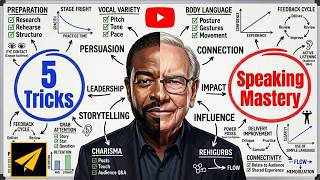
Evan Carmichael breaks down five rules for public speaking from experts like Warren Buffett and Neil deGrasse Tyson: study yourself and others, use silence and vocal range, employ metaphors, control your body language, and tell stories. Beginners should start with familiar audiences like schools or YouTube and treat early attempts as learning, not failures.
Chapters
When I'm training speakers, I tell them the best speakers are the best listeners. To listen to things that touch your heart.
The speakers often forget that many of the terms and concepts they live with are completely unfamiliar to their audiences.
When you wanted to make your point, tell stories.
What's up, Believe Nation? It's Evan. My one word is believe, and I believe in you. I believe you have an amazing gift inside you that I want to see explode out onto the world. Now, I started the Believe Life Series to tackle different personal development topics on a weekly basis to help you be the best version of you. So let's live our best believe life and learn today how to become a better public speaker.
Enjoy.
Let's start off with why it's important with Warren Buffett.
One of the things you would want to be sure to do is, whether you like it or not, get very comfortable— it may take a while— with public speaking, for example. I mean, that's an asset that will last you 50 or 60 years, and it's a liability if you don't like doing it and are uncomfortable doing it, that also will last you 50 or 60 years, and it's a necessary skill.
Now to the rules. Number 1: Study yourself and others with Les Brown.
When I first started out, I disciplined myself to learn about 3 quotes a day. Somebody taped me one time. I gave a lecture at a manpower conference with Bishop T.D. Jakes, and they said I did over 215 quotes and I never repeated myself. So it's— I love quotes. It's a passion of mine, and so they come up when they come up at the appropriate time.
And you have your own quotes?
I have my own, and I study a lot of other individuals. And once I hear it, I repeat it to myself and reuse it in conversation. When I'm training speakers, I tell them the best speakers are the best listeners. To listen to things that touch your heart and then use it in conversation over and over again, and then use it on stage when you're speaking to an audience.
Yeah, not only you and your thoughts but also the people who are—
Everybody that's around you.
Great. And do you advise to people to write their own quotes?
I think that yes, you wanna write, but sometimes you are saying them and you can't hear them because you can't see the picture when you're in the frame. And so when I tell people if you're speaking to always record yourself because there are things that's gonna come up, inspiration, revelations you will receive, you say, whoa, you better write it down. That's right, yes. And so you wanna record that.
Rule number 2: Use silence and vocal range properly with Charlie Hooper.
But for now, let's continue with how Neil uses silence to create tension.
The most astounding fact is the knowledge that the atoms that comprise life on Earth, the atoms that make up the human body, are traceable to the crucibles So you're going to notice two big things here.
One, the first thing is how that silence gets you hanging because he places it before completing his thoughts, and this gets you leaning forward in a way saying, "Go on, go on." It is fantastic for capturing attention. Now, I don't use it a whole lot on YouTube because clicking away here on YouTube is a lot easier than walking away from someone in real life, and attention spans here are very, very short, but in your normal speech, play around with slowing your cadence down and see if that gets people listening more attentively. The second thing here is his range, so let's listen again to that last phrase. "...are traceable to the Crucibles." "The Crucibles" has such a breathy quality. This is something you'll start to see a lot from Neil. He has incredible vocal range. Now, I don't just mean that in terms of pitch, but I mean that in terms of style. He shouts, he speeds up, he emphasizes certain syllables, and he whispers. In fact, you'll notice that when someone has your full attention, builds it up to a big point, and then, whispers, it drags you in even more. You can see in the next part how he actually plays with these pauses, and sometimes he even rushes through the end of a sentence. He actually blows right by periods, as he does in this next part when he says, "These stars." That cooked light elements into heavy elements in their core under extreme temperatures and pressures.
These stars, the high-mass ones among them, You see that?
He actually shifts the speed and the rhythm. He doesn't always pause after his periods, and he doesn't always connect words right next to one another. Sometimes, he adds a giant pause in the middle of a sentence. That makes his speech much more interesting.
Rule #3: Use metaphors with Chris Anderson.
3. Build your idea piece by piece out of concepts that your audience already understands. You use the power of language to weave together concepts that already exist in your listeners' minds. But not your language, their language. You start where they are. But speakers often forget that many of the terms and concepts they live with are completely unfamiliar to their audiences. Now, metaphors can play a crucial role in showing how the pieces fit together because they reveal the desired shape of the pattern based on an idea that the listener already understands. For example, when Jennifer Kahn wanted to explain the incredible new biotechnology called CRISPR. She said, "It's as if for the first time you had a word processor to edit DNA." CRISPR allows you to cut and paste genetic information really easily. Now, a vivid explanation like that delivers a satisfying "aha" moment as it snaps into place in our minds. It's important, therefore, to test your talk on trusted friends and find out which parts they get confused by.
Rule number 4: Pay attention to your body language with Thomas Frank.
Pay attention to your body language. And this is important for 2 specific reasons. Number 1, your body language forms a large part of the nonverbal communication that complements the verbal communication of your words. The way you hold yourself, the way you're poised, your posture, the way you move your hands and gesture to highlight certain points, these all go hand in hand with the words you're speaking and can help to complement and drive home those points. But the other reason is that the unconscious body language that a lot of inexperienced speakers have is something that can harm you. We have a lot of nervous tics. For example, when I was an inexperienced speaker just starting out, a lot of things that I would do, I would put my hands in my pockets, and I guess the camera's fixed right there, but I can try to show you, right? I put my hands in and out of my pockets over and over again while I was speaking, and I would also pace around the stage really distractedly, kind of moving and I wasn't really consciously pacing and using that to effect, I was just doing it unconsciously. So, these are things that you can control to both not distract your audience, but also to help bolster your points.
And rule number 5, the last one before the bonus clip, is tell stories with Patrick Bet-David.
Sometimes when I get asked to speak for 3 hours and they want to do Q&A, that's a different talk than it is from an hour to just give a presentation, than it is from, hey, can you give a 10-minute talk here? Than a 5-minute talk. If I'm asked to talk 5 minutes on TV or on whatever it is that I'm speaking for 5 minutes, here's a point, here's a story. Done. Let me tell you about what's going on over here. Here's the conditions that we're looking at right now.
Da da da da da.
Here's what I think we need to consider changing to. And here's what I believe will be the solution. Let me tell you why I believe this. I remember when it was 1992, and boom, story. Okay? Story. So get into your story. When you wanted to make your point, tell stories. Somebody who is very good at making stories and figuring out ways for me to take a metaphor or an analogy that I connect to, that makes sense, I get it, I got it. I respond to that and most people respond to that as well if you're telling your story.
Now I've got a special bonus clip about public speaking with myself and Sage CEO Stephen Kelly, but before that, the question I have for you is, have you thought about being a public speaker and what is holding you back from really doing it, or if you are doing it on a bigger scale, I'd love to hear from you.
Leave it down in the comments below.
Thank you guys so much for watching. I believe in you. I hope you continue to believe in yourself and whatever your one word is. Much love, I'll see you soon, and enjoy the bonus clip.
John Holt is writing in asking about becoming a public speaker. Wants to be a speaker, wants to find places to speak and fail as a beginner, but in places that won't ruin his credibility in the future when he's awesome. So what advice do you have about becoming a speaker and failing at the start and finding places to get some experience so you can overcome those early adversities?
Yeah, you kind of said it. I think in terms of the question, it's all about practice. You know, I don't know, some famous golfer named Gary Blair, who said kind of the more I practice, the luckier I am. The more you practice, the better speaker you'll be. And I just think it's a gift, but it's a gift that can be taught and learned. And it's an area where, you know, we've talked about mentorship before. It's an area where I'd start, if you wanted to get into it, go into an area actually which is sometimes the most difficult area of people who actually know you. Sometimes you will feel that it's easier to present to complete strangers than people who know you. But actually, if you work and start presentations with people who know you, then it could be like, I don't know, your community group, or you go back to your school if you've got a job where you're a startup or a coder. You go back to talk to the computer science kind of high school kids and do a presentation about why should they be excited about the world of computer science and coding. And that's a great way. And then you can kind of go along to the teacher you used to teach and say, kind of, how did I do? What could I have done differently? What could I do better? After, when you've done a presentation, conversation, then it's about those magical open questions, those friends of yours, like, what could I have done better? What could I have done differently? What messages did we kind of resonate? And also kind of just always ask for feedback because feedback is absolutely the food of improvement. So that's what I'd say. I'd test drive it, exactly what you say. Don't worry about failure. There is no failure. It's just practice.
I totally agree.
I would also start a YouTube channel. Get used to speaking in front of a camera and having people see your opinions, and maybe it's a little less intimidating than speaking in front of an audience at the start. I get a lot of, or maybe most of my speaking gigs through my YouTube channel. People see me talking and they want to hire me to speak at different events. And you talk about, the question talked about places to speak would ruin his credibility in the future. I don't think there's that many places you really have to worry about ruining your credibility. The first place I spoke at was the YMCA. And 3 people showed up at my free event. You know, not the biggest start, but does it look bad on my resume that I started at the YMCA? You know, I don't think there's that many places that really would be a knock against you if that's where you started. So just start. To all of Stephen's points, reach out to your network, places that you've worked before, teachers, clubs that you're a part of, and just offer to do a speech to get some practice. And also get on YouTube, film those speeches, do your own sessions just one-on-one with the camera, and the more practice you get, like Stephen said, the better you're gonna get at speaking.
Raise your standard.
Apple, at the core, its core value is that we believe that people with passion can change the world for the better.
Not one drop of my self-worth depends on You know, it's something to me. I don't ever give up. I'd have to be dead or completely incapacitated.
Hey, Believe Nation! If you want to see my all-time favorite top 10 rules to success, I have a very special secret video for you. These are the individual clips that I have personally learned the most from and applied to my life and my business. Check the link in the description for details.
More from Evan


How the Biggest Mistake in History Created A Trillion-Dollar Empire | Sergey Brin



9 Machiavelli Principles That Force People To Respect You | Machiavellian Philosophy



The First 10 Words That Instantly Ruin A Sales Conversation | Vanessa Van Edwards

The Top 1% Mindset Behind The First $5 Trillion Company | Jensen Huang (Nvidia)

