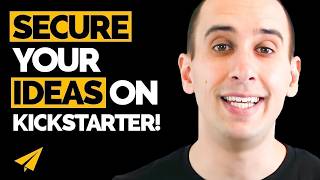
Evan Carmichael explains how to protect an unpatented idea on Kickstarter. Focus your marketing on benefits, not technical details, to prevent reverse-engineering. File a provisional patent before launch, which costs less and gives you a year to test the market before converting to a full patent.
Chapters
How to prevent your idea from being stolen on Kickstarter. So I got a great question from one of my YouTube viewers— love you guys— Augusta, who wrote in to say, "Great info, Evan! I just subscribed to your channel." Thank you, Augusta. "Question: Say I put my idea out there on Kickstarter and it's not patented yet, someone could steal my idea. How do I go about this?" So this is a real fear, and for those of you who aren't aware with Kickstarter, it's a way to raise money for a new idea. You're not giving up a percentage of your business, but you're pre-selling. So it's pre-sales. You say, "I'm gonna make this product. Whoever wants to buy it, you can pay in advance, and then I'll make it." And if you don't make enough money, then you probably don't make the product. There is a big, real concern though that if you put up your ideas on Kickstarter, other people could come in, scoop it, and run with it themselves and say, "Hey, that's a great idea. I'm gonna do it myself." How do you prevent that from happening? So there are two main ways, okay? First one is, remember, with a patent, a patent, to get a patent is a really technical process. If you put up the technical details on Kickstarter, it's gonna be boring, okay? Kickstarter is a marketing website. And so what I would gear towards is explain the benefits of it and not so much how it works. Because I don't care how it works. I care about the benefits I'm gonna get from it. And so this is something that often happened when we were raising capital. So it was in a venture capital business. Entrepreneurs and vendors would come to us and say, "Hey, we need you to sign this confidentiality agreement," which we never signed because we see so many deals. But it doesn't matter because I don't care how your thing works. It doesn't matter to me. I just need to know that it works. Right, and so for the people watching, the people who are going to invest money into this and preorder whatever you're selling— you didn't tell me what it was— whatever you're selling, I don't care how it works. I just want to know that it works, that I get whatever benefit from it. So focus on the marketing side, focus on the benefits and not the specifics. That makes it harder to reverse engineer, makes it harder for somebody else to come up and say, "I'm going to copy them exactly." So you don't have to share all the schematics and diagrams and the technical details. So that will protect you. The second way is is ideally you want a patent, okay? The patent gives you solid protection. But the first step typically is a provisional patent. And provisional patents are easier to get. It gives you wider coverage and are not nearly as expensive, and there's no annual maintenance fee. What it does is basically, the idea for provisional patents is to give entrepreneurs and inventors a year to test out the idea. So to see, can I commercialize this? Can I make money from this? And after that year is up, you have to decide, am I gonna go and get the patent or not and spend all the money on it? So what you could do is if you think you have this great idea, you get a provisional patent for it, you put it up on Kickstarter, you have a year to go out and make money and raise money and, and get some sales and see if this is something that people really want. And if you're making money from it, then you can go and afford to get the patent. If it totally dies on you, no— there's zero interest, nothing is happening, then you have to make the tough call of after that year, do you want to go for the full patent or not? Keep in mind though, with a patent, you still have to enforce it. The most expensive part about a patent is enforcing it. Because people can look at what you're doing and do it themselves. And then you have to go sue them to say, "You can't do this. You can't steal my idea." And you don't have typically the pockets. Entrepreneurs don't have the pockets to do it. The way to make money with a patent is to typically license it or sell it to a big company. So I get the fear. It's a real fear on Kickstarter. You know, you don't want to share your idea with the world and have somebody else come in and scoop it and make millions you know, off of your idea. So remember those two things, okay? Keep it simple with the market and the benefits, not the technical details, so it's harder for somebody to reverse engineer. And then try to get a provisional patent on your idea so you get some protection and gives you a year to decide if you want to go for the full patent or not. Believe. For those of you watching and like the video, give it a thumbs up below. Let me know what you think, leave a comment underneath, ask me a question underneath, I'll make a video response just like this one. And click on my face to subscribe to the channel and see more videos like this. Thank you so much. I'll see you soon.