"PUSH the BALL Forward!" - Louis C.K. - #Entspresso
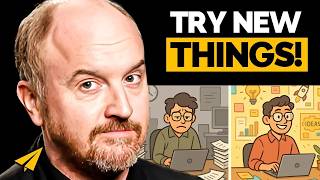
Louis C.K. talks about building Louie through constant iteration, using the metaphor of pushing the ball forward despite setbacks. Evan Carmichael traces how William Wrigley Jr. pivoted from soap to gum and how Ferruccio Lamborghini moved from tractors to supercars after Enzo Ferrari rejected him. The core idea: boredom kills entrepreneurship, so keep experimenting.
Chapters
Rise and shine, it's Enespresso time! Good morning, Believe Nation, it's Evan Carmichael. My one word is believe, and I believe in you. I believe in that amazing gift you have inside you that needs to be shared with the world. So let's start the day off right together. Grab your cup of coffee and sip on today's message: try new things. Over to you, Louis CK.
I wake up every morning, espresso keeps me going.
I wake up every morning.
Well, I never keep trying one. Like, stand-up is always the standby for me. Like, that's what I do.
The meal ticket.
That's— yeah, that's what I am. I'm a comic. I'm a comedian. So anything else I do, it's like, if I make a movie, I would never say I'm a filmmaker. I would never call myself that. I'm a comedian who made a movie, you know? I'm definitely a comedian. I can say that one thing with confidence. But, uh, so I've tried TV, uh, and I try it and it doesn't work, and then I go back to comedy. And then if something I'm doing as a stand-up leads me back to like, hey, this might be a show, then I'll try. I'll try anything that I think might be good. I don't care about like, well, I failed at it before, you know what I mean? Who cares? Try it again. I mean, there's always— I love that philosophy. Well, also, the first time I did a pilot, the very first time I got a deal to do a pilot for a sitcom. I wrote it and they really liked it and it got close and then they said, "We're not gonna make the pilot." [Speaker] That was St.
Louis?
[Speaker] No, that was before that. It was a whole other thing. And then I wrote St. Louis with this other guy and they made the pilot. We got to shoot a pilot. It was so exciting. And I shot a pilot and then they said, "We're not gonna make the show." All right, third time around, made a pilot and got one season of Lucky Louie on the air. And then that was all they wanted. There's a limit to everything that, you can't think everything's just gonna be everything forever. That was the limit of that one. I did one season, okay, and now I've done Louie, and it's, I've gone three seasons, so I got a little further each time. I pushed the ball a little further ahead each time. I mean, not doing something 'cause it didn't work would be like if you're a quarterback, and you go to the line of scrimmage at the 25, or wherever the guy ran it to, and you hand the ball off, and the guy pushes it 8 yards, and you're like, Well, we didn't score a touchdown, let's all go home. Right. I mean, there's no point. But at the same time—
William Wrigley Jr., the founder of the Wrigley gum company, started off selling soap. And he wanted to have a free bonus that anytime somebody bought soap, they'd get a free gift. And he made that first free gift some baking soda. Every time you bought some soap, you get some free baking soda. What he found was people liked the baking soda so much, they kept asking him for it. And he said, "I'm gonna be in the baking soda business." And he got rid of the soap. He stopped selling it. Now he was in the baking soda business. He still liked that idea though of having a free sample given out every time somebody bought from him. So with every package of baking soda that you bought, he'd give you some free gum. And the same thing happened. People liked the gum so much, they decided to get out of the baking soda business and just sell gum. And the Wrigley Gum Company was born. You can almost never predict how your business is going to be successful. You look at any company that you look up to and love and respect and say, "These guys, I want to emulate that kind of impact." You look at their first business plan and you look at where they're at now, it's almost never a direct correlation. There's elements of it, especially like the founding mission, what we're trying to do, the problem we're trying to solve, but the execution of it changes multiple times as you grow up and build your business. If I look at my YouTube channel, I never thought I'd be doing Top 10 Rules of Success, the most kind of iconic series on this channel. It started off as a test. It started off making one video and the video did well. I love it. Great. I loved consuming it myself. It's great that you guys loved it as well. And I thought, okay, I could probably make one video a week on this. I could make it a weekly series. 52 people a year is probably enough to be able to do, right? And it became so popular that I thought, hmm, can we do 2 people a week? We could probably do 2 people a week, like 100 people a year. It's probably doable. And I ran them on Saturdays and Sundays. And then as they gained more popularity, you guys kept leaving feedback saying, "I love this. How about this person? How about this person? How about this person?" And pretty soon we had 2,000, 3,000 requests for different people to do. We're keeping track of all of them in Evernote. And it's like became the biggest task for the people on my team to keep track of all of your requests. And I thought, "We should go daily. We have enough. Like there's enough people." And that became a 5-time-a-week thing. And it still is now. So what started off as some tiny little experiment that I didn't know if it would take off or do well became a cornerstone of how I'm building my channel. I'm constantly evolving and testing new series, even within a series, testing the formatting and the layout and how we bring the content to you guys. It's important. One, one, because it's fulfilling. If you're not expanding, if you're not growing, if you're not trying new things, You get bored. And as an entrepreneur, boredom is the death sentence. We hate being bored. We want to go off and try new stuff. Bring that to your business. Instead of looking outside to do something else, stop worrying about a side business or something else. Bring that energy into your company. If you're bored of your business, you've got to bring more of you to your company. And it all starts from experimenting, from trying new things, from saying yes. You could be William Wrigley selling soap, to then selling baking soda, to then selling gum, and the gum is the thing that takes you off. If you look at Ferruccio Lamborghini, the guy who started Lamborghini, he was in tractors and he bought a Ferrari and he went to Enzo Ferrari, the founder of Ferrari, and told him, "Your engine is amazing. Your engine, like the Ferrari engine, is second to none. Like it's the best engine ever. But the rest of the car, the handling, like the rest of it, here are some suggestions that I think you can make your Ferrari car better." And Ferrari told him, You stick to making tractors and I'll make cars. And Lamborghini got so upset by that that he said, "OK, I'm going to be in the car business." And that's how Lamborghini was started. So he went from making tractors to making the highest of high-performance cars. You never know where your business is going to go. What's important is that you have that mission, you know what you're trying to create, you're trying to create an emotion, a positive impact somehow in the world, helping your customers do something, right? Like your founding principles, values, your one word, bringing that into your company. But the execution of it will change, likely multiple times. One, just as a reaction to the market, like you thought something would work out, but it didn't work out and you had to make adjustments based on what your customers wanted. And two, you're going to grow and change. Your interests won't be the same as they are in 10 years. You're going to grow. You're going to have new interests. You're going to want to incorporate new things into your business. And so it has to be a constant evolution, constantly looking at what you are excited by with what the market wants, and the plan will continue to evolve. You never have a perfect plan. It doesn't mean don't plan. Have a plan and then start doing stuff, start executing, and you start adjusting. So don't be afraid to try new things. And that means you're going to fail a lot. Most things won't work out. Most of my new series that I launch don't work. For every top 10 that I've launched, we've had 5 to 10 series that didn't work. And that's okay, it's part of the process. You learn, it's part of the game. I love everything that I make. I love all those series that didn't work out. But you guys didn't, so we cut it. And that's fine, it's part of the process. It's not absolute failure. It's not like, "Oh, that didn't work out, so I'm gonna quit and give up." You keep trying, you keep experimenting. And by, again, doing those little things, trying those little tests out, it fills you up. That creativity needs to come from the work that you're doing daily, not for some side thing that you're doing. What are you doing daily? And then you can match it to what your customers want and create something amazing. So the question of the day today is I'm curious, what is the most recent experiment that you ran in your business that maybe you just launched and you're hoping is going to work out, or maybe you got feedback that it didn't work out, or the next test that you want to launch? I want some creativity, some tests showing up down in the comments below. Share your experiences. I would love to hear from you. I also want to give a quick shout out to Rod Pinder. Rod, thank you so much for picking up the call. Copy of my book, Your One Word. It really, really means a lot to me, man, and I hope you enjoy it. So thank you guys again for watching. I believe in you, and I hope you continue to believe in yourself and whatever your one word is. I'll see you again tomorrow morning for another shot of espresso. I wake up every morning, espresso keep me going.
I had a little trouble with Sushi Girl because I read it and I thought, wow, this is awfully violent. He even tortures someone with, with pliers to the teeth. And I've been married to a dental hygienist for over 30 years, so yeah, it's may the floss be with you with her. But, uh, I thought this is one of those movies that I would like to see. I don't know if I could handle being in it. So foolishly, I turned it down. And, and my daughter said, you know, you're always complaining about why don't I get parts like Paul Giamatti, or why don't I get parts like Buchemi, because I love those character parts. It doesn't have to be the main role, just something interesting in supporting is fine with me. So she said, if you turn this down, I don't ever hear you complaining about not getting character parts again. I thought, boy, is she right. I wonder if it's too late. And I called my agent and said, contact them and say that I want to meet with the director. And fortunately they hadn't cast that part, because as it turns out, I mean, I didn't know anybody in the cast except for Tony Todd, and he has such gravitas, he's such a great actor, and I was sort of his sidekick. So I thought, well, at least I know Tony. And, um, but it turned out to be, you know, one of the most, uh, fulfilling roles I've ever played, and I didn't expect that.
First of all, I believe that most people, uh, there's really only a few key areas where we have almost like a superpower, okay? Um, aptitudes. All right, I guess we could call it a super aptitude. And, uh, we're looking for those super aptitudes all the time by trying out different lanes. All right, so take myself. Uh, I'm somebody who has attention deficit disorder, and what that means is that I can speak almost indefinitely. It means that I also have almost infinite creativity. And that also comes from growing up with depression. When you're depressed, that can oftentimes trigger this very, very intense creativity. So between having depression, attention deficit disorder, uh, and also my case, if you look at things like, um, growing up unable to read social cues, you have an interesting recipe for how I built real social dynamics. Okay, so I basically found my super aptitudes because by not understanding something so thoroughly, uh, I had to break it down so deeply to understand it. That's social dynamics, which creates great content. Plus, I'm being depressed, uh, creates creativity. And also having ADD allows me to I could talk forever because I don't feel the passage of time in the way that a normal person does. I can't feel time passing, so I could do this forever. Okay, so if you look at that, that created a super aptitude. Okay, now how did I find it? I tried out many different things. As long as I was trying out different things, I was happy. So, tried out one thing, tried another thing, tried another thing, tried another thing, tried another thing.
We've established the fact that we love to play everything. You know, like there's not a genre that we're that we'll shrink from. But at the same time, I think we've just gotten very confident as songwriters to the point where if we want to, if we want to try something, we will. You know, we're not hesitant to try something even if it sounds a little sweeter. Like, you take a song like St. Marie that's on the new album, and it's got a very cool California country vibe to it. 10 years ago, maybe we wouldn't have had the stones to be able to do that, you know. And now we're like, we're gonna do whatever we want, you know. So it's, you know, it's, it's, uh, the, you know, the strength of experience, um, and yet still having that refreshing love for music that encourages you to try new things.
Raise your standard. Apple At the core, its core value is that we believe that people with passion can change the world for the better.
Not one drop of my self-worth depends on your acceptance of me.
I don't ever give up. I'd have to be dead or completely incapacitated. Hey, Believe Nation, if you want to see my all-time favorite top 10 rules of success, I have a very special secret video for you. These are the individual clips that I have personally learned the most from and applied to my life and my business. Check the link in the description for details.
More from Evan


How the Biggest Mistake in History Created A Trillion-Dollar Empire | Sergey Brin



9 Machiavelli Principles That Force People To Respect You | Machiavellian Philosophy



The First 10 Words That Instantly Ruin A Sales Conversation | Vanessa Van Edwards

The Top 1% Mindset Behind The First $5 Trillion Company | Jensen Huang (Nvidia)

