Ray Dalio: This Strategy Will Change Your Approach to Investment and Life!
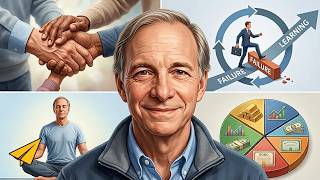
Ray Dalio shares ten rules from building Bridgewater Associates: treat failure as data, use radical truth and transparency, meditate 40 minutes daily for clarity, view markets as machines to understand through data, and know your weaknesses so you can hire people who don't have them.
Chapters
He's an American businessman and founder of the investment firm Bridgewater Associates. He appeared on the annual Time 100 list of the 100 most influential people in the world. According to Forbes, he's the 30th richest person in America with a net worth of over $15 billion. He's Ray Dalio, and here are his top 10 rules for success.
One sentence that I try to describe Bridgewater by, and it's, um, meaningful work and meaningful relations. Is what I want, meaningful work and meaningful relationships through radical truth and radical transparency. So meaningful work means like we're in a mission together, we're excited about what we do, we want to do it excellently, that's meaningful work. Meaningful relationships are these relationships in where there's, you know, like the honesty helps you. You can argue things through, but you always know that there's honesty and that there's mutual caring for each other. Radical truth means that knowing what is true, to be able to deal with reality, whether you like the reality or not, but to know what reality is. Like, do you have— imagine if you had a disease, would you want to know that you had that disease or would you not want to know? I'd want to know. And so to know— if you have a weakness, do you want to know you have the weakness or do you not want to know? Radical truth and radical transparency means you get to see everything. That's very powerful. Failure is a part of the learning process, right? What's the risk of failure? What, you'll be embarrassed? Or risk of failure— how do you distinguish failure from learning? In your whole life, you know, failure implies that it's stopped, that the game stops, right? If it's part of a— you're failing and then you learn, then that learning is part of the moving forward. Right? So that is what the process is like. Fail, learn, move forward, and constantly do that because you're cutting edge. You're going where people haven't been before in inventiveness. So pervasively, we were talking about culture. It is when people disagree and you can take— thoughtful people disagree, you have then the potential of learning a lot. If people who are disagreeing can say, "Why do we disagree?" and work through that conversation in an intelligent way to try to find out what's true, you can learn, you can make progress. It could be a fabulous thing. I believe that everything works like a machine. So when we talk about markets, when we talk about economics, you know how I think. It's just a machine. Everything has cause-effect relationships. And you can program all of that. We're machines. Human brain's a machine, and we operate that way. And in today's age, we have data. We have a lot of data. And so to be able to look at what people are like is a powerful thing. When I, when I hear the interview about General Motors and you think about one country, one company or another, you think of Tesla. And by contrast, okay, look, there are two things that make a difference. It's either people or culture, okay? And that's everything. And so everybody's talking about this was done or that was done. Step back. What were your people like? How were they different? What is your culture like and how's that different? And that's all that matters. And so if you look at it that way and you compare what the future of General Motors is going to be and the future of Tesla is going to be or any such things, that's what all that makes up the difference. And you can put data together that shows that, and you can operate in that way, and that's what makes you effective. What happens with meditation, as you know, um, is it's just a simple exercise that allows you first to clear your head and then brings, um, um, an equanimity to everything. Everything— it eliminates the stress, it eliminates the emotion. And you do it how often? You're a busy guy. Yeah, I've been doing it for 44 years, but I do it twice a day, probably a third of the time, once a day, probably a third of the time, and not at all. For 20 minutes twice a day? Yeah. So you spend 40 minutes a day as part of your— Oh, it's such a great investment. I would say that more than any other factor having any effect on my success, it's been meditation. Because the equanimity and also the creativity, because it opens between the— literally the prefrontal cortex and the amygdala. It opens the two sides of the brain and allows a spontaneity, a creativity, an open-mindedness. And so it's good for not only the health, because stress is a terrible thing, but it also is very good in terms of the clarity, and you don't get the emotional hijacking. And it's great for creativity. So it's helped me a lot. It's the biggest gift I can give anyone. I'm 64 years old. Yeah. I don't want to have fears. Fears of things that— of being open. Fears of— in other words, I'm not going to let a fear stand in the way of something that I believe is valuable. Mistakes are good things. Mistakes are good things, meaning if they're made in learning. In other words, so mistakes are how we learn because mistakes produce pain. And if you produce that and you convert that to learning— like, for example, punishing people for mistakes is bad because they hide things. Where if you were to say to your kid who makes a mistake, the only thing you have to do is tell me what would you have done different in the future, and then we'll be good. That learns— makes that a learning process. Or weaknesses. Everybody has weaknesses, has a number of weaknesses. The great people that I've seen in almost any area always have weaknesses. They just have known what their weaknesses are and have ways of getting around those weaknesses.
We break it into two parts.
We have two basic portfolios.
There is the strategic asset allocation mix, which we call all-weather. And that just has nothing to do with bets. It has to do with how to make all the assets the same risk parity. I would call it risk parity. The problem is when people try to diversify and they own some equities, and equities has a volatility, right, that's large, or they own assets that do well when the economy does well and do badly when the economy does badly, they have a concentration of their risk in some assets, right? They need to have— they need to change the portfolio. They need to buy longer duration bonds or leverage the bonds or bring up so that bonds and commodities and pieces have comparable impacts so that whatever happens in the economy will then have a balancing effect. Because the one thing you could be most confident is that asset classes on average will outperform cash.
Okay.
So if you have— that's a strategic asset allocation. That's what the all-weather piece is. Then there's the bets. The bets are zero-sum, right? In order for you to beat me in the game, you're going to have— it's like poker. It's a zero-sum game. I have— we have 1,500 people who work at Bridgewater. We spend hundreds of millions of dollars on research and so on. We've been doing this for 37 years, and we don't know that we're going to win. In other words, we work that— we have to have diversified bets. We have a lot of diversified bets and so on. So it's very important for most people to know when not to make a bet, because if you're gonna come to the poker table, you're gonna have to beat me, and you're gonna have to beat those who take money. So the nature of investing is that a very small percentage of the people take money, essentially in that poker game, away from other people who don't know when prices go up whether that means it's a good investment or if it's a more expensive investment.
Sometimes the high points come from the low points. They're simultaneously— meaning, I, you know, like, I learned the most when I making mistakes. And so I know, like, for— if I'm making money in the market, it might seem like a high point because you figure, okay, you're making money, but you don't test yourself as much. When you're making a low point and you're in misery, you're saying, how am I doing this wrong? And you're learning a lot, or at least I'm learning a lot. First of all, I have a terrible memory. I'm very unreliable.
I really—
I'm I'm incredibly forgetful. I need people around who will take care of a lot of things for me. In other words, I need handlers. And people who are meticulous and organized. And those are my, you know, those would be the major. I miss, by the way, I mean like at any time, I believe that I'm missing a lot. I look at— there's so many things that I'm not seeing. The one thing that's good about that is that I know that I'm not seeing them. And so that's why I keep going to other people who I find see differently. And that's my biggest advantage. My biggest advantage is not what I know. What I know is a small percentage of what I need to know. My biggest advantage is that I know that I don't know a lot, and I'm worried about not knowing. And that I know how to speak to people who might know a lot, and then I have that process, and then through that I learn a lot and I minimize my chances of harming myself because I don't know.
Thank you guys so much for watching. I made this video because Syed Zen asked me to. So if there's a famous entrepreneur that you want me to profile next, leave it in the comments below and I'll see what I can do. I'd also love to know which of Ray Dalio's top 10 rules had the biggest impact on you. Leave it in the comments. I'm going to join the discussion. Thank you so much for watching. Continue to believe, and I'll see you soon.
More from Evan


How the Biggest Mistake in History Created A Trillion-Dollar Empire | Sergey Brin



9 Machiavelli Principles That Force People To Respect You | Machiavellian Philosophy



The First 10 Words That Instantly Ruin A Sales Conversation | Vanessa Van Edwards

The Top 1% Mindset Behind The First $5 Trillion Company | Jensen Huang (Nvidia)

