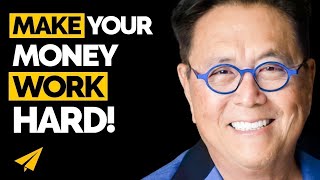
Evan Carmichael profiles Robert Kiyosaki, the author of Rich Dad Poor Dad, tracing his path from Xerox salesman to financial-education entrepreneur. Kiyosaki's core lesson: make your money work hard through assets, not income, and take jobs that teach you cash flow and systems rather than just pay the bills.
Chapters
Hi, I'm Evan Carmichael. Welcome to another edition of Modeling the Masters. I believe that the fastest and most effective way to grow your business is to model the strategies of people who have already done what you're trying to do. So today we're going to look at how a Vietnam vet started two different businesses and failed, but was determined to become a success and not have to work for somebody else. He would eventually go on to become one of the most successful business writers of all time. This is the story of Rich Dad Poor Dad creator Robert Kiyosaki and the top 3 lessons that you can learn from his success. Robert Kiyosaki is an American investor, businessman, self-help author, motivational speaker, and financial literacy expert best known for his Rich Dad Poor Dad book series. After serving in the Marine Corps as a helicopter gunship pilot during the Vietnam War, Kiyosaki returned home to work as a salesman for Xerox. Books. Not wanting to work for someone else for the rest of his life, Kiyosaki had dreams of starting his own business. After unsuccessful stints selling Velcro wallets and t-shirts for heavy metal rock bands, Kiyosaki began promoting the personal growth seminars of Marshall Thurber called Money and You. When Thurber decided to retire, Kiyosaki took over the business and began traveling the world to educate people about financial strategies. To reach more people, he decided to write his first book, which he self-published, Rich Dad Poor Dad. Robert Kiyosaki has written over 15 books and has sold over 26 million copies. 3 of his books have been on the bestsellers list of the Wall Street Journal, USA Today, and the New York Times simultaneously, and he's a sought-after speaker who continues to educate people on how to understand their money. Even though Robert Kiyosaki failed with his first 2 businesses, he was determined to become a successful entrepreneur and he kept at it. He tapped into his passion for teaching people about money and went on to become one of the most successful business writers of all time. To help you grow your business, here are 3 action items that you can learn from Robert Kiyosaki. Action Item #1: Make your money work hard. One bit of advice that has served me well with my business is don't spend money until you're making it. Anybody can spend money. If I gave you $1 million today for your business, I'm sure you can come up with a million different ways to spend it. But not everyone can make money. Bootstrapping should be your mantra. Find ways to get your product or service out without spending money. Get even just a few orders and prove that people will buy what you're selling. Then spend money on expanding your marketing. Your money will be well invested because you know you have something that works. Until you start making some sales, hustle and put your sweat into drumming up some business. Kiyosaki believes that people go to school to learn how to work hard for money, while he tries to teach people how to have money work hard for them. He believes that for many people, success is working hard to land a secure job at a big company or government who'll look after you until you retire. That model might have worked in the Industrial Age, but now in the Information Age, people have to look out for their own financial security because you can no longer rely on your employer to take care of you. One of the best ways of doing this, he believes, is to create your own business and become your own boss. According to Kiyosaki, the poor and middle class work for money. The rich have money work for them. The rich buy or create assets that work for them so they don't have to. An asset puts money in your pocket, and a liability takes money from your pocket. The rich understand the difference and buy assets, not liabilities. Action Item #2: Mind your own business. As entrepreneurs, we have to wear many hats. You're everything from the CEO to the janitor when you start a business. If you want to grow your business properly and have confidence in your decision-making, you need to understand your numbers. Yes, it may be boring and outside your core competencies at the beginning, but when you can understand your balance sheet, income statement, and the numbers that run your business, you'll be in a much better position to drive your company forward. It could be one of the best investments that you ever make into yourself and your business. If you want to achieve financial freedom, Kiyosaki believes that there are 3 key lessons that you need to master: learn how to make money, learn how to manage it, and learn how to invest it. He encourages people to keep their day jobs until they're earning enough money on the side, or from their own business, or from investments, to be able to quit. Kiyosaki also believes that money is a base subject and that it's never too late to start learning. According to Kiyosaki, many people confuse their profession with their business. To become financially secure, people need to mind their own business. Your business revolves around your asset column as opposed to your income column. The rich focus on their asset columns while the poor and middle class focus on their income columns. Action Item #3: Work to learn, not for money. If you haven't started your business yet, a great piece of advice is to get a job where you can learn the skills that you need to succeed as an entrepreneur. Want to set up your own auto shop? Go work for a small auto shop. Learn the ins and outs of how the business runs. Ask the business owner to get involved in other projects in addition to what you are hired to do. Work extra hours and on the weekends to overdeliver and really understand how the business works. You'll first figure out if that industry is for you or not, and you'll also make many of your rookie mistakes while still getting paid by somebody else. Kiyosaki credits much of his success as an entrepreneur to his military education. He learned how to lead men into battle, make important decisions quickly, and be tough. He translated those skills into hiring excellent workers and leading them into business battles. He also credits working for Xerox for teaching him how to sell and how to accept and move forward from rejection. According to Kiyosaki, many entrepreneurs fail to grow because they lack leadership skills, and rather than look in the mirror, they find it easier to blame others. Blame is short for be lame, and you can't be an effective leader if you're lame. Work to learn, don't work for money. Look for jobs that can help you develop the skills of managing cash flow, systems, and people rather than just pay you well. So remember, make your money work hard, mind your own business, and work to learn, not for money. To finish up this video, I wanted to share one of my favorite true stories about Robert Kiyosaki and some of his best quotes. There was once a friend of Kiyosaki's whose 16-year-old son desperately wanted a new car. His friends had all been given one by their parents, and now this son expected nothing less. But it was not going to be that easy for the boy. His father had played Kiyosaki's Cashflow Board Game, and he wanted to teach his son a lesson in financial management. The father gave his son $3,000 but forbade him from using it to buy a car just yet. At the same time, he gave his son a subscription to the Wall Street Journal. The father told his son that only once he had earned an additional $6,000 from investments could he then use $3,000 to buy a car. The rest of the money would of course go into his college fund. My friend said it was the best $3,000 he ever spent, says Kiyosaki. Not only had his son gained a new respect for the power of money, he also learned to spend money wisely instead of letting money burn holes in his pockets. Mm. Thank you for joining me for another dish of Modern Masters. If you like the video and you want to see more, please give it a thumbs up below. I'd also love to hear what you have to think if you want to leave a comment under the video. And stay tuned for the next episode.