Seth Godin's Top 10 Rules for Success
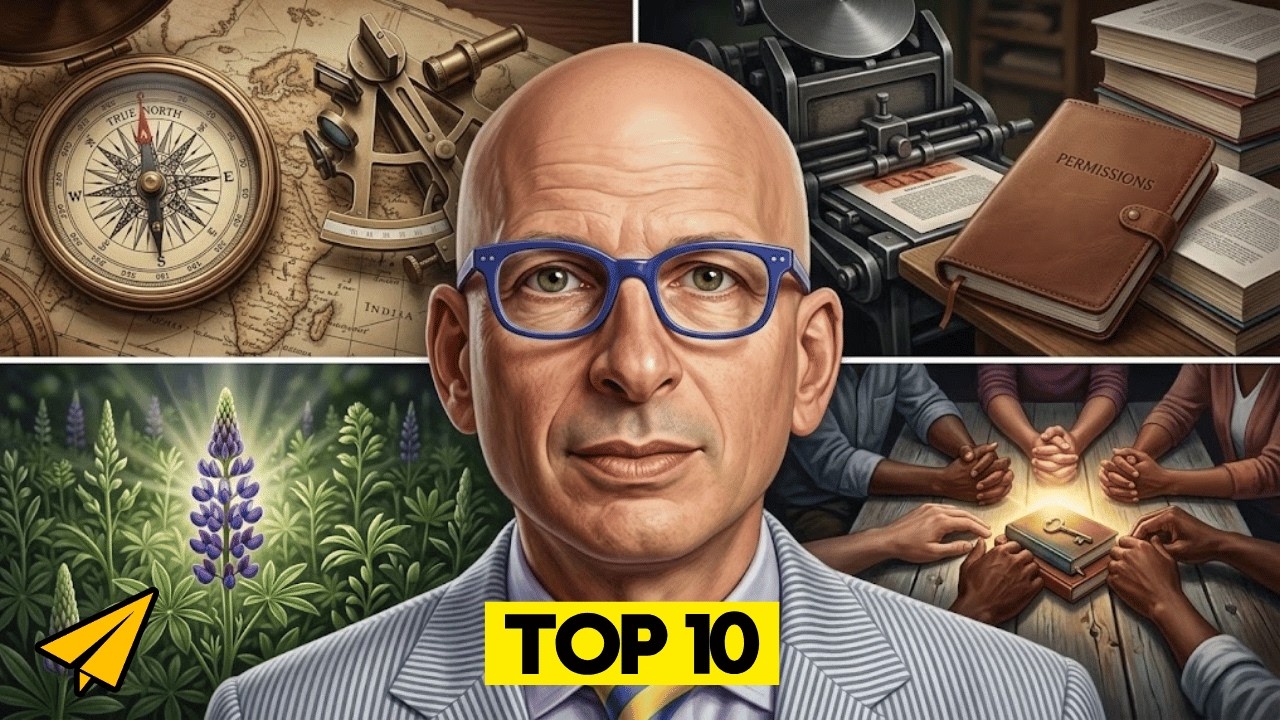
Seth Godin shares ten rules for success, from picking yourself instead of waiting for permission to viewing problems as opportunities. He got 800 rejections before his first win, and argues that resistance is a sign you're doing something that matters.
Chapters
If we're going to do something important, there's going to be resistance. If you don't feel resistance, it might not be important enough.
Seth Godin is a legendary marketing expert, entrepreneur, and bestselling author who has written 21 bestselling books, including Purple Cow, and was inducted into the Marketing Hall of Fame.
You're about to meet one of my mentors, the one and only Seth Godin. He's written more than 20 bestselling books. He's considered the godfather of modern marketing.
He went from building his book packaging company, Seth Godin Productions, out of a studio apartment.
In '86, I started a book packaging company, got rejected 800 times in a row after selling my first book.
To founding Yo-Yo Dine.
We invented email marketing and Yo-Yo Dine, which I ran out of my pocket from the book business.
Selling it to Yahoo.
But eventually we grew to be the largest email marketer in the world.
And then I sold the company to Yahoo in '88.
'98.
1998.
And becoming one of the most influential marketing experts in the world.
Can we just take a moment to say how brilliant Seth Godin is? It's like a masterclass right here.
I love this.
Need motivation?
Watch the top 10 with Believe Nation.
If you've been here before, drop a hashtag #Believe in the comments below so I can feature you here in a future video. And if you're new, welcome to Believe Nation, the only channel that helps you believe in yourself daily, one video at a time. Okay, let's kick it off with rule number 1: start where you are.
It's tempting to just, you know, point to numbers and, you know, what did you grow, how big was your organization? But I think it all starts at home. It all starts with the first noise we hear in our head when we wake up and the last thing we say to someone we care about when we go to bed. And all of that is fueled by the story we tell ourselves, the story of being a victim or the story of being an architect. The story of saying, that person, that one right across the table from me, under the circumstances, they're doing their very best. I can't change them, but I can change the circumstances. And so we begin by realizing that people who have had much worse things happen to them than you or to me or to you, have somehow figured out a way to thrive, to thrive given where they are right now. Because the only place to begin is where you are. If you're waiting to get to somewhere else before you begin, you're never going to get there. We have to start where we are, acknowledge what's happening right around us, and then make a choice. Make a choice about whether we want to change things or whether we want them to stay the same. But you're only a victim if you want to be.
Rule number 2: See a problem as an opportunity.
What I think we're wrestling now with is people are afraid, people are lonely, people are disconnected. They're victims of all sorts of media and commercial systems, and we've been indoctrinated to not notice it. And there are problems all around us, and if we can solve problems, we can make things better. So what I want to help people do is find the words to talk about their problem, Realize what's holding them back. Go solve the problem. Because when we solve problems, we make things better for ourselves and for other people. So problems aren't something to be avoided. Problems are our opportunity. And I believe all problems can be solved. Some things aren't problems. They're situations, and you have to live with them. But if it's a problem, it means there's a solution. And I would like to help people find The vision and the words to see where they're stuck, why they're stuck, and whether it's a problem or a situation.
Rule number 3 is pick yourself.
Pick yourself.
The dominant system does not want you to pick yourself. The dominant system wants you to wait to be invited to go on a reality show, to be invited to apply for a job. They want you to go to the placement office and wait for the company to come interview you. The idea that someone else will pick you and authorize you. They will call you up and they say, Mel, we know you have a novel in you. Would you please write the novel and we will publish it? And I'm speaking from experience here. I've talked to thousands of people in this very situation who have a book inside of them. And my advice to them is, it's simple. Make it into a PDF, email it to 20 people, ask them to share it with others for free. If it spreads, Your phone will ring and now you can get hired to write another one. If it doesn't spread, write something better.
The end.
And almost no one does this because it's really awkward to say, yeah, I picked myself, I wrote this, here I made this. And those 4 words, here I made this, are so challenging, right? That it's easier to buy a cookbook and follow the recipe than to invent something you're going to serve to people you care about. And so if we can find a life where we can identify the things that are important to us, truly important to us, and then pick ourselves not to do the work to win a prize or get a medal, but because we have agency, because we could— the word for that is freedom.
Hmm.
It is the responsibility of showing up To make a thing and offering it to the world. It might just be your family that notices the attic is clean, but you, you realize that you hired yourself to clean the attic. Don't wait till you're gonna sell the house and the realtor hires you to clean the attic. You hired yourself to clean the attic, and that sort of freedom and responsibility, that's where dignity lies.
Rule number 4, eliminate the but.
Here's An actual carrot.
And here is actual water. This is not actually a donkey, but let's pretend this is a donkey.
Okay?
In Burden's philosophy experiment from a couple hundred years ago, the donkey is hungry and thirsty. He has complete freedom. He can move. And he's halfway between a pile of carrots and a bucket of water. And he's trapped because every time he moves toward the water, he's moving away from the carrot. Can't do that because he's hungry. And every time he moves toward the carrot, he's moving away from the water. Can't do that because he's thirsty. And so in the experiment, because we're trapped, we end up dying of hunger and thirst. And all of us do this, and we do it with one simple word, which is but. I want this, but I also want that.
Right?
I want to have a creative life, but I never want to get rejected. I want to run the marathon, but I don't wanna get tired. And we hide the but. We don't say the but out loud.
Also, if you wanna take real action after this video, I made a free worksheet just for you. It covers the top lessons from today, gives you space to write biggest takeaways, and helps you build a simple action plan. It's 100% free. Just click the link in the description below to go grab it, and I'll see you there. Rule number 5, accept the resistance.
The word resistance means anything that we do To get in our own way, to keep us from doing something that's going to scare us. And so let's talk about writer's block. Writer's block was only invented 100 years ago. We know who named it, uh, the woman who wrote Frankenstein's, uh, ne'er-do-well poet husband. And writer's block is based on the idea that you just don't have the muse telling you what to write today. This is nonsense. There's no such thing as writer's block. What happens is if it feels important, if writing a memo feels important, if painting something feels important, if going on a date with someone you've always wanted to go on a date with and it's tomorrow night feels important, we do something internally to insulate ourselves, to protect ourselves, to keep us from being on the hook because we got indoctrinated by school to do that. Because factory workers don't have to be on the hook. They just have to do what they're told. But it's also, I think, part of human nature. And resistance then is something that we cannot make go away. If we're going to do something important, there's going to be resistance. If you don't feel resistance, it might not be important enough. So the question then is, what do you do when it shows up? And the answer is you say, thank you. Thanks for letting me know I'm on the verge of doing something important.
Yeah.
Thanks for reminding me that this needs to be on the top of my priority list. The things I'm procrastinating, I'm procrastinating because of resistance. And so I now have a compass, and the compass points me to the hard work to be done.
Rule number 6, find your purpose.
I think most people we meet would like to be seen, missed if they are gone, understood, and of use.
Right?
That's something that crosses borders and cultures. And yet we end up being a cog in a system. The Uber driver racing around doing things they wouldn't ordinarily do because the system is pushing them to cut every corner. Or the mom who's struggling because the financial system that she's stuck in is pushing her away from the kind of work or parenting she wants to do. And many of those things are injustices, and some of those things cannot be fixed by an individual. We can accept those as situations. You're not going to change Uber. Uber is going to be the way Uber is going to be. And if you choose to be an Uber driver, the rules of Uber come with it. But other things are things where we get to make a choice. And I'm not saying— I want to be really clear— I'm not saying anyone deserves an injustice, anyone deserves where they are right now. But given who you are, given where you are, what are you going to do? What are the choices you do have? And how do we get out of the knot, the stuckness of wanting 2 things that we can't have at the same time? Because it's when we want 2 things at the same time that cannot coexist that we feel stuck. And that feeling of stuckness robs us from the chance to be of use. It robs us from the chance to get to that place that deep down we want to go. So I use the word purpose, and what I mean by that is not you're born with a purpose, because I don't think you were, but you can choose with intent the purpose of whatever you're going to do tomorrow. That purpose might be, I need to get paid. That purpose might be, I need to get this date. That purpose might be, I need to put something on the internet that changes the lives of 1,000 people. When you say your purpose out loud, the purpose of this work is so-and-so. Then I say back to you the very first question, which is the key. Who?
Who is this for?
Is it for everyone, or is it for 12 people or 1,000 people? What change are you here to make, and for who? And if we can't figure out who the who is, then we feel like there's just this amorphous, horrible, heavy blanket on us, trapping us. But if you can find the 5 people you can solve a problem for, or the 25 people, Who would miss you? It starts to work.
Rule number 7, keep your promises.
Once you've been busy pressing the buzzer, now you have to say to yourself, what am I not gonna do in order to be able to do that?
Yes.
So this is about making promises and keeping them. So I am not going to say to somebody, please go ahead, engage with me in this level and I will get back to you, 'cause maybe I can't.
I don't go to meetings.
I don't watch television. So right there I save 7 hours that most people waste every single day. That 7 hours gives me a lot of space to do things that make me seem insanely productive.
Right?
Yeah.
Because I'm not doing these other things. Well, other people really should go to meetings. Other people really should watch TV. That will make them productive in the way they seek to be productive. I'm just saying you pick.
Yeah.
So Twitter was easy for me. Because I said to myself, if I'm going to do Twitter, I should commit to it. There's a dip. And if I commit, I should figure out how to be really good at it. If I'm going to be really good at it, I'm going to have to give up something else. So what do I want to be less good at than I'm good at now so I could be good at Twitter? And I looked at what I thought would be the upsides of that and I said, I don't want to give up anything I'm good at to be good at Twitter. Done. And I never have reconsidered it since because I don't need to. And there are other areas where I have said, you know what? I'm gonna give up this part of my thing to do that thing instead. But we have to acknowledge we have finite resources, finite time, finite connections.
Yes.
How will we use them to produce outcomes that we're proud of? And the worst thing to do, in the words of Zig Ziglar, are to be a wandering generality. What you need to be is a meaningful specific. That means you have to claim it, you have to put yourself on the spot, you have to make a promise and say, I do this. You can count on me. That's what you're gonna get from me.
Rule number 8: Fly closer to the sun.
The story of Icarus is fascinating to look at from a cultural perspective. It's been around for thousands of years.
We all know it.
Daedalus and Icarus go to a desert island. Daedalus, the dad, makes wings out of feathers, gives them to his son, puts them on with wax, Says to his son, "Obey your father. We're flying out of here. Don't fly too high because if you fly too high, the wax will melt and you'll die." And we all know what happened. Icarus got uppity.
He had hubris.
He disobeyed his father, and he died.
Except that's not what the myth said in 1700 or 1500 or 1200.
They changed it. It used to say.
But more important, don't fly too low. 'Cause if you fly too low, the water and the mist will weigh down your wings and you will surely perish.
They took that part out.
Why do you think they took that out?
They took it out because the people in power, the industrialists, want us to fly lower. 'Cause it's easier to ignore us, it's easier to keep us in line, it's easier to get a factory job that way. People who have the hubris to dream of something bigger Change the status quo. And the people who are in charge aren't in favor of that.
Rule number 9 is be persistent.
I am averse to the failure Olympics because I think sometimes it gives us a place to hide. But there are 2 kinds of failures. I have failed more times than anyone who's watching this in terms of projects brought forward that didn't resonate. When I was a book packager, I got 800 rejections in a row. And for more than 10 years, I was on the edge of bankruptcy, 4 weeks away from being completely outta money. Uh, when we were building Yoyodyne, the company that ended up going to Yahoo, our biggest client was AOL. And at one point, the VP of AOL said to me on the phone, if you set foot on our campus, I will have you arrested.
Oh, wow.
Right? So it was high stakes. And there are things that I brought, you know, books I worked on for a year that Sold 1,000 copies. Uh, there were projects, you know, another thing we did for AOL was one of the best ideas I ever had. We worked on it for a year. We built the whole thing out and a week before, uh, it launched, AOL switched its business model from, uh, royalty to flat rate, which meant the project got canceled.
Ugh.
And so there's a lot of bumper cars when you decide to do a life of projects. And I wouldn't have it any other way. The real failure that I think is worth talking about, that's way more interesting now that I've survived the other kind, is the failure of inaction. And like everyone, I have a really long list of that. What are the things I could have done and didn't? Who are the people I could have helped but didn't? And that's the kind of thing I try to pay attention to because I know a lot of people who have succeeded, and the reason they succeeded is because they persisted, but also because they protected against the downside. So they still protect against the downside, but what could they have accomplished if they had protected a little bit less against the downside and instead said, it doesn't matter that this might fail. What matters is that this is worth trying. And that's something I try to motivate myself to do all the time.
And rule number 10, the last one before a very special bonus clip, is be willing to fail.
You're probably gonna fail. Yeah, the stuff you do is probably gonna suck. You're probably gonna get in trouble. Yeah, probably not gonna work. Are you okay with that? Because if you're not okay with that, well then that's why you're having trouble getting your ideas out there. That's why you're having trouble integrating other people into the team. That's why you're having trouble doing X, Y, and Z, because you aren't okay with it not working. So you're waiting For the thing that's sure to work, but the thing that's sure to work isn't going to happen. And if it is, someone's going to do it instead of you. So all that's left are the things that are probably not going to work.
Yeah.
The thing is, when you were four, you told a joke that was funny, and when you were eight, you did a drawing that was interesting. And when you were fourteen, you had a conversation with someone that was truly human.
You're capable of it.
That's not the question.
Everyone. who's watching this has written one intelligent sentence. I've just written more than one. But it's a matter of quantity, not ability.
Yeah.
So where does the quantity come from? The quantity comes from being willing to be wrong, being willing to be made fun of, being willing to be embarrassed, being willing to fail. It never gets easier. It never gets fun, ever. Okay, fine. And gravity also sucks. If we didn't have gravity, we could fly.
Yeah.
So there's gravity, but we don't whine about gravity. We just acknowledge that there's gravity and we walk anyway.
Yeah.
Well, I think the same thing is true about the art that we make, the difference that we make. A customer comes in every day, and the 5th day they come in and it looks like they've been crying. It is not your job to say to them, is everything okay? And give them a hug. But if you did that, what would happen?
Right?
It might not work. They might get really angry with you. It's none of your business. But it also might change their life. You could sign up for that or not. And that's what freedom looks like. And that's why freedom is so scary.
Yeah.
Because freedom doesn't come with a dummy's book, and freedom doesn't come with a permit, and freedom doesn't come with an excuse.
You have to own it, and it probably isn't gonna work.
You know, I've written 7,000 blog posts, and half of them were below average. I just didn't know which ones were below average until after I wrote them.
What's the most important thing that you've learned?
There's the external thing and the internal thing. The external thing is this is our revolution. We live in this moment of time when anyone with $100 can connect to 1.5 billion people around the world anytime they want to. We live in this place where we each have more leverage and a bigger platform than any human on Earth ever had before us. And internally, If not this moment, when? Right? That if we're not going to speak up now, are things going to be easier or better a year from now? We wait for things to calm down. We wait for it to be the right moment. But this is the right moment. That we look back a year in our life, 5 years ago, and we rarely say, I'm disappointed that I spoke up. I'm disappointed that I did my art. I'm disappointed that I connected to somebody. We don't. What we regret is not doing that. So here we are in this moment of high leverage, and all we can do is watch cat videos and whine about our boss. And I just, I think we can do better than that.
And congratulations, you're one video closer to who you're meant to be.
Believe.
To see the one-on-one interview I did with Seth Godin, check the video right there next to me. I think you'll love it. Continue to believe, and I'll see you there. Ladies and gentlemen, we have a legend in the house, author of a new book called The Practice, which is all about finding your creativity, unleashing your voice, and nothing counts until it ships. Mr. Seth Godin, welcome aboard, man.
Thanks, Evan.
More from Evan


How the Biggest Mistake in History Created A Trillion-Dollar Empire | Sergey Brin



9 Machiavelli Principles That Force People To Respect You | Machiavellian Philosophy



The First 10 Words That Instantly Ruin A Sales Conversation | Vanessa Van Edwards

The Top 1% Mindset Behind The First $5 Trillion Company | Jensen Huang (Nvidia)

