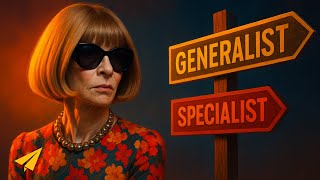
Anna Wintour argues that over-specialization is a liability in modern media. She hires "fearless polymaths" with diverse interests and a willingness to fail, and credits being fired from Harper's Bazaar as valuable as any success. She despises mediocrity and tells the next generation to chase their own vision, not the competition.
Chapters
I don't think of myself as a boss. I mean, I think of myself as someone who's giving direction. I think it's healthy for everyone to lose a job as well as to gain a job. I like people who represent the best of what they do, and if that turns you into a perfectionist, then maybe I am. I think the more you go out, the more you see, the more you experience life, the more you bring back to your day job.
She's a British journalist and editor. She's been editor-in-chief of Vogue since 1988. She's Anna Wintour, and here's my take on her top 10 rules for success. Rule number 5 is my personal favorite, and I'm curious to figure out which one you guys like the best.
I try and be decisive. I try, even if I don't know what the hell I'm doing, I try to be decisive because I think it's very comforting and reassuring and important to the people that work with you to feel that whoever is in charge knows what they're doing and knows what they're thinking, and that if it's a yes, it's a yes, and if it's a no, it's a no. I mean, I don't think of myself as a boss. I mean, I, I think of myself as someone who's giving direction and guidance and vice versa. And I also know career-wise how important it is not to be too highly specialized, especially these days in the world of media. It is crucial to have multiple interests and skill sets, to have tried and possibly failed at many different undertakings. The young people that we hire today at Condé Nast are fearless polymaths, hardworking and passionate, creative and curious. You eventually joined Harper's Bazaar US, and in 1976 it was, you were fired, and I find that extraordinary. No, they were very clear in that they thought that I would never understand the American market. I remember I was the editor on one shoot that was, uh, I think it was a French fashion shows, and I just decided that it would be interesting to have dreadlocks on the models. And I think that that pushed them further than they could bear. So that was it for me. But I, you know, I think it's always part of life to have some knocks as well as some successes and to take risks and, you know, to learn. So I think it's healthy for one to lose a job as well as to gain a job.
What bores you?
Mediocrity. If you see a collection that is— you feel the designer has been lazy or taking inspiration from other designers, it doesn't so much bore me as anger me. What is your best piece of advice for the next generation's influencers? I think it's really to be true to yourself and listen as much as one is able to other people whose opinions you respect and look up to, but in the end it has to come from, from you, and you can't really worry too much by looking to the left or the right about what the competition might be doing or other people in your field might be doing. It has to be true vision. The blurb on your unauthorized biography reads, she's ambitious, driven, Needy, a perfectionist, an inside look at the competitive bitch-eat-bitch world of fashion. Accurate? Well, I'm very driven by what I do. I am certainly very competitive. What else am I? Needy? I'm probably very needy, yes. A bitch? Perfectionist? Perfectionist. Well, let's try bitch first. Bitch. Well, I hope I'm not. I try not to be, but— I like people who represent the best of what they do, and if that turns you into perfectionist, then maybe I am. I don't make notes. I don't— I react very instinctively to everything. I'm a great believer in traveling a great deal. I don't believe meetings— more than 2 people in a meeting is too many. Really, it's true. Do you know about stand-ups? Do you know what this is? No? Okay. So in Silicon Valley now, when you have a meeting, everybody stands in a circle like they're meditating. And that's how— maybe I should try that. I think the more you go out, the more you see, the more you experience life, the more you bring back to your day job. So as I was trying to say in my remarks, I think the problem about big corporations is you get a lot of people my age trying to hold on to their jobs and, you know, clinging on to their pensions and their retirement, and they're not experiencing new things, and they don't like change, and they don't like disruption. So they're either— they don't make a decision or they say no, and as a result, they stagnate. So it's terribly important to bring people in from the outside and not to remain too insular, and also to hire as many young, bright people like all of you as you can, just to teach you how to think about things completely differently. Well, I think all of us at Vogue are always looking for talent, and we're also looking for someone who has a head on their shoulders and understand that being talented is obviously important, but that you also have to have a sense of business, and that being creative and commercial are two words that can work together. It's very important to me that I look good when I go out publicly. I like looking at my clothes rack in the morning and deciding what to pick out. I enjoy fashion, Molly. I mean, I wouldn't be in this job if I didn't. I think clarity is the most important— one of the most important leadership qualities that one can have. I think it's really important to be very specific and very clear in what you expect. To respect and then to delegate. People respond much better when they're in a more independent environment and you're not completely breathing down their neck all the time. The other thing I think is incredibly important is to hire divas like Andre Leon Talley, who will disagree with you and contradict you and not yes you all the time. And not to be scared of having people working with you that have different opinions.
Thank you so much for watching. I made this video because Mari Sylvester asked me to. So if there's a famous entrepreneur that you want me to profile next? Leave in the comments below and I'll see what I can do. I'd also love to know which of Anna's top 10 rules had the biggest impact on you and why. Leave in the comments and I will join in the discussion. Finally, want to give a shout out to Jesse Willoughby. Jesse, thank you so much for buying a copy of my book. It really means a lot to me. For your chance at a shout out in a future video, make sure to pick up a copy of the book and email in your receipt so we can keep track. Thank you guys so much for watching. Continue to believe, or whatever your one word is, and I'll see you soon.