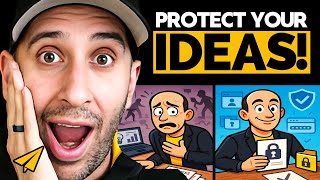
Evan Carmichael explains how to protect a mechanical part idea from theft by a large company. Build expertise that can't be copied, file a provisional patent for legal coverage, and create momentum with customers or technology so acquisition looks cheaper than building it themselves.
Chapters
How to prevent your business idea from being stolen. If you're an entrepreneur and you're trying to sell to big companies, a big fear that comes out is, "What if they steal my idea and try to do it themselves?" How do you overcome that? And this is a question that came in recently from one of my YouTube viewers, love you guys, Yaya, who wrote in to say, "I have an idea as a mechanical part and I want to present it to a big company." What is the guarantee that the idea will not be stolen? Okay, there's a few things that you can do, but your options are also really limited, so you gotta be careful. Here are the things that can help. Okay, if you're presenting to a company and you don't want your idea stolen, the first is to have expertise that they can't duplicate. Okay, if you have a team or there's something with you that cannot be duplicated easily, then that's a competitive advantage, right? So for example, I'm Evan Carmichael. Nobody can be Evan Carmichael. You know, you can get up and you can get in front of a camera and you can try to help entrepreneurs through videos, you can wear the same shirt that I'm wearing, but you'll never be Evan Carmichael. So if you're selling something that's related to you and your team, then that can't be ripped off because that's you and your team. The second thing is a patent. And this is what's going to be important for Yaya who wrote in, who has a part that he wants to sell to a company. Get a patent. Get it protected. And typically with patents you can get a provisional patent which gives you a limited amount of time to go out and get the full-blown patent, but that is what a company will buy. This is from a guy who went out and— I had my first software company and I sold it to a multi-billion dollar company. And what helps is having a patent, because if you have a patent, they can't just rip off that exact same thing that you did. Okay, the last thing is go get some momentum. Get some momentum. Don't just sell a part, sell something more than than the part. And this is what helped me sell my company. This is so important, okay? I had a software company and I was selling my business to a company that wanted a software arm, okay? And their decision-making process is either I'm gonna buy this company or I'm gonna try to do it myself. And what they would do themselves wouldn't be exactly what we did because they don't know our code. But it could be pretty close. But it's going to take them a year to do it, and they're not going to have any customers out of the gate. So the reason to buy from me, the reason to buy my company, was that they got the technology right away and they got a customer base right away. And anytime you're pitching a big company, that's going to be the decision-making process they go to. If they love the idea, they're going to think— they're going to think, can I 'Can we rip this off? Can we do it ourselves? If there's no patent to protect it, or if there is, can we find another way around it? How long and how much money is it going to take me to do it myself instead of paying you?' That's what they're all going to think. And so the way around that is to have some kind of momentum with it. Because you want them to think it's going to take them years to do it and cost them a lot of money. And it's way cheaper to get the market by hiring you or by buying your company. So if you want to prevent your idea from getting stolen, first, have something unique to you. Second, get some kind of patent on it so they can't just rip it off. And three, build some momentum to make the decision harder for them to say, "I'm going to do this myself," because it's going to take them more time and more money than by just acquiring your company right away out of the gate. I know it's a hard process, and I know it's, uh, It's scary, and I knew when I was selling my company that by exposing what we did, they would potentially be thinking about ripping off our software, and they were. All of the companies are going to think that, so it is scary. But if you have enough momentum behind you, it makes the decision easier to say, "Let's acquire them," instead of, "Let's compete with them." So good luck and believe. For those of you watching, like the video, please give it a thumbs up below. Let me know what you think too. Leave a comment. You have a question, put it below. You can subscribe above, click on my face, you can subscribe to the channel. Thank you so much, guys, and I'll see you soon.