Sustaining Your Team's Energy | Business Insights from 14 Minutes of Wisdom
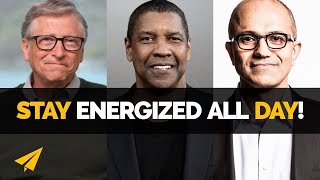
Bill Gates, Denzel Washington, Satya Nadella, Jake Gyllenhaal, B.B. King, Alex Ferguson, Wiz Khalifa, and Mick Fanning share how they generate and sustain energy in their work. Gates kept cash reserves to take risks at Microsoft. Ferguson slept four hours a day in his 30s but needed more rest by his 60s. Nadella says CEOs must be a constant source of energy for their teams.
Chapters
Energy.
Get the energy.
Keep—
sustain that sense of energy.
Great energy.
Energy.
Energy.
Hello, Believe Nation! Today we're gonna talk about how you can raise your energy. And as always, if you hear something that really resonates with you, please leave in the comments below and put quotes around it so other people can be inspired as well. Enjoy!
When I started Microsoft, I didn't think of it as all that risky. I mean, I was so excited about what we were doing. It's true I could have gone bankrupt, but, you know, I had a set of skills that were highly employable, and in fact my parents were still willing to let me go back to Harvard and finish my education if I wanted to.
You've always got a job with me, Bill.
And the only— the thing that was scary to me wasn't quitting and starting the company. It was when I started hiring my friends. And they expected to be paid. And then we had customers who went bankrupt, customers that I counted on to come through. And so then I got this incredibly conservative approach that I wanted to have enough money in the bank to pay a year's worth of payroll even if we didn't get any payments coming in. And I'm almost true to that the whole time. We have about $10 billion now, which is pretty much enough for the next year. Anyway, You know, I— if you're going to start a company, it takes so much energy that, you know, you better overcome your feeling of risk. I don't think that you necessarily, if you're going to start a company, should do it at the start of your career. I think there's a lot to be said for working for a company, learning how they do things. You know, if you're young, it's hard to go lease premises. They made that hard for me. You couldn't rent a car. When you were under 25 at the time. So I was always taking taxis to go see customers. And people would, you know, people say, well, we're gonna go have a discussion in the bar. Well, I couldn't go to the bar. And, but, you know, that's fun because I'll tell you, when people are first skeptical and they go, this kid doesn't know anything, Then when you show them you've really got a good product and you know something, they actually tend to go overboard and they think, "Whoa, they know a lot. Let's really do an incredible amount with these people." So our youth, at least in this country, was a huge asset for us once we reached a certain threshold. It is hard to hire older people because they'll be a little bit conservative about whether they should come and take the risk. And it took 3 or 4 years before we could go out into the normal sort of employment pool. But those problems that come with starting the firm, you better think of those as part of the pleasure, part of the challenge that is part of the excitement. Well, what do you think the biggest difference between doing a play and doing— I mean, it's a cliché question, but I'd be interested to know your answer.
I think a part of what Viola just said is that you get to dig deeper and you get another day. And you get the energy. You do a movie and it's 200 people that are used to it and they don't care. And everybody's doing their job. And it comes in a theater somewhere. And you're picking your nose at home somewhere, clipping your nails. There's no energy. When I was on Broadway 5 years ago with Julius Caesar, I made a decision to sign autographs every night. I don't know what I did. Oh yeah, it ain't happening this time. No. Only as I rub my knees. Only because my knees are bad, it's hard for me to stand. But—
And why did you decide to do that?
Well, you know, I wanted to say thank you. It was my way of saying thank you. And the first night, it was like 5,000 people out there. I said, OK, wait a minute. Everybody who has playbills from our show.
So—
yeah, because it was like people were just wandering up the block. I was like, wait a minute. I forgot I'm on 42nd Street, Times Square. I was like, wait a minute. But honestly—
You were signing for weeks.
The energy— and I was out there an hour and a half every night, every show. Wow. But the energy you got back, the stories, the 5 little old ladies who just drove in from Detroit. And I'm like, well, what y'all doing tonight? They said, we getting back in the car, baby. We got to go back tonight. And you know, a little 84-year-old lady was like, baby, if I was 3 years younger. Oh, true story. True story.
Then we had—
and I say this also because I hope it happens with this play. We had some high schools come. We had one school from somewhere, I forgot where, and they were doing Julius Caesar. And some young kid was like, well, you know, my Brutus is a bit different. He's more the classic stoic. But it was great to engage and exchange with these young people. There was an energy. I got more from it than I gave to the people that I signed for. That's, you know, you don't get that. You know, the odd thing about success in film is the budgets get bigger, you make more money, but they become more formulaic. So you don't get the opportunity. So I, God willing, if I stay around long enough, this is what I'm gonna be doing.
One of the things that people talk a lot about is what gets someone to become an entrepreneur. I mean, you know, it's just a fascinating mindset, right? You really have to be slightly delusional to be an entrepreneur because you have to suspend disbelief. Or you have to believe about your own idea and have deep passion to go pursue it. So, in some sense, quite honestly, before I give advice, I take a lot of inspiration from what you're doing. It takes a lot of guts. It takes a lot of energy to be an entrepreneur. And I think that In that, in there, therein lies, I think, your secret to success, which is your ability to overcome every constraint and every obstacle. And do it with the boldness and the risk-on nature of it. I think it's fantastic. If anything, I would say, especially for entrepreneurs, is you gotta keep, sustain that sense of energy. Over a long period of time. Because we all know, and you are grounded in it, the mortality rate is super high. And that means you will be thrown curveballs, you know, day in and day out, and you have to be able to overcome that. And so being a source of energy in your small team, especially if you're a CEO of a startup, I like to sort of observe them a lot because You can't have a bad day. You're all the time, you know, you get up in the morning, you're coding. In the afternoon, you're talking to your investors. In the evening, you're hiring. And that constant sense of energy and passion for what you're doing is what I think it takes. And to never give up, which is what makes you who you are in terms of the core makeup. I think that for me, I am personally inspired by that. I think that even from a Microsoft culture, that's what really my dream is. My dream is not that, okay, we have a large organization. My hope is that every team inside of Microsoft feels both that sense of energy and empowerment and goes about it.
Do you have moments of repose, moments of just, I'll just take it in and sit quietly?
No.
You know, I gotta— I have to do a lot of plane flights.
Yeah.
And, uh, oh, I'm a handful. I don't know, I haven't made it in the tabloids as the bloke who started the riots and stuff on the planes yet, but I guarantee you it will happen. You know, you can't hang your arm out the window, and you can't stop and have a pee and look at the wildlife.
Yep.
You know, you're stuck in this thing for like sometimes 14 hours in a leg. You know, like going to America is just a 14-hour stint, mate, and it's shocking awful to sit there.
And all the—
you know, you can't— I like a good movie, but not 5 of them in a row. And I don't read much, you know, like I'm just—
You don't read?
How come you don't read?
Well, I do read, but you know, like— Not for 14 hours. You know, surf mags take a good 20 minutes.
To me, I like the live stuff better than stuff on the album because stuff on the album seems more relaxed. You know what I'm saying? You gotta have a certain tone. You know what I'm saying? Puff may be like, "Don't get too excited, just chill, let it flow." But when you on stage, sweat pouring down— I'm a big one too— sweat be drenching. I just be representing, you know what I'm saying? Just doing my thing.
Do you run out of energy emotionally?
This is him not sleeping.
This is me on no sleep right now. I don't.
I can't express how happy of a person I am. I can't express how inspiring and, I guess you can say, motivating my life and the people around me are.
You know, things work in the moment and then can die off, and then things cannot work in one moment and come to life. And if you have any wisdom whatsoever, you know to follow you know, wherever there is great energy. And that's what I followed with Denis when we did Enemy. I went, this guy has great energy. We vibe on each other, and this— I gotta go with this. Like, I don't know what this movie's about, but I know this energy. And I know this energy is success somewhere. Creative success. And that's first and foremost to me. And that's what I follow now. And that energy drives a movie. When you watch it as an audience, it's infectious. When you see that on the screen, and I see it all the time with people, you're infected by that energy, and that's what we want.
We average about 200, about 250 to 275 concerts per year. Sometimes that means you might do 2 in one day. I'm 69, I'll be 70 on September 16th if I live that long, and I find the energy meeting people like yourselves. I enjoy people. I love to play, see people happy. I love to see them dance, see them enjoy themselves. That's energy for me. And it's educational. I get a chance to learn how to say merci beaucoup. I don't speak French, but Lucille does. Music is a universal language. And I believe that because it's been many times I've heard great musicians like Django Reinhardt.
I love—
never hear him speak English, but he speaks it with his guitar. So I think music is a universal language that we can, I believe, communicate with anyone.
The thing about energy, and it's— and anyone listening to this is real important— when you start like I did at United, we'd say at 43, 44 years of age, they see the energy, the players see the energy, they see it bouncing out of you. But when you get to the 60s, they still expect to see it. So I had to look at myself in terms of energy, the hours I slept, 'cause when I was a young manager, 4 or 5 hours, no problem. When I got to that, to my 60s, I needed 6 or 7 hours. So you go to bed earlier, you look at your diet better. Saturday nights were out after the game, went home, you know. I never— very, very seldom around a Saturday night. So that I had to examine myself over my energy because people want to see the energy. Very important aspect of it, you know.
I always envision myself of, you know, being a rapper and being in the game and having success, but you never know what it really feels like or how you're gonna be when you're there. The name Wiz comes from me being the youngest dude in my age group of people that hung out with. They would call me a young whiz, you know, like I was wise beyond my years. And the Khalifa is Arabic. It means successor, leader, shining light. My granddad gave me that name. He's actually Muslim, so, you know, he used to see my path and what I was doing and how hard I was working, and he gave me that name, and I just put the two together. Of course I do rap music and I'm a hip-hop artist, but as an individual, as a personality, and what I give to the people, I see myself as like the lead singer of a band or something. You know, when I go out there, I'm a real performer. It's all about the vibe and the feeling. You gotta be balanced and it's like nothing that I have to put on. I really feel, you know, that energetic and that happy to be in front of the kids.
Thank you guys so much for watching. I'd love to know, what did you think? Did you get your energy raised from watching this video? What was the most important lesson that you learned that you want to apply to your life or your business immediately? What's the first action step that you're gonna take to apply it? Leave in the comments below, super curious to find out. I also want to give a quick shout out to @BestYouPro. Thank you so much for picking up a copy of my book, Your One Word, and taking that awesome picture on Twitter and posting it. I really, really, really, really appreciate it. Thank you guys again for watching. I believe in you. I hope you continue to believe in yourself. And whatever your one word is, much love. I'll see you soon.
More from Evan


How the Biggest Mistake in History Created A Trillion-Dollar Empire | Sergey Brin



9 Machiavelli Principles That Force People To Respect You | Machiavellian Philosophy



The First 10 Words That Instantly Ruin A Sales Conversation | Vanessa Van Edwards

The Top 1% Mindset Behind The First $5 Trillion Company | Jensen Huang (Nvidia)

