The 10 MORNING ROUTINES You NEED to Start USING Right NOW!
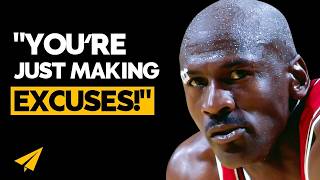
Michael Jordan, Mark Cuban, Jack Ma, and seven other high-profile figures explain why excuses kill success. They share stories of hardship and early struggles, arguing that opportunities open where others complain, and that discipline, self-belief, and relentless work separate winners from the rest.
Chapters
You're just making excuses.
I'm big on excuses.
You can find opportunities.
Don't accept excuses.
Well, we've got no time for excuses.
I don't have an excuse.
No excuses.
No excuses, my friends.
No longer wallow in my self-pity.
Maybe it's my fault. Maybe I led you to believe it was easy when it wasn't. Maybe I made you think my highlights started at the free throw line and not in the gym. Maybe I made you think that every shot I took was a game-winner. That my game was built on flash and not fire. Maybe it's my fault that you didn't see that failure gave me strength, that my pain was my motivation. Maybe I led you to believe that basketball was a God-given gift and not something I worked for every single day of my life. Maybe I destroyed the game. Or maybe you're just making excuses.
The thing about being an entrepreneur is this: it's just all to you. You know, a lot of people like to make excuses. I don't have connections, I don't have money, I don't have this. But you know, if you find something that you like to do or love to do, be great at it and see if you can turn it into a business. And worst case, you're gonna have fun doing what it is you love to do. In best case, you can turn it into a business. I'm just not big on excuses. Uses. I just think if you really— everybody has that opportunity to go for it, they just got to do it.
We have a lot of— we have Alibaba Group, we have a Tmall Group, we have a Taobao Group, we have Alipay. And people say, how you make it? Why this make it? Why people cannot find opportunities, you can find opportunities? And I think people same here today. Jeff, where is the opportunity? I don't have a job, I don't have this, I don't have that. I remember 20 years ago, I, I I hate Bill Gates. I say he took all the job, you know. He's such a great— Larry Page, Bill Gates, and every success people, they did good. And why I didn't have this chance? The same question like you. And later I calm down myself. And luckily I win. I tell you, I'm lucky to know a lot of famous people. Bill Gates, Warren Buffett, Jack Welch, Larry Page, Mark Zuckerberg. I know all of them. I would like to share with you that those people, the difference between those people and other people, they are always optimistic for the future. They never complain. They always try to solve the problems of the others. And I think, where is the opportunity? The opportunity always lies in the place where people complain. Some people sit there complaining, you think, hmm, if I can solve that complaint, that's the opportunity.
I was— had a horrible temper, poor self-esteem, all the things that you would think would preclude success. But I had something very important. I had a mother who believed in me, and I had a mother who would never allow herself to be a victim, no matter what happened. Never made excuses, and she never accepted an excuse from us. And if we ever came up with an excuse, she always said, "Do you have a brain?" And if the answer was yes, then she said, "Then you could have thought your way out of it. It doesn't matter what John or Susan or Mary or anybody else did or said." And it was the most important thing she did for my brother and myself. Because if you don't accept excuses, pretty soon people stop giving them and they start looking for solutions. And that is a critical issue when it comes to success.
We know that too many young men in our community continue to make bad choices. And I have to say, growing up, I made quite a few myself. Sometimes I wrote off my own failings as just another example of the world trying to keep a black man down. I had a tendency sometimes to make excuses for me not doing the right thing. But one of the things that all of you have learned over the last 4 years is there's no longer any room for excuses. I understand there's a common fraternity creed here at Morehouse: "Excuses are tools of the incompetent, used to build bridges to nowhere and monuments of nothingness." Well, we've got no time for excuses. Not because the bitter legacy of slavery and segregation have vanished entirely—they have not. Not because racism and discrimination no longer exist—we know those are still out there. It's just that in today's hyper-connected, hyper-competitive world, with millions of young people from China and India and Brazil—many of whom started with a whole lot less than all of you did all of them entering the global workforce alongside you. Nobody is going to give you anything that you have not earned. Nobody cares how tough your upbringing was. Nobody cares if you suffered some discrimination. And moreover, you have to remember that whatever you've gone through, it pales in comparison to the hardships previous generations endured, and they overcame them. And if they overcame them, you can overcome them too.
My son's 14, he's fabulous. And we're having this conversation about when he plays in sports or when he does something about, do you go full out or do you not? And I see sometimes in him that when he's out on the field or doing something, he doesn't play full out and he'll have an excuse. Like my leg hurts or my arm hurts or something happened. The coach was unfair, whatever. You know, the referee was unfair. And what happens with people is we tend to go out into the world and we look for those sort of excuses about why things aren't the way we want them. And when you do that, you lose all your power in life. When you start focusing on the external, on the excuses, you lose your power. Here's the way people really think. I will tell you, I can go out onto stage and bomb. You go out there and you just bomb, right? And people will respect you for going out there and trying your hardest. It's not how you actually perform that earns you the respect of your peers. It's the fact that you went out and actually did it. That's the difference.
I decided to go to film school because I loved the idea of making films. I love photography. And everybody said it was a crazy thing to do because in those days nobody made it into the film business. I mean, just unless you were related to somebody, there was no way in. So everything else— silly, you're never going to get a job. But I, I wasn't moved by that. I set the goal of getting through film school and just then focused on getting to that level because I didn't, you know, I didn't know where I was going to go after that. I wanted to make documentary films. And eventually I got into the goal of, once I got to school, of making a film. One of the most telling things about film schools, you got a lot of students in those days especially, it's not quite so much today, but wandering around saying, oh, I wish I could make a movie, I wish I could make a movie. You know, I can't get in this class, I can't get any— you know, first class I had was an animation class, it wasn't a production class. I had a history class and an animation class, and in the animation class they gave us 1 minute of film to put onto the animation camera, to operate it, to see how you could move left, move right, make it go up and down. And it was a test to see, you know, then the teacher would— you had certain requirements that you had to do. You had to make it go up, you had to make it go down, and then the teacher would look at it and say, oh yes, you maneuvered this machine to do these things. And I took that 1 minute of film and made it into a movie. And it was a movie that won like, you know, 20 or 25 awards, you know, in every film festival in the world. And kind of changed the whole animation department. And meanwhile, all the other guys were in there and saying, "Well, I wish I could make a movie. I wish there was a production class." And so then I got into another class, and it wasn't really a production class, but I managed to get some film, and I made a movie. And I made lots of movies while I was in school.
While everybody else was running around saying, "Oh, I wish I could make a movie." So speaking of excuses, one of my other favorite ones is no excuses. No victim mentality. The world owes you nothing. The world might come help you, but I wouldn't count on it. And if you start from the feeling that you need the world to participate, in order for you to be successful at taking on this new thing that you're considering doing, you're right to be scared. It might. I wouldn't count on it, though. But if you start from the perspective that the world owes you nothing, which it doesn't, and that it is not likely to bring you any particular help, you have nothing to lose. Because really, isn't that for every one of the people you brought onto your team? Isn't that how you want them to feel? When they report to you. You don't want excuses. That doesn't mean that you can't fail or that they can't ever fail. But right when you're starting, you have nothing to lose, right? When you're a huge company, you can spend 99% of your time worrying how not to mess up the billion-dollar-a-year money hose you've created. But you don't have a billion-dollar-a-year money hose right now. You have nothing. So you can't lose. Spend 99% of your time imagining what would happen if things went well and planning for that. 'Cause there's no downside. It's like a free option on an adventure.
Roberto asks, "What do you feel is a bigger obstacle to success, a lack of time or lack of capital?" Roberto, this is a tremendous question. I think the biggest obstacle to success is a lack of optimism. That question in itself is the problem, my friend, right? You're looking at two things that are both negatives, and guess what? Both of them are obstacles. When I started WineLibrary.com, transformation for my business, I had time, I worked my face off every minute, but we didn't have a whole lot of money in our profit center, so it took more time, right? It's just the way it is. Today I have more money, but boy don't I have time. But neither ever, ever will be an excuse for me, and so, just to drill this through the throat of the VaynerNation, That's right, I went that graphic. Don't smile, DRock. Here's the bottom line. I refuse to allow you to get an answer to that question because both of them are firmly square in the excuse column, and I have no patience for that. There will always be problems. Let's talk about a million other things that are a way to stop success. The health and well-being of your family members, so it takes your mind away from execution. The country you live in's government and political concepts at these moments, à la startups in China that I've invested in that got traction, but then people that were wired into the government decided to not allow it to happen, and then the startup disappeared. Not as easy to be an entrepreneur there. It's still a communist country. Sorry, it just is. And so all these things can be problems, right? There's a competitor with a billion dollars who's also skilled and punches you in the mouth and knocks you out in the first round, right? The world changing. I mean, there's just a million obstacles, right? The media, one bad coverage of you, a moment in time. You know what I think about a lot? You know what I think about a lot? Let's get really real. This is why we did this show. I always, I'm a human being, and I always think about a moment in time. What if I just say the wrong thing at the wrong time, right? What if I call out China for being a communist country in an episode while I'm on a rant and somebody who's watching doesn't like that doesn't like the way that tastes and it takes away a business opportunity for me in China in 7 years. Even though I'm not trying to zing, it's just things that I saw. What if, what if, you know, what if, what if I look down on my phone while I'm driving even though I've really not done that and I hit somebody and I kill them and that becomes the story and they're like, forget about the story about what you think of me, I will never recover from that because I killed somebody because I needed to check a tweet. These are moments in time. So there are so many things that can keep you from being successful, right? The people that you invested in, having something bad happen to them, so it slows you down. My friends, there are a million reasons why not, but there's one great reason why, which is you've just gotta persevere, no matter what it is. It's just the way it is. It's hard being an entrepreneur. It's hard building a business. Everybody thinks it's so easy, that there's an entitlement. There's a disaster. Zinging China, here comes my US zing right now. There is an insane generation of 18 to 25-year-olds right now that think they're entitled to having a business because they saw The Social Network movie and everybody's decided if you're a kid and you know what tech is, because you used Instagram early on, you're entitled to actually build a business. Building a business is hard. And you know what makes it really hard? Everything that happens every day of every moment. So, You can pick time, you can pick money as the one or two things that you think stop you from winning your game, but the truth is there's a million reasons. 99% of businesses go out of business for a reason, and that reason is it's hard. And so, if you're watching this show, I've got a sense of who you are, and you need to start creating layers and layers and layers and layers of skin to be able to get through because the glamour of being an entrepreneur, the goodness, you know, you get very confused by my optimism, 'cause it's my optimism, I can't help it, it's just how I roll, it's probably one of the variable 1% reasons why I'm successful. But please, don't get it twisted. This is hard, every day is hard, and if you don't have the stomach to weather the storm, you will not be successful. And by the way, let me throw you a real weird curveball, and that's okay. People have to look themselves in the mirror and understand if they're a number 2, 3, 4, 5, 6, 7 in an organization that has differences of being a number 1, but maybe that's where your skill set sits. Maybe that's how you make your fortunes and happiness and all the things that you're looking for, and so, that question got me going a little bit, Steve, because it's under the context of excuses, and I will never make an excuse. Everything that's a problem with me, Everything I don't achieve, everything that's a problem at VaynerMedia, and everything is my fault. And I succumb to that, and I respect that, and I actually think that's the way it should be. And so, no excuses, my friends.
When I had open heart surgery and I died, I used to ask myself, I used to wonder to myself, I used to ask the good Lord, I used to pray, why, why, Why did this happen, have to happen to me? I felt like I was a pretty good person. I tried to treat everybody right. I wasn't a prejudiced guy. I loved everybody. I didn't care what color he was. I loved him. So why, why did the Lord pick me? Why did it have to be the fortunate one or unfortunate, however you want to look at it, to be stricken down and have to suffer like this? For a year and a half after my surgery, 18 months, 18 months, 6 months I had to spend in a wheelchair. 6 more months I had to sleep sitting down on the floor with my back up against the wall because if I laid down I couldn't breathe. They had to cut my diaphragm during the surgery, whole lot of complications. And then when I'd sit there, I'd ask the good Lord, why? Why did I have to go through this? Why? Why was I— why did you do this to me? And it got so bad. It was so bad. The pain was so bad. My hurt was so bad. So I used to say, Lord, if I'm going to have to live like this for the rest of my life, then just take me. Take me now. I don't want— I don't want to suffer like this anymore. I went to one of many, many, many doctor visits that I had at the VA hospital. A young doctor approached me, came up to me, said, "CT, I heard you used to be the champion of the world." And I raised my head up, but I had a little inkling of pride still left. And I said, yes, I'm the one that you heard about. I'm the one that they told stories about. Yes, I'm C.T. Fletcher. He said, what in the fuck happened to you? Man, boy, you know that hurt me. That hurt me down deep. But I tell you what, if that doctor was here today, I would thank him because his snide comment is what made me determined to no longer wallow in my self-pity, to no longer ask God why did he do this to me. My determination changed. From that day on, I wanted to prove to that little smart, wise [SPANISH] that I could come back, that I was still C.T. Fletcher. And I wasn't going to let his little smart [SPANISH] be right. I'm not down. I'm not done. I'm not through. It's over when I say it's over and not before.
Thank you guys so much for watching. I'd love to know which of the clips you like the most. And are you going to stop making excuses or do you make too many excuses?
I'd love to hear your story. Share it in the comments below. Thank you guys so much for watching.
Continue to believe and I'll see you soon.
More from Evan


How the Biggest Mistake in History Created A Trillion-Dollar Empire | Sergey Brin



9 Machiavelli Principles That Force People To Respect You | Machiavellian Philosophy



The First 10 Words That Instantly Ruin A Sales Conversation | Vanessa Van Edwards

The Top 1% Mindset Behind The First $5 Trillion Company | Jensen Huang (Nvidia)

