The "15-Minute" Morning Routine That Builds Unstoppable Confidence
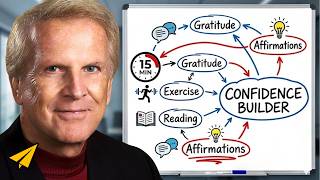
Dennis Waitley breaks down self-esteem into four components: belonging, identity, worthiness, and self-trust. He prescribes a 15-minute morning routine covering posture, appearance, and gratitude, plus an evening sign-off ritual, to build confidence from your core values rather than seeking approval.
You have to build a deep feeling of your own worth inside yourself. True self-esteem does not mean trying to impress other people with your awards. It comes from your internal values instead of your external money. You cannot share any positive emotion with others unless you own it yourself first. A special thanks to the Whateley family for partnering with us to release this video exclusively on my YouTube channel. To check out more about Dennis Whateley Global, click the first link in the description below.
Core values radiate like rings, as when a leaf falls in a pond. The self-centered constantly seek approval from and power over others. They try to impress them with their worth rather than express concern for others' well-being, and their outward appearances usually involve ways to hide their real thoughts and intentions. The value-centered give of themselves freely and graciously, constantly seeking to empower others. Open and modest, they have no need for conceit, which is the opposite of core value. Feeling good about who they are and not needing to talk about their victories or line their walls with celebrity photos, people with core values spend much of their time paying value, as I call it, to others. When praised, they share the spotlight. When they make mistakes, they view them as learning experiences and accept responsibility. Core values are like diamonds—very rare and almost impossible to destroy. One of my favorite stories is from the famous lecture by Russell Conwell, one of America's pioneering motivational speakers. Perhaps you've heard it before: Acres of Diamonds. Not far from the River Indus, there once lived a Persian farmer by the name of Ali Hafed, who owned a large farm with orchards, grain fields, and gardens. He was a wealthy, contented man—contented because he was wealthy and wealthy because he was contented. One day he was visited by an ancient priest, a wise man from the East. The priest sat by the fire and told Ali Hafed how our world was made. He said the Almighty thrust a finger into the fog and slowly turned it around and around, increasing the speed until it gradually became a ball of fire. And then he said, the ball of fire rolled through the universe, burning its way through other cosmic banks of fog and condensing the moisture until it fell in floods of rain upon its surface, which cooled the outer crust. And when the melted mass burst out and very quickly cooled, it became granite. That which cooled less quickly became silver, and even less quickly, gold. And diamonds, said the ancient priest, Diamonds are the congealed drops of sunlight. Declaring diamonds the highest of God's mineral creations, the priest said that one stone the size of Ali Hafed's thumb could purchase the whole country. And if Ali Hafed had a mine of diamonds, he could place his children on the thrones of countries throughout the world. Ali Hafed went to bed that night a poor man. Poor because he was discontented, and discontented because he thought he was poor. "I want a diamond mine," he repeated to himself throughout his sleepless night. He woke the priest early the next morning. "Will you tell me where I can find diamonds?" he asked. "Diamonds?" said the priest. "What do you want with diamonds?" "I want to be immensely rich," replied Ali Hafed candidly. "Then go along and find them. That's all you must do," advised the priest. "But I don't know where to go," Ali Hafed pleaded. "Well," said the priest, "Look for a river that runs over white sands between high mountains. You will always find diamonds in those sands." "I don't believe any such diamonds or river exist," Ali Hafed challenged. "Of course it does. There are many of them," said the priest. "All you have to do is find them." Ali Hafed went to the window and looked out, his gaze fixed upon the mountains that bordered his farm. "I believe you," "I will go," he resolved. He sold his farm and collected his money. Leaving his family in a neighbor's care, he went off in search of diamonds, starting with the nearest mountains. Next he searched in Palestine. Finally he wandered Europe. When the last of his money had been spent, he stood in rags at Spain's Bay of Barcelona, watching the waves roll in. And soon the penniless, hopelessly wretched man cast himself into the oncoming tide and sank beneath the water, never to rise again. One day, continued the old Arab guide, the man who had purchased Ali Hafed's farm led his camel into the garden to drink. And as the beast lapped the brook's clear water, Ali Hafed's successor noticed a curious flash in the shallow stream's white sands. Reaching into the water, He withdrew a black pebble with an eye of light that reflected all the colors of the rainbow. He took the curious stone into the house, put it on the mantle, and returned to his chores. Some days later, he was visited by the ancient priest, and the moment the priest saw the gleam from the mantle, he rushed to it. "There's a diamond here!" he shouted. "A diamond! Has Ali Hafed returned?" "No, he hasn't returned, and that's no diamond," the new owner answered. It's nothing but a stone from out there in the garden. But I know a diamond when I see one, the priest insisted, and I tell you that's what this is, a beautiful diamond. Together they rushed to the garden stream and they stirred the white sands with their fingers and discovered more stones, even more beautiful and valuable than the first. And thus was the diamond mine of Golconda discovered, the most magnificent in history, exceeding even the Kimberley silver mine. For decades, every shovel full from near that stream revealed gems that would decorate the crowns of monarchs. Had Ali Hafed remained at home and dug in his own garden instead of wandering aimlessly into a life of frustration, poverty, and suicide in a strange land, he would have had acres of diamonds. If ever a story had a more powerful moral, I haven't encountered it. Perhaps you've already discovered the wisdom to know that the diamonds you seek are waiting to be uncovered in your own backyard, the backyard of your mind, where your sense of values and your self-worth are embedded. The simple truth is that if we have no internalized feelings of value, we have nothing to share with others. We can need them, depend upon them, look for security in them, but we can't share or give an emotion to anyone unless we possess it. The diamond is inside us, waiting to be discovered, shaped, and polished. Self-esteem is among the most misunderstood terms of our day. Self-esteem is not feeling that you're superior to others. It is not being egotistical, conceited, or arrogant. It is not trying to impress others with your achievements. Authentic self-esteem is the deep-down, inside-the-skin feeling of your own worth, regardless of age, gender, ethnicity, and wealth. Self-esteem is based on internal values, not external fortunes. With the greatest emphasis today on material and physical appearances, young people and entrepreneurs who have more spending money seem even more driven to vie for their peers' attention and recognition, as if buying or pushing their way into the winner's circle were the keys to the good life. However, there's a critical difference between having to prove yourself, wanting to be the best to make up for inadequate self-esteem, and seeking to manifest your inner worth and value, being your best for the pure exhilaration of excellence. We all struggle with these two forms of expression. Being successful and humble make a powerful combination. Think of self-esteem as a four-legged chair. Imagine that you're sitting on it right now and looking in the mirror. Do you respect the person that you see? Is it someone you really wanna be? Are you doing what you wanna do personally and professionally? Are you going where you wanna go? Are you in charge of your life? An unhesitating yes to a majority of these questions suggests that your self-esteem is in good shape. Negative answers indicate that you need to polish your core values. Returning to the image of the chair, the first leg of self-esteem is a sense of belonging. We all have developed the need to feel that we're part of something larger than ourselves. This need, which psychologists call an affiliation drive, encompasses people, places, and possessions. Our instinct for belonging, for being wanted, accepted, enjoyed, and loved by close ones, is extremely powerful. The second leg, which complements the sense of belonging, is a sense of individual identity. No human being is exactly like another, not even an identical twin. We are all unique combinations of talents and traits that never existed before and will never exist again in quite the same package. Leaders stand out particularly for knowing who they are, having confidence in what they believe, and feeling respect for their present lives as well as for their potential. The third leg of self-esteem is a sense of worthiness, the feeling that I'm glad I'm me, with my genes, my background, my body, my unique thoughts. And even if others make you feel that you belong, even if others praise you, you won't feel very worthy if you violate your own values. Without your own approval, we have little to offer. If we don't feel worth loving, it's hard to believe that others love us. Instead, we tend to see those others as appraisers or judges of our value. People who feel undeserving of love because their self-esteem is marginal are easily hurt and easily hurt those who do love them. Insecurity generates the jealousy, excessive possessiveness, and compulsion to turn trifles into tragedies that often ruin caring relationships. If you were lucky enough to have parents who taught you the importance of responsibility, honesty, initiative, courage, faith, self-control, and most of all love, please remember to say a frequent prayer of thanks. Many of us were less fortunate. But we can still build our own values by asking ourselves the right questions. Are your material possessions more important to you than your inner values? Is making a good impression more important than being true to yourself? Do you constantly feel that you must prove your worth with outer achievements? Do you feel guilty when you're praised or when you indulge yourself in some personal pleasure? A sense of belonging, identity, and worthiness can only be rooted in intrinsic core values as opposed to outer, often material motivation, and without them we depend on others constantly to fill our leaking reserves of self-esteem but also tend to suspect others of ulterior motives. Unable to accept or reject others' opinions for what they're worth, we're defensive about criticism and paranoid about praise. And no amount of praise can replace the missing qualities. A healthy sense of belonging, identity, and worthiness is also essential to belief in your dreams. It is most essential during difficult times when you only have a dream to hang on to. The chair's fourth leg is, in a single term, self-trust—a functional belief in your ability to control what happens to you in a changing, uncertain world. A sense of worthiness may give you the emotional means to venture, but you need self-trust, the sense of competence and control to believe that you can succeed, and that belief can't develop without confidence that you can make a difference. Self-trust is essentially confidence in your personal power, not the power to control or dominate others, but power in the richly creative sense of self-empowerment —of being able to successfully do what you set out to do. With a sense of self-trust in place, mind and body join in the journey toward the goal as an inventor, artist, executive, or teacher, or nurturing parent—anything. In theory, once a goal is attained, it no longer serves the same purpose. An entrepreneur who's found investors willing to advance sufficient capital to launch a new business doesn't keep looking for venture capital. However, self-trust is an exception. Empowering you to strive for your goals, it also continues motivating you after you've reached the initial objectives. That's why it's so important to assign responsibility for small tasks to the people involved. The more success they experience, the stronger their confidence grows and the more responsibility they want to assume. In an increasingly competitive global marketplace, each member of the workforce simply must believe that he or she is a team leader, a quality individual who expresses that quality in excellent production and service. With increasing pressures on profit and the need to do more with fewer workers, it's essential to raise the value of the employee's stock in themselves. Self-esteem is a profound belief that you deserve to be happy and successful, combined with a trust or confidence in an ability to manage life's challenges. Here are some action tips to enhance your self-esteem and that of the significant others in your life. Be more aware of your physical appearance. You don't have to be the best looking in a group, just look your best. Being clean says you care about yourself. Make a commitment to join a support group with a proven program that will overcome any habit that reduces the quality of your life. Improve your body language. Stand erect yet relaxed. Keep eye-direct contact with others while you converse. Your pronunciation should be clear, your voice projecting confidence, not too loud. Always extend your hand and offer your own name first in any personal encounter and offer your name first in phone conversations. Smile more often. A smile is a light in your window that says a caring person resides within. Dwell on your strengths and talents. Keep a video record or Facebook record of your professional and personal milestones and achievements, positive memories for reinforcement during difficult times. And also make a video of the older members of your family and senior members of your company relating their experiences and their expertise. Nothing is more important to the younger generation than wisdom from people who've been there before. And nothing is more important than featuring dedicated employees who may not be getting the attention they deserve. Become comfortable giving and receiving compliments. And expressions of affection. An ability to accept appreciation is a sign of healthy self-esteem. So when you receive a compliment, just say thank you. Be open to criticism and relaxed about acknowledging your mistakes. Your self-esteem is not tied to always being right or to an image of perfection. Make the first and last 15 minutes of your day at home and at the office the time I call sign-on and sign-off signatures. The most important for all around you. Make it a habit, no less important than brushing your teeth, to start your day on a positive note. Wake up looking forward to a new slate. Send your partner, child, or spouse off with a loving, encouraging thought, and end the day the same way. We believe that this has influenced our family to rise higher in their aspirations And we know it has changed our own lives.
And congratulations, you're one video closer to who you're meant to be. Believe. For some more incredible Dennis Waitley motivation, check the video right there next to me. I think you'll love it. Continue to believe, and I'll see you there.
Change masters do not blame past conditioning or circumstances for their actions. Their decisions are results of their own choices based on core values and knowledge. Our actions cause consequences.
More from Evan


How the Biggest Mistake in History Created A Trillion-Dollar Empire | Sergey Brin



9 Machiavelli Principles That Force People To Respect You | Machiavellian Philosophy



The First 10 Words That Instantly Ruin A Sales Conversation | Vanessa Van Edwards

The Top 1% Mindset Behind The First $5 Trillion Company | Jensen Huang (Nvidia)

