The $3.17 Habit That Made Warren Buffet the Richest Billionaire in the World
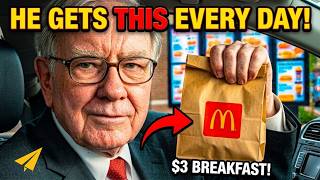
Warren Buffett orders a $3.17 McDonald's breakfast when markets are up, cheaper versions on down days, paying despite owning a free-meal card to stay disciplined. Evan Carmichael traces how tiny habits scaled into empires for Buffett, Sam Walton, and Fred Smith, who turned $5,000 into $27,000 at a blackjack table to save FedEx from bankruptcy.
Chapters
Did you know Warren Buffett orders a $3.17 meal every morning if the market is doing well and a cheaper option if it's not?
I'll have a sausage McMuffin with egg and cheese. $3.17 is a bacon, egg, and cheese biscuit. The market's down this morning, so I think I'll pass up the $3.17 and go for the $2.95.
For decades, Buffett has kept his breakfast simple. He gets a McDonald's bacon, egg, and cheese biscuit with a Coke when the market is strong. But when the market isn't doing well, he picks a cheaper breakfast like a small meal or just coffee. This is the McDonald's I go to frequently.
So what do you you have at McDonald's? Probably 3 times out of 4, I get a sausage McMuffin. Then at lunchtime, I get a Quarter Pounder and fries.
Even though he's one of the richest men in the world, he stays focused on being frugal and consistent. In fact, McDonald's gave him a lifetime card, which means he can eat for free, but he still chooses to pay. For him, paying for his meals is about maintaining his frugal mindset regardless of his wealth.
Here we have my McDonald's card, which lets me eat free at any McDonald's in Omaha for the rest of my life. So that's why the Buffett family Christmas dinner at McDonald's, it explains a lot of things.
He also said, chains of habit are too light to be felt until they are too heavy to be broken, which shows us that small habits can build up over time and lead to big changes in our lives.
Somebody once said that the chains of habit are too light to be felt until they're too heavy to be broken.
So stay consistent and your small actions will add up to something great. If you've been here before, drop a hashtag #Believe in the comments below so I can feature you here in a future video. And if you're new, welcome to Believe Nation, the only channel that helps you believe in yourself daily, one video video at a time. Believe. Warren Buffett has more than $100 billion. He's one of the richest people to ever live on planet Earth. He could have a private chef cook him meals made of gold. He could eat a 5-course breakfast in a mansion. He could buy the finest restaurants in the world and have them closed down just for him. But he doesn't do any of these things. Every single morning, this billionaire gets in his car, drives himself to work, and goes through the McDonald's drive-through. This is not a joke. This is a daily routine that has made him a legend. But there's a special twist to the story that most people miss. The specific meal he orders depends entirely on how the stock market is doing that morning. He doesn't just order whatever he feels like eating. He uses the market to decide his order. If he feels poor because the market is down, he spends $2.61. If the market is doing okay, he spends $2.95. If the market is up and he feels prosperous, he splurges and spends $3.17. You need to understand and the extreme depth of this choice. It's not just some quirky habit of an old man. It's actually lessons in psychology, wealth preservation, and human behavior. So today we're going to look closely at this one simple routine from Warren Buffett. We're going to zoom in on the exact change in his cup, the science of his decisions, and the absolute secret to his massive success. You're going to learn how a $3 breakfast can teach you everything you need to know about building an empire. The 5-minute drive and the exact change. So let's look closely at Warren Buffett's routine here. He lives in the same house in Omaha, Nebraska, that he bought in 1958. It takes him exactly 5 minutes to drive from his driveway to his office at Berkshire Hathaway. On the way, there's a McDonald's. Before he leaves the house, his wife puts a specific amount of exact change into a little cup inside his car. The amount of money in that cup is directly tied to the stock market. When Warren gets up, he checks the market. This determines his exact breakfast choice. So here are his 3 choices. Option 1 is 2 sausage patties. This costs $2.61. He chooses this on days when the market is down. He literally tells his wife that he is feeling less prosperous, so he's going to pass on the bacon and the egg. Option 2 is sausage, egg, and cheese biscuit. This costs $2.95. He chooses this on average days. Option 3 is a bacon, egg, and cheese biscuit. This costs $3.17. He only gets this on days when the market is up and he's feeling rich. He takes the exact change from the cup. Hands it to the person at the drive-thru window, gets his paper bag, pours himself a Coca-Cola, and goes to his desk. So think about the extreme level of discipline that this takes. He has enough money to buy the entire McDonald's Corporation, but he refuses to spend an extra $0.56 on bacon if the stock market is having a bad day. He ties his daily consumption to the reality of his business. He doesn't let his massive overall wealth detach him from the daily reality of money. 56 cents means nothing to his bank account, but the habit of respecting 56 cents means absolutely everything to his mindset. When you're an entrepreneur, it's very easy to start making money and immediately change your lifestyle. You get a big client, so you buy a nicer car. You have a good launch, so you start eating at expensive restaurants. You let your expenses rise to match your income. Warren Buffett does the exact opposite. He keeps his expenses flat and completely predictable. He anchors his physical reality to his business reality, but he does it on a microscopic scale. He feels the pain of a bad market by denying himself a slice of bacon. It keeps him sharp. It keeps him hungry. This keeps him completely grounded in the reality of the numbers. The Lifetime Gold Card. The story actually gets a bit wilder. Warren Buffett loves McDonald's so much that the company actually gave him a special card. It's a gold McDonald's card. This card gives him free food for life at any McDonald's in his hometown of Omaha. Bill Gates has one of those rare cards, but Bill Gates's card works anywhere in the world. Bill, is it true you have the McDonald's Gold Card? I do. Can I see it? Sure. What? That is so shiny. Warren Buffett has talked about this card publicly in interviews. He has a card that gives him free food. He never has to pay for his breakfast again, but he still pays. He still uses the exact change from the little cup in his car. Why would a man who is famous for saving money refuse to take free food? He continues to pay for his meals because for him, the act of paying is the actual point. It's not about getting a cheap breakfast. It's about maintaining a frugal mindset. If he uses the card, the game is over. The connection to the stock market is broken. If the food is free, then a down market feels exactly the same as an up market. He needs to physically hand over the $2.61 to feel the reality of the day. So this can be a lesson for anyone building a business. Sometimes you do things not for the direct financial reward, but for the mental reward. Paying for that cheap meal keeps him connected to the value of a dollar. It reminds him that every cent matters. When he sits down at his desk to make decisions about billions of dollars, he is still the guy who just carefully counted out exact change for a sausage patty. You cannot buy that level of mental grounding. You have to practice it every single day. If he used a free card, he'd lose his daily anchor. The lifetime card becomes his trap. It's a luxury that would make him soft. The true entrepreneurs know that comfort is the enemy of greatness. Warren Buffett intentionally keeps a small amount of discomfort in his life, like denying himself a better breakfast with bacon, to make sure his business edge stays perfectly sharp. The science of the breakfast choice. There's also a deep scientific reason why Warren Buffett eats the exact same type of meal every single morning. It's a concept called decision fatigue. Your brain uses energy every time it makes a choice. It does not matter if the choice is massive, like buying a company, or tiny, like choosing what to where, or what to eat. Every choice burns a little bit of your mental fuel. Psychologists have proven that the human brain can only make a certain number of good decisions in a single day. And as the day goes on, your brain gets tired, your decisions get worse, you start to take the easier way out, you become impulsive, you make mistakes. Warren Buffett knows that his primary job is to make a few very good decisions every year. He needs his brain to be at maximum power. He cannot afford to waste his mental fuel on figuring out what to eat for breakfast. By By going through the same drive-through, looking at the market, and picking from 3 preset options, he entirely removes breakfast from his mental workload. The decision is made automatically by the rules he set up years ago. This is exactly why you see other highly successful people wearing the exact same clothes every day. They are protecting their brain energy. They are saving the decision-making power for the things that actually matter. So when you build a business, you're going to be hit with hundreds of questions every single day. Your team will need answers. Your customers will need help. If you exhaust your brain by making 50 random choices before you even get to your desk, you are going to fail. So look at your morning routine. Are you wasting energy deciding what to wear, what to eat, what podcast to listen to? You are leaking power daily. You need to systemize the small things so you can dominate the big things. Warren Buffett uses a paper bag from a drive-thru as a shield to protect his billionaire brain. You need to build your own shields. Also, if you want to take real action after this video, I made a free worksheet just for you. It covers the top lessons from today, gives you space to write your biggest takeaways, and helps you build a simple action plan. It's 100% free. Just click the link in the description to go grab it. I'll see you there. The heavy chains of habit. This entire morning routine perfectly illustrates one of Warren Buffett's most famous beliefs. He frequently says, chains of habit are too light to be felt until they are too heavy to be broken. Let's play that back again. Chains of habit are too light to be felt until they are too heavy to be broken. This is the absolute core of his success. The $3 breakfast is a tiny, light habit. On day 1, it means nothing. On day 10, it means nothing. But over 50 years, that specific habit has forged a mental chain of discipline that is completely unbreakable for him. People think that success is about making one giant risky leap. They think it's about the one big trade or the viral video or the massive product launch. They're wrong. Success is actually about doing the boring, simple, disciplined things over and over again until it becomes a permanent part of who you are. When you start a new habit, it feels incredibly light. If you decide to wake up 30 minutes earlier to read a business book, that first morning is pretty easy. The habit feels light. But if you do it for 5 years, it becomes an unbreakable chain that physically changes the structure of your brain and of your life. The dangerous part is that this rule also applies to bad habits. If you have a habit of checking your phone the second you wake up, that feels very light. It doesn't seem like a big deal, but year after year, that habit becomes a heavy chain of distraction that destroys your focus and kills your dreams. Before you know it, you're trapped. Warren Buffett engineered his life so that his chains of habit pull him forward towards success, frugality, and clear thinking. His morning McDonald's run is a deliberate chain. He built it on purpose. He wears it every day. So ask yourself, what chains you are building right now. Every single action you take today is forging a link in the chain. Are you building chains that will lift you up or chains that will drag you down to the bottom? Lessons for entrepreneurs. You do not need to be a billionaire to use the McDonald's strategy. You don't even need to like fast food. The specific food doesn't matter at all. The underlying framework of the story is what you need to copy. So here are the exact lessons that you can pull from Warren Buffett's morning routine. And how to apply them to your own entrepreneurial journey. Lesson number 1 is complete emotional detachment. The stock market goes up and down every single day. Most investors panic when it drops and celebrate when it rises. They let the market control their emotions. Warren Buffett does not panic. He simply changes his breakfast order. He takes a massive global financial event and shrinks it down to a missing piece of bacon. He processes the data, accepts the reality, and moves on with his day. When you are running a business, you are going to lose clients. You are going to face bad months. Your sales are going drop. You cannot let those daily swings destroy your mental health. You have to find a way to acknowledge the loss without letting it ruin you. You need to build a system where a bad day just means you skip the metaphorical bacon, but you still show up to the office and do the work. You stay consistent regardless of the weather outside. Lesson number 2 is the true definition of wealth. Most people think wealth is about showing off. They want the expensive watch, the luxury car, or designer clothes so that other people will know that they have money. That's fake wealth. Fake wealth is loud. Real wealth is incredibly quiet. Warren Buffett driving a normal car to a fast food window is the ultimate flex. He does not need anyone to know he is rich. He knows he is rich. He is completely secure in his own value. He does not need to spend money to impress strangers. He only spends money on things that actually bring him a return on his investment. So as an entrepreneur, you must fight the urge to look successful. Looking successful is incredibly expensive, and it drains the capital you need to actually become successful. So stop buying things to impress people on the internet. Keep your overhead low. When your business has a great month, do not go and buy a boat. Take that money and invest it back into the company, or put it into investments for yourself. Act like Warren on a good market day. Treat yourself to something tiny like a $3 breakfast and get back to work. Lesson number 3 is the power of micro routines. You cannot control everything in your business. The market will do what it wants. Your competitors will launch unexpected products. The economy will shift. You have to accept that chaos is part of this game. Because you cannot control the macro environment, you must have total control over your micro environment. Your morning routine is your micro environment. Warren Buffett cannot control the stock market, but he can absolutely control exactly what happens in his car at 8 o'clock in the morning. That 5-minute drive is a completely controlled system. It gives him a feeling of order and stability before he walks into a world of financial chaos. So you can build your own controlled micro routine. Maybe it's drinking a glass of water and reading for 10 minutes before you check your email and react to the world. Maybe it's writing down your 3 biggest goals for the day while you make your coffee. My favorite is the believe walk. Get outside, spend 15 minutes for a walk outside, and listen to something that makes you believe in yourself more. It doesn't need to be a complete 3-hour routine. It just needs to be a specific, predictable action that you can execute perfectly every single day. This simple routine gives you the psychological armor you need to handle the chaos of being a business owner. Building your own drive-through. So take a hard look at your current life and your current business. I want you to find your own version of the exact change cup. What is the one small daily habit that you can tie to your business performance? So maybe if you hit your daily sales calls, you allow an hour at night to watch TV. If you miss your calls, you spend that hour reading a sales book instead. You are building a direct physical connection between your daily actions and your daily rewards. You're making the invisible effort visible. Do not rely on willpower. Willpower completely vanishes when you are tired. Rely on systems. Rely on the chains of habit. Make the good choice the absolute easiest choice. Put the exact change in the cup the night before. Set up your environment so that success is the path of least resistance. You have the power to change your life today. Doesn't start with a million-dollar investment. It starts with the very first decision you make tomorrow morning. It starts with choosing discipline over comfort. It starts with choosing the cheap breakfast when you need to stay hungry. You are capable of building immense wealth and leaving a massive legacy, but you have to start small. You have to start with the 56 cents. Respect the small things and the big things will follow. Build the heavy chains of good habits and nothing in this world will be able to break you. And congratulations, you're one video closer to who you're meant to be. Believe. Now let's learn the hidden lessons behind Walmart's rise. Sam Walton's first store was so successful that his landlord stole it from him. He lost everything, but instead of quitting, he built Walmart to the world's biggest retailer. In 1945, Sam Walton opened a small Ben Franklin franchise store in Arkansas. He worked relentlessly, offering low prices and treating customers like family. Sales skyrocketed, and the store made more money than anyone expected. But success came at a cost. His landlord, seeing how profitable the store had become, refused to renew the lease. Worse, he took over Sam's store for himself, keeping the business Sam had built. Sam lost everything. But instead of giving up, he borrowed money, money, moved to a new town, and bought his own land so no one could take it from him again. He focused on low cost, high volume, and rapid expansion. Store by store, Walmart grew until it became a $400 billion empire with thousands of locations worldwide. Sam Walton's biggest loss became his greatest lesson: never let anyone control your future. When life takes something from you, will you give up or build something even bigger? Early life and first business ventures. Sam Walton was born in 1918 in rural Oklahoma and grew up during the Great Depression. From a young age, he learned the value of hard work and frugality, milking the family cow, delivering newspapers, and doing odd jobs to help his family make ends meet. This early work ethic and resourcefulness shaped Sam's character. He attended the University of Missouri, graduating in 1940 with a degree in economics. Eager to start his career, Sam took a job as a management trainee at a JCPenney store. There, he proved to be a natural at sales but a bit sloppy copy with paperwork. In fact, his boss almost fired him for being disorganized. Sam hated making customers wait, so he'd rush through paperwork and focus on helping people instead. Ironically, this flaw was an early sign of his customer-first philosophy. He would later say there was only one boss, the customer, and he can fire everybody in the company from the chairman on down simply by spending his money somewhere else. Even as an employee, young Sam Walton believed happy customers mattered more than strict adherence to corporate procedure. In 1942, Sam joined the U.S. Army during World War II, serving as an Army intelligence officer until 1945. By the time he returned to civilian life, he was 26 years old, married to Helen Robson, and ready to run his own business. Sam's goal was to open a retail store of his own. With $5,000 of his own savings and a $20,000 loan from his father-in-law, Sam purchased a small variety store, a Ben Franklin franchise in the town of Newport, Arkansas, in 1945. This humble 5,000-square-foot dime store became his training ground as an entrepreneur. Sam threw himself into making the store a success despite having no experience running the business and even unknowingly signing an expensive lease with 5% rent on sales, which was the highest rent anybody had ever heard of. He compensated with sheer determination and smart ideas. He learned everything he could from the franchisor's training program and from observing competitors. Now, early on, Sam experimented with tactics that were unusual at the time but would become hallmarks of his style. For example, he found suppliers outside of the official franchise network to get merchandise cheaper. Then he sold products at lower prices than anyone else, sacrificing profit margin for high volume. He kept the store open longer hours than competitors and made sure shelves were always full. In short, Sam broke the conventional rules of small-town retail to put customers first. 'Everything he did seems so obvious. It seems that way because it is,' an observer noted. 'First he learned all the rules, then he broke all the rules, which did not make sense to him.' The results were astounding. Walton's little Newport store started breaking sales records. In the first year under Sam's management, sales jumped over 45% to $105,000. The next year they rose to $140,000, then $170,000 the year after. In 5 years, Sam had quadrupled the store's revenue to a quarter million dollars and was earning healthy profits. By 1950, it was the top-performing Ben Franklin variety store in the entire region, the best in Arkansas and neighboring states. Sam, at not even 32 years old, had proven himself a brilliant retailer. He repaid his loans early and became a respected business owner in the community, active in the Rotary Club and church board, where with 3 young children and a wife who loved their small-town life. It seemed like the start of a long, successful career in Newport. The Landlord Who Stole His Store. Then, in a heartbeat, Sam lost everything. The success of Walton's first store had not gone unnoticed, especially by his landlord. The store building was owned by a man named P.K. Holmes, whose family had retail interests of their own. Seeing Sam's booming sales and realizing he was earning 5% of those sales as the landlord decided he wanted the valuable store for his own son. When Sam's 5-year lease came up for renewal, Holmes refused to renew it at any price. Sam Walton offered to buy the building. He begged to at least get an extension on the lease. The landlord simply said no. Sam had no renewal clause to protect him, a rookie mistake that left him at the landlord's mercy. Despite all the success Sam had created in that location, he was effectively kicked out his own store. Holmes did pay Sam $50,000 for the store's inventory and fixtures, which Sam considered a fair price, and then turned around and gave the store to his son to run. In essence, the landlord stole the business that Sam had built from nothing. For Sam and Helen Walton, being forced to leave Newport was devastating. It was the low point of my life, Sam admitted. He poured his heart out in his autobiography about that moment. I felt sick to my stomach. I couldn't believe it was happening to It was really a nightmare. I'd built the best variety store in the whole region, and now I was being kicked out of town. It didn't seem fair. I blamed myself for getting suckered into such an awful lease, and I was furious at the landlord. Helen was heartsick at the prospect of leaving Newport, but that's what we had to do. This painful setback taught Sam Walton a hard business lesson: always read the fine print and never let someone else control the ground under your enterprise. He later acknowledged that he was naive about contracts and real estate, saying, I know I read my leases a lot more carefully after that, and maybe I become a lot more wary of just how tough the world can be. In short, Sam learned to never put himself at someone else's mercy again. Many entrepreneurs would have been defeated by such a blow, losing one's thriving store and being forced to uproot your family and business. But Sam Walton was different. As hurt as he was, he refused to indulge in self-pity for very long. I've never been one to dwell on reverses, and I didn't do so then, he said later. His optimism kicked in. Instead of giving up on retail, Sam decided to start over, this time a little bit smarter. He was determined to find a new opportunity and make sure that no landlord could ever pull the rug from under him again. Starting over in Bentonville. In 1950, Sam and Helen packed up their young family and set out to find a new town in which to rebuild their business. Sam drove around Arkansas hunting for a promising location, somewhere small enough to have little competition but lively enough to support a store. He found the ideal spot in Bentonville, Arkansas, a tiny rural town with a population of only a few thousand. This time, Sam was extra careful about the lease. In Bentonville's town square, he found a rundown storefront and negotiated not only to buy the store but also secure a 99-year lease on an adjacent space so he could He absolutely refused to repeat his Newport mistake. In fact, Walton's father-in-law had to step in and convince a reluctant neighbor to grant that long lease, paying $20,000 just to close the deal so Sam could have peace of mind about expansion. With the real estate side locked down, Sam was ready to open his new store. On May 9, 1950, the Waltons held a grand opening for Walton's Five and Ten, the new dime store in Bentonville. The Bentonville store quickly proved that Sam hadn't lost loss's touch. Despite two established variety stores already in town, Walton's Five and Ten undercut them all with consistently lower prices and friendlier service. Customers responded with enthusiasm. Many had never seen a store owner so committed to giving them bargains. Sales at the Bentonville store in its first full year jumped from $72,000 under the previous owner to $105,000, then kept growing to $140,000 and $175,000 in the following In fact, Bentonville's success mirrored Newport's. Sam had essentially replicated his earlier venture, but now he owned the store and had a secure lease. No one could take it away. But Sam Walton wasn't about to stop at one store. As he later said, maybe it was just my itch to do more business, and maybe too, I didn't want all my eggs in one basket. The 1950s saw Walton expanding steadily. He reinvested profits into buying more Ben Franklin franchise stores across Arkansas and neighboring states, often leveraging loans to grow. He even brought his younger brother James "Bud" Walton as a partner to help run the expanding enterprise. Sam also had an innovative approach to motivating store managers. He offered many of them a chance to invest in their own store for a share of the profits. This gave his managers a sense of ownership and drove them to work as hard as Sam did. By 1960, about a decade after the Newport fiasco, Sam Walton was the proud owner of 15 variety stores throughout Arkansas, Missouri, and Kansas. He built a small chain of thriving five-and-dime stores, all based on his formula of low prices, friendly service, and hard work. Yet despite this success, Sam felt the business could do even better. He noticed that even with 15 stores, the profits weren't as high as he expected, given how much effort he and his team were putting in. The reason, he realized, was that the traditional variety store model with relatively high costs and markup limited how low he could price goods and how much volume he could move. So Sam began toying with a radical idea: what if he completely reinvented the concept of the discount store? A new idea: big stores, tiny prices. By the early 1960s, discount retailing was not an entirely new concept in America, but it was still in its infancy and mostly confined to urban There were some big city discount chains that sold goods cheaply, but they typically operated in large towns and urban centers and often only cut prices on select items. Sam Walton's big idea was to bring discount shopping to rural America on a scale no one had tried before. He envisioned large stores in small towns that sold a bit of everything at rock-bottom prices every day, not just during sales. Instead of the traditional high markup on goods, goods, he would slash prices and make profit on high volume— essentially the philosophy he had used in his small stores, but now supersized. This concept flew in the face of conventional wisdom. In fact, when Sam pitched the idea to the Ben Franklin franchise company, who were the Butler Brothers, proposing that they support him in opening a massive discount store that would require buying goods at lower wholesale margins, the directors thought he was crazy. They flat out refused to back him because his plan would have meant cutting their own profit margins in half. To them, selling everything at deep discount in a small town sounded like a fast way to go broke. But Sam believed in his vision. He later said one of his rules was swim upstream, go the other way, ignore the conventional wisdom. And this is exactly what he was about to do. If the franchisors wouldn't join him, he would do it himself. So in 1962, Sam Walton took the biggest gamble of his life. He mortgaged his home, borrowed as much as he could, and pooled resources with his brother Bud to open his first independent Walmart Discount City store. The very first Walmart store opened on July 2nd, 1962, in the town of Rogers, Arkansas, just 20 miles from Bentonville. Sam was 44 years old and finally launching the project that would define his legacy. The store wasn't fancy. In fact, it was a bare-bones operation a metal building and concrete floors. At 12,000 square feet, it was much larger than his dime stores, but still modest by later standards. From day one, Walmart's prices were significantly lower than local competition. Walton stocked a wide variety of goods—clothing, housewares, toys, hardware—and marked everything down, aiming to undercut even the big city retailers. As Sam later described, the Rogers store was truly ugly. And heavy with merchandise, but for 20% less than the competition. He wanted to see if people in a town of 6,000 would flock to a no-frills barn full of bargains. The answer was a resounding yes. Shoppers from Rogers and all the surrounding rural areas poured into the new Walmart. They loved the idea of getting big city discount prices in their own backyard. Walmart was an immediate success, far exceeding expectations, and tellingly, the big retail giants didn't see it coming. 1962 was actually a landmark year in retail. It was the same year that launched the first Kmart, and F.W. Woolworth launched Woolco, both major discount chains targeting urban and suburban markets. But Walton's operation in rural Arkansas flew under the radar. As he later joked, he was too far off the beaten path for the industry leaders to worry about. By being a scrappy pickup driving country boy focused on small-town customers, Sam faced little direct competition at first, and that early freedom allowed Walmart to refine its model and gain a foothold without being crushed by the big guys. Throughout the 1960s, Sam opened more Walmart stores across Arkansas and into neighboring states. The strategy was clear: find towns that were large enough to support a major store but small enough that national chains ignored them, then become the dominant low-price retailer in the area. Sam's company built its own distribution system to keep costs down, locating warehouses centrally so that each store was within a day's drive for Walmart's trucking fleet. By cutting out the middlemen, buying in bulk, and moving goods efficiently, Walmart could keep prices irresistibly low. The concept of everyday low prices was born, and customers were now in the habit of driving long distances to a Walmart to save money. Rise of a retail empire. Walmart's growth in its first decade was impressive. By 1967, the Walton family owned 24 stores, generating $12.7 million in sales, and by 1969, Walmart had grown to 18 stores and was incorporated as a company. Sam Walton, ever ambitious though, realized that to sustain this growth, he would need more capital than he could borrow from banks. In 1970, he took a bold step and took Walmart public. The initial stock offering raised nearly $5 million, a huge infusion at the time, which Sam immediately plowed back into expansion. The Waltons still maintained majority control. Sam's family held about about 61% of the shares even after the IPO. But now they had the cash to accelerate store openings, and accelerate they did. All through the 1970s, Walmart opened new stores at a blistering pace, spreading across the South and Midwest. Sam's strategy of saturating smaller markets before competitors arrived proved to be very effective, and from 1977 to 1985, Walmart exploded from 190 stores to 800 stores. By 1980, Just 18 years after the first store opened, Walmart had 276 stores and was opening about 100 new stores per year. The once tiny Arkansas venture was now becoming a national powerhouse in retail. In 1983, Walmart opened its first Sam's Club warehouse store in Oklahoma, expanding into wholesale bulk sales for small businesses and individuals, another highly successful format. In 1988, Walmart launched its first Supercenter, combining a full grocery supermarket with general merchandise under one roof, foreshadowing the one-stop shopping behemoths of today. And as Walmart grew, Sam Walton became incredibly wealthy, but he remained humble and fiercely devoted to his company's principles. In 1985, Forbes named Sam Walton the richest man in America, worth an estimated $2.8 billion at that time. However, those who saw Sam around this time often comment on his lack of interest in luxury He was famously frugal, continuing to drive an old pickup truck and fly in coach class on airplanes despite his fortune. He preferred wearing his old clothes and a Walmart baseball cap to fancy suits. When asked about his modest lifestyle, Walton said people might not understand why he didn't indulge more, but for him, running the business was the real thrill, not material extravagance. His down-to-earth style filtered into Walmart's culture, where he referred to all employees as associates and often visited stores to chat with staff on a first-name basis. He even instituted a morning cheer, "Give me a W-A-L-M-A-R-T," that workers would do to build team spirit, a quirky tradition that continues in Walmart meetings. Sam also had a fun competitive streak that endeared him to employees. One famous example: in the early 1980s, he made a bet with his executives that the company could not achieve a pre-tax profit margin of 8%. Confident they wouldn't hit that high mark, Sam promised that if they did, he'd do something outrageous— dance the hula in a grass skirt on Wall Street. Well, sure enough, Walmart hit the 8% profit goal, and Sam was a man of his word. In March 1984, pedestrians in New York's Financial District were treated to the hilarious sight of 65-year-old Sam Walton, one of the richest men in the world, wearing a grass skirt and lei, doing a hula in front of the New York Stock Exchange. The event was even captured in a photograph and became part of Walmart's lore. This stunt showed that Sam never took himself too seriously. He was willing to embarrass himself a bit to celebrate his team's success. It also illustrated how much he cared about his associates meeting goals. He was genuinely delighted that they proved him wrong by achieving record profits. Meanwhile, Walmart's business triumphs continued. By 1987, Walmart had become the third largest retail in the United States, behind only Sears and Kmart. The tide was turning in retail, and Walmart was leading the change of a new model. In 1988, at age 70, Sam decided to step down as CEO, naming David Glass as his successor. But Walmart stayed on as chairman, remaining deeply involved in the company's direction. Walmart kept expanding geographically, entering California and the Northeast in the late 1980s and early 1990s, and also kept expanding its store formats. All this time, Sam Walton was battling an aggressive cancer diagnosed in 1989, but he hardly let it slow him down. At Walmart's June 1990 annual shareholders meeting, a frail but determined Sam stood up and forecast that Walmart would hit $125 billion in sales within the next decade. That sounded astonishing at the time. Walmart sales were about $32 billion, but Walton was as bullish as ever. In truth, his prediction turned out to be too Walmart would surpass that figure well before a decade was up. In the early 1990s, Walmart overtook Kmart and Sears to become the number one retailer in America, confirming that Sam's formula of low prices and broad reach was unbeatable. Final days and lasting legacy. In March 1992, as Walmart approached its 30th anniversary, the company, now a nationwide giant, received special recognition. President George H.W. Bush awarded Sam Walton the Presidential Medal of Freedom on March 17, 1992, in front of a cheering crowd. The president praised Walton's entrepreneurial spirit, his innovation in retail, and his concern for employees and the community. Too weak to stand for long, Sam accepted the medal from a wheelchair with his characteristic humility. It was one of the last times the public saw him. Just a few weeks later, on April 5th, 1992, Sam Walton passed away at age 74. At the time of his death, Walmart had over 17,000 over 1,500 stores across the country, plus a few international locations, and was generating nearly $50 billion in annual sales. Sam's personal fortune was nearly $25 billion, making him not only America's richest man but one of the wealthiest individuals in the world. Although Sam was gone, the company continued its meteoric rise under the foundations that he had laid. Just as Henry Ford revolutionized manufacturing with the assembly line, Sam Walton revolutionized retail with his relentless focus on efficiency and low prices. He shifted the balance of power in retail from manufacturers to consumers. The idea that the customer is king was exemplified by Walmart's ability to demand lower prices from suppliers and pass the savings on to shoppers. The Walmart model paved the way for an era of big box retailers and category killers, from Home Depot to Costco, all following the template of large-scale discounting that Sam championed. Business schools began teaching the Walmart the dual impact of positive for consumers, challenging for competitors and suppliers that a Walmart store brought to any region. Today, Walmart is a colossus, the largest company in the world by revenue and the biggest private employer with over 2 million associates worldwide. In the fiscal year ending 2020, Walmart's revenues were about $524 billion and they continue to climb. The company that started in a small Arkansas town now has 12,000 stores globally. Sam Walton's 3 surviving children, Rob, Jim, and Alice, and their families collectively still own about half of Walmart stock. And for several years running, the Walton family has been ranked as the richest family in America, a testament to the enduring value of Sam's creation. Yet beyond the numbers, Sam Walton's legacy is about more than just a retail chain. It's about a mindset. He demonstrated that treating customers well and never being complacent could shake up an entire industry. He proved that big dreams can start in small places, that a merchant in a town of 3,000 people could outthink and outwork the titans of retail. Sam also taught through his own life the importance of humility and continuous learning. He was known to visit competitor stores, even famously getting arrested in Mexico for crawling on a store floor to measure aisle width because he was benchmarking their own store layout, always looking for ideas to improve Walmart. He never stopped trying to learn from others, whether it was a store manager or rival CEO. And when mistakes or failures happened, Sam owned up to them and moved forward stronger than before. But perhaps the greatest lesson Sam Walton left us comes from that terrible low point when he lost his Newport store. He didn't let bitterness or defeat consume him. Yes, he was angry and felt life had been unfair, but he channeled those feelings into determination. As a Harvard Business Case Study noted, He added, great entrepreneurs often face setbacks that seem unfair, but they view them as temporary misunderstandings to be corrected with even greater effort. Turning setbacks into success. The story of Sam Walton is the story of turning a devastating setback into an even greater success. If his landlord had never thrown him out of that first store in 1950, Walmart might never have happened. Sam himself acknowledged that losing the Newport store was a pivotal moment that drove him to innovate and expand more boldly. It taught him to never again let someone else control his destiny. As a direct result, he made sure to own or secure his store locations thereafter, and he expanded his business so no single blow could ever wipe him out. In an ironic twist, nearly 20 years after being run out of Newport, Sam Walton returned by opening a large Walmart store in Newport in 1969. And guess what? Customers in Newport voted with their feet. They chose Walmart's low prices over the old Ben Franklin store that Sam's former landlord and his son were running, eventually forcing that store to close. Sam didn't gloat publicly, but he did note with subtle satisfaction that his customers ultimately shut down the very business that had once pushed him out. Life had come full circle. Sam Walton's journey from a single dime store to a global retail empire carried an inspiring message: when life knocks you down, you can come back stronger. His philosophy was simple: work hard, learn from everyone, innovate fearlessly, and put the customer first. But living it out revolutionized an industry. From driving a beat-up pickup truck while being the richest man in America to dancing the hula in a grass skirt to celebrate his employees' achievement, Sam showed that success doesn't have to change your values or your sense of humor. He remained the same determined, customer-loving country boy even at the top. So the next time you visit a Walmart, take a moment to remember the man who started it all with one tiny store, then lost it and decided not to quit. Sam Walton's life proves that a major loss can hide a greater opportunity, and that perseverance and adaptability are key to achieving great success. As Sam once said, celebrate your successes. Find some humor in your failures. And above all, never let anyone else dictate your fate. When life takes something from you, would you give up or build something even bigger? The choice, as Sam Walton's story shows, is truly up to you. Believe in yourself and keep going, and you just might change the world in the process. Now let's learn how a C-grade college idea created FedEx. Fred Smith had an idea in college: a system to deliver packages overnight. His professor gave him a C and said it would never work. But Fred believed in his vision. He started FedEx, bought a fleet of planes, and put everything on the line. Then it almost collapsed. He was down to his last $5,000. Here's where it gets crazy. Fred took that $5,000, flew to Vegas, and gambled it all on blackjack. He walked out with $27,000, just enough to keep FedEx alive. That gamble paid off. Today, FedEx delivers over 15 million packages a day and is worth billions, all because Fred didn't quit when things got tough. Fred's story proves this: bet on yourself even when no one else will. The college vision that earned the C. In 1965, a Yale undergraduate named Fred Smith had a bold idea for revolutionizing shipping. For an economics class, he wrote a term paper proposing a fast fast integrated air-ground delivery network that could transport packages overnight anywhere in the country. His concept was essentially a hub-and-spoke system. One carrier would handle a package from pickup to final delivery, flying shipments to a central hub for sorting and then sending them out to their destinations by air and truck. It was a radical idea at the time, so radical that according to legend, Smith's professor was unimpressed. The story goes that the paper received an average grade, a C. With a professor deeming the idea infeasible. Smith later said he didn't actually recall the exact grade, joking it was probably a C. But one thing was clear: his vision was met with skepticism. Yet Fred Smith refused to discard his dream simply because others doubted it. This C-grade idea, doubted in the classroom, would soon launch an entirely new industry. From Vietnam to the birth of FedEx. Fred Smith's determination only grew after college. He served as a U.S. Marine Corps officer in Vietnam from 1966 to 1969, earning honors like the Silver Star and Purple Heart. Smith later credited the Marines with instilling in him the leadership and discipline needed to start a business, stating, I do not believe I could have built FedEx without the skills I learned from the Marine Corps. His military experience taught him to stay calm under pressure, and to strategize, qualities that would prove vital in his entrepreneurial journey. In 1971, a few years after returning from Vietnam, Fred Smith decided to put his Yale term paper plan into action. Using $4 million of his own inheritance and raising about $80 to $91 million in venture capital and loans, he founded Federal Express Corporation, FedEx, in Little Rock, Arkansas. Why Federal Express? Smith thought the name sounded like it served the whole country and might even appeal to the Federal Reserve. Who were one of his target clients. Not long after, he moved the operation to Memphis, Tennessee, which offered a centrally located airport with favorable weather and plenty of hangar space. FedEx officially began operations on April 17th, 1973. On that inaugural night, 14 small aircraft carried 186 packages to 25 US cities. It was a modest start, but a proof of concept. Fred's overnight delivery network was finally real. In fact, the very first FedEx plane fleet consisted of Falcon 20 jets jets, one of which Smith affectionately named Wendy after his daughter. From the outset, FedEx marketed itself as an airline for packages only, highlighting its singular focus on speedy parcel delivery. In the early days, FedEx handled the entire journey of a package, from pickup by courier van to sorting at a central hub to transport via FedEx aircraft— a revolutionary integrated approach. Despite excitement around the idea, FedEx's early years were fraught with challenges. Building a national delivery network from scratch was enormously expensive. By 1973, 1974, the company was losing up to $1 million per month and burning through its capital. The 1970 oil crisis sent fuel prices soaring, which hit the young airline hard. FedEx had only a handful of planes and vans, but keeping them running was eating up cash. Smith had mortgaged everything and sold some of his family assets to keep FedEx afloat. Still, by 1974, FedEx was on the brink of bankruptcy, struggling to pay bills and salaries. Early struggles. FedEx on the brink. Fred Smith's fledgling company nearly went under before it truly got going. In the first 2 years, rising fuel costs and operating expenses drove FedEx millions of dollars into debt. Smith had made ambitious growth plans, adding more cities and more planes each month, but the costs were outpacing revenue. By 1974, FedEx was in crisis mode. The company had dwindled to just $5,000 in the bank. Bank, barely enough to fuel its planes for a few days of operation. Desperate to raise funds, Smith pitched investors and even defense contractors General Dynamics for an infusion of capital, but he was turned down repeatedly. One rejection at a General Dynamics board meeting would set the stage for a legendary gamble, as we'll see shortly. FedEx had already taken extreme measures to stay alive. Pilots paid for fuel with personal credit cards, and some employees' paychecks went uncashed cashed, all to keep the planes flying a little bit longer. These sacrifices underscore how much Fred and his team believed in the mission. But belief alone couldn't buy jet fuel. By mid-1974, bankruptcy was a very real possibility. Payroll was due, fuel suppliers were awaiting payment of a $24,000 fuel bill, and no new funding was in sight. It was during this low point that Fred Smith decided to take a true truly unconventional step, one that would either buy FedEx a little more time or end the dream entirely. The Las Vegas Gamble. With FedEx's last $5,000 literally in his hand, Fred Smith made a now legendary gamble. After being rejected by General Dynamics, he was stuck in Chicago's airport trying to get home to Memphis. Instead of flying back defeated, Smith impulsively flew to Las Vegas. His plan? Bet FedEx's remaining funds at the blackjack tables, a bold, some would say crazy, attempt to win money to pay the company's fuel bill. It was a do-or-die moment at a Las Vegas casino. Smith put the fate of his company on the line with the flip of cards. In an astonishing turn of events, he turned that $5,000 into $27,000 by the time he left the blackjack table. This was enough to cover FedEx's $24,000 fuel bill and keep the planes running. Running for at least one more week. When Roger Froch, FedEx's operations chief, learned what Smith had done, he was stunned. "You mean you took our last $5,000? How could you do that?" Froch asked. Smith shrugged and famously replied, "What difference does it make? Without the funds for the fuel, we couldn't have flown anyway." In other words, if FedEx was going down, he had nothing left to lose by betting it all. Smith later joked that no MBA would recommend gambling as a financing strategy. But in this case, sometimes it pays to be a little crazy early in your career. That infusion of $27,000 was not a permanent fix to FedEx's problems. It bought mere days of operation, but it proved to be the omen and spark of hope that Fred Smith needed. With renewed determination, he used that time to seek out new investors. Smith told his team that if we're gonna go down, we were gonna go down fighting. He refused to quit when so many employees and partners had put their faith in him. And his tenacity paid off. Not long after the Vegas trip, Smith convinced investors to inject another $11 million in capital, providing a much-needed lifeline for him. By 1976, FedEx was on more stable footing and turned its first profit of $3.6 million. Fred Smith's crazy gamble has since become a bit of Silicon Valley lore, an example of extreme commitment to one's vision. Had that weekend in Las Vegas gone differently, FedEx might not exist today, but fortune favored Smith's audacity. The win gave FedEx a second chance, and Fred made sure to capitalize on it. Turning point and rapid growth. After surviving the 1970s scare, FedEx began to soar. With new funding in hand, Smith and his team aggressively expanded the business. They launched a direct mail advertising campaign to build brand awareness and keep improving efficiency. In 1975, FedEx introduced its first drop box, boxes, allowing customers to deposit packages after hours for next-day pickup. By 1976, daily package volume had grown to around 19,000, and the company was consistently profitable. One of the biggest catalysts for FedEx's growth was a change in federal law. In 1977, Congress deregulated the air cargo industry— was Public Law 95-163— lifting restrictions on routes and aircraft for freight airlines. This was a game changer. Fred Smith, who had lobbied hard for deregulation, wasted no time. As soon as the law allowed, FedEx acquired 7 Boeing 727 jets, much larger planes than its small Falcons, enabling it to carry more cargo farther and faster. In 1978, FedEx went public on the New York Stock Exchange, raising additional capital. The company then launched Cosmos, a computerized tracking and logistics management system that was pioneering for its time. What it did was allow FedEx to monitor packages and trucks and weather together in real time. And this emphasis on technology would become a FedEx hallmark. By the early 1980s, the numbers told an incredible story. Federal Express became the first American company to achieve $1 billion in revenues within 10 years of startup without mergers or acquisitions. That milestone, reached in 1983, underscored how quickly FedEx's service had gained traction. Virtually overnight—pun intended—Fred Smith had created not just a company but entire entire new market segment: overnight, time-guaranteed package delivery. An often overlooked aspect of FedEx's success was Smith's eye for marketing and branding. In 1978, FedEx introduced what would become one of the most famous advertising slogans ever: "When it absolutely, positively has to be there overnight." This bold promise was more than just an ad; it was a guarantee that set FedEx apart from any competitor. Smith poured resources into promoting the slogan, even airing a memorable fast-paced TV commercial featuring a rapid-talking actor to drive home the point that FedEx meant speed. He wasn't just selling delivery, he was selling certainty. That marketing genius built tremendous trust in the FedEx brand. Customers came to believe that if you absolutely, positively needed to get a package somewhere overnight, FedEx was the only way. Smith focused on brand promise, created loyal customers and fueled word-of-mouth growth. By the end of the 1980s, FedEx had firmly established itself as a leader in express shipping. It opened a superhub in Memphis, which was a massive sorting facility that became the central nerve of FedEx's network, in 1981. The company also expanded internationally. It started servicing Canada, hey, in 1981, and in Asia and Europe in the years soon after. Under Smith's leadership, FedEx continued to innovate. They developed handheld barcode scanners for tracking tracking. They established real-time dispatch systems for couriers, and they constantly improved logistic algorithms. Each innovation further improved their speed or reliability, widening FedEx's competitive moat. Innovations that set FedEx apart. Several key innovations drove FedEx's rise and remain core to its operations even today. We can start with the hub-and-spoke system. Fred Smith's original hub concept became reality with the Memphis Superhub. Hub. All packages fly to a central hub for sorting each night, then are flown out to their final destinations by morning. The system maximizes efficiency and speed. Smith essentially created a package clearinghouse, much like how banks clear checks, but for physical parcels. Today, hub and spoke is the standard in logistics and even adopted by passenger airlines, but FedEx was the trailblazer. Tracking technology. FedEx was among the first to implement computerized package tracking in the late In the mid-1970s, FedEx developed internal tracking numbers to monitor shipments and soon made tracking available to their customers. This transparency was new to the industry. Customers could actually follow their package's journey. The company also equipped its couriers with wireless devices, the DAD system, for real-time communication and dispatch. These technologies not only improved the reliability but also built customer trust. In fact, one of FedEx's original SuperTracker barcode scanners now sits in the Smithsonian Museum, which is a testament to how significant it was. Overnight sorting and logistics mastery. Coordinating thousands of shipments overnight required cutting-edge logistics software. FedEx's COSMO system and later advancements gave it an edge in efficiency. Planes were routed, trucks dispatched, and staffing optimized using data long before big data became a buzzword. Customer convenience. Beyond drop boxes, FedEx introduced services like like ZapMail, an early fax-based rapid document delivery in the 1980s, and continuously improved its courier network to allow last-minute pickups. While ZapMail ultimately failed, it shows FedEx's willingness to experiment to meet customer needs. Through these innovations, FedEx consistently stayed a step ahead. Smith's philosophy was that growth and success come from innovation and investment and increase in scale. In other words, keep innovating and expanding to serve more customers. FedEx did exactly that. Building a global empire. What started as Fred Smith's college project is now a global logistics powerhouse. FedEx, short for Federal Express as it rebranded in the 1990s, grew from that single hub in Memphis to a worldwide network of hubs and routes. By the 2000s, FedEx was handling not just overnight air express but also ground delivery, freight services, and international express through divisions. It acquired other companies like Flying Tigers Air Cargo and Kinko's to broaden its reach. The company Smith founded now connects virtually every corner of the earth with reliable delivery service. To appreciate the scale of FedEx today, look at some of these numbers. Global workforce: over 547,000 team members operate FedEx's businesses, reflecting the enormous manpower behind its logistic machinery. For context, That's more than the population of most mid-sized cities. Worldwide reach. FedEx serves more than 220 countries and territories across the globe. If a plane receives mail, chances are FedEx can deliver there from major cities to remote towns. Daily package volume. FedEx moves over 15 million packages each day on average. That's every day. Millions of documents, gifts, products, and urgent shipments absolutely positively arriving at their destination. It's a far cry from the 186 packages on that first flight night in 1973. Financial scale. FedEx's annual revenues are around $90 billion as of recent years, placing it among the top companies in the world. The business Fred Smith started in his college years became a $90 billion empire. This massive scale was achieved in just a few decades, driven by Fred Smith's relentless pursuit of his vision. Fred Smith remained at the helm of FedEx. For decades, guiding this expansion. He served as CEO and chairman, overseeing the company's innovation and growth into the 21st century. In June of 2022, after 50 years, Smith retired as CEO, passing the reins to his successor, though he stayed on as executive chairman. By this time, FedEx was not only delivering overnight envelopes, but also enabling e-commerce globally, providing supply chain solutions, and even aiding in disaster relief logistics. The company's purple and orange logo had become synonymous with fast, dependable delivery. It's worth noting too that Fred Smith's impact extends beyond just business. Over the years, he also engaged a lot in philanthropy, donating to educational causes, healthcare, and supporting his community, though often quietly. He also became part owner of the Washington Football Team for the NFL and remained an active voice in industry affairs, championing issues issues like free trade and infrastructure development. Smith's achievement earned him many accolades. He's widely regarded as one of the greatest entrepreneurs in transportation history. He was often asked to share his advice, and one of his core messages was about risk and perseverance. Legacy and lessons. Fred Smith's story is the stuff of entrepreneurial legend. He took a half-baked college paper idea, one that experts dismissed, and through vision and sheer it, built it into an industry-defining company. Along the way, he stared down failure multiple times. When critics said an overnight delivery network was impossible, he proved it was possible. When FedEx was nearly broke, he gambled everything he had to buy just a little more time and then made the most of that time. His journey offers several powerful lessons. Believe in your vision. If you genuinely believe you have a game-changing idea, don't let the naysayers stop you. Smith's professor didn't see the potential but Smith trusted his own analysis. Conviction is crucial for any innovator. As Smith demonstrated, innovation often starts when others stop believing. Perseverance in the face of adversity. Things got extremely tough for Smith, far tougher than most new CEOs face, yet he didn't quit. He was willing to do anything ethically to save his company, whether that meant flying around the country pitching investors or even flying to Vegas to roll the dice. That persistence instance that refusing to check out or give up was the deciding factor in FedEx's survival. Calculated risk-taking. While gambling the last $5,000 was unconventional, it underscores a point: bold risks can be necessary, especially early on. Smith assessed that without a last-ditch effort, FedEx was finished. So the downside of gambling was no worse than doing nothing. It was a calculated risk born from desperation, yes, but highlights the kind of decisive boldness entrepreneurs sometimes need. Fortune favors the bold. Innovation and continuous improvement. Smith didn't just rest after the initial success. He and FedEx kept innovating from technology to services. They kept one-upping themselves, making it hard for competitors to catch up. This taught the business world that to stay on top, you must keep evolving and driving change. Customer-first mentality. The famous slogan, absolutely, positively overnight, exemplifies emphasize FedEx's promise to customers. Smith built the company on a foundation of trust and reliability, always focusing on meeting customer needs, which are speed, reliability, tracking, transparency. That customer-centric ethos created immense brand loyalty. Fred Smith passed away in June 2025 at age 80, but his legacy is very much alive. Each day, millions of packages circle the globe on FedEx planes and trucks, a living testament to his vision. He didn't just create a company, he created a new category of service and changed the way the world does business. Entrepreneurs continue to study his story for inspiration. After all, it's not every day that a sea paper and blackjack bet lead to a multi-billion dollar enterprise. And perhaps the most important takeaway is the simplest: never quit when things get tough. Bet on yourself even when no one else will. Fred's journey demonstrates that with self-belief, perseverance, and a bit of daring, you can deliver on even the wildest dream. His story proves that great success often demands great courage and sometimes the willingness to gamble on your own vision. To learn how Jack Ma, a failed teacher, built a $200 billion empire, check the video right there next to me. I think you'll love it. Continue to believe, and I'll see you there. Jack Ma went from failing his university entrance exam twice, being rejected by 30 different companies including KFC, and earning just $12 a month as an English teacher to founding Alibaba
More from Evan


How the Biggest Mistake in History Created A Trillion-Dollar Empire | Sergey Brin



9 Machiavelli Principles That Force People To Respect You | Machiavellian Philosophy



The First 10 Words That Instantly Ruin A Sales Conversation | Vanessa Van Edwards

The Top 1% Mindset Behind The First $5 Trillion Company | Jensen Huang (Nvidia)

