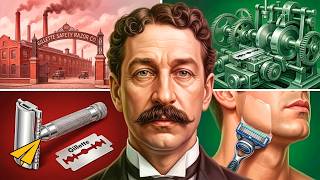
King Gillette spent 13 years failing before inventing the disposable razor blade and building a company eventually worth $57 billion. He learned from mentor William Painter, used celebrity endorsements and military contracts to scale fast, and offered Theodore Roosevelt the presidency of his company.
Chapters
Hi, I'm Evan Carmichael and welcome to another edition of Modeling the Masters. Today we're going to look at how an inventor failed for 13 years, ran out of money, and then turned his life around, became a millionaire, and eventually sold his business for $57 billion. This is the story of King Gillette from the Gillette razor company and the top 3 lessons that you can learn from his success.
King Gillette was a creative entrepreneur who from the age of 17 dreamed of making money from his inventions. For 13 years he struggled to earn a living and was scared that he would never live up to the expectations that his parents had for him. Both his mother and father were successful inventors and he was ashamed that he had to take a job as a traveling salesman to pay his bills because he couldn't make money from his inventions like they had. Now 40 years old with no hope on the horizon, an embarrassed Gillette hit rock bottom and moved back home. Down but not out, he refused to give up and looking for a mentor. Gillette went to work for William Painter, a local entrepreneur who invented a special type of bottle cap and turned it into a profitable business. Painter told Gillette the key to enormous riches was to invent something where customers would use the product up, then throw it away, so they'd keep coming back for more. One morning while thinking about Painter's advice, Gillette was frustrated with his razor. Its blades were dull and were too worn out to be sharpened. Suddenly he saw his opportunity: make disposable razor blades that could be thrown away. Gillette rushed back to his room and wrote a quick note to his wife. "I've got it," it read. "Our fortune is made." With a $5,000 loan from investors, Gillette opened up the Gillette Safety Razor Company. He sold 51 razors and 168 blades in his first year. The following year, he sold 90,888 razors and over 120,000 blades and never looked back. By the time Gillette was 55, his company dominated the razor industry and he was ecstatic. He had achieved his dream dreams of becoming a millionaire. Just over a century after the company was founded, it was sold to Procter Gamble for $57 billion.
By not giving up on his dream and by seeking a mentor, King Gillette was able to overcome over a decade of failure and finally make his parents proud. He was able to build a successful business from one of his ideas. To help you profit from your ideas, here are 3 action items that you can put to use in your business.
Action Item #1: Don't let experts tell you what you can't do. As an entrepreneur, it's important to seek out advice. After all, you don't have all the answers and you can't do everything by yourself. Don't be embarrassed about asking stupid questions. It's the fastest way to learn. Be careful though not to take anyone's advice as being the only way to do something. Make sure that it makes sense for you and keep looking for answers until you find one that will work. When Gillette first came up with the idea for a razor with disposable blades, he was elated, but he needed metallurgists to help him make the product.
Gillette.
He went right to the top and enlisted the help of experts from the prestigious university MIT. But when he told them what he wanted, they told him it was impossible. According to Gillette, "The razor was looked upon as a joke by all my friends. A common greeting was, 'Well, Gillette, how's the razor?' If I had been technically trained, I would have quit." Unwilling to throw in the towel, Gillette kept looking until he found someone who believed it was possible and who could help him. He got his patent for the razor in 1901 and proved the experts wrong. Action Item #2: Leverage other brands to grow your business. When you're first starting out, customers don't know you and it can be hard to be taken seriously. One great way to overcome this is to partner with other people, companies, or associations and use their name to give you more credibility. Having the support of a recognized brand will help you get through the clutter and increase the chances that prospects will buy from you. In the company's early days, Gillette focused his marketing on the uniqueness of his razors compared to those that had come before. As knockoffs hit the market, he had to change his approach. So he began cultivating a number of brand associations. Gillette ran ads that featured testimonials from the likes of Baseball Hall of Fame shortstop Honus Wagner. Wagner was the most popular baseball player of his generation, and the celebrity endorsement proved to be a huge success for Gillette's sales. Gillette started a new trend in the world of advertising.
Advertising.
No longer did an ad speak to the product's benefits. Instead, Gillette began to associate his products with an image of the lifestyle he wanted to convey. He understood that people were not just buying a product, they were buying into an idea. Under Gillette, shaving went from being a mundane morning ritual for most men to being an important experience. With the right razor, a Gillette razor, shaving could transform you into a powerful, athletic, and attractive man, just like the sports figures in his ads. That idea took Gillette from being just another Razor Company to being one of a kind. Action Item #3: Form partnerships to build your customer base. Partners can give you credibility, and they can also explode your customer list. A great way to break into a market is to look at who is currently working with your target audience and then partner up with them so they can do the selling for you. Gillette was always looking for an angle to promote his business and stay ahead of the competition. When World War I hit, he made a vital decision: give a Gillette razor to every soldier in the service. He sold razors to the government at cost and let them distribute. He designed a special metal case shaving kit for every American soldier, with ads touting that "Every man in khaki ought to have one." The U.S. government took Gillette up on his offer and ordered 3.5 million razors and 36 million razor blades for all of its soldiers. As a result, Gillette had to hire more than 500 new employees who worked around the clock to get the order filled. But Gillette suggested it was not just about being a one-time promotional scheme. By supplying American troops with razors, he was securing his future. He had created a huge base of customers who had grown accustomed to the Gillette razor and would keep coming back for blade refills long after the war was over.
So remember, don't let experts tell you what you can't do. Leverage other brands to build your business, and form partnerships to grow your customer base. I wanted to end this video today by sharing one of my favorite true stories about King Gillette.
Always a big thinker, in 1910 Gillette wrote a business plan for a new company and offered former US President Theodore Roosevelt the presidency of the company. As a salary, Gillette was prepared to pay a fee of $1 million, or roughly $25 million in today's dollars. Roosevelt declined the offer.
Thank you for joining me for another edition of Modeling the Masters. If you enjoyed the video, please give it a thumbs up below. I'd also love to hear your thoughts if you want to leave a comment below the video. And stay tuned for the next episode.