The Grit Behind Greatness | How Robert F. Smith Became a Billionaire
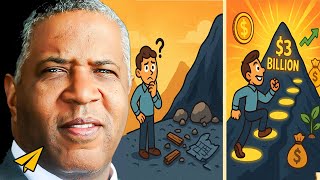
Robert F. Smith, founder of Vista Equity Partners, shares how intellectual property and grit built his path from Bell Labs and Goldman Sachs to billionaire status. He worked 100-hour weeks, learned to solve problems alone, and credits mentorship and self-belief over external doubt.
Chapters
You can actually make more money being smart than you can being strong or fast.
Running your own race demands trusting yourself even when others don't.
This is not a lifestyle business. And if you want to make it a lifestyle business, this is the wrong business to be in.
He's the founder, chairman, and CEO of Vista Equity Partners, a firm with over $26 billion under asset control. He's ranked by Forbes as the 268th richest person in America. He has an estimated net worth of over $3 billion. He's Robert F. Smith, and here's my take on his top 10 rules for success. Rule number 2 is my personal favorite, and make sure to stick around all the way to the end for some special bonus clips. Also, as Robert is talking, if he says something that really, really is meaningful to you, please leave it in the comments below. Put quotes around it so other people can be inspired as well.
Enjoy.
Intelligence can create huge profits, and in fact, you can actually make more money being smart than you can being strong or fast. Okay, and so the importance of developing intellectual property cannot be underestimated. Because I want you to think about something. Intellectual property, no one else can take that from you, point number one, if you manage it right. Point number two, it is constantly evolving and it actually takes no capital. If I'm going to go into real estate business, it takes me a whole lot of money to go buy a building and get in the real estate business. Intellectual property, I just have to think through how it actually works and then develop it. And that's what really launched me on the path to saying, you know what, you know, as good as I thought I was playing football and all those wonderful things, and my mom was a wonderful governor to my ambitions. She said, you're a far better scholar than you are athlete, which kind of hurt my feelings at the time. But she was absolutely right. And I started to turn my attention to what I call developing my mind.
Running your own race demands trusting yourself even when others don't. Because guess what? There are a lot of people, good people, people who love you, who trust you, and who you love and trust, who want the best for you. And you'll come to them with some ideas about what you want to do and how you want to do it, and they're going to say, "That's crazy." Just like when I left my first engineering job at Kraft and was telling my grandfather I was going back to business school, and he said, "That's a great-paying job. That's crazy." And when I finished business school and decided to join the tumultuous world of investment banking, my friends and my family spoke up with concerns about my sanity. And when I left Goldman Sachs right after we'd gone public to set up a private equity firm called Vista, my mentors and colleagues at Goldman Sachs thought I was crazy. And to top it all off, when I told them I'm gonna start a firm, we're gonna focus on enterprise software and not be diversified like all other private equity firms, I was gonna hire a team of smart, young, talented people who'd never done this before, everyone knew I was certifiable. And I did this, of course, in the spring of 2000, about 2 months before the entire tech bubble crashed. Well, all I can tell you is I've never been mad at these folks, In fact, I'm grateful for their advice and their concern, because in their caution I found my courage. In their doubts I found my resolve. And in their warnings I found my voice and chartered my own journey. And I'm proud of the VISTA story. We take risks, we do things differently, and we listen to our own voice. We run our own race, and it has worked. We are now considered to be the number one private equity firm on the planet and have been so for the last decade.
And did you go straight to Wall Street after college?
No, I worked for about 6 years in applied research and development.
You know, one of the joys of being a chemical engineer is, we talk about becoming the modern-day alchemist, you learn how to create things, you know, transform matter from one form to another, and that's what was important to me. I wanted to be an inventor, and so I worked for about 6 years in chemical Applied research development, got a chance to travel all over the world with big companies like Kraft General Foods and Air Products and Chemicals solving some very complex problems with using my engineering skill set, and I loved it, absolutely loved it, until one day I was sitting there with the head of my division and head of marketing, the head of sales, head of development for, you know, it's a small division, but then Philip Morris was part of Kraft, And I realized when we went through our 6 most important strategic priorities, I was leading 5 of them.
I was half the age of everybody in the room.
And I know I was making a third of everybody in the room. I said, I'm either doing something very right or very wrong.
And it's a bit of both.
Right.
And so this kind of that lesson of the realization of worth and self-worth, right? I said, you know what, this is a great experience.
I'm having fun.
I got 3 promotions in like 18 months because I was doing all these great and wonderful things. But then I realized there's probably something else out there.
That you are enough to be who you want to be and to create what you want to create. You have to make sure that beyond the intention that you put out there, you put action to support the intention. Don't say, I want to be a millionaire, but don't take the activities to do it. Or, I want to be the best at something, but don't practice it. It's important to understand that you are enough piece is, you know, You know, put in the vision, have the vision of what you want to become, but you have to put consistent action behind that vision in order for that to manifest. And it has to be consistent. You know, I had the good fortune to be— I was invited here by one of my fraternity brothers, Louie Tobias, and I remember many a day, Louie and I, Friday night, we're going to go to the party, and we went to the party, and we finished the party at 2:30, and 3 o'clock, We were back studying so that we could do well on an exam on Monday. It is the importance of knowing that it's your own intention and your power and your actions that can actually lead to, you know, the outcome that is good, that you want to have manifest.
And the first and foremost important thing about running your own race is dreaming big. And here I'm called back to my childhood when I was just starting elementary school. At that point in time, the Supreme Court had just ruled that public school districts could pursue desegregation by using forced busing to achieve racial balance in their schools. In fact, I started my own education as a first grader being bused to a school across town, even though my father was a principal at a school 5 blocks away. Although I was a live subject in one of the nation's most controversial legal debates, I frankly didn't know what the big deal was all about because these kids who didn't look like me sure acted just like me. But desegregation was a big deal to my parents, and leaders of their generations knew that great change was in store and it was the right thing to do. And they often met with resistance and often violent resistance. But because of their struggle, their sacrifice, I received a great gift, and that's the gift to dream big. I knew my history. I remembered the pride of my mother telling about when she took me and my brother, brought us back to Washington, D.C., and held me as a 9-month-old during the March on Washington when Martin Luther King laid out his dream for equal and harmonious meritocratic America. And dreaming big to me meant knowing my history but not being bound by it. It meant harnessing the past to drive me into the future. It meant grounding myself in who I was and where I came from so I could soar to become who I wanted to become.
The sponsors of Robert Smith's career, uh, only did so after I demonstrated that I'm willing to make the commitment to my career.
It's a two-way street.
It's not just, oh, here's, you know, the person you're going to sponsor, make sure that they get on good deals. No, it is they see you in the office, you're grinding 100 hours, you're getting it done, you know, you're making sure there's no mistakes.
And if there is a mistake, you correct it.
You're following up, you're reaching outside of your knowledge to go learn more. When you do that, sponsors are more than happy to then take credit for you. Okay, and that has been my experience, but it has all come through— you got it, you got it, you got to demonstrate that that's who you are and that's your priority. If it's Friday night and it's 5 o'clock, your sponsor seeing you leaving because you got, you know, happy hour with your boys, well, guess what? I mean, and they're there, you know, you got to be conscious of that sort of stuff. Okay, I like when they come back in on Saturday because they did come back and I'm wearing the same thing I wore Friday night, right? Okay, this guy's dedicated to his craft. And so when this deal happens, they're happy to stand up in front of the managing principal of the firm at that time to say, hey, you know, Robert did this work. You see what I mean? So it's a two-way street. And sponsors, you know, again, I have the opportunity, and I do in my firm, and build and develop people. But we have— when we do our reviews, part of what we're looking at, you have that kind of grit, if you dedicated to this credit. This is not a lifestyle business. And if you want to make it a lifestyle business, this is the wrong business to be in, okay? So that's— in the world I live in, that's something we think about and we talk about in that context.
That's just the nature of it.
So we look for, you know, again, I will sponsor those. And even my folks now who have not grown up with me in this business, I sponsor them because I saw them putting that level of effort and energy in 15 years ago.
And guess what?
They still do it today.
In America, education is not enough, especially for us as African Americans. You also need to have access to the economy. And so as I'm now going from, you know, from elementary school to middle school to high school, I started to actually think about, well, what is access to the economy? Why did they live in that great house And A, their father is a contractor, but owns his own contracting business. And yet down the street, I had a friend, his father worked for a contractor, but didn't own his own contracting business. They lived near us. And when I looked at that, I said, you know, part of what has to happen, and in my mind was I needed to, and I wanted to become a business owner. And that was early on. So literally, you know, I started my first business when I was probably 9 or 10 years old. I was selling golf balls. and I cut grass, I did all those sorts of things, 'cause the fact of the matter is I actually didn't like wearing my brother's clothes until I was 14 years old. I wore hand-me-downs basically until that period of time. And I don't know if any of you have experienced that, but kids can be cruel in some respects, but part of that also hardens you to help you understand and help you to reach some of your goals. And part of my goal was to be part of an economic class in America where I could buy my own clothes, the ones I wanted. And buy the shoes that I wanted, and go the places I wanted. And one of the advantages of, again, having parents who wanted me to read and forced me to read, I got a chance to read a number of things, and one of the things that inspired me early in my life was actually, believe it or not, the James Bond novels, because as I read them, they took me and transported me to places that I had no idea actually really existed. And if you've ever seen any of those movies, I mean, they characterize them in these movies, and I was like, wow, this is pretty terrific. I want to figure out a way to actually get to that place. And that is part of the impetus behind me working hard and also driving myself to, to go figure out how to create an opportunity that I could actually make big and lasting and have an impact.
So when I got to Bell Labs, they shared offices and I happened to share offices with a PhD in chemical engineering. And this man had patents that were probably 30 pages long. And he'd become one of my first mentors. And on my first day of work, as we got settled into his office, he turned his chair around, he kind of looked me up and down, and held this computer chip in front of me and said, this is an operational amplifier. It's failing in our Merlin systems out there in the field. You need to figure out why it's failing so we can fix it. If you have any questions, ask me.
And then he turns around.
And so you see, unlike today's technically sophisticated high school students, I had no idea what an operational amplifier was, what it was supposed to do, what this one didn't do. And so, before the days of Google and Wikipedia, we had this thing called a library. And I went to the library. And I pulled every book on operational amplifiers I could find. I talked to everyone in the halls who would listen and ask questions. And by the end of the summer, not only did I have an idea about why this wasn't working, but I had built a system that simulates the field conditions that causes them to fail. And then with my mentor's help, we fixed the problem. My guess is even now, I'm probably the most knowledgeable intern at Bell Labs on operational amplifiers in the history of that company. But the important thing was the challenge from my mentor was more than to teach me something about this obscure integrated circuit. It's a challenge that has reaped rich dividends for me over my entire career. It is the joy of figuring things out.
What do you think the accelerators to success are, particularly in environments where structures are not designed to help people succeed?
Sure. This is, is complex. There's an education piece, then there's a knowledge piece, and then there's a practitioner of a craft piece that all are important, and you do need to have guides. Along the way, at least if you're a person of color, okay? And I say that because, you know, being a person of color, I see the difference in my experiences versus others and, you know, in what their experiences have been. And I wouldn't say that it is— who knows if it's overt or not. I just can tell you what my experience has been. So, you know, first of all, you have to do well enough. No, actually, you have to be, you know, have a desire to be great at what it is you want to do, first of all, to do this business. That's the first thing. And you have— there's a fundamental base level of understanding of, you know, basic math. You got to be good at it, okay? Really good at it. And then from there, you have to understand and start to listen to to the structures around how deals are done, and there's a whole fact pattern capturing that's important that while you can listen, the only way to really learn it is to do it, and you have to become expert, and there are talks about what is an expert? Well, an expert's someone who dedicates 10,000 hours to their craft, okay? That's a lot of time, not over 20 years, but in as compressed a period of time as possible. The advantage of going to these investment banks is in a heady environment, that happens in 100-hour work weeks. Right? And while all your friends who you graduate college with are going out on Friday night and Saturday night, guess what? You're working.
And on Sat, you're working.
You are working. But that's how you build that fabric and to be an expert at your craft. You cannot do this business well if you are not an expert at your craft. So all of those things, first of all, you have to have structures and opportunity to see it. Then you have to dedicate yourself to it. And then you have to have people who can help you understand and navigate to some extent, you know, why certain deals went one way and why certain deals went the other way. And it is highly nuanced. It isn't something that you're just— you can just read in a case study. You have to live it, and you have to live it through the eyes of someone who has lived it. And to the extent you see people who have lived it and you're in that environment, you have to now seek out the time and force that engagement of why it went one way versus another and see how that fits in the context of, you know, of this— of the deal business. So those are, I mean, it's complex and it is, but the rewards beyond the personal rewards, but you know, the rewards are just astounding, okay, in terms of personal growth, personal development, and frankly the opportunity to then train and build others so that they can become experts in their craft and realize their dreams, right? So I think, you know, that's the arc of the opportunity there that is, is in this world, I mean, is a rarefied air of people who are really good at this and who really get an opportunity to do it and practice it at a size and scale that matters.
You know, in this world, and I, you know, the importance of actually, you know, going through the process of understanding what the problem is, and then figuring out yourself, and every now and then you need some help, that's fine. But if you get too much help, you never figure out how to do things, and you don't develop the grit. And some of the older folks in this audience are shaking their heads. Yeah, you got to have grit. And grit means getting turned away from things 14, 15 times, calling someone every 2 weeks, you know, every day for 5 months, and then finally it materializing in something that you want. And discovering the joy of figuring things out means, you know, if, you know, for, you know, fight through those problems, understand and learn how you address those problems, and come up with the answers to those come up with the answers to those problems within a solution that is uniquely yours. That's an important part of growing up and solving problems, because if you can't solve easy problems now, you will not be able to solve difficult problems later.
Thank you guys so much for watching. I made this video because Arlethia White asked me to. So if there's a famous entrepreneur that you want me to profile next, leave it in the comments below and I'll see what I can do. I'd also love I would love to know what of Robert's message had the biggest impact on you and why. What was your favorite clip? What did you learn from this? How is it going to impact your life or your business? Please leave it in the comments below. I'm going to join in the discussion. I also want to give a quick shout out to Jason J. Rise Fonseca from RiseOnline.com. Thank you, J. Rise, for picking up another copy of my book. It really, really, really means a lot to me. So thank you guys again for watching. I believe in you. I hope you continue to believe in yourself. And whatever your one word is. Much love.
I'll see you soon.
I went to the same high school in East Denver as my father did, Denver East High School, and I remember taking a computer science course. And at the time they introduced this thing called a transistor, which is the building block of computers for those who don't know. And transistors were invented at this place called Bell Labs, which had a facility about 20 miles from my home. And after that lesson, I went and I dug up the telephone number to the Bell Labs facility and I called them. I said, do you have summer internships? They said, we absolutely do. I said, fantastic. They said, if you're between your junior and senior year in college. I said, hey, I'm a junior in high school, I'm taking advanced math classes and computer science, getting all A's. Just like being in college. They said, no, it isn't. So I called every day for 2 weeks straight. The HR director, of course, stopped taking the calls after the second day, and I left a message with my phone number. Then I called every Monday for 5 months. And every time I called, the receptionist just chuckled, and she took my name, and she took my number, and she said, "We'll get back to you if there's an opening." And I kept at it. And to my surprise, the human resources director called my house in June and said, "Listen, an intern from MIT didn't show up. We have an extra slot. We're not promising you anything, but why don't you come on in and interview? Now, of course, I knew I was the most qualified candidate for this job. And the truth is, I went in, I interviewed, I got the job. So the important thing that I want you to think about here is the persistence to get that job led to me working at Bell Labs for the next 4 years, becoming a co-op student, and ultimately finishing with a degree in chemical engineering from Cornell, all from being persistent.
More from Evan


How the Biggest Mistake in History Created A Trillion-Dollar Empire | Sergey Brin



9 Machiavelli Principles That Force People To Respect You | Machiavellian Philosophy



The First 10 Words That Instantly Ruin A Sales Conversation | Vanessa Van Edwards

The Top 1% Mindset Behind The First $5 Trillion Company | Jensen Huang (Nvidia)

