The Power of a Solid Routine: Jordan Peterson's Formula for Success
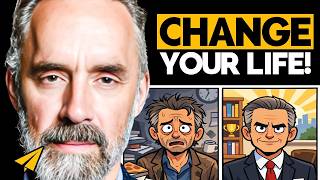
Jordan Peterson outlines a four-step formula for success: stop harmful habits, build a realistic daily schedule, set concrete goals, and break them into micro-habits. He emphasizes writing down your thoughts, confronting feared tasks, and developing conscientiousness to achieve long-term results.
Chapters
Stop doing the things that you know are wrong. Make a damn schedule and stick to it.
Sometimes, you know, I can't sleep at night because I'm thinking about something, and usually what I'll do is go write it down.
It's important to distinguish between those because that's partly— and this is back down to the micro-routine analysis— so if I was saying, well, you're going to try to make yourself more industrious, okay, number one, specify your damn goals, because how are you going to hit something if you don't know what it is?
Hello, Believe Nation! My name is Evan Carmichael. My one word is believe, and I believe that entrepreneurs will solve all of the world's major problems. So to help you on your journey today, we're going to learn from clinical psychologist and professor Jordan B. Peterson and my take on his top 10 rules of success. Rule number 4 is my personal favorite, and I'd love to know which one you guys like the best. And as always, as you're watching, if you hear something that really resonates with you, please leave it in the comments below. Put quotes around it so other people can be inspired. You might win a prize as well. And also, when you write it down, it's much more likely to stick for yourself as well. Enjoy!
Enjoy. Stop doing the things that you know are wrong, that you could stop doing. Right? So it's, it's a fairly, it's a fairly limited attempt. First of all, we're not gonna say that you know what the good is, or what the truth is, in any ultimate sense. But we will presume that there are things that you're doing, that for one reason or another, you know are not in your best interests. There's something about them, that you just know you should stop. They're kinda self-evident to you. Other things you're gonna be doubtful ab— about. You're not gonna know, which way is up, and which way is down. But there are things that you're doing, that you know you shouldn't do. Now, some of those, you won't stop doing. For whatever reason. You don't have the discipline, or maybe there's a secondary payoff, or, you don't believe it's necessary, or it's too much of a sacrifice, You're angry or resentful or, or afraid, who knows. So forget about those for now. But there's another subset that you could stop doing. It might be a little thing. Well, that's fine. Stop doing it and see what happens. And what'll happen is your vision will clear a little bit, and then something else will pop up in your field of apprehension that you will also know you should stop doing, and that you could stop doing, because you strengthened yourself a bit by stopping doing the particular stupid thing that you were doing before. That just puts you together a little bit more. And you could do that repeatedly, for an indefinite period of time. And, you know, that doesn't necessarily mean that you're going to ever be able to formulate a clear and final picture of what constitutes the truth and the good. But it does mean that you'll be able to continually move away from what's untruth and what's bad. And, you know, that's not a bad start. Make a damn schedule! And stick to it! Okay, so what's the rule with the schedule? It's not a bloody prison! That's the first thing that people do wrong. They say, "Well, I don't like to follow a schedule." It's like, well, what kind of schedule are you setting up? "Well, I have to do this, then I have to do this, then I have to do this, you know, and then I just go play video games, because who wants to do all these things that I have to do?" It's like, wrong! Set the damn schedule up so that you have the day you want! That's the trick. It's like, okay, I've got tomorrow. If I was going to set it up so it was the best possible day I could have, Practically speaking, what would it look like? Well, then you schedule that, and obviously there's a bit of responsibility that's going to go along with that, because if you have any sense, one of the things that you're going to insist upon is that at the end of the day, you're not in worse shape than you were at the beginning of the day, right? Because that's a stupid day. If you have a bunch of those in a row, you just dig, you know, you dig yourself a hole and then you bury yourself in it. It's like, sorry, that's just not a good strategy. It's a bad strategy. So maybe 20% of your day has to be responsibility and obligation, or maybe it's more than that, depending on how far behind you are. But even that, you can ask yourself, "Okay, well, I've got these responsibilities. I have to schedule the damn things in. What's the right ratio of responsibility to reward?" And you can ask yourself that, just like you'd negotiate with someone who is working for you. It's like, "Okay, you gotta work tomorrow." Okay, so I want you to work tomorrow. And you might say, "Okay, well, what are you gonna do for me?" that makes it likely that I'll work for you? Well, you could ask yourself that, you know. So maybe you do an hour of responsibility and then you play a video game for 15 minutes. I don't know, whatever turns your crank, man. But you know, you have to negotiate with yourself and not tyrannize yourself. Like you're negotiating with someone that you care for, that you would like to be productive and have a good life. And that's how you make the schedule. It's like, and then you look at the day and you think, well, if I had that day, that'd be good. Great! You know, and you're useless and horrible, so you'll probably only hit it with about 70% accuracy, but that beats the hell out of zero! Right? And if you hit it even with 50% accuracy, another rule is, well, aim for 51% the next week. Or 50.5%, for God's sake. Or— because you're gonna hit that position where things start to loop back positively and spiral you upward.
Sometimes, you know, I can't sleep at night because I'm thinking about something, and usually what I'll do is go, write it down. I have some writing to do. So I get up and I go write down what I'm thinking, and that usually does the trick. But because I had been playing with YouTube, I thought, well, I'll try making YouTube video and telling people what I'm thinking about and see if that performs the same function as writing. And to me, the function of writing, while it's twofold, one is conceivably to communicate with people, although the fundamental purpose for me is to clarify my thoughts so that I know— because if something is disturbing you, what that means is that it needs to be articulated. It's the emergence of unexplored territory, something that disturbs you. That's the right way to think about it. It's unmapped territory that's manifesting itself. It's like a vista of threat and possibility. And you need to articulate a path through it. And so that's what I was doing. It's like, I was thinking, well, this is bothering me, and this seems to be why, and here's what I think is going on. And so I made the videos, and in some sense, I didn't think anything more of it.
You don't have to necessarily have done anything wrong for things to get completely out of control. It's a terrifying doctrine. But it's not a hopeless doctrine, because it still says that there's a way forward. There's a pathway forward. Pathway forward is to adopt a mode of being that has some nobility, so that you can tolerate yourself and perhaps even have some respect for yourself as someone who's capable of standing up in the face of that terrible vulnerability and suffering. And that the pathway forward, as far as the existentialists are concerned, is by— well, certainly by the avoidance of deceit, particularly in language, but also by the adoption of responsibility for the conditions of existence and some attempt on your part to actually rectify them. And the thing that's so interesting about that is— well, two, as far as I'm concerned, and some of this is from clinical experience, you know, if you take people, and I've told you this, and you expose them voluntarily to things that they are avoiding and are afraid of, you know, that they know they need to overcome in order to meet their goals, their self-defined goals, if you can teach people to stand up in the face of the things they're afraid of, They get stronger. And you don't know what the upper limits to that are, because you might ask yourself, like, if for 10 years, if you didn't avoid doing what you knew you needed to do, by the def— by your own definitions, right? Within the value structure that you've created, to the degree that you've done that, what would you be like? Well, you know, there are remarkable people who come into the world from time to time, and there are people who do find out over decades-long periods what they could be like if they were who they were, if they said, if they spoke their being forward. And they get stronger and stronger and stronger, and we don't know the limits to that. We do not know the limits to that. And so you could say, well, in part, perhaps the reason that you're suffering unbearably can be left at your feet, because you're not everything you could be and you know it. And of course, that's a terrible thing to admit, and it's a terrible terrible thing to consider, but there's real promise in it, right? Because it means that perhaps there's another way that you could look at the world, and another way that you could act in the world, so what it would reflect back to you would be much better than what it reflects back to you now. My experience is with people that we're probably running at about 51% of our capacity. Something— I mean, you can think about this yourselves. I often ask undergraduates, How many hours a day you waste, or how many hours a week you waste? And the classic answer is something like 4 to 6 hours a day. You know, inefficient studying, watching things on YouTube that not only do you not want to watch, that you don't even care about, that make you feel horrible about watching after you're done. That's probably 4 hours right there. You know, you think, well, that's 20, 25 hours a week, it's 100 hours a month, that's 2.5 full work weeks. It's half a year of work weeks per year. And if your time is worth $20 an hour, which is a radical underestimate, it's probably more like $50 if you think about it in terms of deferred wages. If you're wasting 20 hours a week, you're wasting $50,000 a year. And you are doing that right now. And it's— because you're young, wasting $50,000 a year is a way bigger catastrophe than it would be for me to waste it, because I'm not gonna last nearly as long. And so if your life isn't everything it could be, you could ask yourself, well, what would happen if you just stopped wasting the opportunities that are in front of you? You'd be who knows how much more efficient. 10 times more efficient. 20 times more efficient. That's the Pareto distribution. You have no idea how efficient efficient people get. It's completely— it's off the charts. Well, and if we all got our act together collectively, and stop making things worse, because that's another thing people do all the time. Not only do they not do what they should to make things better, they actively attempt to make things worse because they're spiteful, or resentful, or arrogant, or deceitful, or— or homicidal, or genocidal, or all of those things, all bundled together in an absolutely pathological package. If people stopped really, really trying just to make things worse, We have no idea how much better they would get just because of that. So there's this weird dynamic that's part of the existential system of ideas between human vulnerability, social judgment, both of which are, are, are, are major causes of suffering, and the failure of individuals to adopt the responsibility that they know they should adopt. It isn't merely that your fate depends on whether or not you get your act together and to what degree you decide that you're going to you live out your own genuine being. It isn't only your fate. It's the fate of everyone that you're networked with. And so, you know, you think, well, there's 9 billion— 7 billion people in the world. We're going to peak at about 9 billion, by the way, and then it'll decline rapidly. But 7 billion people in the world, and who are you? You're just one little dust mote among that 7 billion. And so it really doesn't matter what you do or don't do. But that's simply not the case. It's the wrong model, because you're at the center of a network. You're a node in a network. Of course, that's even more true now that we have social media. You'll— you'll know 1,000 people, at least, over the course of your life. And they'll know 1,000 people each, and that puts you 1 person away from 1 million. And 2 persons away from 1 billion. And so that's how you're connected. And the things you do, they're like dropping a stone in a pond. The ripples move outward. And they affect things in ways that you can't fully comprehend. And it means that the things that you do and that you don't do are far more important than you think. And so if you act that way, of course, the terror of realizing that is that it actually starts to matter what you do. And you might say, "Well, that's better than living a meaningless existence. It's better for it to matter." But I mean, if you really asked yourself, would you be so sure if you had the choice? I can live with no responsibility whatsoever. The price I pay is that nothing matters. Or I can reverse it, and everything matters. But I have to take the responsibility that's associated with that. It's not so obvious to me that people would take the meaningful path. Now when you say, "Well, nihilists suffer dreadfully because there's no meaning in their life, and they still suffer." Yeah, but the advantage is they have no responsibility. So that's the payoff, and I actually think that's the motivation. Say, "Well, I can't help being nihilistic, all my belief systems have collapsed." collapsed. It's like, yeah, maybe, maybe you've just allowed them to collapse because it's a hell of a lot easier than acting them out. And the price you pay is some meaningless suffering, but you can always whine about that and people will feel sorry for you, and you have the option of taking the pathway of the martyr. So that's a pretty good deal, all things considered, especially when the, uh, when the alternative is to bear your burden properly and to live forthrightly in the world. Well, what Solzhenitsyn figured out, and so many people in the 20th century— it's not just him, even though he's the best example— is that if you live a pathological life, you pathologize your society. And if enough people do that, then it's hell. Really. Really. And you can read The Gulag Archipelago if you have the fortitude to do that, and you'll see exactly what hell is like. And then you can decide if that's a place you'd like to visit. Or even more importantly, if it's a place you'd like to visit and take all your family and friends. Because that's what happened in the 20th century. The next best predictor of lifetime success is conscientiousness. Well, so, and of the two aspects of conscientiousness, say, orderliness and industriousness, the better predictor is industriousness. So the question is, well, what can you do about your industriousness? And the answer to that is Well, that's kind of rough too, because there's a strong genetic component. But you can work on micro-habits with regards to your conscientiousness. And I think the best micro-habits— this is partly to do with this Future Authoring program processes— I think the best thing you can do with regards to your conscientiousness is to set up some aims for yourself. Goals that you actually value. And the Future Authoring program helps people do that. And basically, it does a situational analysis of— it helps you do a situational analysis of your life more than even a psychological analysis, I would say. And so the questions are something like, "Well, alright, you're gonna have to put some effort into your life. And you need to be motivated to do that. And so, what are the potential sources of motivation?" Well, you could think about them in the Big Five manner. You know, if you're extroverted, you want friends. If you're agreeable, you want an intimate relationship. If you're disagreeable, you want to win competitions. If you're open, you want to engage in creative activity. If you're high in neuroticism, you want security. Okay, so those are all sources of potential motivation that you could draw on, that you could tailor to your own personality. But then there are dimensions that you wanna consider your life across. And so we ask people about, well, if you could have your life the way you wanted it in 3 to 5 years, if you were taking care of yourself properly, what would you want from your friendships? What would you want from your intimate relationship? How would you like to structure your family? What do you want for your career? Well, how are you going to use your time outside of your job, and how are you gonna regulate your mental, physical— mental and physical health, and maybe also your drug and alcohol use, because that's a good place to auger down, you know, 'cause alcoholism, for example, wipes out, you know, 5 to 10% of people, so you wanna keep that under control. And then, so maybe, you know, you develop a vision of what your life— what you would like your life to be, and that associates the So the goal— once the goal is established, and then you break down the goal into micro-processes that you can implement, the micro-processes become rewarding in proportion, in relation to their causal association with the goal. And that tangles in your incentive-reward system. You know, we talked about the dopaminergic incentive-reward system, and that's the thing that keeps you moving forward. And the way it works is that it works better if It produces positive emotion when it can see you moving towards a valued goal. Okay, well, what's the implication of that? Better have a valued goal, because otherwise you can't get any positive motivation working out. And so the more valuable the goal, in principle, the more the micro-processes associated with that goal start to take on a positive charge. And so what that means is, well, you get up in the morning and you're excited about the day. You're ready to go. And so, as far as I can tell, what you do is you specify your long-term ideal. Maybe you also specify a place you wanna stay the hell away from, so that you're terrified to fail, as well as excited about succeeding. 'Cause that's also useful. You specify your goal. You do that— you do that, in some sense, as a unique individual. You wanna specify goals that make you say, "Oh! If that could happen as a consequence of my efforts, it would clearly be worthwhile." Because the question always is, why do something? 'Cause doing nothing is easy, you just sit there and you don't do anything. That's real easy. The question is, why would you ever do anything? And the answer to that has to be because you've determined, by some means, that it's worthwhile. And then the next question might be, well, where should you look for worthwhile things? And one would be, well, you could consult your own temperament. And the other would be, well, you kinda look at how— look at what it is that people accrue that's valuable across the lifespan. Look, look what— so you do a structural analysis of the sub-components of human existence, and I already did that. You need a family, you need friends. Like, you don't need to have all these things, but you better have most of them. Family, friends, career, educational goals, plans for, you know, time outside of work, attention to your mental and physical health, etc. You know, those are— that's what life is about. And if you don't have any of those things, well, then all you've got left is misery and suffering. So that's a bad deal for you. So, once you set up that goal structure, let's say, and that's really, in many ways, that's what you should be doing at university. That's exactly what you should be doing, is trying to figure out who it is that you're trying to be. Right? And you aim at that. And then you use everything you learn, as a means of building that person that you wanna be. And I really mean "want to be," I don't mean "should be," even though those things are gonna overlap. And it's important to distinguish between those, because that's partly— and this is back down to the micro-routine analysis, so if I was saying, "Well, you're gonna try to make yourself more industrious," okay, number 1, specify your damn goals, 'cause how are you gonna hit something if you don't know what it is? That isn't gonna happen. And often people won't specify their goals too, because they don't like to specify conditions for failure. So if you keep yourself all vague and foggy, which is real easy, 'cause that's just a matter of not doing as well, then you don't know when you fail. And people might say, "Well, I really don't wanna know when I fail, because that's painful. So I'll keep myself blind about when I fail." That's fine, except you'll fail all the time then. You just won't know it until you've failed so badly that you're done. And that can easily happen by the time you're 40. So, so, I would recommend that you don't let that happen. So that's willful blindness, right? You could have known, but you chose not to. Okay, so once you get your goal structure set up, you think, "Okay, if I could have this life, looks like that might be worth living." Despite the fact that it's gonna be, you know, anxiety-provoking and threatening, and there's gonna be some suffering and loss involved in all of that, obviously. The goal is to have a vision for your life such that, all things considered, that justifies your effort. I started to pay very careful attention to what I was saying. I don't know if that happened voluntarily or involuntarily, but I could feel a sort of split developing in my psyche, and the split— and I've actually had students tell me the same thing has happened to them after they've listened to some of the material that I've been describing to all of you. But I split into two, let's say. And one part was the, let's say, the old me that was talking a lot, and that liked to argue, and that liked ideas. And there was another part that was watching that part, like, just with its eyes open, and neutrally judging. And the part that was neutrally judging was watching the part that was talking and going, "That isn't your idea. You don't really believe that." 'You don't really know what you're talking about. That isn't true.' And I thought, 'Hmm, that's really interesting.' So now I've— and that was happening to like 95% of what I was saying. And so then I didn't really know what to do. I thought, 'Okay, this is strange. So maybe I've fragmented, and that's just not a good thing at all.' I mean, it wasn't like I was hearing voices or anything like that. I mean, it wasn't like that. It was— it was— well, people have multiple parts. So then I had this weird conundrum, it was like, "Well, which of these two things are me? Is it the part that's listening and saying, 'No, that's rubbish, that's a lie, that's— you're doing that to impress people, you're just trying to win the argument, you know'?" Was that me, or was the part that was going about my normal verbal business me? And I didn't know, but I decided I would go with the critic. And then what I— tried to do, what I learned to do, I think, was to stop saying things that made me weak. And now that— I mean, I'm still trying to do that because I'm always feeling when I talk whether or not the words that I'm saying are either making me align or making me come apart. And I think the alignment— I really do think the alignment is— I think alignment is the right way of conceptualizing it, because I think if you say things that are As true as you can say them, let's say, then they come up, they come out of the depths inside of you. Because we don't know where thoughts come from. We don't know how far down into your substructure the thoughts emerge. We don't know what processes of physiological alignment are necessary for you to speak from the core of your being. We don't understand any of that. We don't even conceptualize that. But I believe that you can feel that, and I learned some of that from from reading Carl Rogers, by the way, who's a great clinician, because he talked about mental health in part as the coherence between the spiritual, or the abstract, and the physical, that the two things were aligned. And there's a lot of idea of alignment in psychoanalytic and clinical thinking. But anyways, I decided that I would start practicing not saying things that would make me weak, and what happened was that I had to stop saying almost everything that I was saying, saying. I would say 95% of it. It's a hell of a shock to wake up and— I mean, this was over a few months, but it's a hell of a shock to wake up and realize that you're mostly dead wood. It's a shock, you know, and you might think, well, do you really want all of that to burn off? It's like, well, there's nothing left but a little husk, 5% of you. It's like, well, if that 5% is solid, then maybe that's exactly what you want to have happen. Adopt the mode of authentic being. And that is something like refusing to participate in the lie, in deception and the lie, to orient your speech as much as you can towards the truth, and to take responsibility for your own life and perhaps also for the lives of other people. And there's something about that that's meaningful and responsible and noble, but also serves to mitigate the very suffering that produces, say, the nihilism or the flee into the arms of— flee or the escape into the arms of totalitarians to begin with. You need something to shelter you against your own vulnerability. You can think about the world this way. You can think about it as your orderly little plan. That's a place. And you can think about it as the place that things that disrupt your plan comes from. That's another place. This is a bigger place than this. Because there's an endless number of things that can disrupt your plan, and only a tiny number of them that can, you know, that will help you work it out. So part of the question then too is like, are you the friend of your plan, or are you the friend of the thing that disrupts your plan? And I would say you should work to become the friend of the thing that disrupts your plan, because there's a lot of that. And then if you become the friend of the thing that disrupts your plan, then you start to develop strength in proportion to the disruptive force. And that's really what you want. You want to be able to implement your plan, obviously, but you want to be able to take on the consequences of error. And learn from it. And then you win, constantly. Because even if something goes sideways, you think, "There's something to be derived from this." That's wisdom, fundamentally. Plan a life you'd like to have. And you do that partly by referring to social norms, that's more or less rescuing your father from the belly of the whale, but the other way you do that is by having a little conversation with yourself about— as if you don't really know who you are, because you know what you're like, you won't do what you're told, you won't do what you tell yourself to do, you must have noticed that. It's like you're a bad employee and a worse boss, and both of those work, you know, for you. You don't know what you want to do, and then when you tell yourself what to do, you don't do it anyways. You should fire yourself. And find someone else to beat. But, but, you know, my point is, is that you have to understand that you're not your own servant, so to speak. You're someone that you have to negotiate with, and that's— and you're someone that you want to present the opportunity of having a good life to. And that's hard for people because they don't like themselves very much. So, you know, they're always like cracking the whip and then procrastinating and cracking the whip and then procrastinating, and it's like, God, It's so boring and such a pathetic way of spending your time. If you configure your life so that what you are genuinely doing is aiming at the highest possible good, then the things that you need to survive and to thrive on a day-to-day basis will deliver themselves to you. That's a hypothesis, and it's not some simple hypothesis, right? Because what it basically says is If you dare to do the most difficult thing that you can conceptualize, your life will work out better than it will if you do anything else. Well, how are you going to find out if that's true? Well, it's a Kierkegaardian leap of faith. There's no way you're going to find out whether or not that's true unless you do it. So no one can tell you either, because just because it works for someone else, I mean, that's interesting and all that, but it's no proof that it'll work for you. You have to be all in in this game. There is no more effective way of operating in the world than to conceptualize the highest good that you can, and then strive to attain it. There's no more practical pathway to the kind of success that you could have if you actually knew what success was. The world shifts itself around your aim. Because you're a creature that has an aim. You have to have an aim in order to do something. You're an aiming creature. You look at a point, and you move towards it. It's built right into you. And so, you have an aim. Well, let's say your aim is the highest possible aim. Well then, so that sets up the world around you. It organizes all of your perceptions. It organizes what you see and you don't see. It organizes your emotions and your motivations. So you organize yourself around that aim, and then what happens is the day manifests itself as a set of challenges and problems. And if you solve them properly, then you stay on the pathway towards that aim. And you can concentrate on the day. And so that way you get to have your cake and eat it too. Because you can point into the distance, the far distance, and you can live in the day. And it seems to me that that makes every moment of the day supercharged with meaning. Because if everything that you're doing every day is related to the highest possible aim that you can conceptualize, well, that's the very definition of the meaning that would sustain you in your life.
Thank you guys so much for watching. I made this video because DudeWhat212 asked me to. So if there's a famous entrepreneur that you want me to profile next, check out the link in the description and you can go and cast your vote. I'd also love to know which clip resonated the most with you, what lesson are you going to take from this video and immediately apply to to your life or to your business somehow, leave it down in the comments below. I'm really curious to find out what you have to say. I also wanna give a quick shout out to Nathan from the Productivity Game channel. Nathan, thank you so much for picking up a copy of my book, Your One Word, and making that awesome YouTube video on your channel about it. I really appreciate the support, man, and I'm so glad you enjoyed my book.
Carmichael states that there is one word that defines who you are, connects all the things in your life that make you come alive, and will help you escape the chains of mediocrity.
Thank you guys so much for watching. I believe in you. I hope you continue to believe in yourself and whatever your one word is. Much love.
Así es. No one can live without a routine. You just forget that. If you guys don't have a routine, I would recommend, like, you get one going because You cannot be mentally healthy without a routine. You need to pick a time to get up. Whatever time you want, but pick one and stick to it, 'cause otherwise you dysregulate your circadian rhythms, and they regulate your mood. It's disciplined, it's predictable, and bloody well stick to it. You're gonna be way healthier and happier and saner if you do that. And then the other thing that you need, because this is one of the things the psychoanalysts got wrong, I think, is that they overestimated the degree to which sanity was a consequence of internal— of being properly structured internally, you know. Because from the psychoanalytic point of view, you're sort of an ego, and that ego is inside you. And of course, it rests on an unconscious structure. But the purpose of psychoanalysis is to sort out that unconscious structure and the ego on top of it, and to make you a fully functioning and an autonomous individual. But there's a problem with that, because the reason that you're sane as a fully functional and autonomous human being isn't because you've organized your psyche, even though that's important. The reason that you're sane if you have a well-organized unconscious and ego is because other people can tolerate having you around for reasonably extensive periods of time, and will cuff you across the back of the head every time you do something so stupid that people will dislike you permanently if you continue. And so what people are doing to each other all the time, just nonstop, is broadcasting sanity signals back and forth, right? It's like, you smile at people if they're— well, if they're not only behaving properly, but behaving in a way that you would like to see them continue to behave. You frown at them If they're not, you ignore them. If they're not, you shun them. You roll your eyes at them. You manifest a disgust face. You don't listen to them. You interrupt them. You won't cooperate with them. You won't compete with them. It's like you're blasting signals at other people about how to regulate their behavior so frequently, well, it just makes up all of your social interaction. That's why we face each other, and we have emotional displays on our face, and we're looking at each other's eyes, and we know exactly We know as much as we can about what's going on with each other, given that we don't have immediate access to the contents of their consciousness. And so partly what you're doing with your routine is establishing yourself as a credible, reliable, trustworthy, potentially interesting human being who isn't going to do anything too erratic at any moment. And everyone else is around there tapping you into shape, making sure that that's exactly what you are. And that's how you stay sane. And so what happens to people people too, if they don't have a routine and they get isolated, is they start to drift. And they drift badly, because the world is too complicated for you to keep it organized all by yourself. You just cannot do it. So a lot of our— so we outsource the problem of sanity. And it's very intelligent that we outsource the problem of sanity, because sanity is an impossibly complex problem. And so the way that we manage the incredibly complex problem is we have a very large number of brains working simultaneously on the problem all the time.
More from Evan


How the Biggest Mistake in History Created A Trillion-Dollar Empire | Sergey Brin



9 Machiavelli Principles That Force People To Respect You | Machiavellian Philosophy



The First 10 Words That Instantly Ruin A Sales Conversation | Vanessa Van Edwards

The Top 1% Mindset Behind The First $5 Trillion Company | Jensen Huang (Nvidia)

