The SUCCESS Formula to Dominate Your Industry | Stan Lee | Top 10 Rules
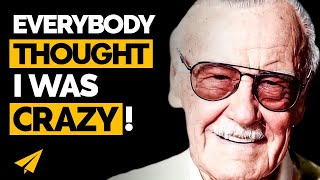
Stan Lee explains how Marvel became dominant by treating readers as friends, not demographics. Spider-Man was rejected by his publisher but became a bestseller when Lee snuck it into Amazing Fantasy's final issue. Marvel's success came from creating stories Lee himself would enjoy and signing fan letters as "Stan" to build community.
Chapters
I got this great idea. I want to call him Spider-Man, and he's a teenager.
So I gave him the idea, and he said, "Stan, that is the worst idea I have ever heard." I always had the feeling that the other comic books, they had good stories, good artwork, everything was fine, but there was a detachment.
Years ago, I used to feel somewhat embarrassed that I was writing comics. It is such fun. Creating characters, writing stories, even doing interviews, even though I can't hear most of what the guy says to me.
Will you shut up? Can't you explain anything in a simple way? Everybody thought I was crazy, you know. That book sold better than most of the others in that period.
Do you have a specific target audience?
Oh, just anybody who can read, anybody who's literate.
People want entertainment. People want adventure stories.
We suddenly began to realize, hey, we've got fans. Fans? We never had fans before. Oh man, I am so fired.
He's a comic book writer, editor, TV show host, and actor. He created Spider-Man, the Hulk, Iron Man, Thor, the X-Men, and many other fictional characters. He led the expansion of Marvel Comics from a small division of a publishing house to a giant corporation. He's Stan Lee, and here's my take on his top 10 rules for success.
I had done the Fantastic Four and the X-Men, and my publisher said, "Hey, they're doing well, do another one." So I came up with Spider-Man, and I said to him, "I got this great idea. I want to call him Spider-Man, and he's a teenager." So I gave him the idea, and he said, "Stan, that is the worst idea I have ever heard." He said, "First of all, people hate spiders. You can't call a hero Spider-Man. Secondly," he said, "he can't be a teenager. Teenagers are only 13 years old." "Only sidekicks. And finally, he can't have personal problems. Don't you know what a superhero is?" So he wouldn't let me do it. One day we had a book we were gonna kill called Amazing Fantasy.
When you're gonna do the last issue, nobody cares what you put in it.
Just to get it out of my system, I put Spider-Man in the book and we sold it. And it was a bestseller. So my publisher called me in a couple weeks later, he said, "Stan, you remember that character Spider-Man that you and I liked so much? Why don't you do a series of him?" And that's how Spidey was born.
I tried to inject a feeling of warmth in all the books. I always had the feeling that the other comic books, they had good stories, good artwork, everything was fine, but there was a detachment. Even in their letters pages, and they had very few. We were the ones who really made letters pages popular. But occasionally they'd run a letters page and it would be like this: Dear Editor, "Dear Stan, I read your story and I liked it. Signed, Charles Smith." And the answer would be, "Dear Charles, thank you very much. The Editor." Well, I decided to run letters pages, but I wanted to make them friendly. I wanted the kids to feel a part of Marvel. So even if somebody wrote a letter that said "Dear Editor" to me, when I printed it, I wrote "Dear Stan." I changed the word "Editor" to "Stan." when I answered the letter, instead of saying, "Dear Charles," I'd say something like, "Hey, thanks a lot, Charlie!" You know? And I tried to keep the tone friendly, as if I'm a guy they know and we're just talking together. And after a while, it became very natural. And after a while, all the letters were, "Hey, Stan, I loved your story!" "Hey, Stan, I hated your story!" Whatever it was. But it was like they knew me and I knew them.
I'd like to think of myself as an entertainer. I feel if I can entertain people in any way, it's very gratifying. Because it's a funny thing. Years ago, I used to feel somewhat embarrassed that I was writing comics. I felt, there are men building bridges and working in laboratories on cures for illness and doing real things, and I'm writing these comic books. But over the years, I've learned how much joy these comic books have brought to people, and, um, I began to realize that entertainment is very important in people's lives. Most people, almost everybody, have lives that have problems and troubles and things to worry about, and if you can entertain somebody, take his or her mind off the things that would normally be bothering them, That's a good thing to do. So I like to think of myself as an entertainer, somebody who offers a little entertainment to people in whatever form it may be. Mostly in my case, it had been comic books.
How do you keep the creative juices flowing to keep creating work over the years?
Greed is probably one of the reasons. No, actually, I'm doing what I enjoy doing. It's like other men like to play golf, so they play golf every chance they can. So you don't say to them, "How come you're playing golf today? You played last week." Was the same with me. To me, it is such fun creating characters, writing stories, even doing interviews, even though I can't hear most of what the guy says to me. But, um, it's an exciting life, and when you do something that you know the fans seem to enjoy, that gives you such satisfaction you don't want to stop.
My publisher had learned that DC Comics, which was then called National Comics, had a book called the Justice League, and it was selling very well, and it was made up of a number of superheroes. So he said to me, Stan, why don't you come up with a book with a team of superheroes? And I really didn't I didn't want to do the same old thing with guys who just wear costumes and masks and have secret identities and the girl is always a token girl who has to be rescued all the time. In fact, at that time I really wanted to quit because I had been doing these comics for about 20 years and they were— I had the same instructions from my publisher all the time. Don't use words of more than 2 syllables. Don't play up too much dialogue. The readers get bored reading dialogue. And so I felt I was just writing one-dimensional stories. And my wife said to me, "You know, Stan, if you wanna quit anyway, why don't you do the next book you do the way you want to do it, just for fun? The worst that happens is you'll be fired and you wanna quit, so what's the big deal?" And luckily, that was when he asked me to do this team of superheroes. So I thought, how can I make them a little different than what had gone before? One, no secret identity. Two, the girl is gonna be as much a valuable member of the team as the other three guys. Three, I, um, instead of the heroine not knowing that the hero is really a hero, you know, that Clark Kent lo is, Lane syndrome.
I'll let them be engaged.
They know each other and they know what they do, and that's it. And instead of the typical teenage sidekick, I'll get a younger member, but I'll let him be the brother of the girl. So after the girl and the guy get married, he'll be the, um, brother-in-law.
So it'll be a little family, and I felt at least that'll make it realistic.
Then to continue I felt Reed Richards will be the hero. Reed Richards, or Mr. Fantastic, as he modestly called himself. I don't want him to be the typical square-jawed hero who says, "Let's go get 'em!" But I thought I'd make him a little bit more like me, something of a bore. He talks too much. He uses whatever big words he can think of. And I'll have fun with that because the other members will always say, "Will you shut up? Can't you explain anything in a simple way?" And I thought I'd have them talk to each other like real people do. Then I needed a fourth member who I wanted to be totally different, a guy who's really strong. But I thought, what if he's half monster? What if he could supply a lot of the humor and also a lot of the pathos. And I don't know, I think really, I don't know how I came up with the idea, but I'm so glad I did, 'cause I love the thing.
I think he's one of the best characters I ever came up with.
As you can probably tell, the main objective was to try to make them as close to real human beings who might have possessed superpowers as I could. There was one time, and I don't even remember, it might have been the Fantastic Four or some other book. We had a story that I thought wasn't that good, but we were stuck with it. We had to send it out. There was the due date. I didn't have time to do it over. And on the COVID I wrote a little note, some— I don't remember the exact words, but something like, "Hey kids, I've got to admit, this isn't the best story we've ever done." But we've given you so many good ones before, we think you owe it to us to buy this one also. Everybody thought I was crazy, you know. That book sold better than most of the others of that period, and I got a ton of mail saying, "You guys are great! Nobody else would have written anything like that!" Do you have a specific target audience?
Oh, just anybody who can read, anybody who's literate. It used to be, again, that comics were just for little kids, or they were thought to be for little kids.
But that's changed.
Yeah, yeah, with Marvel, because we started directing Marvel at ourselves, really. The theory was we're going to write the kind of stories we would enjoy reading, you see. And I didn't know if it would work or not, but it worked better than anybody expected because we grabbed a lot of readers who were much older who liked the kind of things that we liked, but we didn't lose the young kids. So we ended up— we have kids 7 years old who read Marvel who don't understand the subtle implications and ramifications and the psychology and philosophy and the subliminal moralizing, but they love the nutty characters and the long underwear and the colorful costumes. And the older readers enjoy all the little subplots and the little asides we put in and the little things that a young kid can't ever grasp, but they're there in the story.
We've reached a happy medium.
Yeah. So we find the best formula, if you call it that, is we don't try to write for any audience. We try to write stories we would enjoy, and apparently there are enough people in the world who have the same tastes. I hate to say that. I'd like to think my tastes is far better, but apparently everybody must have pretty much the same taste, 'cause the books sell pretty well.
If you do a good movie, a good television series, anything good, you'll get the audience. There's never a chance to worry. People want entertainment. People want adventure stories. They just want 'em to be good.
I can tell you exactly when Timely Comics became Marvel. Actually, from Timely, they had a lot of other names in the interim, I don't remember all of them, but the last name they had before they became Marvel was Atlas Comics. And after we did the Fantastic Four and we did the Hulk, Spider-Man, the X-Men, so forth, we suddenly began to realize, "Hey, we've got fans!" We had never had fans before. We had never gotten fan mail before. But all of a sudden, with the start of our new superheroes, We got real letters. I like this, I don't like this, you did a great job on this. So I decided we ought to change the name of the company, get something better than Atlas. And the very first book that Martin Goodman had ever published, when I could— even before I came to work there, was called Marvel Comics. So I figured Marvel's a great word, and also there's so much you could do with it. You could make up slogans and mottos. So I decided I would treat Marvel like a big advertising campaign. And I made up slogans like, "Make mine Marvel," "Marvel marches on," "Welcome to the Marvel Age of Comics," you know, things like that. And I came up with a lot of catchphrases. I would sign all the things I wrote with "Nuff said" or "Hang loose" or "Face front." But I noticed that the competition was starting to use those expressions too. So I figured I've gotta get something that they won't copy. And I tried to think of something A) they wouldn't know how to spell and B) they wouldn't know what it means. And that's why I came up with the word "exhalsior." Is that a—
declares to be the number one agenda of this week's UN summit, with the leaders of over 200 nations attending. Secret Service has transformed Ellis—
Hey, Murdoch!
As far as I'm concerned, security ought to be beefed up. Good morning, Dr. Krenzler. Security ought to be beefed up a lot more in a place like this.
Look out!
Welcome back to the Baxter, Dr. Richards.
I've got the usual for you.
Good to have you back, sir.
Thanks for You know, I guess one person can make a difference.
Enough said.
Invitation, sir.
I should I should be on that list.
Name?
Stan Lee.
Yeah, uh, nice try, buddy.
No, no, really.
I'm Stan Lee.
Hey, Tony.
Remember me? Sure don't. You look great, Hef.
Here's something a bit more interesting. It's possible gamma sickness. Milwaukee. A man drank one of those guarana sodas Guess it had a little more kick than he was looking for.
Wow.
This is Larry.
Hey, the Oracle of Oracle.
What a pleasure, nice to see you.
Larry King.
Larry!
If I can help.
¡Vamos!
Did it work? I am honored to present this Medal for Valor to my personal friend, Captain America. Captain America.
Captain, that's your cue. I thought he'd be taller.
It just seems like there's a lot they're not telling us.
Superheroes in New York? Give me a break.
These so-called—
Waiting on the big guy, ma'am.
Iron Man. A lot of people eat here just to see him fly by, right?
Maybe another time.
Table's yours as long as you like. Nobody's waiting on it. Plus, we've got free wireless radio.
Ask for her number, you moron.
Victorian home in the Cotswolds. But could you even give her a moment, what with your banking job requiring you to travel to the States from Tuesday to Saturday every other week?
No, I'm I'm terribly sorry about your loss, dear.
As for you, now is your chance to do better. Why don't you see that you take it?
Thank you, sir.
Let's go.
I have one question for you.
What would you like for Christmas this year?
What else I would get?
We're broadcasting live from this gallery of the prison yard in Paris, France.
One more time!
This is Alfred, everybody!
Alfred!
Yeah, can I have my shoe back?
You gonna wear that? No. If you're gonna fight a war, you gotta wear a uniform. Oh man, I am so fired. Go Parisi!
Peter Parker!
I think I know that guy.
Peter Parker!
Thank you so much for watching. I made this video because Aaron Derrico asked me to. So if there's a famous entrepreneur that you want me to profile next, Leave it in the comments below and I'll see what I can do. I'd also love to know which of Stan's top 10 rules meant the most to you, had the biggest impact. Leave it in the comments, I'll join the discussion. Thank you so much for watching. Continue to believe, and I'll see you soon.
Well, you know, reality television shows are so big now. I want— I like to get on the bandwagon whenever I can find one, and I felt if we're gonna do a cartoon an animated movie for the Hub Network. I want to make it more different than anything before. Why not make it a reality animated cartoon? So in order to make it a reality cartoon, we have real people in it. I'm as real as I know I can get, so I'm in it. We have a few other real people.
You got Jim Belushi is in it.
Jim Belushi.
Christian Slater.
They're doing the voices, right?
Terry Hatcher, Sean Astin, Armie Hammer's in it. Flea and Darren Criss, they're all voicing superheroes. Are the superheroes new heroes?
They're all new heroes. Actually, they're aliens from another planet, which is not unusual in a superhero story. There's always so much more to do. I'm working on so many things now that I don't think you can ever feel you've really made it until you totally retire, which I hope I won't have to do for at least a week or two.
I am—
it's very easy not to get a swelled head when you don't feel that you've really made it yet. I mean, there's so much more to do.
I've been lucky in a number of areas. I have a great wife, a great daughter, but in that one area I have been extremely lucky because I love to write. Well, that isn't true. I hate to write, but it comes easy to me and I write fast. Because I don't like to write and I like to get finished quickly, but I enjoy it after I finish knowing that I've done it. But I enjoy the people I work with, 'cause I work with writers, with artists, now with directors, producers, and I'm always working in an atmosphere where we're trying to think of what can we do now? What kind of movie can we do? What kind of television show?
What kind of book?
Book.
I've often thought it's really tragic there are so many people whose jobs are just jobs. I mean, they go to work because they have to make a living, but it's nothing that they really enjoy doing. And that's really most of the world. And I, I really have a great sympathy for most of, of the working people. And I'm aware that I'm incredibly lucky because of the work I do. And so are, and so is anybody who really enjoys his work, whether he's a shoemaker or a sportsman, anybody. If you enjoy your work, I think that, that's one of the secrets of some sort of happiness.
More from Evan


How the Biggest Mistake in History Created A Trillion-Dollar Empire | Sergey Brin



9 Machiavelli Principles That Force People To Respect You | Machiavellian Philosophy



The First 10 Words That Instantly Ruin A Sales Conversation | Vanessa Van Edwards

The Top 1% Mindset Behind The First $5 Trillion Company | Jensen Huang (Nvidia)

