"There is NO WINNING the GAME of BUSINESS!" - Simon Sinek (@simonsinek) - #Entspresso
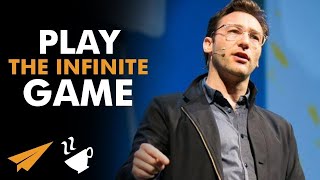
Simon Sinek argues business is an infinite game with no winner, unlike the finite mindset that drives companies to obsess over beating competitors. Microsoft focused on defeating Apple while Apple focused on its mission to help teachers. Start by learning from predecessors, then shift toward innovation and long-term fulfillment.
Chapters
The game of business has existed longer than every single company on the planet today, and it will outlast every single company on the planet.
If you are just getting started in industry, I think you can actually make faster progress if you start by playing the finite game instead of the infinite game.
Do something you're very passionate about and don't try to chase what is kind of the hot passion of the day.
Rise and shine, it's entspresso time! What's up, Believe Nation? It's Evan. My one word is believe, and I believe in you. I believe you have an amazing gift inside you that I want to see explode out onto the world. So let's start your day off right together. Grab your cup of coffee and sip on today's message: Play the Infinite Game. Over to you, Simon Sinek.
I wake up every morning Espresso, keep me going.
Awake, good very morning.
The game of business is an infinite game, right? It obeys all the rules. There are known and unknown players. You don't know all the competitors necessarily in one industry to another. The rules are changeable. We haven't all agreed what the rules are. And there is no winning the game of business. right? The game just perpetuates. In fact, the game of business has existed longer than every single company on the planet today, and it will outlast every single company on the planet today. If you look at the Dow Index, of 30-something-odd companies that make up the Dow Index, something like 70 or 80% of those companies are 35 years or younger, right? So, it gets me thinking, if you listen to the language that companies use, they don't know what game they're in. They talk about being number one, talk about beating their competition based on what agreed-upon criteria, based on what agreed-upon timeframe. Is it market share? Is it profits? Is it revenues? Square footage? Number of employees? Over what, 1 month, 5 months, 6 months, a year, 5 years, 10 years, the life of the company? I haven't agreed to those rules. And so companies can arbitrarily declare themselves number one in anything they want if they set the standards and the time frames. And the only reason we do these things on annualized basis, we tend to compare ourselves to other organizations annually, is only because we pay taxes annually. If we pay taxes every 18 months, that would be sort of the standard. But again, we still haven't agreed what the metrics are to be number one. That means The companies that are playing the infinite game are playing against most of the others who are playing the finite game, means those finite companies find themselves in quagmire. Almost every single bankruptcy— not almost every— every single bankruptcy is a company that's run out of the will or the resources to play. They drop out of the game. The game will persist. Another company will fill their space. It's not like the business stops or the industry ends. The companies that are playing the infinite game will frustrate those finite players, which I absolutely adore. So I spoke at an education summit for Microsoft. I also spoke at an education summit for Apple. Now, I would say about 70 to 80% of the executives at Microsoft spent about 70 to 80% of their PowerPoints talking about how to beat Apple. At the Apple summit, 100% of the executives spent 100% of their presentations talking about how to help teachers teach and how to help students learn. One was obsessed with their journey, with their vision, with their cause. The other one was obsessed with their competition. Guess who's stuck in quagmire? Guess who's frustrated by their competition?
So I agree that playing the infinite game is ultimately where you want to be as an entrepreneur. If you want to be a game-changing entrepreneur, you have to change the rules. You have to set new standards. Standards. What I would say though, that if you are just getting started in the industry, I think you can actually make faster progress if you start by playing the finite game instead of the infinite game. Let me explain. I think when you're first getting started, you can learn so much from the people who are already ahead of you. You can learn about how they made their success, how they got to where they were, what specific strategies, what motivated them. You can learn a ton that that can really shortcut your path. But if all you do is copy the people who've come before you, then the best you're gonna be is a junior version of them. You're just gonna be mini-me of whoever that person is that you're looking up to. And hey, for you that may be enough. But if you are a game-changing entrepreneur, your ultimate success will be by you being that best version of yourself. But I just think that if you're at the very beginning of your business or of your path, it's actually faster to play the finite game and learn from the people who've come before for you. This is what almost sunk my first business. I was in biotech, I had a software company, I'm 19 years old, turned down high-paying jobs to be an entrepreneur and live the dream, and I thought I had to come up with every genius idea myself. And I, I almost lost the business. I told my business partner that I quit. Now I was at the end of my rope. I felt worthless, valueless. I felt like I wasn't making a contribution, wasn't making a difference. It wasn't until I asked myself Who has done this before? Like, I can't be the first person to try to figure this out. Somebody has done this before, and if I can model their success, then I can have some similar success to what they did, or at least be further ahead than I am right now. And that's when I learned about Bill Gates, and I learned about other software entrepreneurs, and I copied them, I modeled them, I brought their strategies to my business, and that's when my company started to take off. Now again, if all I did was copy Bill Gates, then I'd be a junior version of Bill Gates. So eventually I had to come up with my own plan, my own strategies, my own nuances, things that are different, how I was going to operate. But man, did he save my company. Man, did that ever help me get my launching pad up to the point where my company was actually getting some traction. The same thing happens with YouTube. What you guys may know me for right now with my YouTube channel, when I first started, I always asked myself, who has done this before? Who can I learn from? Who is the expert? Expert. And so when I started with YouTube, I subscribed to Derral Eves and I subscribed to Tim Schmoyer and I digested all of their content and I learned all of it and I applied all of it and my business started to grow. My YouTube channel started getting more subscribers. Things started to take off and I was having success. And as my channel started growing and as my channel passed their channels, I had to start thinking about new ideas, new techniques, new, new strategies, things that I can apply to my channel that maybe other people aren't doing. And now I'm pioneering and testing a whole bunch of different things on my channel that nobody else is doing. I haven't seen any other YouTube do it. And so that's, that's the point now where I'm playing the infinite game on YouTube, but I was playing the finite game at the start, and it massively shortcutted my success. And so yes, ultimately I believe that you need to play the infinite game, you need to be an innovator, you need to be on the cutting edge, you need to find your voice, your path, You can't do it exactly like anybody else did it. But, huge caveat, if you are just at the beginning, I firmly believe that by starting and modeling success and studying the people who've come before you and learning from them, you could rapidly shortcut your path to becoming close to their level, and then you need to go and innovate, and then you need to inject your own personality, your own points of differentiation, once you understand how the model works. Now I've got a really special bonus clip for you but before that, commitment of the day: you watch this video, what did you take from this that you are going to immediately apply somehow to your life or to your business? Leave it down in the comments below. Make it real by writing it down. You're much more likely to follow through. I want to see it. Thank you guys so much for watching. I believe in you. I hope you continue to believe in yourself and whatever your one word is. Much love. I'll see you again tomorrow morning for another shot of inspresso, and enjoy the bonus clip. Clip.
Do something you're very passionate about and don't try to chase what is kind of the hot passion of the day. I think we actually saw this, I think you see it all over the place in many different contexts, but I think we saw it in the internet world quite a bit where, you know, at sort of peak of the sort of internet, you know, mania in say 1999, you found people who were, you know, very passionate, so they kind of left that job and decided I'm gonna, you know, do something in the internet because it's, you know, it was almost like the, you know, the 1849 gold rush in a way. I mean, you find that people If you go back and study the history of the 1849 Gold Rush, you find that at that time, everybody who was within shouting distance of California was, they might have been a doctor, but they quit being a doctor and they started panning for gold. [LAUGHTER] And that almost never works. And even if it does work, according to some metric, financial success or whatever it might be, I suspect it leaves you ultimately unsatisfied. So you really need to be very clear with yourself. And I think one of the best ways to do that is this notion of projecting yourself forward to age 80, looking back on your life, and trying to make sure you've minimized the number of regrets you have. That works for career decisions. It works for family decisions. You know, do you want— I have a— I have a 14-month-old son, and it's very easy for me to— if I think about myself when I'm 80, I know I want to watch that little guy grow up. And so it's— I don't want to be 80 and think, "Shoot, you know, I missed that whole thing, and I don't have the kind of relationship with my son that I wished I had," and so on and so on. So if you think about that— so I guess another thing that I would recommend to people is that they always take a long-term point of view. And I think this is something about which there's a lot of controversy. You know, there's a lot of people, and I'm just not one of them, believe that you should live for the now. I think what you do is you think about the great expanse of time ahead of you and try to make sure that you're planning for that in a way that's gonna leave you ultimately satisfied. So this is just my, this is the way it works for me. And I mean, everybody needs to find that for themself. So I think there are a lot of paths to satisfaction, and you need to find one that works for you.
So let me give you the one word secret to happiness. One word.
This is all you need to be happy.
The most important word ever.
If you had to think of one word that's most important to you or that sums you up or that would be kind of like a little beacon, Hey, Believe Nation!
If you want to know what the most important one word is for Tony Robbins, Gary Vaynerchuk, Oprah Winfrey, will.i.am, and Howard Schultz, I have a very special secret video for you. Check the description for details.
More from Evan


How the Biggest Mistake in History Created A Trillion-Dollar Empire | Sergey Brin



9 Machiavelli Principles That Force People To Respect You | Machiavellian Philosophy



The First 10 Words That Instantly Ruin A Sales Conversation | Vanessa Van Edwards

The Top 1% Mindset Behind The First $5 Trillion Company | Jensen Huang (Nvidia)

