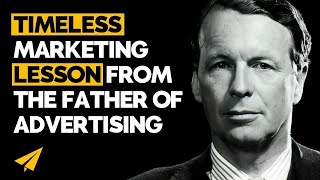
David Ogilvy started his ad agency at 38 with $6,000 and no copywriting experience, then sold it for $864 million. He built the business on three principles: deliver measurable results for clients, test everything obsessively, and hire great people and develop them. His ads used oversized logos, prominent faces, and editorial layouts because advertising must sell, not just be creative.
Chapters
Hi, I'm Evan Carmichael, and welcome to another edition of Modeling the Masters. I believe that the fastest and most effective way to grow your business is to model the strategies of people who've already done what you're trying to do. So today we're gonna look at the story of how a 38-year-old man who had never written an advertisement in his life started an ad agency with $6,000 to his name and went on to become one of the most sought-after marketers in the world. This is the story of advertising legend David Ogilvy and the top 3 lessons that you can learn from his success.
David Ogilvy was the founder of Ogilvy Mather and is known as the father of advertising. He took the long road to success working as a hotel chef, a British intelligence officer, and a traveling salesman selling kitchen stoves door-to-door. He had success in sales and thought he could help other companies improve their marketing efforts, so he started his own advertising agency in 1948. 1949. He was 38 years old, had never written an advertisement in his life, and only had $6,000 to his name. But he had a big dream and wanted to see it through. Attracting clients was a challenge in the beginning, but he focused on getting results for his clients, and he firmly believed that the best way to get new clients was to do outstanding work for his existing clients. The few clients he was able to get loved his approach. They rewarded him with larger budgets and referrals to other potential accounts. After building up his business in New York, he decided to merge with the London-based agency Mather and Crowther in 1965. It gave his firm an international reach, and the next year Ogilvy Mather was one of the first advertising agencies to go public. His company was acquired in 1989 for $864 million after Ogilvy built up a reputation for being the most sought-after wizard in the advertising industry, according to Time magazine. He was elected to the U.S. Advertising Hall of Fame in 1977 and was inducted into the Junior Achievement U.S. Business Hall of Fame. His legacy continues to leave a mark on everyone in the advertising world, and his story provides lessons in marketing that we can all learn from.
By focusing on his clients and by building his referrals, David Ogilvy was able to go from a startup with zero experience into the most recognized person in his industry. To help you boost your client referrals, here are 3 action items that you can learn from David Ogilvy.
Action item number 1: Get your clients results. Do you want more referrals for your business? Blow your current clients away with how great a job you do. Don't just exceed expectations, go way above and beyond. Your customers are busy people. If you want them to talk about you, then you need to give them a reason to. Referred clients spend more, buy more often, have a shorter sales cycle, and are way easier to work with. Referrals are the best way to attract more ideal clients, so start offering so much extra value into what you do that they can't help but talk to everyone they know about you. Ogilvy made getting results for his clients his firm's top priority. He realized that if he didn't deliver, they wouldn't get repeat business or client referrals. He didn't want ads that were too creative that people couldn't understand. He also didn't want well-written ads that were boring and weren't going to be read. He focused instead on creating ads that would bring in dollars for his clients, which is what he believed he was hired to do for his clients. When he believed too many awards were being handed out in his industry for creativity, he created his own David Ogilvy Award to recognize the campaign that did the most to improve a client's sales or reputation. The award let everybody at his company know that they should focus primarily on making the cash register ring and not being the most creative. According to Ogilvy, "In the modern world of business, it is useless to be a creative original thinker unless you can also sell what you create. We sell, or else. The recommendations we make should be the recommendations we would make if we owned their companies." without regard to our own short-term interests. This earns their respect, which is the greatest asset we can have. We exist to build the businesses of our clients. Action Item #2: Test, test, test. What you start off with is never what you end up with. Your products and services change, your marketing changes, and your business plan changes. The only way to figure out if something is going to work or not is to test. Don't wait until you have the perfect idea or perfect business plan because they don't exist. Start sooner, get feedback from potential customers, and make changes and continue to test, test, test until you start getting the results that you're looking for. Ogilvy liked to create campaigns that had a big idea attached to them. If you don't promote your business with a big idea, then people will largely ignore you. He realized that in order for your big idea to work, you have to test. Ogilvy believed in the importance of research so much that when he opened his company, his official title was Research Director. He tested everything about his campaigns until he honed in on the concepts that delivered the best results. According to Ogilvy, you aren't advertising to a standing army, you're advertising to a moving parade. The most important word in the vocabulary of advertising is test. Test your promise, test your media, Test your headlines and your illustrations. Test the size of your advertisements. Test your frequency. Test your level of expenditure. Test your commercials. Never stop testing, and your advertising will never stop improving. If you pretest your product with consumers and pretest your advertising, you will do well in the marketplace. Action Item #3: Hire great people. Read almost any famous entrepreneur profile, and you'll see that hiring great people was one of the strategies that help propel their success. You need to figure out what you're really good at and where you add the most value to your business, then hire amazing people to do everything else. Hire people who believe in what you're doing and who love doing the tasks you need them to do so you can focus on building your business. Ogilvy understood how important it is to have a great team of people working with you. He therefore spent a great deal of effort making sure that they were given challenging opportunities recognition for achievement, and as much responsibility as they could handle. He invested in the hiring, training, and gave them independence and flexibility. If an employee was battling a personal problem like illness or alcohol abuse, the company would make every effort to help them. In return, however, Ogilvy demanded the most from his people and had exceedingly high expectations of them. According to Ogilvy, "If we hire people who are smaller than we are, we become a company of dwarfs. If we hire people who are larger than we are, we become a company of giants. Some of our people spend their entire working lives in Ogilvy Mather. We try to make it a stimulating and happy experience. We put this first. We see no conflict between adherence to high professional standards in our work and human kindness in our dealings with each other. We treat our people as human beings. I believe in a Scottish proverb, "Hard work never killed a man. Men die of boredom, psychological conflict, and disease. They do not die of hard work." Set exorbitant standards and give your people hell when they don't live up to them. There is nothing so demoralizing as a boss who tolerates second-rate work.
So remember, get your clients results, test, test, test, and hire great people. To finish up this video, I wanted to share one of my favorite true stories about David Ogilvy and some of his best quotes.
In his ads, Ogilvy would often make the company logo twice the size, a good thing to do because most advertisements are deficient in brand identification. He would also show his clients' faces because the public is more interested in personalities than in corporations. Other Ogilvy techniques include studying and imitating graphics used by editors since it's been found that the less an advertisement looks like an advertisement and the more it looks like an editorial, the more readers stop, look, and read. He would place photographs at the top of his ads, given that people have a habit of scanning downwards, and also learned that there's very little value in saying something without illustrating it, because the viewer immediately forgets it.
Thank you for joining me for another edition of Mylinda Masters. If you like the video and want to see more, please give it a thumbs up below. I'd also love to hear feedback if you want to leave a comment under the video. And stay tuned for the next episode.