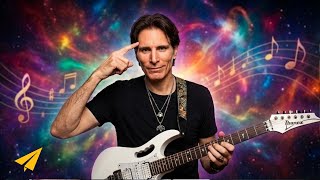
Steve Vai, who sold over 15 million albums and won three Grammys, shares ten mindset rules that shaped his career. He started as Frank Zappa's transcriptionist and built his success on following excitement, deep focus, and treating practice as play rather than work.
Chapters
He's an American guitarist, singer, songwriter, and producer who sold over 15 million albums worldwide. He started his career as a music transcriptionist for Frank Zappa. He began a solo career in 1983, has released 8 solo albums, and won 3 Grammy Awards. He's Steve Vai, and here are his top 10 rules for success.
The thing that you're most comfortable with, that you do the best, because that's what you're going to do the best. You know, like me, I've got strengths and I've got weaknesses. I don't work on my weaknesses. I ignore them and I cultivate my strengths. The level of achievement that we have at anything is a reflection of how well we were able to focus on it. Because the only thing that's holding you back is the way you're thinking.
If you're gonna take any advice from me, I would tell you to find the thing that excites you the most and go after that. Whether it's just playing, you know, a Led Zeppelin song and not practicing scales. You don't have to know music. You know, you tell Jeff Beck to play an F# on the G string, he might not know what it is. Well, maybe he would know that. But, you know, great musicians don't necessarily have to know about music. The important thing is, is to find what it is that excites you and disregard what anybody else is doing or saying and just go after that. That's what you're gonna be the most successful at also.
It's good to have a goal, and wherever you set your goal, you have to have the patience, the discipline, and the faith to break it down and take it step by step. Even if your goal is to be able to play a Beatles song on the beach That's a particular goal, and you need to break it down and build and have faith and have the— visualize yourself doing it, you know. And if you visualize yourself doing it and you stick to your guns, there's nothing in the world that can stop you.
I recommend that you pick a time that's yours, a time where you shut off the cell phone, shut off the telephone, turn off the internet, and sit and focus on your goal.
And then I would learn— I wanted to understand music. I always loved the idea of knowing the language of music. To me, music on paper was like art. It looked beautiful. I could never really— poetry was just words to me at the time. Art was just paint mixed together. If I ever tried to draw something, it's like stick figures. You know, I got no talent whatsoever, but music was just beautiful, you know, and it looked like art, and I wanted to know what it meant, and I wanted to be able to control it, and I wanted to be able to master it. And so I studied music, not just the guitar, and I was composing before I was even playing the guitar.
And whenever you go to do something creatively, you're always— well, at least me, you know, there's these little voices of insecurity or whatever, you know, that stop us from doing certain things. You know, "Well, it's not good enough," or "You can't do this," or "Nobody's gonna like it, you're gonna be made fun of," you know, "This isn't what everybody else is doing." But when you get a good idea, or when you get a compelling idea, it's almost like a fever. It transcends all of the insecurities, and you get this profound desire to make it real.
It's no work.
There's no work involved because it's all a joy because you know you're reaching your goal. You know what I'm saying? I never worked a day in my life in this business. I mean, with the guitar.
I never struggled. Honestly.
I've had a lot of challenges. I've had to, you know, I've been through a lot, but when it came to my feelings about what I do and my success, so to speak, never struggled a day in my life because for me, playing the guitar was my juice.
And whatever you really, really, really want, you get. And whatever you really, really, really don't want, you get. Because whatever your mind is focusing on, you pull these things into your life. So your perspective is so important. And for me, it was a slow, slow, slow, slow build, but it got me out of that depression and really lifted me up. And I mean, and every— and I don't lose, you know, and sometimes you go like this, you know, it's not just a straight, you know. And but, but I've, I've always kept that desire, you know what I mean? And it's a sincere desire. And when you ask for something like that, you start seeing things about yourself, because really the way the world is relative, it's the way you see yourself that shapes the world, you know? It doesn't shape the world, it shapes your perspective on the world. So, if you want to continually change, you have to have that desire. You know, so, you know, I can pinpoint certain things in my— certain points in my life where, you know, you have these moments of clarity. You know, like I was talking about the academic portion, the clarity of the guitar. But there's really these— we all have these very subtle, intuitive moments of clarity. But you have to want them. If you're stuck in a particular way of thinking for your whole life, you're not going to get them.
You have to see them.
You have to want to be— you want to— you have to want to improve yourself as a person.
You could sit in your room all day and practice for years, but when you get on a stage and the lights are on, everything changes.
OK?
Nothing feels the same as the garage. Your foot pedals, your sound, everything is different. Even if you've done a sound check.
Because people come in the room and it makes everything sound different. And it's easy to be like a deer in the headlights, you know?
"Oh my God, what am I going to play? Okay." You lose your note when that happens.
What I've learned to do most of the time is just make believe everything sounds great.
Just, everything's good, you know? I like to do that. Relax.
And breathe.
And that helps so much, really, because the thing that's making, you know, you freak out is just not feeling comfortable because maybe there's people watching or the lights. Lights change everything.
You can't—
I can't hardly see you guys. I can't really see my pedals very well, and that can freak you out if you're not used to it, you know. So you kind of learn to go into almost autopilot, and you zone out and zone in, and And the best way to get there is relaxing. And when I say relax, you think about it, you bring your attention into relaxing and breathing. And then you go about what you need to do. It brings you— it grounds you, brings you back.
Whenever you get discouraged, go to the big picture.
Go back to that place of excitement. That's how you get through it.
You go to the big picture.
Go to the Chi fame because it's so crystallized in your head that when you know, when you feel like, I, I can't do this, you know, you go back to that picture and you can see yourself doing it.
Thank you so much for watching. I made this video because Aaron Gonzalez asked me to. So if there's a famous entrepreneur that you want me to profile next, leave it in the comments below and I'll see what I can do. I'd also love to know which of the top 10 rules meant the most to you? Leave it in the comments. I'll join in the discussion. Thank you so much for watching. Continue to believe, and I'll see you soon.