This Is What ALWAYS Happens Before You Catch Your "Big Break" | Zig Ziglar & Muhammad Ali
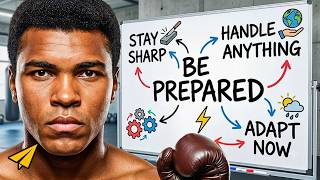
Zig Ziglar, Muhammad Ali, Tiger Woods, and others explain why preparation always precedes breakthrough moments. Ali kept his tools ready, Streep rehearsed obsessively, Quincy Jones studied music theory constantly. Success isn't luck; it's being ready when opportunity arrives.
Chapters
You gotta prepare.
Become prepared.
The preparation is key.
Get prepared.
You have to be prepared.
You got to be prepared.
Prepare yourself.
Be prepared.
Hello, Believe Nation! Today we're gonna talk about how you can always be prepared to handle anything. As you guys watch this video, if there's a sentence that really resonates with you, link it up in the comments with quotes so other people can share and enjoy as well.
I'm sure Henry will tell you, any fighter that knows what's happening, you really can't plan a fight when you're meeting the man you never met before, right? You just have to get your tools ready. Here's a car stops on the highway. They call the AAA or whatever and say, "My car's broke down. What is it?" The lady, she don't know what's wrong. Well, the man comes with all the tools and he come equipped to handle whatever the problem is. Astronaut goes into space and he pretends that something happens to the ship before he take off. He gets out and he works on it. He's not looking for something to happen, but it might happen. So I didn't know. I just had everything ready. Now, After the first round, being here with a top professional, a man so great, had so many knockouts, never been defeated, never been even scratched, I didn't know really how good he was. So I had to come in actually a little nervous and with everything ready. After one round of dancing, I found out that this would tire me out, so I would have to resort to ropes. I figured that out after the first round. So I said, I'm gonna go to these ropes and I'm gonna let this man throw everything he can, let him tire himself out. He might look like he's winning, and if he don't hurt me, I'm gonna stay here. But if he should be as great as they say he is, he is, if he hits as hard as they say he hit, when he hits you and breaks your arm, he knocked out Joe Frazier, I couldn't do it, knocked out Ken Norton, he was a big bad giant before the fight, you remember. Now you remember that, don't you? How bad he was? They don't say that now, but you remember he was a real bad cat the other day, right? Don't forget that. Now, after I found out he didn't have it, I stayed there. But if he had had what I thought he had had or what they said he had, I'd have kept running, hoping I wouldn't get tired.
You do very strong characters in pretty much everything. You have very strong decisions.
Do you make those decisions before you start and then kind of come to the set with what you're going to do and then adjust in small ways, or are you—
Well, the, the way I always approach it is this, that, um, uh, I, I like to have my own ideas completely worked out so that if a director, I come to find his working method is that he doesn't want to talk to me, that I'm not at a loss. There's nothing worse. I've seen other actors who stand and somebody shouts action and they just go, I don't know what to do. I need— they need somebody to come and tell them what to do. I never look at a director as somebody who tells me what to do. I look at it as someone who we work together in something, and therefore I need to be responsible too. So I have to bring something to the table and say, I will do it this way. If you never say anything, if you keep silent, this is how I'll do it. And I'll give a few different versions, but it would be, it wouldn't matter if they said nothing.
How many of you feel like I've made this talk before? Can I see your hand, please? Several hundred times. I made it yesterday. You know what I did between yesterday and today? I spent over 6 hours getting ready for today. You see, I think it would be arrogant if I thought I could stand up and spit it out just because I did it yesterday or hundreds of times. That's arrogance. That's when Buster Douglas knocks out Mike Tyson. That's when an expansion team in Houston beats an established NFL team in Dallas. I dare not. Look at the people here, several thousand. I'm taking over an hour. That's several thousand hours of time. Where would my integrity be if I came here unprepared to make something, a presentation that could make a difference in your life? Life. There is no way. You gotta prepare for it, ladies and gentlemen.
Something that I have always treated golf as— I've treated golf as a sport. And because I've played other sports growing up as a kid and competing against people who did train in that sport, we all trained physically to become better able to compete. You know, it would be asinine for someone to go ahead and not train to play American football. Or for someone not to train to play basketball. So that's why I do all the lifting, that's why I do all the running, I do all the training that it takes to become physically prepared to play.
To me, it's become much more about craft. And I think actually on a smaller scale, though I think it's possible to do it on a really big scale, but I think that on a smaller scale, I think preparation is key. That I kind of went back to deciding choosing preparation over everything and the amount of time it takes when you have a lot less money to use, you know, and you have to make choices very specifically and they have to be kind of prepared much earlier on so that you're free in, you know, a very small period of space. You have a lot more freedom because of all the preparation that you've done. That was a— that, I mean, just in terms of the, the process of acting, that's what I I started to learn when I did End of Watch, this movie with David Ayer. You know, I spent 5 months with police officers, and that was sort of the beginning of realizing how much I loved preparation and how much I loved the process before the performance. And I had always loved that when I was on stage because there's always that very formal rehearsal process that allows you to explore and use your mind and go to places places that are wrong as well as places that are right. And I love being wrong and right, you know? And I love people saying, "Mm, that idea doesn't really work for this," you know, when I'm having an exchange with the director. I love that. I love the— I love that kind of I'm bringing an idea and it gets vetoed or it gets accepted. Whatever it is, it's just the ability to bring ideas. And I see that it's much more possible to do that within the prep time than it is in the moment of shooting.
Well, you know, management is, I think, is kind of a relentless process. So I guess first, like someone said to me, what changed in the crisis versus before? Nothing. It's like, if you're not prepared for tough times, you're not gonna be, you can't like get prepared when times get tough. Like you need the army before the war starts. And so that means a disciplined group, they know what they're doing. The only real difference is that our risk committee used to meet once a week for a couple hours, and in the crisis it met at 7 AM, 12, you know, lunchtime, 5 o'clock, 10 o'clock, 5 AM if it had to, 24/7 for 6 straight months. And we didn't say— it wasn't very formal. We said, hey, if you got a problem, go to the meeting and bring the people you gotta have. And everyone shares the reports and shares the information, tries to react very quickly.
You need luck because I have seen lots of smart people, lots of people who have worked hard, they haven't been blessed. And you need luck. But at the same time, let's remember Louis Pasteur's words that God favors the prepared mind. So you have to be prepared to take advantage of that luck. Luck you need, but be prepared to seize that luck.
If you're going to get into something, you got to be prepared. You got to do something big, you know, and you got to, you got to You know, I feel like this Power record with me and Lil Wayne is definitely a statement record, but it's just real. It's timing. You know, I mean, I tell you all the time, I ain't on my time. We on God's time.
Absolutely.
So how LeBron James or one of them feel when they in the gym, you gotta go practice, work on your jump shot, you know, work on your game. I feel like artists now need to spend that time in the studio than just partying all day.
What advice do you have for the future of making great records?
Know what you're doing. Study everything. You know, study music. You know, because I'm hearing some funny stuff now that drives me crazy. I talked to some of the producers today. We were doing an amazing project in Rabat, Morocco last year. We had all of the number one singers in the Arab Spring. Libya, Egypt, Jordan, Aleppo, Damascus, everywhere. And we're recording over there, and I'm calling no names over there. And I said, do you read music? He said, yeah, I used to, but I forgot. Give me a break, man. You don't forget how to read music. But man, you have to understand and put the work in to learn the science, man. You do. You can't play a trumpet if you don't know how to— you know, you have to— it's a science. The armatures, diaphragmatic breathing, there's a lot of secrets with everything you attempt to do, you know, retrograde inversion and counterpoint. It's been— as I say, there's only 12 notes, man, so you can figure out what you have to do to get your own sound. You have to do that through rhythm, melody, and harmony. And you have to do a lot of research to figure that out. You know, you have to know what's going on. You have to understand, I don't know, Ravel and Alpenberg and Basie and Duke and Bo Diddley and Melly Mel and Ludacris and Drake and all of them. Come on, man. You know, it's doing your homework, man. That's all I can say. Prepare yourself, because my thing was, I was all, my biggest fear, and I don't play with that word at all, was to get a great opportunity that I'm not prepared for. So when Frank Sinatra called me, man, I was ready for him. I'm telling you. And he'd test me. He really— Ray Charles too, because those guys are rough, man. Billy Eckstine, Ray Charles, Frank Sinatra, they will kick your booty, you know. And he'd say to me in the first— we'd do an arrangement at Capitol Studios. He'd say, Q, that first 8 was a little dense. I said, no problem, man. And I put all the horn— the trumpets and harmonious fools stems out, transfer the saxophones to alto flutes and stuff like— let's go. He was testing me. He only did it 3 times, and after that he said he knows what he's doing.
And I—
because I was ready for it. And that's the biggest compliment, man, and accomplishment you can have in your life, is to say, I got my stuff together. I got my shit together. You have to have it together, man.
You do.
And this goes back to my from Boy Scout days is be prepared. I know what you're thinking, you're already prepared, you've mapped out the rest of your life, the rest of your education, postgraduate work, residencies, fellowships, clerkships, and you're gonna have a long meaningful career. You have all of your plans already laid down. That's not the preparation I am talking about because let me tell you, The likelihood of you winding up 10 years from now doing what you think you're gonna be doing 10 years from now is probably less than 1 in 10. The truth of the matter is you don't know what opportunities are going to be presented to you. You don't know where you're gonna succeed and where you're gonna fail. The careers that you wind up in are invariably going to be very different. So what I would do is I would focus on how I interact with people. How I approach problems. I would get involved in government. If you want to go into public service, I would recommend you first become a billionaire, but that's another issue. You're going to spend your entire life doing something different than what you think, and the good news is that Dartmouth is preparing you for that, because while you think they're individual subjects, what they're really teaching you to do is to think and to reason and to build relationships, and that's what's going to carry you Thank you guys so much for watching.
I'd love to know what you thought of the video. Which of the clips had the biggest impact on you and why? What are you gonna change now in your business as a result of watching this video? Leave it in the comments below and I will join in the discussion. Also wanted to give a big shout out to Steven Moten, or Moten, I hope I pronounced that okay. Steven bought 5 copies of my book. Thank you so much, Steven. He bought 1 for himself and 4 for family members. So I really appreciate that, Steven. Big, big ups, big thumbs up to you, man. And for those of you watching, if you guys want your chance at a shout out in a future video, make sure to pick up a copy of the book and email in your receipt. Super important so we can keep track. Thank you guys so much for watching. Continue to believe, or whatever your one word is, and I'll see you soon.
More from Evan


How the Biggest Mistake in History Created A Trillion-Dollar Empire | Sergey Brin



9 Machiavelli Principles That Force People To Respect You | Machiavellian Philosophy



The First 10 Words That Instantly Ruin A Sales Conversation | Vanessa Van Edwards

The Top 1% Mindset Behind The First $5 Trillion Company | Jensen Huang (Nvidia)

