This Simple Learning Habit Made Me The CEO of Microsoft | Satya Nadella
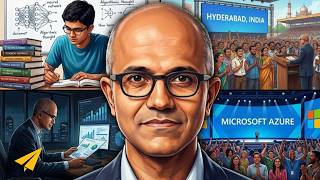
Satya Nadella, CEO of Microsoft, credits his rise to a learning mindset and finding meaning in work. He built Microsoft's culture around empowerment and growth, emphasizing that confidence without arrogance matters more than being everywhere at once.
Chapters
I get energized when I see people achieve high standards in anything. We all spend far too much time at work for it not to have a deeper meaning. All great achievement is in— happens only when you have self-belief and you have confidence in yourself. Is you have to fall in love with what you do. When it comes to culture, what I aspire for us as a company is a learning, living culture. You really have to be slightly delusional Ah, to be an entrepreneur. How do I integrate my life and my work? Because to think of these things as separate is not possible.
We have a very clear vision of what it is that we are trying to get done.
Our customers are going to make choices that make the most sense for them, and they're not going to be homogenous choices. In order to truly go after the concept, you need capability.
He's an Indian-born American business executive. He is currently the CEO of Microsoft. Before becoming CEO of Microsoft, he was the Executive Vice President of Microsoft's Cloud and Enterprise Group. He's Satya Nadella, and here are his top 10 rules for success.
I think more than anything else, perhaps what defines me is, and this I've also understood ex post, is I'm a lifelong learner. I get energized when I see people achieve high standards in anything. At work, when somebody comes to me with an idea that they've implemented and it's something that I've not seen before, that's the thing that gets me going. I, you know, as I say, I buy more books than I can finish. I sort of sign up for online courses more so than I can actually finish them, but I love it. And thank God for these new online courses where they even have 10-minute segments, so at least a sense of accomplishment is much easier. It's like the new Cliff Notes. Yeah, I wish I had it when I was growing up. But I think that that is perhaps more than anything else that gives me the energy. And it's not just the learning for learning's sake. What I think we all in business in particular thrive in is applied learning. To be able to take that, create products, create programs, approaches to how we work with customers and partners, and excelling in them. And being able to sort of both do that and more importantly learn from others who are doing it is what I would say defines me the most. That notion of finding the soul of a company is something that I constantly think about. In fact, probably in my early 30s, I was doing very well at Microsoft and I had this guy whom I worked for, his name was Doug Burgum. And in fact, he was the founder of Great Plains, which became our business applications business in Dynamics. But the fascinating thing was I was working for him and one day he sort of looks at me and he's, you know, and he says, "Hey, are you excited about work?" And he said something that stuck with me, which is, "We all spend far too much time at work for it not to have a deeper meaning." And in some sense, he was sort of invoking that notion of finding in work your own purpose and your own soul. And of course, individually it matters, and I've always thought that collectively the company has a soul because it's made of people. And I asked that question, what does Microsoft exist? What is that sensibility that we have? And that's what led me to rediscover in our 40 years there's been this one constant thread of empowerment. And that's why when I talk about our mission, that is our soul. It is empowering every person and organization on the planet to achieve more. I've always felt that I'm not— I have confidence. I mean, this is one of those fascinating things, right, I've learned, which is all great achievement happens only when you have self-belief and you have confidence in yourself. But there is this fine line between confidence and hubris that I've always felt that I want to be on the side of confidence, not hubris, and to assume destinations in my mind is more hubris than confidence. And lastly, perhaps most important of all, is you have to fall in love with what you do. Because everything else then simply becomes easy. If you just are so passionate about what you do, one, it doesn't feel like work for sure. And more importantly, It is perhaps the best way to find meaning in what you do. And I was just thinking about sort of what's the best way to capture it, and I remember reading this Gandhi quote, which I think is the most appropriate way to capture it. He said something along the lines of saying that, "Live every day as if it's your last day." but learn as if you're going to live forever. The culture of a place is what I think defines the pursuit of excellence. In other words, you can sort of look at a company and say, wow, they're doing great things, but you've got to really look underneath that and understand the culture because that's what produces whatever it is that you achieve in terms of greatness. And to me, the concept that there is one culture and you want to change it by unfreezing it and freezing it back again, as a model itself, I don't think works. There have got to be enduring values, but when it comes to culture, what I aspire for us as a company is a learning, living culture. The thing that we have anchored on is this notion of growth mindset. It comes from psychology. Enough theory there. If you take that posture that every day I'm going to be better than the previous day as individuals and as a company, that's the culture I want at Microsoft and that'll serve us. In fact, that's what's going to make us great listeners, learners, and doers. One of the things that people talk a lot about is what gets someone to become an entrepreneur? I mean, it's just a fascinating mindset, right? You really have to be slightly delusional to be an entrepreneur because you have to suspend disbelief. Or you have to believe about your own idea and have deep passion to go pursue it. So, in some sense, quite honestly, before I give advice, I take a lot of inspiration inspiration from what you're doing. It takes a lot of guts. It takes a lot of energy to be an entrepreneur. And I think that in there lies, I think, your secret to success, which is your ability to overcome every constraint and every obstacle and do it with the boldness and the risk-on nature of it. I think it's fantastic. If anything, I would say, especially for entrepreneurs, is you gotta keep sustaining that sense of energy over a long period of time. Because we all know, and you are grounded in it, the mortality rate is super high. And that means you will be thrown curveballs day in and day out, and you have to be able to to overcome that. And so being a source of energy in your small team, especially if you're a CEO of a startup, I like to sort of observe them a lot because you can't have a bad day. You're all the time, you know, you get up in the morning, you're coding, in the afternoon you're talking to your investors, in the evening you're hiring, and that constant sense of energy and passion for what you're doing is what I think it takes, and to never give up, which is what makes you who you are in terms of the core makeup. And I think that for me, I am personally inspired by that, and I think that even from a Microsoft culture, that's what really my dream is. My dream is not that, okay, we have a large organization. My hope is that every team inside of Microsoft feels both that sense of energy and empowerment and goes about it.
Who are your heroes or heroines? Who do you look up to either now or in the past?
Many, many different, but there's this one gentleman I worked for. His name was Doug Burgum. He was actually the founder of a company called Great Plains that we acquired, and it is sort of— at one moment he told me this, which is, look, we spend I spend far too much time at work. I mean, when I think back at it, I mean, I've spent 24 years already at Microsoft, and for it to be just work, it not to have deep meaning, would be a real waste individually. And so he sort of really got me onto this path of trying to seek in everything I do that what is the sense of purpose, and that I think as what is inspiring, you know, because we have this— how do I integrate my life and my work? Because to think of these things as separate is not possible. The modern life doesn't allow us to do that. So therefore, you got to harmonize the two, and that's something that I've learned over the years.
To me, we have a very clear vision of what it is that we are trying to get done, and I want to stay true to that. We absolutely— the biggest bet we have is our organic bet, always. And it's true even for Michael. And then on top of that, we will look at any opportunity that fits with where we want to get to. What is it that we can uniquely do? If anything that I ask myself each day is I don't want to be in every part of the tech industry. I want to be in things that are big addressable markets where Microsoft has a unique contribution to make. Because I think that sense of purpose and identity is what makes companies successful, not just doing everything. And so to me, that's what will drive whatever we do organically and whatever we do inorganically.
If you look at our industry, how is our industry going to succeed? Succeed. It's only going to succeed if we can add value to our customers. Our customers are going to make choices that make the most sense for them, and they're not going to be homogeneous choices. They're going to use all of our different applications. They're going to use multiple platforms, and it's incumbent on us, especially for those of us who are platform vendors, to partner broadly to solve real pain points our customers have. That's really how I've approached it. I don't think of it as a zero-sum with any one competitor. We're going to compete vigorously in certain domains, but the total opportunity for us to take the power of digital technology and empower every person and every organization is so huge that these partnerships, I think, really only help amplify that, and that's why we are here. We were at the Apple event, I guess, last week, and they're all testament to sort of both what is it that is our computing vision and also the realities of our customers. Clearly, there was a concept that you fell in love with that got you to create this startup. Now, the reality is that concept itself will morph as you learn more about your customers, as you learn more about your competition. As you learn more about your environment, that concept itself will evolve. But the thing that from day one that you will have to keep in mind is the capability that you need to build to chase after that concept, have that persistence. And that capability building is perhaps even for a CEO of a 100,000-person company is as important as the concept itself. Because sometimes I think for a large company like us or for a startup, we fall overly in love with just the concept, but in order to truly go after the concept, you need capability and you have to sort of think about the bandwidth that you apply every day to building that capability. That means human capital in our case. I mean, your recruitment, the amount of time you spend recruiting your co-founder to the other employees is perhaps the most important capability in initial days, but it goes a lot beyond that.
Thank you so much for watching. I made this video because Purav Soni asked me to. So if there's a famous entrepreneur that you want me to profile next, leave it in the comments below and I'll see what I can do. I'd also love to know which of Satya's top 10 rules had the biggest impact on you. Leave it in the comments and I will for joining the discussion. Thank you so much for watching. Continue to believe, and I'll see you soon.
More from Evan


How the Biggest Mistake in History Created A Trillion-Dollar Empire | Sergey Brin



9 Machiavelli Principles That Force People To Respect You | Machiavellian Philosophy



The First 10 Words That Instantly Ruin A Sales Conversation | Vanessa Van Edwards

The Top 1% Mindset Behind The First $5 Trillion Company | Jensen Huang (Nvidia)

