Top 10 Rules for Success From World's Richest People
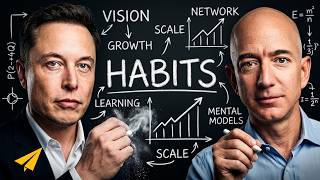
Evan Carmichael breaks down ten success principles from billionaires like Elon Musk, Jeff Bezos, and Warren Buffett. The rules include investing in ideas you believe in, dreaming big, embracing failure, staying curious, and focusing on the long term. Bezos cleaned a McDonald's bathroom; Buffett got rejected from Harvard.
Chapters
Some of the richest people in the world don't think the way you think. They trust ideas most people are too scared to believe in.
Do you like the product roadmap? Do you like— it seems like they, they make great products and they're likely to make great products in the future. If that's the case, then I would say that's probably a good company to invest in.
They chase goals so big they sound unrealistic.
This little kid who went, you know, here in high school 40+ years ago, I was dreaming at that time of building a space company.
They fail more than most people even try.
You're going to fail at some things.
They set goals that force them to grow.
I want to be able to build what I think are sort of the ideal experiences.
They question themselves when things get easy.
I gut-check against my core beliefs every day.
They spot opportunities others ignore.
If you put me in the witness protection program, and nobody knew who I was and I had to just start purely from scratch, but I still knew what I know now, I could do well, but I would have to search out some unique opportunity.
They think long after everyone else quits.
We always try to concentrate on the long term.
They test, experiment, and figure it out as they go.
We spent a while just experimenting with it at Stanford.
And they build their life around a mission that actually matters.
And this has given Oracle a mission and given me and others, others at Oracle, a purpose. And I think that's— I think there is nothing more important than that.
Today you're about to learn the top 10 rules for success from the world's richest people. If you want to think bigger, move faster, and build real wealth, this video is for you. Need motivation?
Watch our top 10 with Believe Nation.
If you've been here before, drop a hashtag #believe in the comments below so I can feature you here in a future video. And if you're new, welcome to Believe Nation, the only channel that helps you believe in yourself daily, one video at a time. Okay, let's kick it off with number 1, invest in what you believe with Elon Musk.
If it's long-term for a company, then you can say like, well, does that— is that— do you like the products or services of that company? And is it likely to— do you like the product roadmap? Do you like— it seems like they, they make great products and they're likely to make great products in the future. If that's the case, then I would say that's probably a good company to invest in. And I think you also want to believe in the team. So if they're, well, that's a talented and hardworking team, they make good products today, they seem to be still motivated to make things in the future, then I'd say that's a good company to invest in.
Fair point.
Yeah. And now, that won't solve for the daily fluctuations which happen and sometimes are pretty extreme, but over time, that is the right way to invest in stocks because a company is just a group of people assembled to create products and services. So you have to say, well, what are the, how good are those products and services? Are they likely to continue to improve in the future? If so, then you should buy the stock of that company and then don't worry too much about the daily fluctuations.
Rule number 2, have a big dream with Jeff Bezos.
You built two of the most successful companies shaping the world today. Did you ever think you were going to come back to Miami?
Well, this little kid who went, you know, here in high school 40+ years ago was dreaming at that time of building a space company that would one day take heavy polluting industry off Earth. And this guy sitting here on stage with you is still dreaming the same dream 40 years later. That kid was also working at the McDonald's on Dixie and 130-something Street. I recently took Lauren there. We drove through the drive-through, got Big Macs and chicken nuggets. It looks exactly the same as it did 40 years ago. That was a great job, by the way. I learned a lot. Be on time. You have to start at the bottom. I cleaned the bathrooms. It was, you learn a lot. The ketchup dispenser got stuck open one day, 5 gallons of ketchup all over the floor. Then who do you think they asked to clean it up? This guy.
Rule number 3, embrace failure with Warren Buffett.
How do you deal with failure and what's your advice to young entrepreneurs, like me in this case, especially with regards to failure and how to approach it?
Yeah, well, if you fail, you really do dust yourself off and get right back in. I mean, you're going to fail at some things. You're going to have some human relationships that don't work out, you know, fairly significant number of people get divorced. I mean, you know, that's a very big decision to have turn out badly. But I think if you study almost everybody and read Kay's book, you know, personal history, and you'll— everybody fails at some things. I mean, you know, particularly when you're younger. I mean, you know, you do have less experience in evaluating humans and, you know, and just knowing about whatever it may be, businesses. But it is not fatal. I mean, if you're healthy and you live in this, particularly living in this country, there's gonna be an opportunity that comes along. I got turned down for the Harvard Business School when I got out of the University of Nebraska. And I remember I went to Chicago to get interviewed. This is when you traveled on the train. And so I spent 10 hours going there and this fellow looked at me and About 10 minutes, he said, "You know, forget it, pal." Oh, wow. And now I gotta go back on the train 10 hours and think, "What am I gonna tell my dad?" Oh no, think about it. "What am I gonna tell my dad? I mean, my dad always told me I could do anything." Now I've just gotten turned down. But it turned out to be one of the best things that ever happened to me, 'cause then I went to Columbia where Ben Graham was. In fact, it probably even affected who I married because I took a 1-year course at Columbia instead of 2 years at Harvard, and she might have found some other guy during that time. Almost everything in my life that looked like a failure has either turned, usually that's turned into a success. The world isn't over. If you have bad luck in health, that's tough. I mean, there's just no getting away. I've been lucky on that. But the other kind of things, if you're healthy and you're bright and you've got decades ahead of you, something goes wrong, if you find yourself working for the wrong employer and they're, you know, they're doing things you don't approve of or they're not treating you fairly, you know, the world isn't over yet. You know, you just go out and find somebody else.
Number 4 is set big goals with Mark Zuckerberg.
One of the big themes, I think, for the next chapter of what we do is I want to be able to build what I think are sort of the ideal experiences, not just what you're allowed to build on some platform that someone else built. But like, what is actually, if you can think from first principles, what is the ideal social experience? So I, I think what you would like to have is not a phone that you look down at, um, that kind of takes your attention away from the things and the people around you, you know, not just a small screen. I think what you ideally have is glasses and Through the glasses, there's one part of it where the glasses, they can see what you see and they can hear what you hear. And in doing so, they can be kind of the perfect AI assistant for you because they have context on what you're doing. But then part of that is also that the glasses can project images, basically like holograms, out into the world. And that way, your social experiences with other people aren't constrained to these little interactions you can have on a phone screen. In the not so distant future, you can imagine— because you guys have demoed some of the stuff that we've done— a version of this where we're having a conversation like this, but maybe one of us isn't even here. They're just like a hologram, and we have glasses. And it really— there's the question of delivering a realistic sense of presence. There's something magical in the realm of building social experiences around the feeling of human presence. Being there with another person and this physical perception, right, where we're very physical beings, right? People like to intellectualize everything, but a lot of our experience is very physical. And this physical sense of presence that you are with another person doing things in the physical world is something that you're going to be able to do through holograms, through glasses, without being taken away from whatever else you're doing. Just kind of have that mixed in with the rest of the world. It's going to be, I think, the ultimate digital social experience. And I think it's also going to be the ultimate incarnation of AI because you're going to have conversations where it's like, all right, there's some people. It's like maybe like I'm physically here. There's like a person. You're like a hologram there. There's an AI that is kind of embodied as someone is there. And the glasses will enable this. So, okay, so how are we going after this, building this? This is like some, some huge project. We've been working on it for, for 10 years. And there are a lot of different challenges to solve to get there. There's like, you have to build a novel display stack, right? It's not— these aren't just screens like the kind that are in phones. There's this long lineage. They're connected to the screens that have been in TVs and monitors and things for a long time. There's been this massive optimization of the supply chain. There's like brand new display stack around holographic displays. That basically need to get created. And then they need to be put into glasses. They need to be miniaturized. And you also, in the glasses, need to fit chips, microphones, speakers, cameras, eye tracking to be able to understand what you're doing, batteries to make it last all day. Ah, great idea. New novel RF protocols. Yeah, it's like, OK, it's a pretty big challenge. So we're like, all right, let's go. Try to go for the big thing, right? And we, we've been working on that for a while and we're pretty close to being able to show off kind of the first prototype that we have of that. And I'm really excited about that.
Also, if you want to take real action after this video, I made a free worksheet just for you. It covers the top lessons from today, gives you space to write your biggest takeaways, and helps you build a simple action plan. It's 100% free. Just click the link in the description below to go grab it. I'll see you there. Rule number 5 is gut check yourself daily with Jensen Huang.
Everyone has some version of CUDA for a thing that they think really makes sense for the sector or makes sense for their technology or what have you, but where the market doesn't see it yet. Do you think it's possible to extract any kind of generalizable principles around when you should really doggedly trust that vision and when perhaps it's worth reconsidering in a fashion that, yeah, we could extrapolate from in the case of CUDA and other kudos that have existed over the course of NVIDIA's history?
Yeah, the question is determination and commitment versus stubbornness. And that line is fuzzy. Look, I gut-checked against my core beliefs every day. I still do. And you gut-check against it the first principles by which you reasoned about your strategies. The first principles by which you reason about your strategies, those first principles are easy to remember. And it's not a long list. And now the question is, are those principles— did they change in some fundamental way? Are external conditions such that they no longer matter as much as before? Did somebody else solve the problem, and therefore that problem has now disappeared? Is it there will never be any need? You got to check it, right? Constantly. And to the extent that that's number one, gut check. You have to, first of all, you really have to be careful to distill down the first principles instead of I want something. That's stubbornness. You can't reason about it. I just want it. We're not 5-year-olds, right? And so you got to reason about it.
Rule number 6 is be curious with Bill Gates.
Some teachers would say this kid should be skipped ahead 1 or 2 grades. Some teachers would say this kid should be held back. You know, so that kind of is, what? You know, make up your mind. You know, I had one experience where I worked on a report about the state of Delaware, and I ended up doing this 200-page report with the great wood cover while the other kids turned in, you know, 5 or 10-page reports. And it was very embarrassing that I thought, wow, did I, you know, kind of overdo this thing. And yet, you know, that ability to concentrate, you know, would hold me in good stead in terms of reading long books and applying that concentration and curiosity first to cards, then to math, and then finally to software and how would software change the world. But, you know, they never were quite sure what to do. And, you know, sending me to a therapist actually ended up being brilliant, and sending me to a very nice private school where the classes were a bit smaller and I could get, I always got an unfair share of attention from the teachers. We'd have like 15 people in the class, but almost 20% of the teacher's time in terms of telling me what to read or marking my writing up, I got an unfair share, partly 'cause my curiosity or energy level did mark me out. In both positive and, and negative ways.
Rule number 7 is look for the right opportunities with Mark Cuban.
So if literally, if I started you again with all your knowledge today, you don't think you could be a billionaire?
No.
No.
Unless I got lucky again, right? I mean, could I find opportunities to get me there? There's only a few of those types of opportunities. You can start, you know, a hedge fund and hopefully do well, and then you raise a lot of money. You could take a company public, you can start a private company and have and be bought out. Those really are the primary ways to get to that level of wealth. And so could I try any or all of those things? Yeah. Like if I had to have an, if you put me in a witness protection program and nobody knew who I was and I had to just start purely from scratch, but I still knew what I know now, I could do well, but I would have to search out some unique opportunity, whether, 'cause you know, to be a billionaire, there's gotta be something that's very leverageable, right? Something that just explodes financially. But there's a whole lot of people who are really, really smart who do each and all, each of those things or one of them really well. And we don't know who they are.
Rule number 8 is concentrate on the long term with Larry Page.
Yeah, I talked a little bit about focusing the company, and I think that I want to talk a little bit about making some big bets. And we always try to concentrate on the long term, what we're doing for the long term. And I think that many of the things we started up that are really big now, like Chrome, were seen as kind of crazy when we launch them. And so how do we decide what to do? What do— you know, how do we decide what's really important to work on? Well, I like to call it the toothbrush test. So the toothbrush test is, do you use it as often as you use your toothbrush? And for most people, I guess that's twice a day. Raise your hand. Twice a day?
Yeah.
Okay, most people. So I think, you know, we really want things like that. And I think things like Gmail, obviously, I use much more than twice a day. And YouTube, you know, I think that those things are amazing. And I think that, you know, we look at things like YouTube, people thought, "Oh, you guys are never going to make money with that. You bought it for $1.4 billion. You know, you're totally crazy." And we were reasonably crazy, but it was a good bet. And we've actually been doubling revenue every year on YouTube for 4 years. Actually, if you're doubling things, it starts to add up pretty quickly, even no matter where you start from. So I think that's a good example of the— how sort of our philosophy is that we see things that people use a lot, that they're gonna— that are gonna be really important to them, and we think that usually you can make money from those things over time. You know, a well-run technology business can be monetized over time.
Rule number 9 is experiment with Sergey Brin.
I think, like, you know, we worked on the ideas behind Google for a number of years, starting probably like in '95. And kudos to Larry to like really focusing on the link structure of the web. But it was at the time the web was the new thing and everybody would do, you know, it was so easy to create some new idea. Like I think my first money-making idea was this pizza ordering. You know, it seemed crazy at the time that you could order food online. Nowadays we take it for granted. And as a joke, I like put a Coke ad at the top. I thought it was haha, so funny, there'd be internet ads. But obviously, yeah, turned out to be not that funny. Anyway, it failed quite profoundly because Like the way it worked is you'd put in your order to the website and then pizza places were not online, generally speaking, but I had this idea they had fax machines, so it would automatically send them a fax with the order. But then I realized they don't actually check their faxes very often and it flopped from there. So that didn't particularly pan out, but it was at the time, I guess all of us probably in the computer science department understood how the internet worked pretty well, how web servers worked. Like you could whip one of these out really quickly. So everybody was just trying stuff on the web. It was just a very creative period. Anyway, so Larry was focused on the link structure. I was working on data mining at the time and we joined forces and Soon enough, we found that we had something that was pretty useful for search, but we spent a while just experimenting with it at Stanford and thinking to make an academic project or not. We tried to license it to various internet companies. One time we had pitched it to Excite, and Vinod Khosla, to his credit, thought, Hey, this is great, you guys should buy this. But Excite wasn't very interested. But we had an email back and forth with them, a note, and we sent a note and said, okay, we'll license you the technology for $1.6 million. And we get a reply like 15 minutes later saying that, oh, that's a lot of moolah, but okay. And we're like excited, the graduate students, that was a lot of money. And then our friend Scott, at the time there were 4 of us working on it, Scott and Alan were the other two. They went off to start their own companies. Anyway, Scott comes in laughing hysterically, and it turns out he had faked the reply because back then you couldn't send an email from anybody. So yeah, that deal didn't come to pass, obviously. But eventually Larry and I just decided that, hey, to scale this up, it would be really good to get actual money. And eventually we found some angels, which was very easy. And my advisor, Jeff, because for me, I was leaving a PhD program, my parents were disappointed, but he was like, well, why don't you just give it a try? And if it doesn't work out, you come back. So I'm still on leave of absence technically, might still come back. We'll see how it goes.
And number 10, the last one before a very special bonus clip, is Find Your Mission with Larry Ellison.
As Oracle grows up, as Oracle matures as a company, and just running, running the engineering teams at Oracle, which I've done since the beginning, the difference between projects where they are mission-based and projects that are, if you will, economic competition-based— we want to beat the competition, versus, yeah, we— no, I mean, yeah, in fact, we wish there was more competition. We wish there were better systems out there. Medicine was not as far advanced as, let's say, the credit card business. You know, there's a global database for credit with everyone's credit card— credit information that allows you to have credit cards. And I can, you know, I can fly to wherever, Saudi Arabia, London. Moscow, Beijing, and walk into a store and hand down a little rectangular piece of plastic, and they can check in a couple of seconds whether I'm creditworthy or not and whether I can get that because there's a global database. However, if I'm in London and the terrible thing, you guys drive on the wrong side of the street, so I step off the curb, I look in the wrong direction, this is really bad. I get hit by, let's hope, a very small, like a Smart Car. I don't want to get hit by one of those double-decker buses, but because that's— then because, you know, then you don't need my medical records at all. But I get hit by a Smart Car. I'm injured. You take me to hospital. And of course, you want to know what is my blood type, what am I allergic to, what medications am I on? Oh, you know nothing about me. Well, that's not really fair. You know that I can pay the bill. You can look at my credit card and immediately determine that I can afford care, but what care? There's no system that keeps track of our medical records in a single place that anyone can find in an emergency. But I can immediately find all of your credit history and exactly— and your credit limits, all the information about you. What does that say about our priorities as a civilization? Shopping's more important than the lives of our family. It's really kind of bizarre. So it's a problem. I've talked about this problem for a very, very long time, but talking about it and doing something about it are very different. So we decided, that it would be good for Oracle to take on such a mission. And we thought we would— we thought we actually had the right technology. We were equipped to actually solve this problem. I really do mean solve, absolutely solve the problem. Certainly the problem I just mentioned where if you are in a case of an emergency, all of your medical records are immediately available. We know we can solve that problem. So if we can, we must. So that's why we did it. Also, it was one of those like, like, like cars with Elon. He can do something that's very valuable for the environment, something everyone thinks is an important mission— clean energy, clean automobiles. But he can do well while doing good. There's also an economic incentive in it for Tesla and his people who are working on the problem. So Oracle got a mission. Oracle got a chance to deploy the most advanced technology in pursuit of solving a bunch of medical and healthcare problems, healthcare system— systems problems. And there was the emotional reward of making, making the world a better place. But also all the people that are working on this are going to be handsomely rewarded should we be as successful as I think as I think we will be.
But I think that's a key issue, and that is when people get up in the morning, they like to come and address a mission that makes a difference.
Yeah.
And, you know, they like to make a decent living, but they also like to have a, you know, a commitment to something that will help humanity.
Absolutely. I mean, we're all looking for a purpose, right?
Exactly.
At a certain stage in our careers, we're all looking for a purpose, including individuals and companies.
Yeah.
And this has given Oracle a mission and given me and others, others at Oracle, a purpose. And I think that's— I think there is nothing more important than that. Freud said there are two things important in life: love and work, not necessarily in that order.
When I was 16, I got this job working for a newspaper in Houston. And my job was to sell subscriptions to the paper on the telephone. And, um, I realized, uh, two, uh, things when I was doing this. I realized that, uh, people that, uh, were buying the newspaper generally had two things in common. Either they were moving to a new residence or they were getting married. And, uh, it turns out that you could go find information about both of those things in enormous quantities. So in the state that I lived in, in Texas, when you get it, when you want to get a marriage license, you have to file with the state and it's public information, particularly the address that you want the license sent to once it's issued. So I hired all my friends, and went to every county in the surrounding 16 counties in Houston, captured the addresses of all the people that applied for marriage licenses, and sent them a direct mail offer to offer them the newspaper for a free trial and then a subscription. And, you know, ended up making a fair sum of money for a teenager.
And congratulations, you're one video closer to who you're meant to be.
Believe.
For 10 more amazing rules from the world's richest people, check the video right there next to me. I think you'll love it. Continue to believe, and I'll see you there.
Number 1 for me, life lesson, is that ideas matter.
Now people say, of course ideas matter.
What kind of stupid life lesson is it that ideas matter? The truth of the matter is
More from Evan


How the Biggest Mistake in History Created A Trillion-Dollar Empire | Sergey Brin



9 Machiavelli Principles That Force People To Respect You | Machiavellian Philosophy



The First 10 Words That Instantly Ruin A Sales Conversation | Vanessa Van Edwards

The Top 1% Mindset Behind The First $5 Trillion Company | Jensen Huang (Nvidia)

