Unlock Your Potential: Be at the Edge of Chaos- Strategies for Bold Entrepreneurs | Reed Hastings
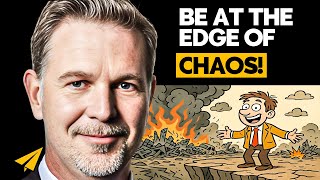
Reed Hastings, Netflix co-founder, talks about operating at the edge of chaos where creativity and failure coexist. He shares how Netflix beat Blockbuster and why embracing failure and confronting fear are essential for bold entrepreneurs pushing beyond their comfort zones.
Chapters
Good morning, Believe Nation. Today's message is be at the edge of chaos. Over to you, Reed Hastings. I wake up every morning, espresso keep me going.
If we're not creative enough, if we don't push it hard enough, you know, we've got to have some failures. And so we don't really want to have all hits. I'm really glad the first ones are hits. But you know, the sign that you're right at the edge of chaos, the edge of creativity, is that some stuff doesn't work.
Now why do you want to be there? Because networks don't want to be there.
Life's short. I mean, you know, why are we doing this?
We're like, we want to have a difference.
Attaboy, right?
You know? And so it's innate. It's wanting to push the edge, to create something that people are proud of and that they enjoy.
This is a message I think entrepreneurs can relate to really, really well. We want to do something different. We want to have a big vision. We want to be bold. We want to break barriers. We want to do something that people can be proud of and that we can be proud of, that our grandkids will be proud of. That's what we do as entrepreneurs, right? We don't want to work in some boring job for the rest of our lives. We want to take ownership. We want to create something meaningful, impactful, special. That's what we want to do as entrepreneurs. And I think what gets in our way a lot of times is fear. I think the fear of it not working out, the fear of being judged, the fear of losing money, The fear gets in the way, right? And often we will rationalize the fear with a practical excuse. We'll convince ourselves that we can't do that because of X, Y, Z, right? Like, I can't go to that conference because, ah, I'm too busy. You know, I got so much going on here. Ah, you know, I can't do that conference. I can't take that phone call. I've got such a crazy busy schedule, right? We'll come up with a reason why we can't do something, but the real reason is we're just afraid. And I think hearing messages like this from Reed can hopefully push you through the fear. And what really helped me was thinking about, I don't want to live with regret. I don't want to look back on my life and think that I really wish that I said yes to that opportunity, that thing that I talked myself down from because I thought it was a practical thing to do, but really was just afraid. I don't want, I don't want to live with regret of that thing. I wanted to go for it. And so by me looking back on my life at age 90 or whatever it is, it helps just remind me that the fear that we have is short-term, is something that needs to be broken through if you wanna go off and do the big thing, have the big impact. So be on the edge of chaos.
I love it.
So the question of the day today is, I'm curious for you guys, what are you doing that is putting you on the edge of chaos? Leave it in the comments below. I'm super curious to find out. Thank you guys so much for watching. I believe in you. I hope you continue to believe in yourself and whatever your one word is. and I'll see you again tomorrow morning for another shot of espresso. I wake up every morning, espresso keep me going. Hey guys, we're looking at doing a Reed Hastings top 10 rules. Here's a quick sneak peek bonus view at some of the clips we're looking at. I'd love to know your thoughts on the clips. Let me know.
Interesting about you, the way you conduct your business, is that when stuff doesn't work out, you apologize. You go and say, "I made a mistake," and all that. What is that, the first time you had to go out there and say, "Sorry"? This was wrong. And it was, I remember with the increase, the rate increase, right? And then you were like, "Well, forget about it." Like, what was that experience like for you as a boss when you were like, "I have to go and own this"?
Going through marriage counseling 20 years ago was really how I moved to become a better manager and leader.
Really?
And yeah, you know, this marriage counselor was able to get allowed me to see that I was often lying to myself and to my wife. You know, saying, "Oh, family's the most important thing," and I'd stay at work all night. And that the value of honesty is that people can take honesty, even if it's not necessarily what they want to hear, if it's really sincere.
'03 and '04 were growing really fast. '05, Blockbuster attacks. And so we thought we were very clever. We came up with a number of ways to counterattack. And remember that everybody's got every DVD. So you've got basically The same— Blockbuster and us had the same content offering, because it's non-exclusive licensing to get DVDs. So we could differentiate on our service fulfillment levels were 99% and theirs were 89%. But that's like a really abstract— for a customer, you know, thinking of signing up doesn't mean anything, right? And then they discounted massively, so it was like half our price. And so we were losing share. So, We were struggling with what to do about it, so we did 3 or 4 big efforts. One is in the end of '05, we added Netflix Friends, which was our own social network. Remember in '05, Facebook's just on a few universities, okay? So our own social network amongst our members, and if you enabled each other, you could see what each other were renting and rating. And we thought, "Wow, the viral effects of this would be really powerful," et cetera. We added ad sales. Back in the day, it was like a Yahoo-type banner banners, and you could have— we could have— we sold banners, you know, above the choosing interface. We added used DVD sales on our site to consumers. So, you know, of course we had some excess DVDs from 4 years ago, so we added an operation to sell them for $4 a pop, and, you know, it's a different logistics, but we added all that. And we added Red Envelope Entertainment, which was a group that we brought in to buy DVDs, buy films out of Sundance and similar festivals to then publish them on DVD, so getting into content. So we did these 4 efforts. And each one, you know, was a dozen people, 15 people, and made us feel great. I mean, the employees loved them because, you know, here was a tangible thing that was not just 98% versus 89%. Here was the thing that they couldn't do or weren't doing and was a differentiator, right? And wasn't management so clever? Uh, and we went through these waves of battles in '06 and '07, uh, and in the end we won. Uh, they ended up closing down their online thing and two years later going completely bankrupt. But we looked back and none of those four efforts made any contribution to our victory. Uh, and one by one we had closed them down along the way, every single one of those four. And so in hindsight, we realized when attacked, we should retreat to do the core better and not try to broaden the surface of attack, essentially. And it was a great lesson for us of focus. And so now when people say, "Aren't you getting into news or sports?" We're like, "Absolutely not!" and we're really confident of our answer. Like movies and TV shows on a global basis, enormous market. So we're much less subject to being prone to go off and chase the shiny object, to try to have something in a checklist to differentiate, and to trust. In hindsight, if we had just gone from like 98% perfect to 99.9%, we would have done a lot more for the business. It's hard work. It's operational logistics, how to get DVDs not to break. I mean, the amount of poly— carbon analysis we had to do, all this stuff, we would have beaten Blockbuster sooner than we did.
This concept of binge viewing that seemingly has altered people's, the way people consume content. Can you talk a little bit more about that and how did you decide, did you plan for that and how do you exploit that?
No, really binge viewing, we counterplanned on it because we tried to kill the term. Because binge is associated with negative things really. And we thought this wasn't good. And what we didn't realize is that the term would come to be gentler interpreted. And the fact that it was a little bit aggressive helped it catch fire. But the first real binge viewing was DVD, TV sets on DVD. And people would get Sopranos and The Wire and Mad Men on DVD and watch 10 episodes. So that we felt the behavior just on DVD shipments going to TV series. And then when you brought that online, it really accelerated it. And, you know, when you think about it, when you buy a book, you know, 10 or 15 chapters in a book, then it's not remarkable that you're allowed to read 3 chapters one night, one the next night, and 5 chapters the next night. Yeah, you know, that basic thing of human control, of watching on your schedule instead of on the programmer's schedule, in hindsight, it's pretty basic. So linear TV as we know it will be as much of a relic in 20 years as the fixed line telephone. You know, like, some of your parents will still have one, but You know, most people, you know, it's pretty irrelevant for.
More from Evan


How the Biggest Mistake in History Created A Trillion-Dollar Empire | Sergey Brin



9 Machiavelli Principles That Force People To Respect You | Machiavellian Philosophy



The First 10 Words That Instantly Ruin A Sales Conversation | Vanessa Van Edwards

The Top 1% Mindset Behind The First $5 Trillion Company | Jensen Huang (Nvidia)

