WHY Goal Setting TRANSFORMS Your Life
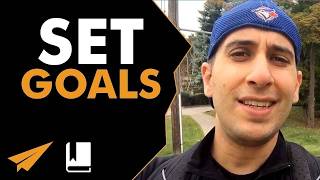
Evan Carmichael argues that clear, measurable goals boost performance when you know what you want. He uses examples like a 20,000-step daily Fitbit target and his current book project with publisher deadlines to show how specific targets drive incremental improvement, though he notes that exploring without rigid goals can foster creativity when clarity is lacking.
Chapters
Is it important to set goals for yourself? So if you pick up any business book or you follow any of the experts, you'll often hear how important it is to set goals. Everybody tells you, "You gotta set goals. You need to set goals for yourself and your business to have success." But there's a new wave of people led by guys like Leo Babauta from Zen Habits who don't do goals, who don't like goals. They say goals restrict their freedom and their creativity, and they get more stuff done, they find, when they don't have goals. And so I thought I'd weigh on it in this video because one thing that I know is that what gets measured gets managed. And that when you have a goal, you're much more likely to hit it. You're much more likely to pass your own expectations. You're much more likely to push for something when you have a goal. Here's an example. Let me pull out my pocket. I use a Fitbit. This is it here. I have a daily goal. Today is, uh, it's just past noon. I don't know if you can see that. I don't know if you can see that. It's just past noon. I have 15,000 steps. My daily goal I set for myself was I wanted 20,000 steps. Ever since I got this thing, I'm taking an insane number of steps because I know that I'm tracking it. And tracking it and setting a goal— my first goal is 20,000 steps a day. I wanted to blow past it. In my business, I wanted to beat the guy at my agency for the number one YouTube channel, and I blew past it. And so having these goals helps me succeed. It helps me push myself further than I would. In some seminars that I've done, I would ask people to hold their breath for as long as they could. So, "Hold your breath as long as you can." And they would time it. And at some point they would all, "Whew," right? They've lost their breath. And then I asked them, "Okay, I want you to hold your breath for 5 seconds longer." And they would get out their watch or their clocks and then do it. And everybody could do it. Everybody could hold their breath for 5 seconds longer. You ask them again, asked them to hold their breath for 5 seconds longer, everybody could do it again. Why? The first time I asked them, set it for as long as you can, as long as you can physically hold your breath, and yet everybody could go a little bit more because they had a goal. Another example, I'd ask people to raise their hands as high as they could, right? Raise your hand as high as you can, reach for the stars, raise as high your hand as high as you can. And people would always be able to raise it just a little bit higher the next time if I asked them to, to say beat that record, because they had a goal. And so I find goals are extremely helpful, but The caveat is you have to know where you're going. When you have a plan, when you know what you want to accomplish, having goals will help you get there faster. But if you don't know what you want to do, if you don't have a plan, then you're going down the wrong path, right? You can get down the wrong path a lot faster, but it won't help you because you're going down the wrong path. And I think that we all have these moments in our life, whether they last for days, weeks, months, a year, where we, we do have absolute clarity. We know exactly what we want to have happen in our life, and we set out into execution mode. And when you're in that mode, goals will help you. Goals will help you get there faster, help you reach for your, your best self, and push you beyond where you thought you'd be able to go. But we also have these moments where we don't know what we want, right? You don't have that clarity. You look at your life and say, ah, this is kind of boring. I don't want to do what I'm doing right now. I seek creativity. I seek difference. And there the goals that you set for yourself won't help you as much. That's where you need to follow your flow. Find something that excites you, explore, say yes, and you can't plan it out as well. And so I find I can understand both camps. I understand the guys who say you got to set goals, I understand the guys who say you don't set any goals, and I think the real balance lies in embracing both of them. When you have that absolute certainty, you set goals. When you don't know what you want to do, you don't set goals and you go and explore. So in the context of this book, because this video is about— supposed to be about me writing my book, I find that goals help me in that there's deadlines for things. So the publisher has given me a deadline. I have to have it done by January and submit it to them. And I set little mini deadlines for myself every week. I'm now in editing mode. I'm walking to Whole Foods right now, and every week I want to get at least one chapter edited and done. So that's what— that's— I get in there, you know, I grab my smoothie, sometimes a lunch, and I gotta start editing and I wanna not have to leave until I've edited my chapter. And so setting those timelines and those goals helps me accomplish what my specific goal is to write the book a lot easier. Okay, let's get to your questions. I seem to get a lot of these spikes where I ask for questions and I get a ton and then I forget to ask for questions the next time and then I don't get a lot. And then next week we get a lot again. So we're in a lull. We're in a low question day. The first one was from from Pete who said, audiobook suggestion: connect with the National Library Services for the Blind. They'll record your book for you and make it accessible not only to the blind community but other readers. Thanks Pete, really appreciate that. On all of the marketing stuff, promotion stuff, again, because we're so far out of it actually being released, it's not really on my mind yet. My mind is focused on getting the book finished, written, edited, out the door. But I appreciate all the feedback and suggestions you guys have for the marketing side. Once it's up and to the publisher, I will be focusing all my efforts then on figuring out the marketing side. Next up, New Future Builder. As always, I appreciate you answering the questions and the questions of so many others. Shows you know how to offer value to us. Thanks, man. Appreciate that. I'm curious as to why the publisher takes an entire year to put the book out. Are most publishers that way? And if not, I'm assuming they had the most leverage despite the wait time. How did the time of release affect how you wrote the book in terms of keeping things time relevant? This is a fantastic question. One that honestly frustrates me, I think it frustrates a lot of authors, why does it take so long? I think in general, big companies have a hard time keeping up with the pace of entrepreneurs. A lot of the brands that I work with, we talk about projects and they talk about all the teams they need to involve and the timelines. Like, it's gonna take you that long? Are you kidding me? I could get that done in a week. And so it's the nature of dealing with a big company. I have yet to see a huge company that just works insanely fast. And so I don't honestly know what happens in that year. I'm assuming it's a bunch of editing in revisions and deciding what stays in the book and what gets cut and working on the book cover. I don't see why that has to take a year, but I'm not the publisher. I don't understand their business fully, and so I'm just trusting in the process and then using that time instead to, to market and to talk to you guys and make videos. And in terms of the timing being relevant, a lot of the stuff that I like talking about and that is in the book is timeless stuff. Go back to the top of this piece talking about goals versus no goals. That stuff is relevant in 20 years. It was I wrote it 20 years ago, and my aim as much as possible is to create content that lives, that lives forever. I want that to be part of my legacy. Now, there are some things social media-wise, technology-wise, internet-wise that, that change very frequently, and there's not a ton of that in the book. My specific aim again was to make it something that when you look at this in 5 years, 10 years, 20 years, 95% of the principles are still still relevant, applicable, and so it doesn't really impact how I write the book so much as my frustration in wanting to get the book out and to you guys and to having an impact on the world. And then last question is from Sam. I agree about wanting to do things yourself and feeling put out from people not being able to reach you at your level. I immediately find this hard to deal with because there have been many times that I felt that telltale excitement of something starting to come to fruition only to find those I'm working with apply themselves half-assed. It saps my motivation and I feel like I get knocked back a few steps. Is this just the situation telling me I've chosen the wrong people to work with, that I should keep adventuring for the right people to surround myself with? Thank you, sir. Sam, appreciate that. Notice that you are BTA 67 on that. That's awesome. You're ahead of my BTA because I had a weekend that I took off, so you might have the highest BTA of, uh, all the subscribers, I think, so far. So keep on. Thank you, bro. To answer the question, yeah, it's super common, right? At the beginning of any project, everybody is mega excited, ready to go, and invariably people overpromise and underdeliver, and they lose their excitement. And it's not malicious for the most part. It's not people feeling like they can get something done and then they can't, and they're lying to you, and they're like they're trying to, uh, you know, put them up with something that they're not actually. I don't think that's the case for most people. Most people just are not that committed in general. Most people don't follow through, and most people don't have the hustle just in general. And so finding those people, those right people to work on a project, is really important. So a couple things that might help: one, I would try to find the project that I am so excited about that no matter who I'm working with, if it doesn't work out, I will just want to find somebody else to work with because I love it so much. So, you know, I love working on these videos as an example. I love, I love my YouTube channel for you guys. I have a team that helps me now. It started with just me, and now there's 5 of us who work on the channel. And if everybody quit, if everybody stopped doing it, if everybody said this is too much, you know, or they lost their motivation, their excitement, their energy, I would still I would find replacements. I would build a new team because I love doing it. And if your happiness in a project is dependent on other people's enthusiasm, then that's a problem that you would probably want to look at, right? The project that I'm doing, the book, the videos, my company, the new company I bought, I would do regardless of the team. I would build a team, I'd build a new team if the right people weren't already in place. And so I think you have to have that level of enthusiasm and excitement yourself to keep yourself motivated and to keep the team going as well. And then in terms of bringing on the right people, people, it's so important. And it's understanding different motivations for different people and understanding what roles they could be. Because some people are just not great partners. Some people have great skills, might be great employees, might be great contributors, might be great consultants, but they're not partnership material. What I always try to do as much as possible with any role that I make is to have people start on a small scale and then see how they do. If I'm working with somebody in some kind of partnership capacity, it's usually because I've worked with them before on something smaller where I've really enjoyed their work. We enjoy how we work together, and I obviously would love their commitment level. So I wouldn't just go into a relationship where it's, hey, I own half, you own half, let's start this thing up and it's amazing. If I was working with somebody who was newer to me that I haven't worked with before, I would absolutely have some kind of earn-in clause where they might be able to earn up to a certain percentage in the business But we're starting off working on a project basis where they have to put their sweat into it and make sure that it's something that they're committed to and will succeed with. I do the same thing when I'm hiring people for my team. I'll hire them on one small project as a trial, see how well we work together. You know, everybody who works for me, Christina, who's editing this video, you know, we worked on a small trial before and she was awesome and she over-delivered and said, "I have to have Christina on my team." And that's why we're still working together. And now we've brought her husband on to help edit as well. Hey Sam, how you doing? So I think it's really important. I think people put too much stock into what's on a resume. They put too much faith into an interview. They put too much faith into the initial excitement, where really what you need to do is start testing people, start working with people, start on a small scale, and then start building it up. Whether they become an employee, whether they become a partner in your business, make sure you test small and build up. That's my advice. That's it for the questions. It's a short day today, so for you guys, you have questions that you want me to answer, Leave it in the comments below, ideally somehow related to the topic today, which was about setting goals versus not setting goals. And of course, if you have a question about my book, your book, the book writing process, leave it below and I'll do a video reply next week. And question of the day, I would love to know what you guys think about goal setting. Is it important? Do you set goals? Is it always important in your life? Do you see moments where it's not so important? I'd love to hear your thoughts. Leave in the comments below. Thank you guys. Continue to believe. I am off to edit, and I'll see you soon.
More from Evan


How the Biggest Mistake in History Created A Trillion-Dollar Empire | Sergey Brin



9 Machiavelli Principles That Force People To Respect You | Machiavellian Philosophy



The First 10 Words That Instantly Ruin A Sales Conversation | Vanessa Van Edwards

The Top 1% Mindset Behind The First $5 Trillion Company | Jensen Huang (Nvidia)

