Why Social Media Is Stealing Your Success (and How to Stop It in 17 Minutes)
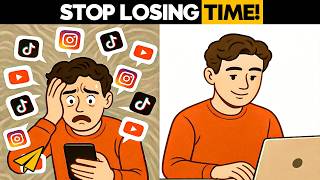
Evan Carmichael argues social media steals entrepreneurs' time and focus, then gives five strategies to stop it. The average person spends 2 hours 21 minutes daily on social media and needs 23 minutes to recover from each interruption. Tanya Dalton found her best clients never came from social platforms.
Chapters
Social media is stealing your success. It's tricking you into feeling productive because you can get clients there, but it's actively robbing you of focus every single day. And if you keep letting social media steal your attention, you'll never become the successful entrepreneur that you were meant to be. Odysseus knew all about dangerous distractions. On his journey home, he was warned about the sirens. These were creatures whose enchanting songs lured sailors to their doom. Odysseus still wanted to hear their song, but he refused to lose everything for it. So he plugged his crew's ears with wax and had them tie him tightly to his ship's mast. As they rode past the sirens' island, Odysseus begged and screamed for release. The song was that irresistible, but his men were unable to hear him and they were under strict orders to keep him tied up. His ship sailed to safety because Odysseus removed his ability to give into temptation. He felt the pull of the siren's call, the same pull that you feel right now every time your phone buzzes with a new notification while you are trying to get work done. I felt that pull in my own life too. When I was starting my business, I had to sacrifice a lot of distractions that my friends were calling fun. I remember allowing myself only one social night out per month, partially because I was broke and I just couldn't afford it, but also because I was laser-focused on making my company work. And listen, it was hard. It was hard watching everyone else relax and have fun while I worked. I felt like I was missing out, but I told myself that I do difficult things and I did not want to let the FOMO or fear stop me from taking action. So saying no to almost everything that wasn't building my business became the thing that saved me. Every hour I saved from mindless parties or entertainment was an hour invested into my dream. Now, maybe you're thinking exactly what one of our subscribers, Swoggles Ute, asked. How do I avoid getting distracted by social media when that's where I get my clients? And I get it. It feels like you have to be on all the time or you're going to lose business. But ask yourself, are you using social media or is it using you? And if it's truly a tool for clients, then you should be in control of it, not endlessly scrolling, not constantly checking. Just like a bartender can't be drunk on the job, an entrepreneur can't be hooked on the feed and expect to stay effective. So flip. Being always online isn't what lands you clients. Delivering value is. In fact, many entrepreneurs realize too late that social media was a vanity trap. It felt like work, but it wasn't moving the needle. Tanya Dalton, a CEO of 14 years, discovered none of her best clients had even found her through social media. All that posting and checking was requiring maximum time, energy, and money for minimal dollars. For her, social media was a distraction from from true success. So yes, your clients might be on social, but they don't need you glued to it 24/7. They need you at your best. So you're creative, you're focused, you're delivering results, and that means that you need to take back control. So how do you actually do it? How do you beat social media distraction without losing the connections that matter for your business? Let's break it down. Here are 5 strategies to free yourself from social media distractions and up your productivity. If you've been here before, drop a hashtag #believe in the comments below so I can feature you here in a future video. And if you're new, welcome to Believe Nation, the only channel that helps you believe in yourself daily, one video at a time. Believe. Step number 1, recognize the true cost of distraction. You must start by getting honest about how these little quick checks are actually stealing from you. It's more than you think. The average person now spends about 2 hours and 21 minutes per day on social media. That's over 2 hours of your day gone every day. For an entrepreneur, that's huge because time is your most valuable asset. And it's not just the minutes spent scrolling. Every time you get pulled away from work to take a little peek at your feed on that notification, you lose momentum. Research from the University of California Irvine shows that after even a brief interruption, it takes about 23 minutes and 15 seconds to fully regain focus on your original task. 23 minutes. Think about that. A quick 2-minute Instagram check could cost you nearly half an hour of productive work by the time your brain gets back into gear. Do that multiple times a day and hours disappear. These platforms are designed to be addictive. It's not a personal failing that you feel the urge to check. It's by design. Former Facebook president Sean Parker admitted they built social media to exploit your psychology, saying, "God only knows what it's doing to our children's brains." Scrolling gives you a quick dopamine hit, little reward, and that trains you to keep coming back. But those quick hits come at the expense of your long-term goals. So I need you to internalize this. Every time you're distracted by social media, you're paying with something irreplaceable: your time, your energy, and your mental clarity. It's like compound interest in reverse, though. Small distractions snowball into big losses. Once you see the true cost, you'll feel far more urgency to actually change. Number 2, set strict boundaries and stick to them. The next step is to regain control by setting hard rules for when, how, and why you use social media. Think of it like installing guardrails on a winding road. Without them, it's too easy to go off a cliff. So schedule your social media time, literally block it out on your calendar like an appointment. For example, instead of constantly hopping in and out of apps all day, you decide I'll handle all of my social media work between 4 and 5 PM every day, and that's it. This is called time blocking, and it's a game changer for productivity. Experts recommend creating a dedicated block, like 60 minutes, for emails and social media tasks rather than letting them interrupt you all day long. So during that block, you focus only on those tasks, responding to client DMs, posting content, checking industry trends, and nothing else. When the time is up, you log off and you get out. Why is this effective? Because you're training your brain that social media time has a defined start an end. It's not a constant background noise anymore. It's a scheduled activity with a purpose. You go in with intention and you leave when you're done. This structure prevents the slippery slope of, I'll just check for a minute, which then turns into 30 minutes before you know it. Also, set physical boundaries if you can. So maybe you decide you only use social media from your laptop or at your desk, not on your phone, not on the couch. By changing the context, you make it easier to stick to your habit. Or on your work computer, you might even have a separate browser profile just for business media with no algorithmic newsfeed to tempt you. And outside of that business hour, log out of your accounts, make it slightly inconvenient to get back on. That friction becomes your friend. Remember, entrepreneurs lead. They don't follow endless rabbit holes. One entrepreneur I mentioned earlier, Tanya Dalton, called out the limiting belief that you have to be on every platform constantly. Once she set boundaries and eventually cut out her social media, her business didn't die, it grew. Think about that. By refocusing her time on more meaningful connections like emails and live events, she stood out in a crowded marketplace. So your turn, decide right now when and where you will engage with social media and hold that line. Hold, your focus will thank you. Number 3, use social media with purpose. Become a producer, not a consumer. So a big mindset shift here is to treat social media as a tool for your business not a toy for your boredom. There's a massive difference between using social media intentionally and letting it use you. If social media is where you find clients, then approach it like a business task. That means you go on each platform with a clear objective. So example, I'm going to post an update about our new service, or I'm going to answer unanswered comments and then message 3 potential leads, right? You have a to-do list for your social session. If it's not on the to-do list, you don't do it. You're there to create value, not consume randomness. The moment you find yourself drifting into the timeline with no aim, stop. That's like wandering into the forest without a trail. You'll get lost in there for ages. So here's a strategy. Create more than you consume. For every piece of content you consume, like watching someone else's story or post, aim to create one of your own. A post, a reply, a helpful comment, a story. This keeps you in the mindset of an active contributor, not just a passive scroller. It also directly benefits your business content and engagement that your clients or prospects see rather than you silently comparing yourself to others' highlight reels, right? Also focus on down the high-value interactions and ditch the vanity metrics. Followers and likes are nice, but if they aren't translated into business, they become a distraction. So double down on the social media activities that actually generate leads or build relationships. Maybe it's posting valuable content. Maybe it's participating in a niche forum or group where your clients are hanging out. Tanya's wake-up call was realizing that she was chasing follower counts while none of her soulmate clients, as she calls them, came from those followers. She switched to channels that mattered, like her podcast and email, once she saw the data. So in your case, figure out which 20% of your social media actions drive 80% of the results. That's the Pareto principle in action. Do more of those and feel free to cut the rest. You do not need to do everything. You need to do the right things. Finally, embrace the idea of delayed gratification. Building a business is a long game, and sometimes you have to forego the instant gratification of a quick scroll for the sake of a bigger reward. The famous Stanford marshmallow experiment showed that children who resisted the temptation of one treat now, waiting to get two treats later, tended to have better life outcomes and success as they grew up. The ability to delay gratification is like a superpower for entrepreneurs. Every time you resist opening that app and instead invest that time in your craft, your product, your skills, your clients, you're essentially waiting for for the second marshmallow. You're trading a fleeting moment of amusement for a step closer to that dream outcome of yours. That's a trade that winners make. Number 4: Eliminate triggers and distractions in your environment. So even with strong boundaries and a clear purpose, willpower alone can fail if you're constantly tempted. So the solution is to proactively remove or reduce the triggers that pull you off track. Make it easier to do the right thing and harder to do the wrong thing. So start with notifications. These are basically digital siren songs. The pings, the buzzes, the little red dots. They're designed to grab your attention immediately. Turn them off. All of them. That's what I do. Except the truly critical ones. You don't need a ding every time someone likes a post or every time an acquaintance tweets something out. Those can wait until your scheduled social media time. Even better, log out of the social media apps. We talked about this entirely during work blocks so they can't notify you at all. Consider what Ed Sheeran did. He got so tired of feeling overwhelmed and sad by his phone constantly pulling at him that he completely got rid of his smartphone in 2015. Now that's extreme, but listen to his reasoning. He said after ditching the phone, it was like a veil just lifted. Suddenly he could live life uninterrupted. In an interview, he described how even if he tried to ignore his phone buzzing in his pocket during a conversation, part of his mind would fixate on like Who was that? What was that vibration? I'm kind of listening to you, but I'm also thinking about the phone. That is exactly what every notification does to you. It fractures your attention. So take a page from Ed. Remove the buzz. Even if you don't throw your phone in the ocean, you can turn it on silent. You can put it face down. You can leave it in another room when you need to focus. Out of sight, out of mind. Next, look at your digital environment. If you find yourself wasting time on certain apps or sites, Use tech to fight tech. There are website blockers and apps like Freedom or FocusMe or even built-in screen time controls that can block access to specific sites during the hours that you choose. If Instagram is your culprit, you might do your business posting from a desktop browser where you don't get the addictive Explore feed. If YouTube sucks you in, consider a browser extension that hides the recommended videos. Yes, these things all exist. You can use them. It's like putting locks on the cookie jar if you're on a diet. Nothing wrong with structuring your environment to support your goals. And don't forget the physical environment. If you work from home, is the TV on in the background with news or Netflix? Turn it off. That's another distraction. Are there other easy buttons for procrastination around, like a gaming console right next to your workstation? Right, mute them, hide them, whatever it takes. Create a workspace that signals, this is where I focus. Sometimes just a change in setting can help. So example, you could work from a library or co-working space where the atmosphere is everyone is concentrating. It's harder to slack off when those around you are dialed in. The goal here is to engineer your surroundings so that staying on task is the path of least resistance. When you do this, you rely far less on sheer willpower, which can fluctuate, and more on habit and structure. You're tying yourself to the mast, just like Odysseus, so even the siren songs, when they start playing, you simply can't steer towards it because you've set yourself up to prevent If you want to take real action after this video, I made a free worksheet just for you. It covers the top lessons from today, gives you space to write your biggest takeaways, and helps you build a simple action plan. It's 100% free. Just click the link in the description to go grab it. Let's start building real momentum in your life and business. I'll see you there. Number 5, prioritize deep work and real connections. Ultimately, overcoming social media distraction isn't just about what you avoid. It's about what you do instead. It's about making the meaningful work and connection so fulfilling that the shallow stuff loses its appeal. One concept I love is deep work, coined by author Cal Newport, which is the act of focusing without distraction on a cognitively demanding task. This is where you produce your best work. You have your best ideas and you truly move the needle in your business forward. When you schedule time for deep work, Treat it as sacred during those periods. Protect them fiercely. No social media, no trivial emails, nothing that isn't related to the important project at hand that's in front of you. You might start with just 30 minutes of deep work a day and build up, but when you're in it, be in it. You'll find that not only do you get more done, you also get a sort of satisfaction that mindless scrolling can never compete with. The human brain actually enjoys focus. It's where we find states of flow and accomplishment. After a good session of creating or problem solving, checking social media will feel more like a cheap dessert. You know, maybe it's like tasty and sweet for a second, but not nearly as nourishing as a meal of deep work that you just had. And over time, you'll crave the focus more than the distraction. Also, lean into real-world connections and experiences. One reason we reflexively check social media, it's due to loneliness and boredom. We seek connection or a break. You can fulfill those needs in a far healthier way. Instead of chatting in a comment thread, call up a friend or fellow entrepreneur and have a real conversation, right? Instead of watching a random video at a break, step outside and take a short walk. Get some fresh air. Let your mind wander a little bit. It's okay to be a little bit bored. These things rejuvenate you far more. Ed Sheeran mentioned that the best part of quitting the smartphone was the moments he has now, the uninterrupted with the people that he loves. That's the goal. Those real moments give life the richness. And guess what? When you're happier and more fulfilled offline, you're less likely to seek escape online. Finally, work on adopting the identity of a focused, disciplined entrepreneur. This is crucial. Tell yourself, I'm the kind of person who values my vision over short-term urges. I am a leader, not a follower. I run my business. I don't let distractions run me. When social media tempts you, this identity will kick in. No, that's not who I am. I don't scroll mindlessly when I have a mission to fulfill. This isn't, just willpower. It's self-image. And we are all wired to act consistently with who we believe we are. So if you drop the hashtag #believe in the comments before, you know this community, Believe Nation, it's all about building belief. So start believing that you are indestructible, that you are focused, that you can handle the discomfort of not checking your phone for a few hours because you've got something more important cooking up right now. And here's the beauty. Each day that you follow these steps, each day that you stick to your schedule, that you get your deep work done, that you avoid all the nonsense, you reinforce that identity. You prove to yourself that you are in control. The distractions lose its power over you because you decide what matters. You decide. You'll start seeing results. Maybe in those extra hours of productive work, you design a better product or you reach out to more clients, or you simply end your day feeling proud of yourself instead of feeling drained. And those results pour into the motivation to continue. So it becomes a virtuous cycle for you. Every time that you overcome a distraction, you strengthen your focus muscle. The fact that you're here right now watching this and you're working on yourself shows that you mean business. You're not just avoiding social media. You're becoming a person who values their purpose over pleasure. So keep applying these strategies and you'll do more. You'll feel better and you'll lead better. And congratulations, you're one video closer to who you're meant to be. Believe. To watch the 5 warning signs your morning routine might need to be improved, check the video right there next to me. I think you'll love it. Continue to believe, and I'll see you there. Do you want to know the 5 warning signs your morning routine needs improvement? Perhaps you already feel each sunrise finds you stressed and scrambling. This is urgent because those early hours shape your whole day.
More from Evan


How the Biggest Mistake in History Created A Trillion-Dollar Empire | Sergey Brin



9 Machiavelli Principles That Force People To Respect You | Machiavellian Philosophy



The First 10 Words That Instantly Ruin A Sales Conversation | Vanessa Van Edwards

The Top 1% Mindset Behind The First $5 Trillion Company | Jensen Huang (Nvidia)

